

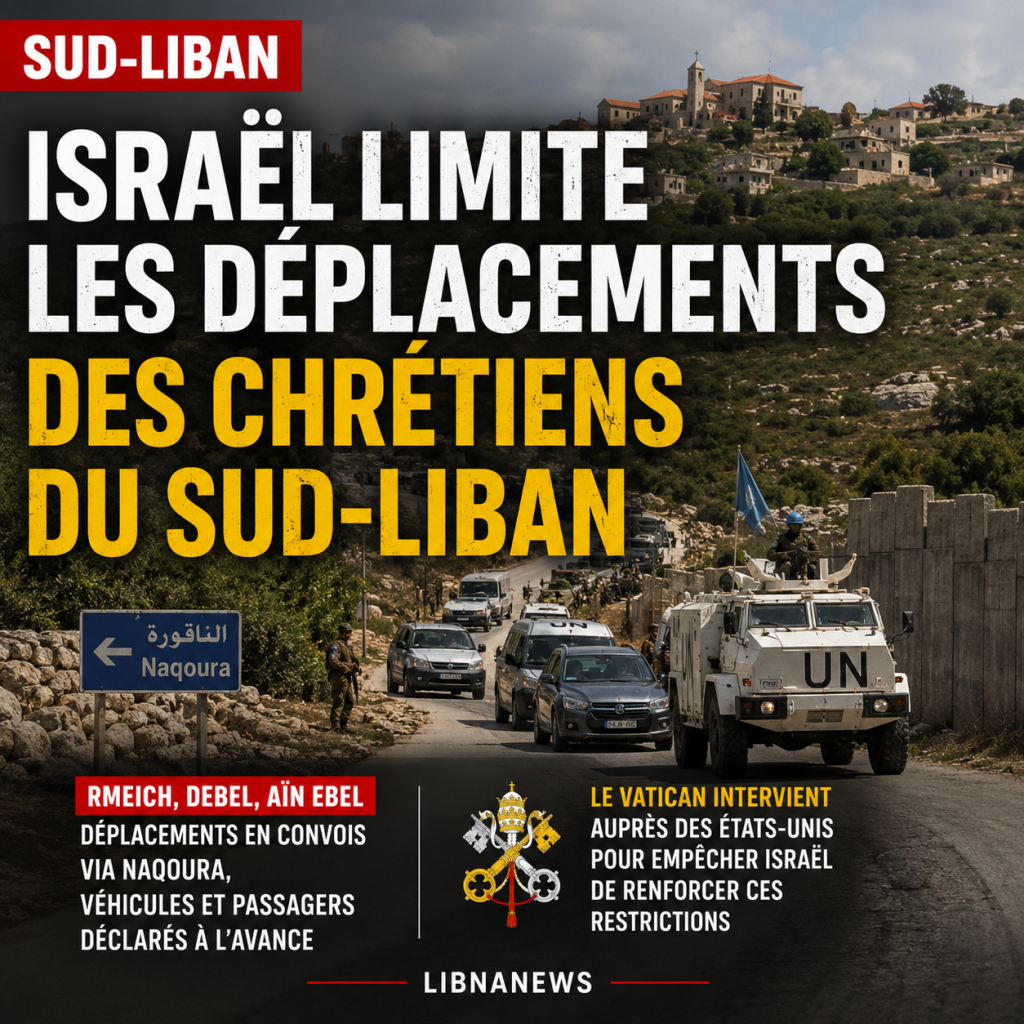
The Israeli army imposed restrictions on the movement of the inhabitants of Rmeich, Debel and Ain Ebel, three Christian localities in Bint Jbeil District in southern Lebanon. Residents wishing to leave or return to their villages must now travel in organized convoys, declare their vehicles in advance and pass on the identity of the passengers. The journeys take a route through Naqoura, with an escort from the Lebanese army and then from the United Nations Interim Force in Lebanon (Final). These restrictions led the Vatican to intervene with the United States in an attempt to prevent Israel from further restricting the movement of its inhabitants.
Israel limits the movement of three Christian villages
Rmeich, Debel and Ain Ebel are in a particular situation because of the presence of Israeli forces in the surrounding localities and areas. The three villages, located in Bint Jbeil District, remain inhabited, but their residents can no longer move freely between their homes and the rest of Lebanese territory. The usable roads now depend on the conditions imposed by the military situation.
According to information gathered from local sources, no vehicle can travel alone between these villages and inside Lebanon. The inhabitants must enter a convoy organized in advance. At least one convoy, comprising several cars or buses, departs daily from one of the three localities to the rest of the country or travels in reverse.
This organization transforms ordinary civilian displacement into operations requiring security coordination. A resident who has to reach Beirut, go to a medical or administrative appointment, work outside the village or simply return home must now take into account the timetable and conditions set for convoys.
A route imposed by Naqoura
People cannot freely choose their route. The convoys must travel along the coastal axis south of Tyre before reaching Naqoura, a border town which hosts the Finul headquarters. They then continue to Rmeich, Debel and Ain Ebel.
This route is a detour from the usual connections between the villages of Bint Jbeil and the rest of Lebanon. It has become necessary because of the Israeli presence in the surrounding areas and the inability to normally use several land axes. The isolation of the three villages is therefore both military and geographical.
The situation effectively creates a particular corridor for their inhabitants. Residents remain on Lebanese territory and in their own villages, but their movements to another part of the country are subject to a coordination procedure involving several military forces.
Pre-registered vehicles and passengers
The restrictions do not concern only the route. Anyone wishing to enter or leave one of the three villages must report their travel before departure. The characteristics of the vehicle and passenger information shall be communicated in order to facilitate the organisation of the passage.
The Finul checks identities and vehicles before ensuring the necessary coordination with Israeli forces. This procedure should allow convoys to cross the areas concerned without being blocked or exposed to military operations. However, it means that the movements of Lebanese civilians between their villages and the rest of the territory depend on prior authorization and coordination.
An individual car cannot therefore decide to leave Rmeich, Debel or Ain Ebel independently of the device. The movement must be part of a previously formed convoy, which considerably limits the daily freedom of movement of the inhabitants.
The Lebanese army and the Finul organize the convoys
The Lebanese army and the Finul carry out various stages of the journey. The army accompanies the convoys to the Qleile area, south of Tyre, about 15 kilometres from the border with Israel. The vehicles of the Finul then take over to accompany the civilians to the villages concerned.
This division of responsibilities is intended to maintain regular liaison with the three locations despite the military situation. The presence of the Finul becomes essential in the parts of the journey where coordination with the Israeli army is necessary. It also allows the transport of essential products to the people who have chosen to stay.
Humanitarian and medical aid also borrows this mechanism. Convoys from inside Lebanon supply villages under international escort. Maintaining this link thus far prevents a complete break with the rest of the country, but it also highlights the degree of isolation achieved by the three localities.
Rmeich, Debel and Ain Ebel remain inhabited
The three villages are a special case in the landscape of southern Lebanon. Despite military operations, a civilian population continued to live in Rmeich, Debel and Ain Ebel. Over the months, this presence has required the organization of supplies, travel and sometimes medical evacuations in an increasingly demanding security environment.
Residents have consistently stated their willingness to remain in their villages. This decision is of particular importance in a region where fighting and destruction have caused significant displacement. For local officials, preserving the ability to circulate and receive essential products is therefore an essential condition for maintaining residents.
Isolation is not entirely new. Access difficulties had already been reported in previous months, particularly for humanitarian and medical operations. The new element lies in the particularly strict framework of movements, with a specific route, of organized convoys and the impossibility of a civilian vehicle to travel individually.
Vatican intervenes with the United States
Restrictions imposed onchristians of South Lebanonhave now taken on a diplomatic dimension. According to reports, the Vatican, through its representative in Lebanon, intervened with the United States in an attempt to prevent Israel from imposing these constraints on the inhabitants of Christian villages.
This intervention is part of the Holy See’s attention for several months to the people of southern Lebanon. The Apostolic Nuncio in Lebanon, Bishop Paolo Borgia, visited the region, including Rmeich, Debel and Ain Ebel. Humanitarian initiatives have also provided food, medicines and other essential products.
However, the move to Washington marks a change of registry. It is no longer just a matter of material support for the inhabitants, but of intervening on the conditions imposed on their movements. The United States has a direct channel with Israel and plays a central role in the discussions on the security situation in Lebanon.
However, there is no indication that this intervention has already led Israel to change the scheme. At this stage, therefore, residents continue to rely on organized convoys to enter or leave their villages.
The Christian villages of Marjayoun are not subject to the same regime
The restrictions do not apply to all Christian localities in southern Lebanon. In the Marjayoun district, residents of Klaiaa, Jdeidet Marjayoun, Bourj el-Muluk and Deir Mimas can continue to travel between their villages and the interior of the country. They have a route through West Bekaa, Hasbaya, Ibl al-Saqi, Dibbine and Marjayoun.
This difference is explained by the territorial and military configuration. Unlike Rmeich, Debel and Ain Ebel, these localities still have an axis to reach inside Lebanon without passing through the Naqoura corridor. They are therefore not subject to the convoy system imposed on the three villages in Bint Jbeil District.
However, restrictions exist in this sector. According to local sources, residents can normally reach their localities, but are not allowed to accommodate internally displaced persons from the surrounding villages. This therefore limits the possibilities of accommodation in an area where many families have had to leave their homes.
Journalists visiting the sector also face certain prohibitions. In particular, they are asked not to photograph the neighbouring village of Khiam, which is particularly exposed to military operations and the Israeli presence.
Freedom of movement dependent on coordination with Israel
The situation of Rmeich, Debel and Ain Ebel raises a broader question than the usual difficulties of displacement in a war zone. The inhabitants travel between Lebanese localities, but must communicate their identities and vehicles before they can take a journey within the national territory. The Israeli military presence around the villages makes this coordination necessary under current conditions.
The Lebanese army and the Finul provide practical organization and security of convoys, but their movement depends on coordination with Israeli forces. This situation places the inhabitants in daily dependence on a military device which they do not control. It affects personal travel, professional activities, access to care and supply.
It also raises the question of the sustainable maintenance of the population in these three localities. The possibility of staying in a village depends not only on the absence of direct fighting, but also on access to food, medicine, services and the rest of the territory. The more burdensome travel procedures become, the more difficult this civilian presence becomes to maintain.
The Vatican’s intervention with the United States shows that the case is now beyond the local scope. For Rmeich, Debel and Ain Ebel, however, the immediate challenge remains concrete: to restore less restrictive traffic while, on Wednesday 26 August, the inhabitants must always use the convoys passing through Naqoura to reach the rest of Lebanon.




