

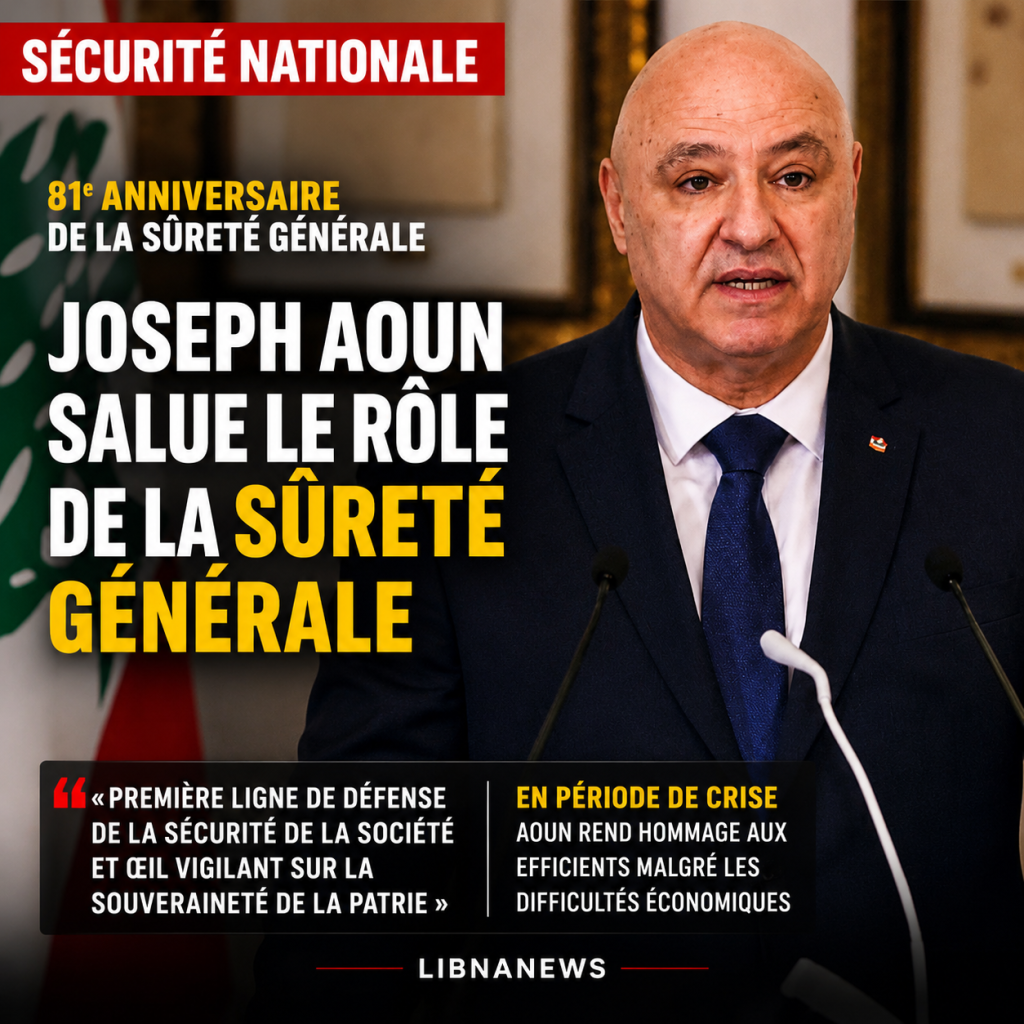
Lebanese President Joseph Aoun paid tribute to the General Security on Wednesday, 26 August, for the 81st anniversary of its creation. He described it as « the first line of defence of the security of society » and « a vigilant eye on the sovereignty of the homeland ». These statements take place in a particularly sensitive context for the institution: two days earlier, its Director General, General Hassan Choucair, granted a six-month residence to Mohammad Reza Chibani, appointed by Tehran as ambassador to Lebanon but whose Beirut had refused accreditation. The General Security ensures that this residence does not confer diplomatic status on him.
Aoun places General Security at the heart of the state
Joseph Aoun congratulated the Director General of General Security, General Hassan Choucair, as well as the officers, non-commissioned officers, civil servants and military of the institution.
The Head of State expressed his pride in the history of the General Security and the sacrifices made by his staff. He recalled his missions in protecting national security, stability, border control and services to citizens and foreign residents.
Above all, the President has placed this anniversary in the current situation in the country.
» This opportunity comes as Lebanon goes through a delicate and exceptional phase of its history, » he said. He spoke of the intertwining of economic, social and security challenges, which, according to him, place state institutions in the face of a test of resistance and preparedness.
Joseph Aoun considers that the General Security has managed to maintain its missions despite these difficulties. He described it as a « safety valve » and an « essential pillar of national stability ».
His message therefore goes beyond the traditional tribute to an institution on the occasion of its anniversary. It reaffirms the role of military and security agencies in the presidential conception of the State.
General Security, « first line of defence »
Joseph Aoun used particularly supported terms to define the function of theGeneral safetyprotection caps (if present).
He presented it as « the first line of defence of the security of society » and « the watchful eye on the sovereignty of the homeland ». It also considered that it reflected the institutional face of Lebanon.
The President identified several priorities: maintaining preparedness for security threats, combating terrorism and organized crime, enforcing the law firmly and fairly, and providing administrative services with transparency.
He also stressed the preservation of internal cohesion.
This reference to sovereignty and law enforcement takes on a particular resonance in the aftermath of a decision by the General Security which has provoked a political controversy: that concerning the stay in Lebanon of Mohammad Reza Chibani.
Chibani’s residence places General Security under the spotlight
The case dates back to Monday 24 August. Mohammad Reza Chibani applied to the General Security for residence in Lebanon on the basis of a valid Iranian passport.
The Director General of General Security, Hassan Choucair, granted him a six-month residence.
The main point, however, concerns the status under which this authorisation was granted. Chibani enjoys this residence as an Iranian national and not as an ambassador or diplomat accredited to the Lebanese State.
According to the information provided on the file, the decision is based on Decree-Law No. 10188 of 18 July 1962, in particular Article 21 thereof. It allows the Director General of General Security to grant certain residences within the framework of his administrative prerogatives.
In particular, the General Security has the possibility of granting « courtesy residences » to certain categories of foreign nationals. The duration may be up to three years and may be renewed. In the case of Chibani, the period granted was limited to six months.
This decision does not confer any diplomatic status on him.
This legal distinction is at the heart of the response to the controversy: the General Security has allowed the presence of Chibani on Lebanese territory, but it has not recognized him as a diplomatic representative of the Islamic Republic of Iran.
Beirut refused his diplomatic accreditation
However, the issue goes beyond mere administrative formality.
Mohammad Reza Chibani had been chosen by Tehran to succeed Mojtaba Amani as head of the Iranian embassy in Beirut. But the Lebanese authorities finally refused his accreditation.
The file had already caused tensions between Beirut and Tehran. The question of his stay therefore became politically sensitive when his previous authorisation expired on 24 August.
A few days before that deadline, press reports indicated that Lebanon did not intend to renew the document allowing Chibani to remain in its territory.
The decision finally taken by Hassan Choucair opened a different path: to allow him to stay six months in Lebanon, but only as an Iranian national.
Legally, the two issues are distinct. The accreditation of an ambassador is diplomatic relations and requires acceptance by the host State. An administrative residence permit does not constitute diplomatic recognition.
It is precisely this distinction that the authorities put forward to explain the situation.
An administrative decision that has become a political matter
Despite this distinction, the decision was criticized.
The subject is sensitive because Chibani is not an Iranian national without a particular function. He is the man chosen by Tehran to officially represent Iran in Lebanon, even though the Lebanese authorities have not accepted this designation.
The question raised in the public debate therefore concerns the opportunity to allow him to remain in Lebanon after the refusal of his accreditation.
Critics of the decision see it as an ambiguous situation: Lebanon refuses Chibani as ambassador but allows him to stay six months on its territory.
On the contrary, the legal response is based on the separation between the two statutes. The authorization granted by the General Security does not allow Chibani to act as ambassador. It does not grant him accreditation or diplomatic status.
This distinction also allows for a better understanding of why simply talking about « renewal of the Iranian ambassador’s visa » can lead to confusion. More specifically, it isresidence granted to Mohammad Reza Chibani as an Iranian nationalWhile his status as Ambassador-designate was not recognized by Beirut.
Controversy takes place against the background of tensions with Iran
The case cannot be separated from the deterioration of political relations between Beirut and Tehran.
Tensions included Iranian positions on Lebanese State decisions on the arms monopoly and the authority of legal institutions.
Statements by Iranian officials were seen in Lebanon as interventions in the internal affairs of the country. The President of the Iranian Parliament, Mohammad Bagher Ghalibaf, is one of the leaders whose positions have provoked Lebanese reactions.
In this context, the question of the Iranian ambassador is no longer merely a protocol issue.
The refusal to accredit Chibani has become one of the visible signs of tensions between the two States. The residence which was granted to him on 24 August therefore comes in a diplomatic environment already loaded.
She also places Hassan Choucair and the General Security in an exposed position. Their decision falls within their administrative competence, according to the elements advanced to justify it, but its consequences are inevitably political given the identity of the beneficiary.
Joseph Aoun’s comments take on a special significance
It was in this context that Joseph Aoun chose, two days later, to pay a strong tribute to Hassan Choucair and the entire General Security.
Nothing in the presidential message for the 81st anniversary explicitly presents Joseph Aoun’s statements as a response to the Chibani controversy.
It would therefore be excessive to see there a direct presidential validation of the decision taken on 24 August.
However, chronological proximity should be noted. The President personally congratulates Hassan Choucair and describes his institution as a guarantor of the sovereignty and enforcement of the law at the very moment when these two concepts are invoked in the debate on the presence of Chibani in Lebanon.
Joseph Aoun stressed in particular the need to « execute the laws firmly and fairly. ».
The presidential message thus takes on an additional institutional dimension. He recalled that the Head of State intended to make legal bodies one of the central instruments for the restoration of public authority.
Aoun links security institutions to « state survival »
The most political passage of the message also concerns all military and security institutions.
« Today, the bet on General Security and on all military and security institutions is a bet on state survival and the concept of law, » said Joseph Aoun.
The President therefore explicitly links the functioning of these institutions to the existence of a State capable of exercising its authority.
This position joins a central theme of the current Lebanese political debate: the state monopoly on sovereign decisions, security and the use of force.
General Security occupies a specific place in this system. Its competences include borders, entry and residence of foreigners, passports and several national security issues.
The Chibani case shows precisely how a decision under these administrative powers can quickly acquire a diplomatic and political dimension.
The economic difficulties of the agents remain complete
Joseph Aoun also devoted an important part of his message to the living conditions of General Security personnel.
He acknowledged that his military and agents are facing the economic and financial crisis, like their colleagues in other military and security institutions and all Lebanese.
The Head of State assured that the government was working to address this situation through an institutional effort and a « strong will ».
However, it did not announce any specific new financial measures on the occasion of this anniversary.
Joseph Aoun wanted above all to assure the staff of his support. He told them that their sacrifices were a source of pride and that they would not be in vain.
The 81st anniversary of the General Security comes at a time when the institution is simultaneously confronted with the material difficulties of its personnel, the security challenges of the country and an unusual diplomatic controversy.
The question of Mohammad Reza Chibani remains suspended from a distinction that Beirut intends to maintain: his presence in Lebanon is now allowed for six months as an Iranian national, but this authorization does not alter the Lebanese refusal to recognize him as ambassador.




