

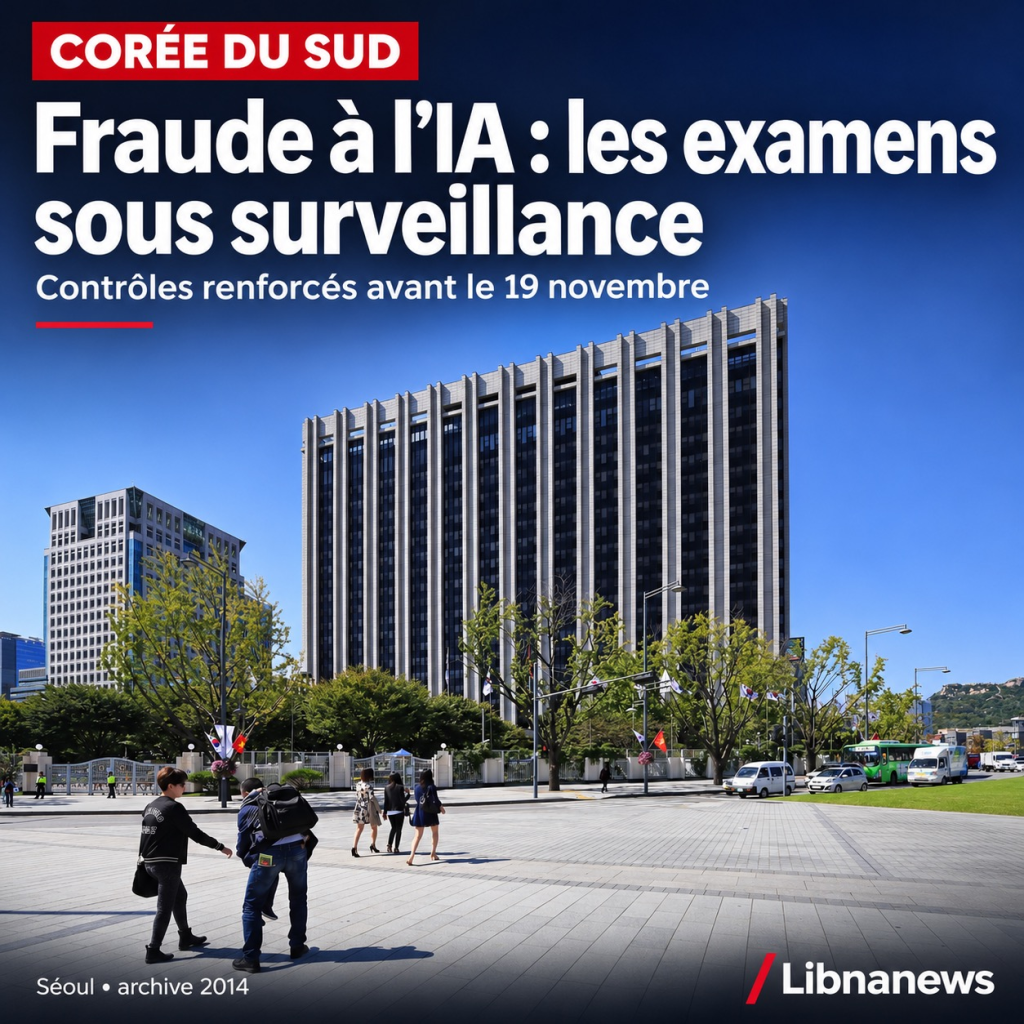
South Korea is undertaking a review of the monitoring of its reviews following a case of artificial intelligence fraud involving the assistance of tax advisers. On Monday, November 16, 2026, the Ministry of Economy and Finance announced the opening of a procedure to cancel the result of the candidate who came to the top of the 63rd edition and forbid him to represent himself for five years. The final decision must be taken after an administrative hearing.
The case now exceeds this only professional competition. The Ministry of Labour and the national body responsible for qualifications, HRDK, plan to look for signs of fraud in the national examinations organised this year. The government is also preparing specific measures against the use of connected devices, three days away from the university entrance test on 19 November.
An administrative procedure, separate from the criminal investigation
The economic communiqué of 16 November states that the tax administration sent a prior notification to the candidate concerned. The hearing provided for in the administrative procedure must precede the decision on the annulment of the examination and the temporary exclusion.
The department describes a candidate with the highest score by diverting artificial intelligence technologies. Its document does not publish any expertise of the equipment used or technical demonstration of the process. It confirms the administrative response, but not reconstitutes every step of fraud.
At the criminal level, HRDK must initiate a complaint to obstruct the activity and cooperate with the police. The working group also plans to examine the facts if further reports indicate suspicions.
Results of recent years will be reviewed
The Ministry of Economy and Finance intends to monitor the results of candidates admitted to the tax competition over the last three to five years. The work will focus on the distribution of notes by person and subject. Anomalies identified may result in in-depth audits.
This review does not mean that all previous results are suspect or cancelled. The aim is to identify the situations that warrant an investigation by cross-referencing the grade profiles and the information available. The press release does not announce any additional number of fraudsters already identified.
The working group brings together the Ministry, tax administration and HRDK. Their division of labour distinguishes between sanctions and the evolution of competition, cooperation with investigators and practical improvement of surveillance. The professional organisation of tax advisers and private specialists should also be asked to propose improvements.
Enhanced controls from the next tax competition
For the 2027 edition, the authorities are preparing a set of measures: verification of new electronic and communication devices, enhanced training of supervisors, establishment of a reporting centre, extension of video surveillance and introduction of radio detectors. The press release presents these devices as measures to be implemented, not as equipment already widespread in the rooms.
The broader component announced by the Ministry of Labour is the national qualification examinations held in 2026. An emergency meeting, held on 15 November, decided to use the characteristics of the case discovered to look for further irregularities. A comprehensive prevention plan must be drawn up before the end of the year.
The academic rendezvous of November 19
The interdepartmental meeting on 16 November also examined the university entrance examination for the academic year 2027, scheduled for Thursday, 19 November. Prime Minister Han Seong-sook called for an emergency interdepartmental team, the delivery of all devices connected to the entrance to the centres and a rigorous control of their possession during the trials.
It asked to study with the relevant bodies the shutdown of public Wi-Fi in the centres during the examination. This is not yet a confirmed general cut. The authorities also want to keep alerts and investigations after the tests: the end of an examination must not prevent the search for later discovered fraud.





Comments