

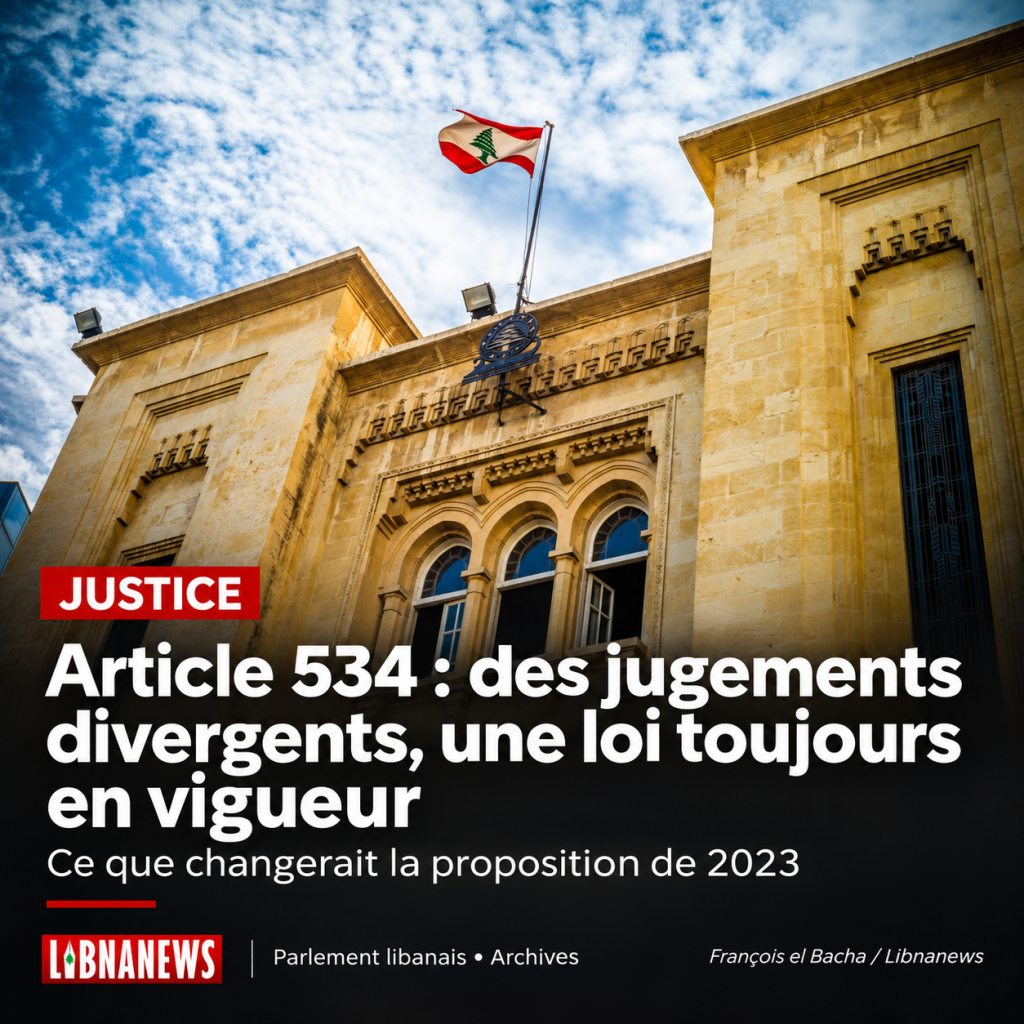
Article 534 of the Lebanese Penal Code remains in force, despite judicial decisions restricting its application to same-sex relations. The difference is essential: to obtain a stay of proceedings in a case does not mean to abolish criminality for all. The proposal tabled in July 2023 is aimed precisely at passing this second stage.
The documents also avoid another shortcut. The courts have not adopted a uniform reading. Two judgements at Mont-Lebanon in 2019 show different approaches, including the scope of privacy. The debate is therefore not limited to an already acquired decriminalization or automatic application of the text.
Article 534: a brief text, a disputed field
The text published in the legislative basis of the Lebanese University provides for up to one year’s imprisonment for a sexual relationship that is deemed to be contrary to nature. It does not specifically refer to sexual orientation. The disagreement concerns in particular the meaning of that qualification and the conditions under which an act may be criminalised.
This wording explains why reading the article number alone is not sufficient to describe a decision. A judge may dismiss a prosecution for lack of evidence, consider that the elements of the offence are not gathered, or interpret the text in the light of individual rights. These reasonings are not the same. None should be confused with the vote of a law repealing the article.
In November 2019, a majority favours restrictive reading
Judgment No. 349 of 28 November 2019 emanates from the Twelfth Correctional Chamber of the Mont-Lebanon Court of Appeal. In particular, the prosecution challenged a decision that had excluded proceedings under article 534. The court upheld this part of the judgement by majority.
His reasoning is not limited to finding an insufficient file. The majority judges believe that interpretation must take into account the purpose of the text and social development. They place the article in the chapter on attacks on public morals. In this reading, we must seek an achievement corresponding to this purpose, rather than sanctioning a direction in itself.
The majority refers in particular to exposure to third parties, the public place or the involvement of a minor in need of protection. In the case under review, it does not find the circumstances justifying the application of the article. The continuation of the decision in favour of the accused is thus the result of an interpretation of the criminal field as well as of the examination of the facts.
However, a dissenting opinion accompanies the judgment. Counsel Bou Nassar considers that the text does not explicitly require the publication of the act and contests the addition of this condition. It refers to the legislator’s responsibility to repeal or amend the provision. Thus, disagreement exists within the judgement formation itself.
In March 2019, another Chamber had confirmed convictions
The judgment No. 100 of 20 March 2019, delivered by the Fourteenth Chamber of the same Court of Appeal, reached a different conclusion in another case. The defendants requested that their sentences under article 534 be dismissed. The Court confirmed them, including the statements and confessions recorded in the proceedings.
However, it has amended the penalties, taking into account the time spent in detention and imposing a fine. The continuation of the conviction must be distinguished from this adjustment of the sanction. A reduction of sentence is not an acquittal.
The facts and records differ: these two judgments do not constitute an experiment comparing identical situations. However, they show that the existence of a restrictive decision had not eliminated the criminal use of the article. Presenting them as the stages of unanimously favourable case law would erase documented differences.
What the 2023 proposal really requires
The proposal registered on 12 July 2023 has nine signatories from several parliamentary groups. Its first article provides for the repeal of Article 534. The second concerns previous cases: it provides for the termination of the relevant proceedings, judgements and prosecutions and prohibits their referral to another judicial authority within the scope of the text.
Two other provisions complement this scheme. One removes incompatible texts; The other provides for an entry into force as soon as it is published in the Official Journal. These are the effects sought by the authors, not measures already applicable. The presence of signatures and the administrative deposit are not valid for adoption.
The explanatory memorandum refers to dignity, equality, public freedoms and the protection of privacy. The signatories also report the risks associated with certain investigative practices. These arguments explain their legislative initiative. They alone are not a judicial decision invalidating all previous proceedings.
A parliamentary path distinct from judicial decisions
The Legal Agenda parliamentary monitoring register indicates a transmission to the government on 20 July 2023. He then mentioned a reference to the committees of the Administration and Justice and Human Rights on 27 March 2025. The fact sheet consulted does not list any committee or plenary meetings devoted to the text, and does not show any government response.
These indications describe the monitoring recorded by this observatory, without replacing a comprehensive official record of all parliamentary activity. They do not allow a date to be announced. As of 16 November 2026, the legal basis in force of the Lebanese University retains Article 534; no published repeals are established by the documents reviewed.
The challenge therefore remains to distinguish three levels: protection obtained in a given case, competing interpretations of the courts and the general amendment of the Penal Code. The 2023 proposal concerns this last level. As long as it does not become a law in force, favourable decisions should not be presented as a national deletion of the article.





Comments