

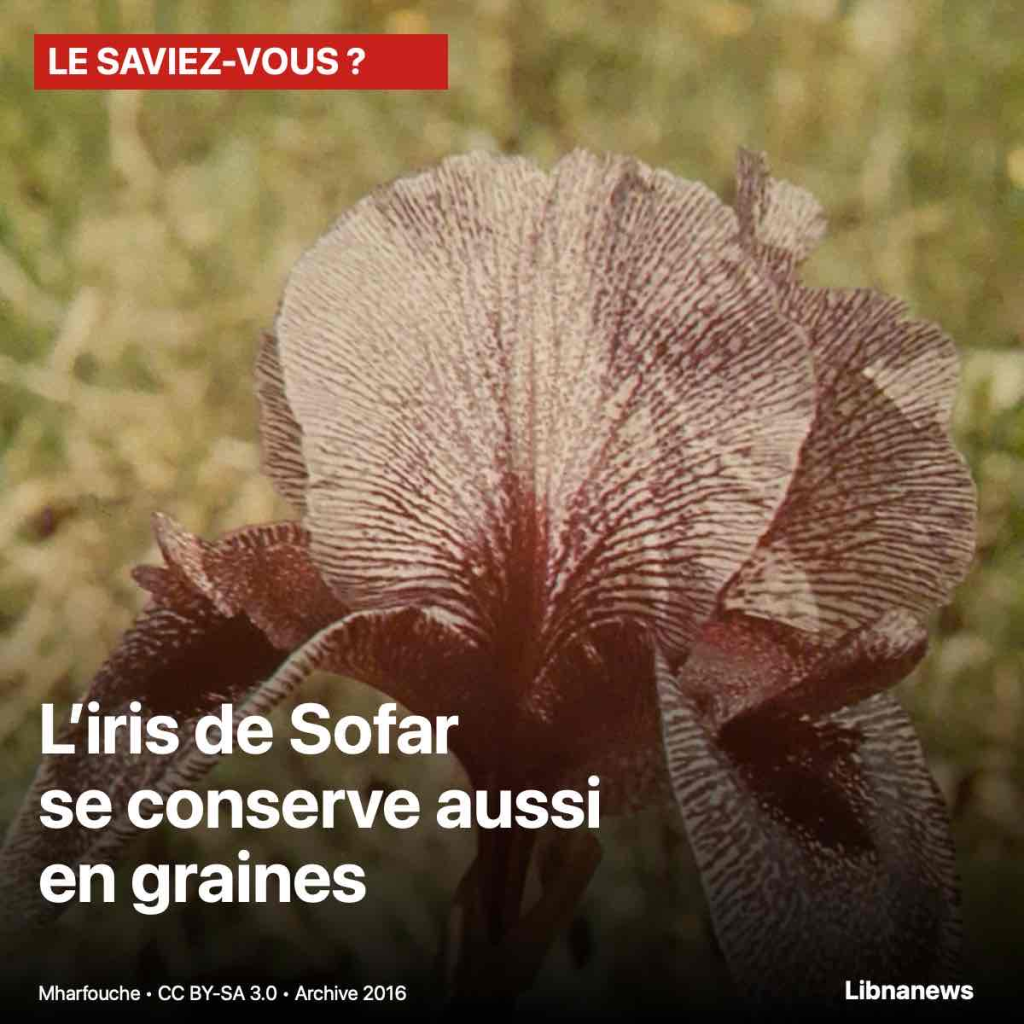
Did you know that? The seeds from Lebanon were sheltered in a British seed bank. These include those of an iris known as Sofar. This discreet safeguard tells another way of protecting a flower: to preserve its capacity to be reborn, without confusing this reserve with the protection of its mountains.
In a photograph taken in Lebanon in May 2016, Sofar’s liris unfolds a flower with finely veined motifs. Behind this spectacular appearance, botanists follow a plant whose conservation is played on several scales: in scientific collections, in seeds and on the slopes where it grows. Its history allows us to understand why a seed bank is neither a mere warehouse nor a substitute for nature.
A Lebanese flower, several scientific names
Sofar’s Liris appears in the botanical works under the nameIris sofarana. Plants of the World Online, held by the Royal Botanical Gardens of Kew, today treats this name as a synonym forIris susiana. It indicates Lebanon as an area of origin for this species. This change in classification does not erase the observations made under the old name: it requires careful reading of the publications and labels of the collections.
Precision is particularly important for forms and subspecies. A study on Lebanese iris distinguishesIris sofaranasubspecieskasruwana. It is under this designation that the authors mention seeds stored at Millennium Seed Bank, Wakehurst, United Kingdom. They also report seeds ofIris cedretii. Therefore, this statement should not be transformed into a statement that every diris population in Lebanon would have a double reserve.
Seeds rather than a bouquet
The study was published online in October 2008, prior to its publication in a volume dated 2009. Field research dates back to the blooms of May 2002 and 2003. Scientists compared historical localities found in grasslands and literature with local populations. They had confirmed the presence of iris only in half of the previously known populations. This result describes their survey, not a census of 2026.
Urbanization, agriculture and grazing were identified as pressures. The Society for the Protection of Nature in Lebanon also highlighted, in a presentation published in 2013, the risk of collecting flowers and plants. Beauty can thus become a handicap: taking a wild plant or preventing its seed production does not mean preserving it.
What a seed bank does
At Wakehurst, the protocol described by Kew begins well before the freezer. The collection is accompanied by information on the location, habitat and sampling period. A reference specimen is used to verify botanical identification. Each lot then receives a number that links the seeds to this information. Without this traceability, a sachet would not sufficiently tell which plant it contains or where it comes from.
Seeds compatible with this method are dried, cleaned and placed in watertight containers at -20 °C. Samples are regularly tested for germination. The aim is not to keep a dead envelope, but a material capable of producing a new plant. Cold and drying prolong conservation; they do not exempt from verifying viability.
Not all plants lend themselves equally to this process. Kew states that some seeds do not support desiccation or remain unsustainable under normal conditions. The collections include research, species reintroduction and vegetation restoration. However, their use depends on the quality of the lots, their quantity and the agreements governing their access.
Lebanon also owns its own bank
This story is not a mere departure of seeds from abroad. The National Seed Bank of the Lebanese Agricultural Research Institute was established in 2013 in Tal Amara, Bekaa. The Crop Trust’s BOLD program indicates that approximately 1,300 samples previously kept at Wakehurst were repatriated that year.
Its record lists 2,387 samples in June 2023: it is a photograph dated from the collection, not a total updated today. Preserved groups include cereals, legumes, forage plants, wild relatives of crops, and medicinal and aromatic plants. Doubles held in several institutions limit the risk of losing an entire collection in the same place. These figures cover the whole of the bank, not just the iris.
In Ehmej, protect also the slope
The conservation of seeds addresses part of the problem. In Ehmej, Jbeil District, El-Dichar’s natural site illustrates the other part: maintaining habitat. The local presentation of the project describes more than 62 hectares of public land mobilized for this sanctuary, originally designed around the protection of a rare plant. It is located between 1 650 and 1 800 metres above sea level.
Protecting this environment does not only benefit the liris. Trees and other species that share their slopes also benefit. A seed kept away from the site may be a useful reserve; It does not replace soil, interactions with other living beings, or a habitat capable of hosting the plant. For the walker, the difference is simple: photographing this flower makes it possible to take away the memory while allowing it to continue its cycle on site.
Cover photograph: Mharfouche, Lebanon, 14 May 2016, via Wikimedia Commons.Licence CC BY-SA 3.0. Boxing and typographical clothing Libnanews, under the same license; original flower not generated.





Comments