

Returning to a village is not enough to take over a farm. In southern Lebanon, farmers still describe inaccessible land, destroyed trees and expected compensation. Their testimonies, gathered in a Lebanese press report published on 14 November 2026, point to the cost of a new start and support programmes. The Minister of Agriculture, Nizar Hani, said that the answer was being implemented.
The dossier does not concern the announcement of a new national balance sheet. It sheds light on the practical difficulties of recovery, several months after the first evaluations. Accessing a parcel, having liquidity and finding a productive tool are three distinct problems. The routes of Ahmad Diab, Houla, and of Oday Muslimi, Chaaytiyeh, show the effects.
Farmers of South Lebanon: Resuming on another land
Ahmad Diab cultivated about 25 dunums of beans and wheat in Houla. According to his testimony on November 14, he was unable to resume exploitation of this land. He therefore rented another piece of land in Chaqra to try to reconnect with his activity. Displacement does not only concern his place of residence: it also changes the material conditions of his work.
The farmer claims that the ministry recorded its losses after the war of 2024. However, it states that it has not received any compensation at this stage. This testimony concerns his personal situation. It cannot be said that no aid has been paid throughout the South. However, it shows that a damage identified and a payment received remain two different steps.
The use of leased land meets the need to produce without waiting for the return to the original parcel. It also requires building the necessary resources for a new campaign. The report describes savings from war and displacement, while the purchase of seeds and inputs must precede harvest. Future income does not immediately finance these first expenses.
In Chaaytiyeh, lemon trees do not go back
Oday Muslimani reports that he found the lemon trees from his farm destroyed when he returned to Chaaytiyeh. He wants to replant, but says he does not have the necessary funds. He also evokes the fear of a resumption of war. In his account, the lack of money and the security risk are reinforced: hiring the remaining resources becomes more difficult when their result can again be lost.
The destruction of trees differs from the loss of a single crop. The report highlights the time it takes to replace the plantations and regain their production. The recovery therefore includes a period during which maintenance costs return before income. For Muslimi, agriculture is its main resource, not an easily suspended complementary activity.
The measures described in the file include the replacement of damaged trees, the rehabilitation of orchards and vines, and their maintenance until recovery. This work responds to lasting damage. Support for inputs and seasonal income is another need: to allow farmers still in a position to grow not to lose an additional crop year.
Ministry distinguishes on-site census and verification
Nizar Hani assures, in the same report, that the ministerial plan remains in effect. He explained that the affected areas had been examined in two stages. Before launching projects, recorded damage must be verified on the ground. This procedure must specify their scope and nature before intervention.
The Minister also states that agricultural services in the South continue to operate. The centres in the occupied territories were transferred to Nabatiyah and Saida, according to his explanation. Their movement is intended to maintain service to operators despite the loss of access to certain sites.
Hani claims that aid is distributed periodically in different regions. Faced with this presentation, some farmers interviewed said they were still waiting for their compensation. The two findings are not automatically incompatible: execution may concern part of the files without covering all the needs. The report does not provide a nominative balance sheet to reconcile each request, decision and payment.
Production losses exceed material damage
An evaluation published by the Ministry of Agriculture on 17 June 2026 shows these difficulties. It was carried out with the National Council for Scientific Research and United Nations partners and estimated production losses at $530.5 million. Direct damage was 41.2 million. These amounts already published do not constitute a new total as at 14 November.
The document also distinguished 56,320 hectares affected by production losses and 1,380 hectares requiring direct rehabilitation, excluding field crops. The surfaces therefore do not describe the same phenomenon. A land may lose its production due to lack of access or work, without all its equipment being destroyed. Conversely, damaged orchards may require sustained reconstruction.
This distinction joins the two situations reported in November. Diab is looking for another land to pursue his crops. Muslimi must restore the means to produce on his own farm. A limited response to the only visible damage would not cover the same needs as support for lost income or expenses for the next season.
Equipment announcements, but not a delivery balance
On 9 November, Joseph Aoun announced funding for 1,500 greenhouses and 50 water pumps. These facilities must support agriculture on accessible land. This announcement, already detailed by Libnanews, does not constitute a record of the installations actually delivered. Nor does it allow all previous claims to be considered settled.
In the testimony of 14 November, the wait is about the possibility of working again, not just about the existence of a program. For Ahmad Diab, today it passes through a rented plot in Chaqra. For Oday Muslimi, it depends on how to replant its lemon trees. The timetable for aid thus remains in line with that for agricultural work.
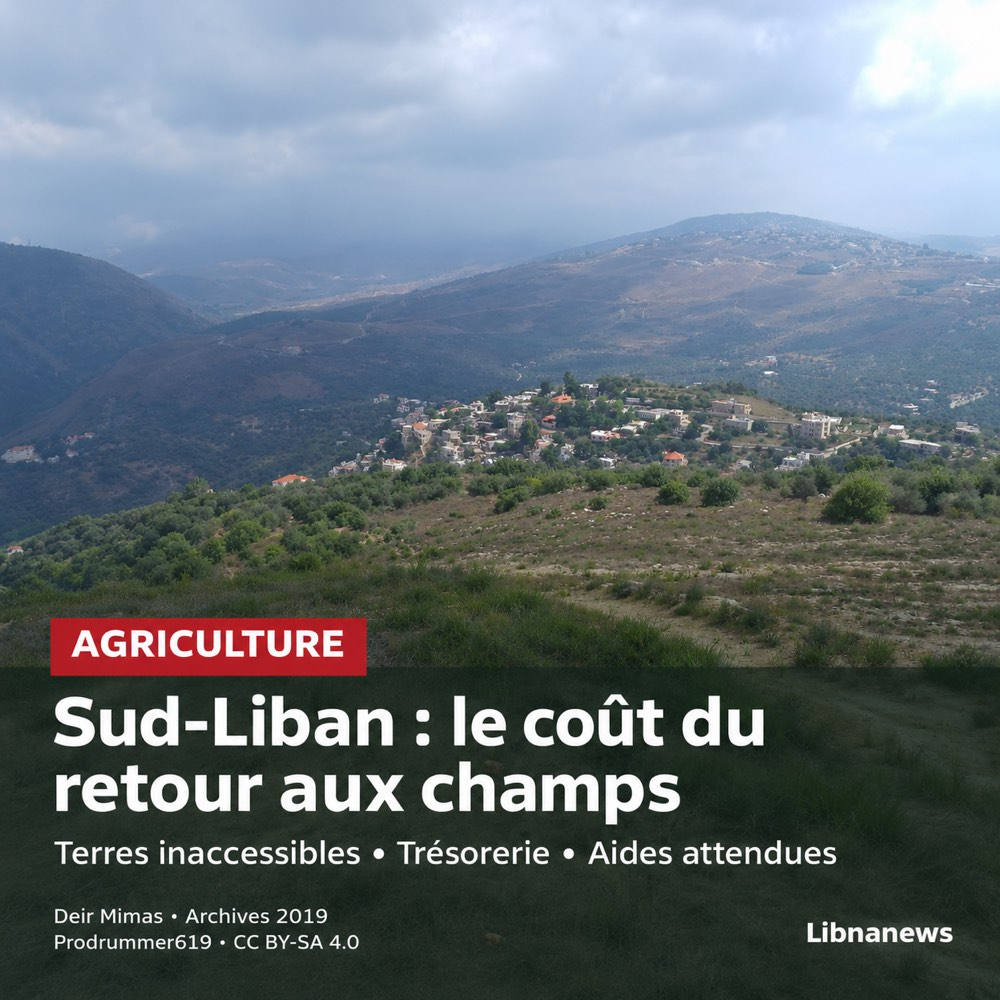
Archive Illustration: Deir Mimas, August 7, 2019. This photograph does not represent the damage of 2026. Photo Prodrummer619 / Wikimedia Commons, CC BY-SA 4.0; Libnanews dressing under the same license.





Comments