

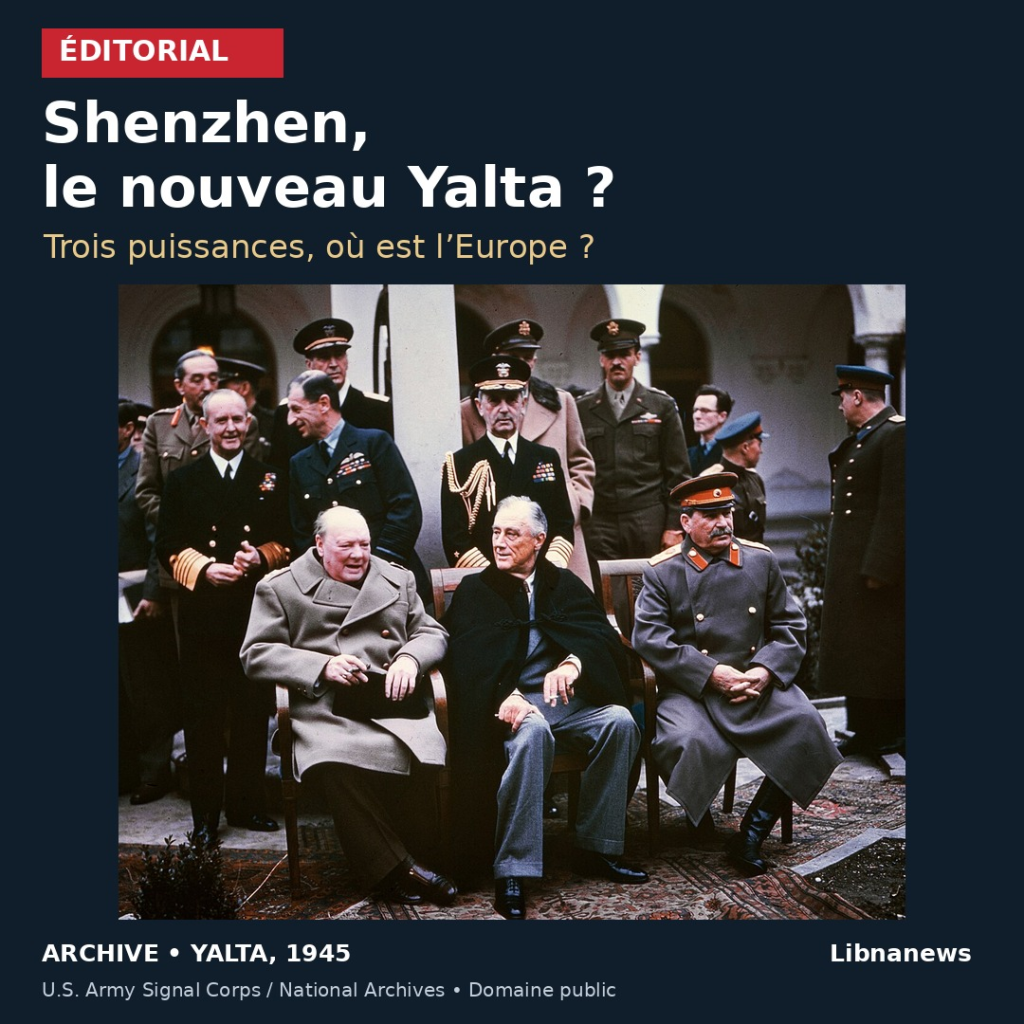
Editorial. Three leaders, a Chinese city, a ready-to-use historical comparison. The meeting announced for November 19 between Donald Trump, Xi Jinping and Vladimir Putin in Shenzhen already has its nickname: a new Yalta. Only the agreements are still missing. An embarrassing accessory, of course, but the posters of the great productions always come out before the film.
On the evening of November 18, however, the facts require that the conditional be kept at hand. Xi welcomed Trump to Shenzhen. Beijing announced a meeting of the three presidents for the next day. It sets an appointment, not a sharing of the world. No treaty redistributing Europe, Asia or the Middle East can be deduced from a protocol programme. A handshake is not a cadastre.
A new Yalta, with a distribution error
Let’s start by returning his chair to Winston Churchill. In Yalta, from 4 to 11 February 1945, the British Prime Minister sat with Franklin Roosevelt and Joseph Stalin. To say that Europe was absent would therefore be false. To say that the peoples of Europe were all represented would be just as adventurous. Churchill defended British interests, not a mandate from the whole continent.
The conference dealt with the end of the war and the post-war period: Germany, Poland, United Nations organization, Soviet participation in the war against Japan. The texts also included democratic commitments. Their existence and subsequent respect are two different issues. Reducing Yalta to three men quietly cutting a map erases both military power relations and unfulfilled promises.
In Shenzhen, the three presidents are not the leaders of a victorious coalition ending a common war. They represent competing powers, whose interests can intersect without confusion. The resemblance comes first from photography: three men, a lot of power, little room for others. A useful analogy to ask a question; a dangerous shortcut if it already serves as an answer.
Europe did not lose its APEC badge
Another clarification, less spectacular than a downgrading trial: the European Union is not a member of APEC. This forum brings together twenty-one Asia-Pacific economies. His absence from the annual meeting therefore does not prove that a Chinese bailiff had withdrawn his invitation card. Geography did not become a diplomatic sanction at night.
The real question is the political meeting held next door. If three powers discuss global security, with possible consequences for Ukraine and Europeans, who represents those concerned? The detailed agenda and results remain to be established. But the format is already speaking: the participants agree at least on their presence; others must recall why their consent matters.
It’s an essential difference. Europe does not have an automatic seat right in every conversation between great powers. Nor should it accept that a conversation between great powers becomes, by its own prestige, an authorization to decide in its place.
The world’s after-sales service
In its conclusions of 18 June, the European Council recalled that peace could not be decided without Ukraine. He also claimed that the Union would decide on matters within its competence or affecting its security. The position is clear. The problem begins when a perfectly worded formula must become a balance of power.
Europe can hardly be satisfied with the role of after-sales service: others announce the historical solution, it examines the consequences, organises financing and looks where to place guarantees. It would be a strange division of labour. One photograph, another spreadsheet. The spreadsheet is indispensable; It should not be a foreign policy.
But mocking European impotence is not enough to explain it. The Union has commercial powers, budgets and sanctions instruments. Its States have their military capabilities and diplomatic choices. The challenge is to transform these tools into common commitments that are credible enough to weigh before negotiations, not just to comment on their outcome.
A useful European presence is therefore not measured by the number of seats claimed. It involves specifying who negotiates, on which mandate, with what resources and limits. Twenty-seven votes do not automatically make a loud voice. But three serious voices, in front of three flags, are not universal.
Three powers are not three owners
But we must guard against the opposite. Trump, Xi and Putin are not in themselves a scandal. Between powers capable of causing major crises, dialogue is better than communication through military demonstrations. Reducing risk, clarifying a position or obtaining a verifiable commitment would be a useful outcome. It would not need to be sold as the solar system overhaul.
The danger arises when power becomes title to property. Discussing Ukraine does not give the right to dispose of Ukrainians. Exchange on European security does not replace European agreement. Less powerful countries are not the technical annexes to a press release drafted elsewhere.
From Lebanon, the shade deserves more than a smile. A country that often awaits the results of conversations held away from it knows the price of this diplomatic grammar: the powerful speak of stability; Others look for what the word will cost them. This experience should make wary of any promise of order that begins by forgetting those who will have to live there.
Shenzhen, the new Yalta? For the time being, an announced meeting and a legitimate question. On 19 November, we will have to look at the commitments, their scope and those they concern. As for Europe, it would do well to prepare something other than a reaction to the final communiqué. Being deeply concerned is a respectable provision. It’s not yet a place at the table.
Churchill, Roosevelt and Stalin at Yalta in February 1945. Photograph of archives, without documentary relationship to the contemporary summit in Shenzhen. U.S. Army Signal Corps / National Archives, public domain. Whole photo preserved; Libnanews dressing.





Comments