

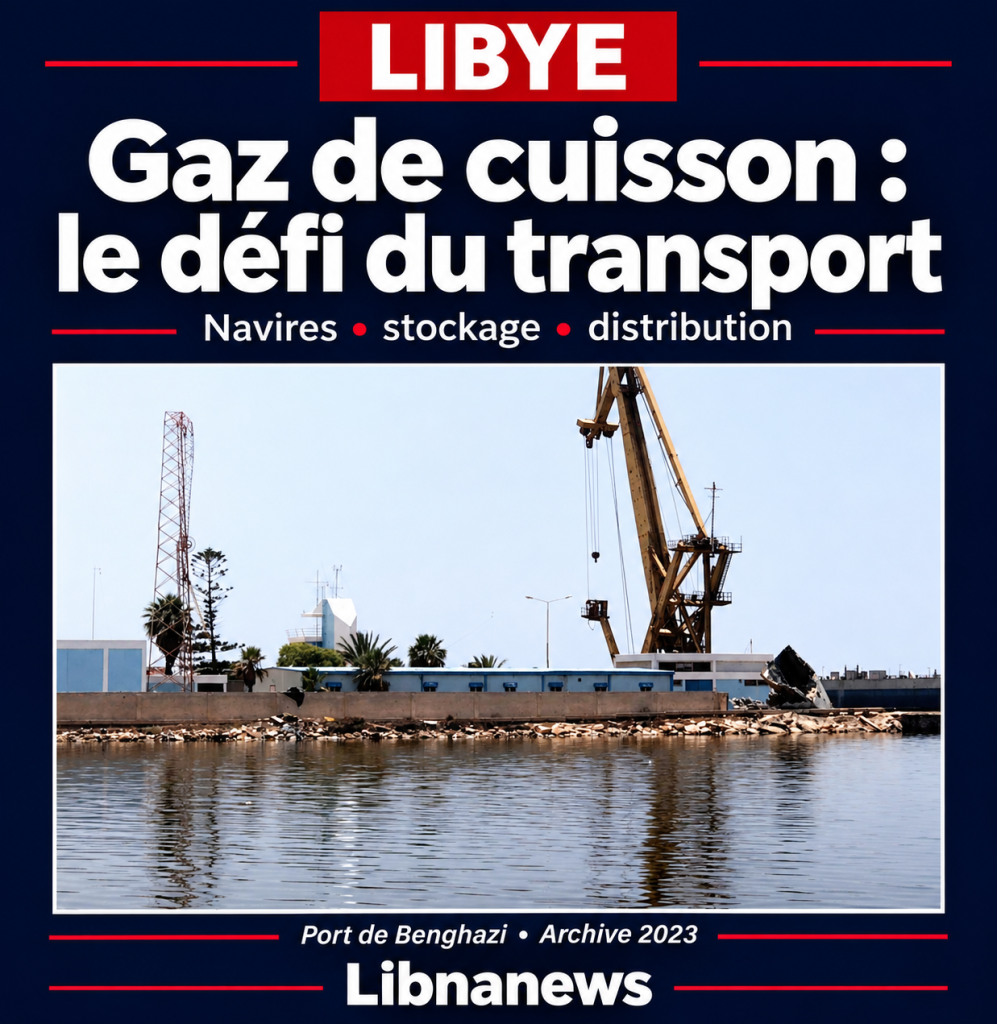
In Libya, the arrival of new shipments of cooking gas is not enough to close the distribution crisis. The announcements of 14 and 15 November 2026 show a revival of several links: ships, storage, filling of bottles and points of sale. At the same time, the Public Prosecutor ‘ s Office has announced pre-trial detention in an investigation into maritime transport contracts. This dual development sheds light on a concrete difficulty: having gas and sending it regularly to households are two separate operations.
Gas in Libya: a cargo in Benghazi
On 15 November, the company Brega for the marketing of petroleum products announced the start of the unloading of the vessel Al-Tahaddi 2. It had arrived at the Benghazi oil terminal with about 1,900 tons of liquefied petroleum gas. The company indicated that the pumping had resumed in order to strengthen the stocks.
Brega also reported the operation of the immediate filling points in Benghazi during the morning and evening periods. This communication describes a delivery and a local organization. It does not constitute a national balance sheet of gas availability at distributors.
It is also necessary to distinguish between the arrival of the vessel, its connection to the terminal and the complete transfer of its cargo. The communiqué of 15 November confirms the start of operations. It does not provide a final statement of the volumes distributed to households.
Maritime transport at the centre of the difficulties
By 1 November Brega had recognised tensions over the supply and distribution of LPG. The company linked them to variations in ship navigation and arrival times in Libyan ports. He explained that these shifts had temporarily affected pumping and storage in some areas.
The company indicated that it was keeping its teams ready to receive and unload cargo upon arrival. It also referred to coordination with the supervisory and security authorities to organise the quantities available and their distribution at the official price.
This presentation places the difficulty in the routing chain. It does not show that all cities were in the same situation. Nor does it establish that domestic production had ceased. The dates of the vessels, the volumes stored and the filling capacity shall be followed separately.
A person in custody
On 15 November, the Attorney General’s Office announced the pre-trial detention of the national oil company’s shipping officer. The investigation concerns the management of contracts for the transport of cooking gas.
According to the Public Prosecutor ‘ s Office, there have been shortcomings in the connections from the ports of Melitah and Zawiya to Tripoli, Misrata and Benghazi. In particular, it involves chartering a ship exposed to legal risks and then detained in a Greek port.
The Prosecutor’s Office claims that this situation contributed to the depletion of Brega’s stocks and to an increase in the cost of gas. These are the elements presented by the prosecution in an ongoing proceeding. Pre-trial detention is not a conviction. The press release does not specify the name of the detained vessel or the defence arguments. It does not allow all the distribution difficulties observed in the country to be attributed to this episode alone.
To the west, the Derna and filling facilities
The National Oil Company operational point, dated 14 November, mentions another shipment. The Derna was unloading about 2,300 tons of LPG in Tripoli. His departure to Misrata, to deliver the rest of his cargo, was announced for the next day. That timetable had yet to be confirmed by actual operations.
The company also reported that the Zawiya refinery continued to produce LPG for the western part of the country and the Western Jebel. In Melltah, trucks continued to load the product to feed other regions.
This information shows that maritime and road routes operate in parallel. The presence of a load in a port does not guarantee its immediate availability at each point of sale. Transport to depots and subsequent filling and delivery of cylinders are still necessary.
Local distribution, the last visible link
Brega reported on 14 November that pumping operations since the Derna had resumed. It also reported the operation of the filling facilities at the Tripoli and Al-Hani depots. They supply distribution centres, distributors and direct outlets.
The distinction is important for the inhabitants. A deposit can receive from the product without all queues disappearing simultaneously. Available announcements describe the mobilization of facilities, but do not publish a uniform time frame for access to a bottle.
In Suq al-Jumaa, the municipality announced the opening, from 15 November, of a daily distribution point near the Arada clinic. The scheme was coordinated with Brega and placed under municipal supervision. It aims to reduce travel and expectations. This proximity measure should not be presented as a solution covering all the agglomeration of Tripoli.
Brega fire remains a separate event
On 11 November, a fire in the gas complex operated by Sirte in Marsa Brega killed one worker and injured four others. The National Petroleum Company described an incident involving a gas pipeline supplying boilers. She announced the preventive shutdown of the installation and fire control.
However, it claimed that the event did not affect the local gas market supply or crude oil production. Distribution tensions had also been recognised earlier. Without any additional element, it would therefore be unjustified to present this fire as the established cause of the shortage of bottles.
On November 14, the National Oil Company announced that it had hired an additional gas vessel, which was scheduled to enter service within two weeks. This is the next concrete deadline to follow, with the volumes actually discharged and the evolution of distribution.





Comments