

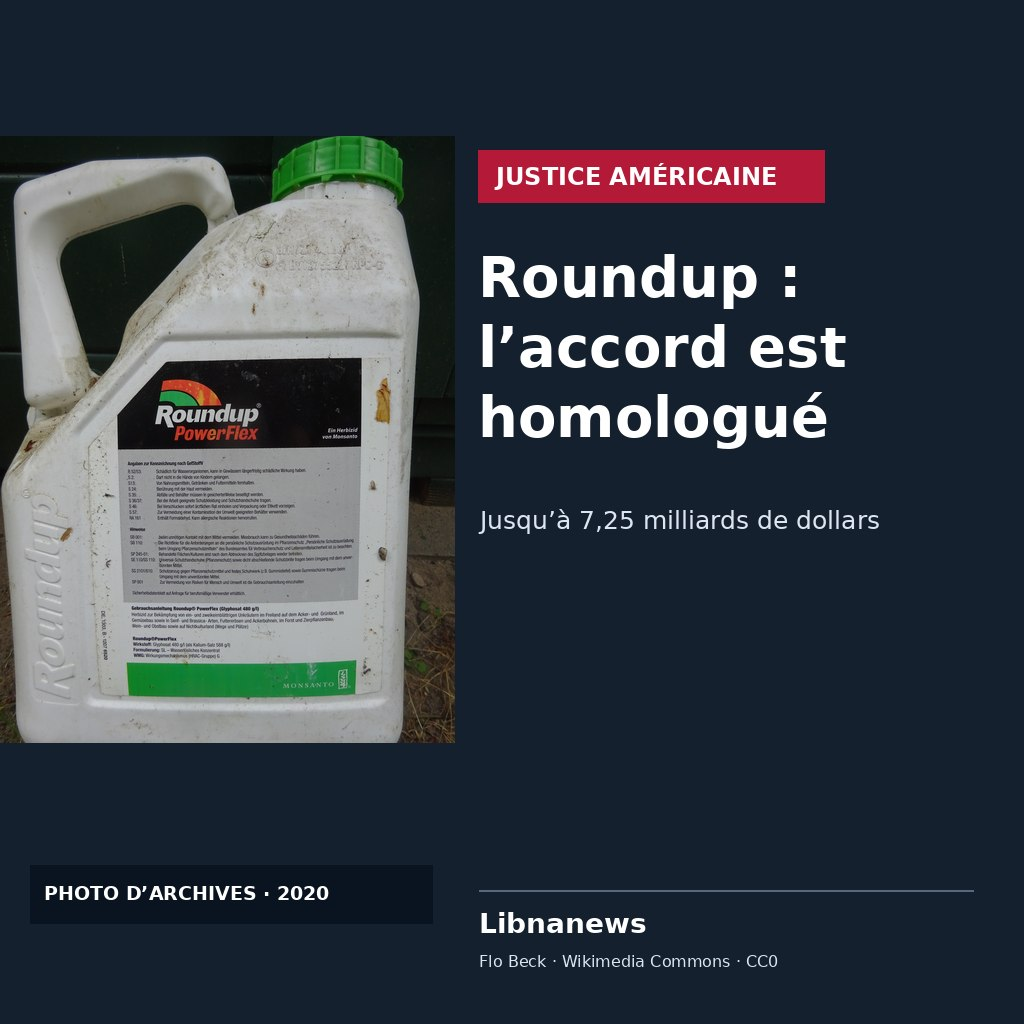
A court in Saint-Louis, Missouri, approved on Friday, November 20, a collective agreement on complaints related to Roundup weeding in the United States. Monsanto, a subsidiary of Bayer, plans to spend up to $7.25 billion over 21 years. The decision may still be appealed and the agreement does not involve recognition of responsibility.
A funding ceiling, not an immediate payment
The court gave its final approval to the agreement presented in February, after initial provisional approval in March. This step validates the mechanism at the level of the court which is seized of it; However, it does not render the decision irrevocable. Bayer states that in the event of an appeal, Monsanto’s subsequent payments would be suspended until it was settled. The figure of $7.25 billion corresponds to the cumulative ceiling for contributions, including amounts already paid. It does not correspond to an amount immediately available or an amount distributed equally among the persons concerned.
The Regulations apply to persons who claim to have been exposed to Roundup in the United States prior to February 17, 2026 and who have been, or will be, diagnosed with non-Hodgkin’s lymphoma under certain conditions. For future diagnostics, Bayer indicates a period of 16 years after the entry into force of the Agreement. This period is not confused with the maximum 21 years during which Monsanto may be called upon to finance the scheme. The administrator of the regulation sets out eligibility criteria and variable amounts depending on the record, including exposure and diagnosis. Therefore, each individual application is not subject to approval.
The collective agreement and the Durnell judgment do not answer the same question
Missouri’s judgment follows a separate decision of the United States Supreme Court, rendered on 25 June in the caseMonsanto versus Durnell. The Court held that federal law prevented Monsanto from proceeding on the basis given by this complainant: the absence on the label of a warning that the federal framework did not require. She overturned the decision of the Missouri Appeal Court and referred the case back to her.
The judgment concerns the possibility of imposing an additional mention by the law of an American State. It does not constitute a medical conclusion as to the origin of a complainant’s lymphoma and does not, by itself, exclude any other form of recourse. The agreement approved in Saint-Louis answers another question: the conditions under which claims may be compensated by a collective arrangement, without the company admitting fault.
The timing of payments now depends on appeals
The administrator of the agreement states that the entry into force is not automatic: it depends on the expiry of the appeal periods or the outcome of any appeals. The court shall make available the judgement and a list of valid applications for withdrawal of the group. The persons on this list are not in the same situation as those who simply challenged the terms of the settlement by remaining members of the group.
Nor does the judgment alter European rules. In the European Union, glyphosate remains approved as an active substance until 15 December 2033, subject to conditions. The authorisation of products containing them is subject to separate examination by Member States. On the one hand, Missouri ruled on a US compensation agreement; on the other, the European authorities ruled on the use of plant protection products.





Comments