

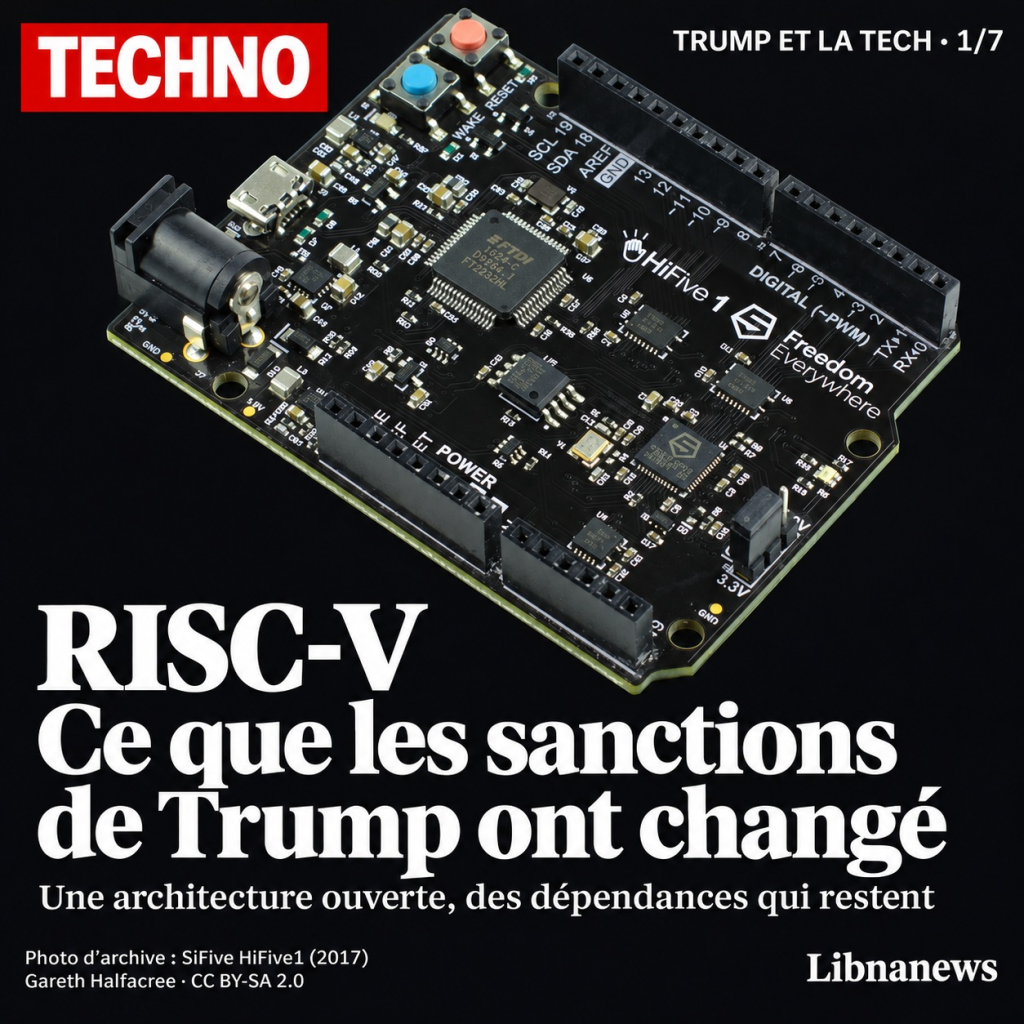
RISC-V offers flea designers an open set of instructions, usable without charge on this architecture. American restrictions against Huawei under Donald Trump have strengthened the strategic interest of this freedom. Yet they did not create technology or its market. The advances announced in 2026 show a wider movement: American companies also participate in its development, without removing industrial dependency.
On September 15, 2026, SiFive and AMD presented a demonstration of artificial intelligence on a server equipped with RISC-V processors. The platform used the ROCm software from D-AMD and its graphics cards. The central processor organized the work; the accelerators performed the inference calculations. This distribution counts: adopting RISC-V does not mean replacing the entire US technology chain.
This first part of our series on American decisions and technology examines this paradox. Washington can restrict access to certain products while sheltering companies that develop open architecture. Between these two movements, the industrialists seek more control over their components.
RISC-V: a precise freedom, not a free chip
A set of instructions defines the operations that a processor includes: calculate, compare values, move data. It provides an interface between software and hardware. RISC-V makes this interface open. A manufacturer may use it to design a processor without paying a fee for using the set of instructions.
The circuit that will execute these instructions must then be created. This work requires engineers, tools, verifications and manufacturing. A company can also buy a processor core already designed. This product can be owned and paid even if it uses RISC-V. The opening of architecture therefore does not automatically make public the plans of each chip.
The distinction avoids a frequent misunderstanding. RISC-V is neither a single processor brand nor a factory. Two compatible circuits can have very different performances, consumption and prices. The choice of architecture is not enough to classify their quality.
An invention prior to the commercial war
The project began at the University of California in Berkeley in 2010, including Krste Asanović and David Patterson. In August 2014, the two researchers were already defending a free instruction game in a technical report. They consider uses ranging from objects connected to large computer systems. The RISC-V foundation appeared in 2015, before Donald Trump’s first term.
The search for an open architecture therefore responds first to technical and economic motivations. Researchers want to be able to experiment. Industrialists seek to customize their circuits and choose their suppliers. These objectives existed before the US sanctions against Huawei.
The international association transfers its incorporation to Switzerland in March 2020. She explains that she wants to preserve the global development of the standard. It also states that this decision is not based on any single country, government, business or event. Presenting this displacement as the only consequence of Trump’s decision would go beyond his official explanation.
What American restrictions have changed
On May 16, 2019, the Trump administration registered Huawei and certain subsidiaries on the Entity List. Transactions involving products subject to U.S. regulation then require licences within the scope concerned. In August 2020, Washington expanded controls to include certain products manufactured abroad using US technology or software.
This second stage shows the extent of dependency. Buying outside the United States is not always enough to get out of the US rules. The processes and equipment used in a plant can also count. Companies must examine their production chain, not just their supplier’s address.
In this context, an open-licensed architecture is of additional strategic interest. It allows you to work on part of the processor without negotiating access to the instruction set with a sole provider. It is an incentive to diversify technical choices. However, the available documentation does not allow for an estimate of the proportion of RISC-V’s global increase attributable to sanctions.
The chronology also exceeds Donald Trump. The Biden administration announced on 7 October 2022 wider controls on advanced computing and certain manufacturing equipment. It strengthened them in October 2023. Attributing this whole policy to the Republican president alone would erase continuity between administrations, despite their different methods.
China invests, the United States invests
Alibaba provides a concrete example of Chinese participation. On October 19, 2021, the group announced the opening of its XuanTie core code, based on RISC-V. Developers can use them to prepare their own prototypes. This initiative must be distinguished from Yitian 710, the server processor presented in the same press release: this one is based on Arm.
This case illustrates several simultaneous strategies. A group can develop RISC-V components, use another architecture for its servers and retain foreign partners. The adoption of an open standard therefore does not prove a complete break with Western technologies. It adds a possibility in a set of industrial choices.
On the American side, SiFive announces on 15 January 2026 the integration of NVLink Fusion, Nvidia’s interconnection technology, into its future solutions. The goal is to connect its processors to the group’s accelerators. The opening of the instruction game can thus accompany a commercial cooperation with an American supplier, rather than its replacement.
On August 24, SiFive introduced BigSky, a RISC-V development server. The company states that CUDA operates on this platform to drive loads executed on Nvidia graphics processors. It announces limited availability for software porting and testing. These elements describe a concrete industrial step, not a generalization in all data centres.
The software also decides on adoption
A usable chip must find compatible operating systems, compilers and applications. Changing architecture requires rebuilding, adapting and testing part of this set. The extensions chosen by manufacturers must also remain sufficiently consistent to limit fragmentation.
On August 9, 2025, Debian 13 integrated for the first time the official support of the riscv64 architecture. This step gives compatible hardware users access to a stable Linux distribution. It does not guarantee that all commercial applications work immediately on each RISC-V machine.
Common technical profiles are designed to facilitate this work. BigSky presents itself as conforming to the RVA23 profile. In the demonstration conducted with AMD in September 2026, companies are still talking about optimizations to continue. Showing a d.
The autonomy remains a chain to be built
RISC-V removes a constraint in the set of instructions. It does not provide lithography machines, electronic design tools, memory or assembly capabilities. Nor does it subtract a chip from the controls applicable to its characteristics, destination or end-user. The open standard does not constitute a commercial exemption.
The industrial interest therefore depends on the problem to be solved. For a team that wants to customize a processor, freedom of design can be crucial. For a private manufacturer to access an advanced factory, changing architecture does not restore this access. For a server operator, software compatibility and technical support remain deployment conditions.
The next steps will be measured in the applications carried out, qualified systems, controls and machines actually deployed. SiFive is still targeting its BigSky server for development and validation. The transition from these tests to sustainable installations will provide a more useful measure of the progress of RISC-V than only performance announcements.





Comments