

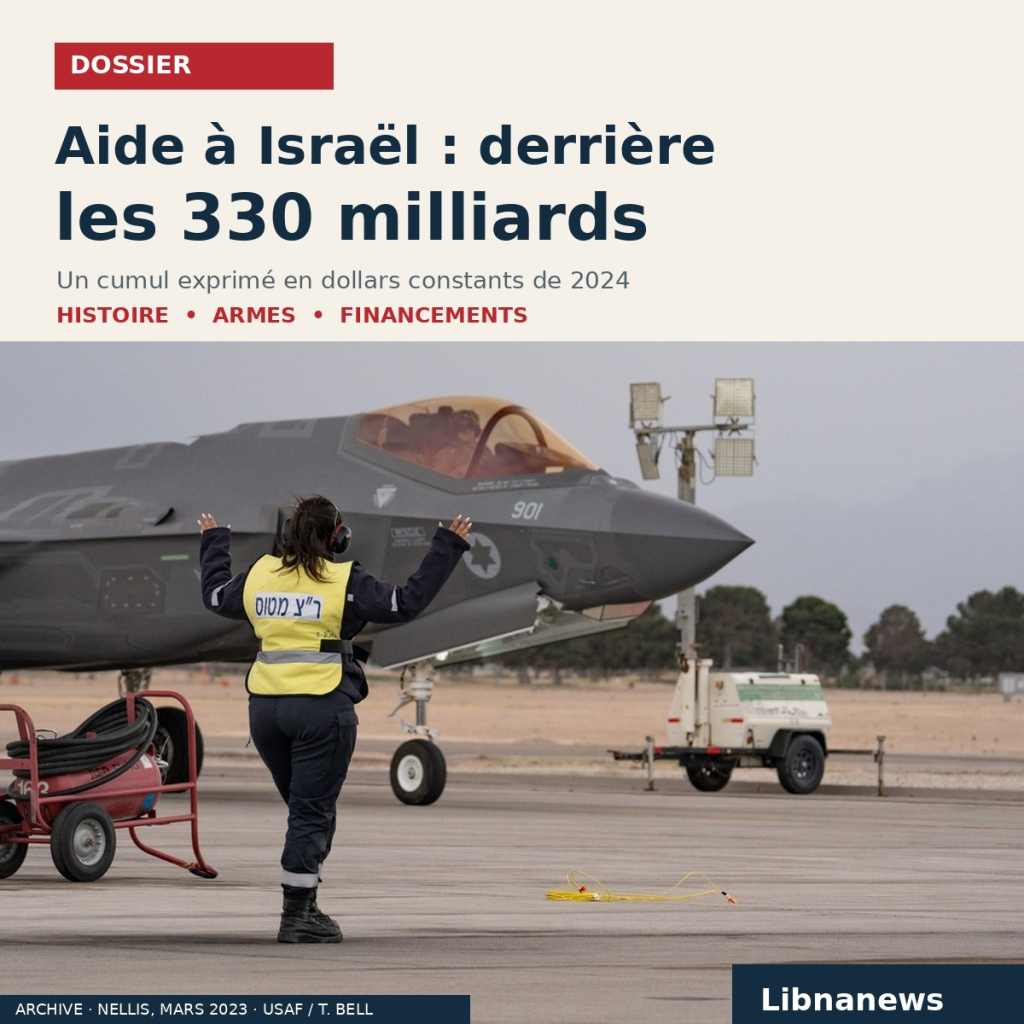
A loan for agriculture in 1949, warplanes from the 1960s and then billions dedicated to missiles and interceptors: American aid to Israel changed in nature as much as in scale. The figure of approximately $330 billion, reissued in recent days, summarizes this exceptional support. Provided that it is adjusted for inflation and does not correspond to a statement of payments until November 2026.
Israel is, according to the Congressional Research Service (CRS), the first cumulative recipient of US external assistance since the Second World War. This historic rank does not mean that it comes first every year. He says above all about the duration of a relationship that has gone through the changes of administration in Washington, the regional wars and the transformation of Israel into a developed economy.
Two days after Donald Trump’s announcement of the end of annual aid from 2027, the debate deserves better than an isolated amount. What is this help made of? How much money does the former economic assistance provide? And what exactly is the total of 330 billion?
330 billion: inflation-adjusted figure
The amount of approximately $330 billion recovered byYnetis attributed to the Council on Foreign Relations (CFR). It must be read in constant 2024 dollars: old aids are revalued to take account of price developments. A dollar committed in the 1950s thus weighs more than a recent dollar in this addition.
ThecFR historical graphcovers the financial years 1946 to 2024. He used data from ForeignAssistance.gov, added anti-missile credits from 2006 and said that 2024 was partially reported. The accompanying text speaks of « more than $300 billion ». The figure of 330 billion therefore remains an estimate attributed to this compilation, with its period and limits, and not a nominal total decided on the day of its resumption in the press.
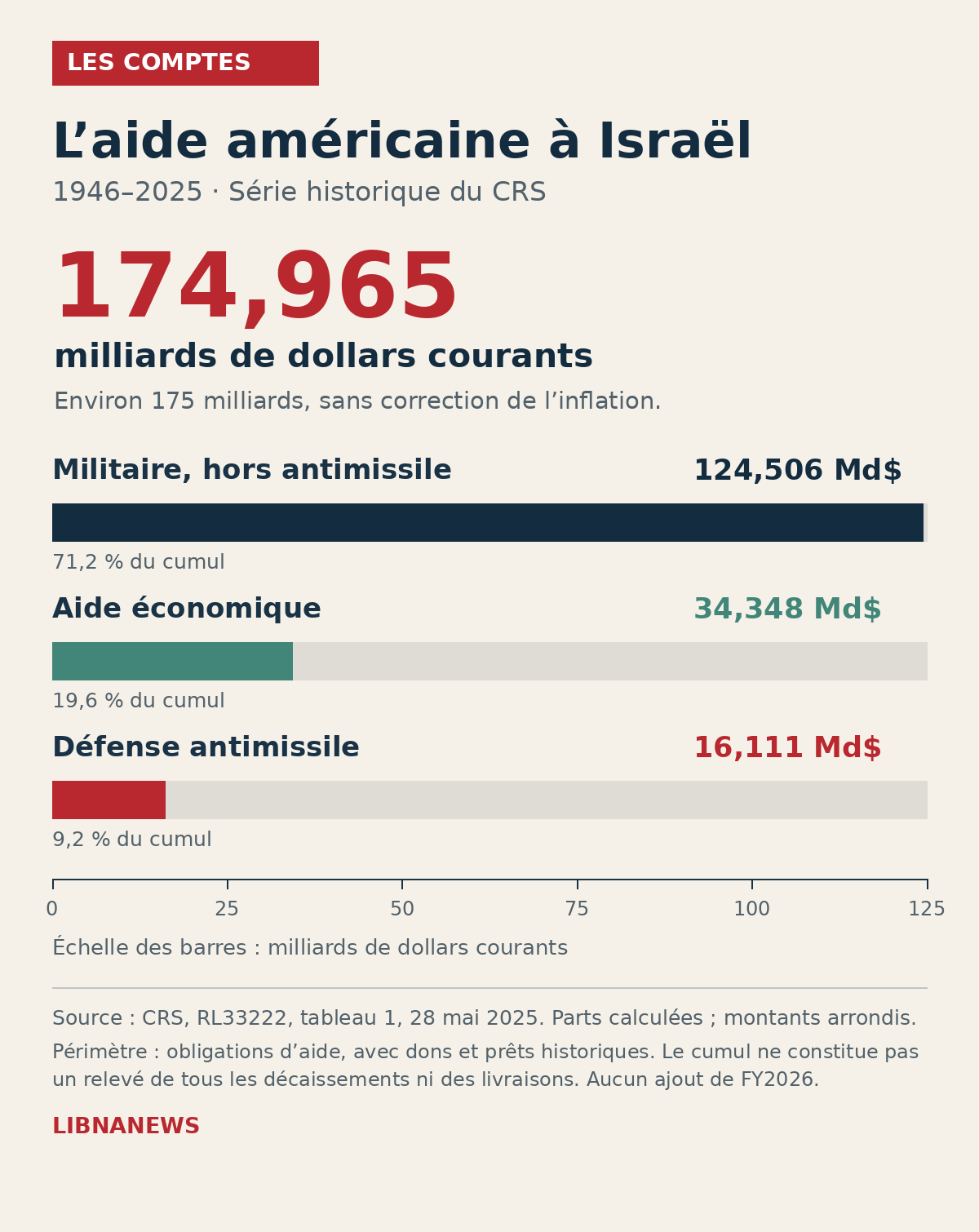
Table 1cRS report of 28 May 2025offers another measure:174.965 billion current dollars, or about 175 billion, in the 1946–2025 series. The beginning of the series takes up the statistical wording of the CRS; The first major loan to Israel dates from 1949. The table adds the amounts to the prices of each period. Its breakdown distinguishes 124.506 billion non-missile military assistance, 34.348 billion economic assistance and 16.111 billion missile defence. Military and anti-missile assistance together account for about 80% of the total.
The same report also cites a State Department/USAID estimate of $298 billion in constant 2024 dollars for the period 1946–24, based on data available in January 2025. The historical Greenbook base excludes the anti-missile credits of the Pentagon. This explains a difference in scope, without allowing the mechanical allocation of the 32 billion separating 298 and 330 to a single item: the extraction dates and the coverage of the series are not identical.
Table CRS is entitled « obligations », i.e. commitments. It brings together historical assistance and recent budget financing, including old loans. It is not an audit of all disbursements. In the U.S. budget, the vote opens up an expenditure capacity, commitment creates a legal obligation, and then comes payment. The delivery of an aircraft can still take place several years later. Confounding them artificially inflates balance sheets or gives the impression that ordered materials are already available.
1949: the first major loan also finances fields
The formula « since 1948 » refers to the creation of the State of Israel. The first major US government financing was granted in January 1949: a $100 million export-import bank loan. Thearchives of the State Departmentdetails a rate of 3.5% and a reimbursement over 12 years. A second loan of 35 million follows in December 1950. About half of the funds from these two loans go to agriculture; Industry, transport and communications absorb most of the rest.
This origin illuminates a story often told only through weapons. Between 1949 and 1965, US assistance reached an average of some $63 million per year, of which over 95% was aid for economic and food, according to the historical annex of the SRC. The financing goes hand in hand with the development of the country and the reception of immigrants. Military assistance remains modest, while France is a major supplier of weapons to Israel.
The Hawk missiles sold by the United States in 1962 and the Phantom aircraft approved for sale in 1968 announce the change. The fiscal leap appeared at the beginning of the following decade: US military loans increased from $30 million in 1970 to $545 million in 1971.
1973–1985: the turning point in military aid
The war of October 1973 gave the relationship a new dimension. A December US law opens up $2.2 billion in exceptional military assistance. In 1974, Richard Nixon distributed this envelope between 1.5 billion grants and 700 million loans. Emergency military aid becomes a central instrument of US support.
The 1979 Israeli-Egyptian peace treaty added a diplomatic function to this funding: Washington accompanied the commitments of the two countries and the consequences of the Israeli withdrawal from Sinai. The appropriations announced for this whole agreement must be broken down among beneficiaries before they are included in an Israeli balance sheet.
In 1985, an economic supplement of $1.5 billion supported the stabilization of an inflationary economy. The same year marked the transition from all US military aid to Israel to donations. This distinction counts in the reading of cumulation: early repayable loans and contemporary grants do not offer the same financial advantage to their beneficiary, even when they are included in a long series of assistance.
From the late 1990s onwards, the ten-year protocols organised long-term support. The first covers the 1999–2008 financial years and accompanies the phasing out of bilateral ESF economic assistance. It disappeared in 2008, without the cessation of all civil or binational programmes. The second protocol foresees 30 billion military aid in 2009–2018, with separate missile financing.
38 billion over 10 years, voted year after year
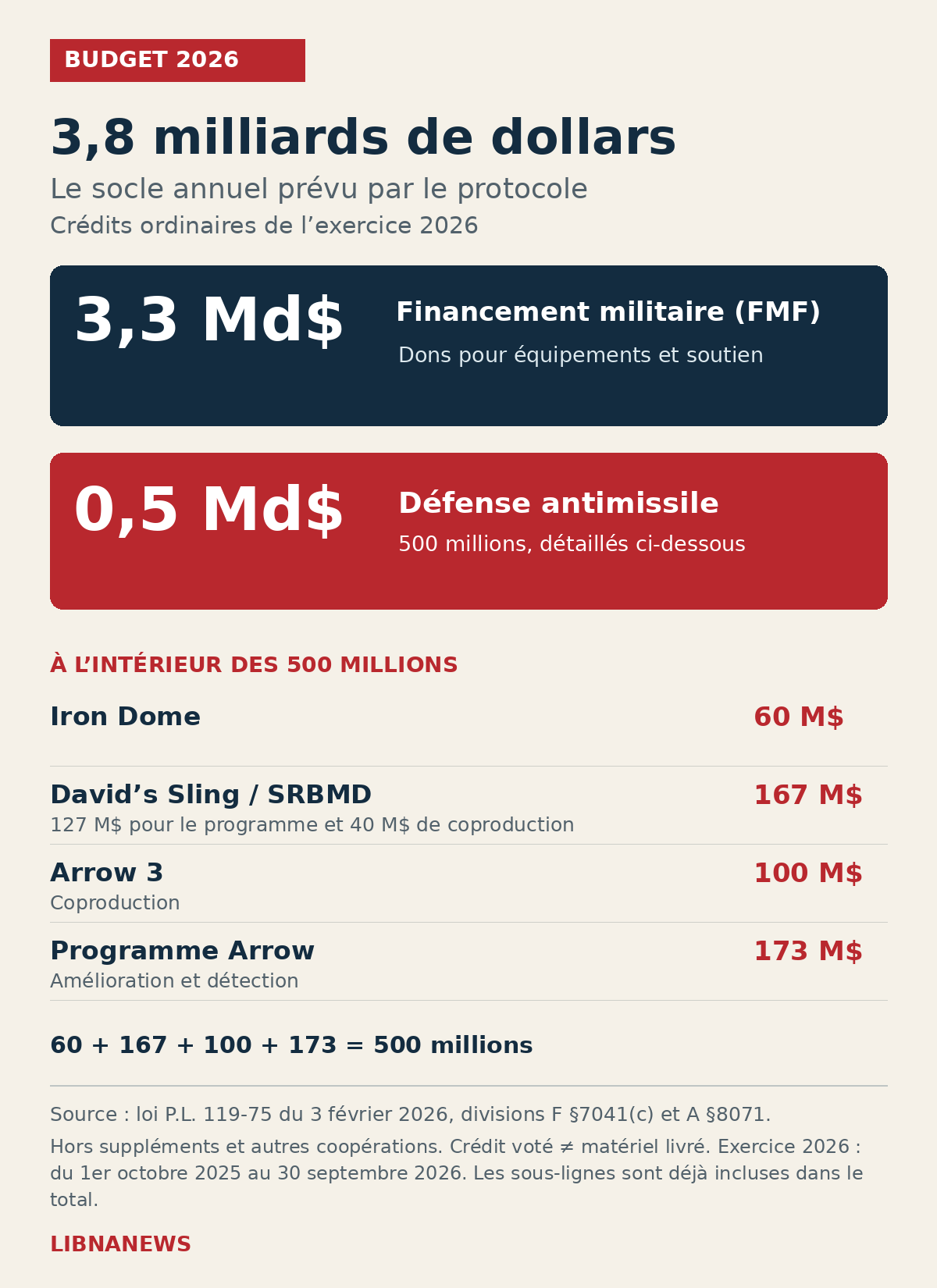
The protocol signed under Barack Obama in September 2016 provides $38 billion for fiscal years 2019–2028: 33 billion Foreign Military Financing (FMF) and 5 billion missile defence. Its regular pace is therefore 3.3 billion military donations and 500 million for missile programmes per fiscal year.
This visibility allows Israel to prepare long purchases and manufacturers to predict their orders. The protocol, however, remains a political commitment subject to Congressional appropriations. The 38 billion are not paid at once or added to the total after the ten annuities: it is these annuities that materialize the commitment.
For financial year 2026, thelaw promulgated on 3 february 2026provides at least 3.3 billion FMF grants and 500 million for Israeli missile programmes. Other defence cooperation, notably against drones and tunnels, is outside this ordinary envelope. These recent appropriations are presented separately here: the historical accumulation of 175 billion remains that of the CRS table decided on in 2025.
The US exercise begins on October 1 and ends on September 30. Budget year 2026 ended on 30 September 2026. This difference with the civil calendar becomes decisive when a political announcement evokes a change « from 2027 ».
2024: year of supplement of 8,7 billion
The exceptional envelopes explain the tricks of this story. For fiscal year 2024, the CRS table accounts for $12.5 billion: the 3.8 billion ordinary, plus $8.7 billion voted in April after the outbreak of the war in Gaza.
The supplement includes FMF 3.5 billion, Iron Dome 4 billion, Davids Sling and Iron Beam 1.2 billion. The additional anti-missile and laser lines thus reach 5.2 billion. They are already included in the 12.5 billion fiscal year and in the historical total. Counting them a second time would be to add the envelope and its contents.
Major regional laws also include expenditures by U.S. forces and other positions. Their total amount cannot be presented as a full transfer to the Israeli Government. The same caution applies to loan guarantees: Washington can guarantee a loan raised on markets without immediately paying the equivalent of its face value. The CRS treats them separately as direct aid.
Aircraft, ammunition and three defence floors
FMF funds a wide range of equipment, services and support. The F-15, F-16 and F-35 illustrate the sustainable installation of American equipment in Israeli aviation. The first F-35I were delivered in 2016; the funding of the first batches by FMF donations is documented by the CRS. The agreement announced in June 2024 for 25 additional aircraft, with support and maintenance, covers approximately $3 billion and provides for deliveries from 2028.
The equipment, helicopters, spare parts, bombs and guide kits complete this set. They meet different needs: combat, transport, extension of the range, maintenance in operational condition or renewal of stocks. A possible US sales notification indicates an estimated limit; it does not prove the signature of the final contract or the delivery of all the advertised material. The FMS sales channel can also mobilize US aid, Israeli funds or both.
The missile defence follows a distinct architecture.Iron Dome, originally developed by Israel, targets in particular short-range rockets. US support starts in fiscal year 2011, before a co-production agreement in 2014.David, developed jointly, covers threats of intermediate scope. FamilyArrowtreats ballistic missiles, Arrow 3 allowing interceptions out of the atmosphere.
These credits pay for research, testing, interceptors and co-production. For 2026, the 500 million ordinarys are divided into 60 million for Iron Dome, 167 million for Davids Sling/SRB®, 100 million for Arrow 3 co-production and 173 million for Arrow system improvement and detection. The breakdown describes the use of the envelope; it does not add an additional 500 million to each system.
Aid that also finances American factories
Much of the FMF is used to purchase from U.S. suppliers. As a result, federal support also feeds U.S. orders and production chains. The exception allowing Israel to use a share of these funds for purchases in its own country is gradually shrinking and must disappear in fiscal year 2028. For 2026, the law still reserves at least 250.3 million to this possibility.
Anti-missile co-production also binds industrialists from both countries. This organisation explains why the debate goes beyond the question of an annual transfer to Israel. U.S. budget commitments support Israeli military capabilities, while providing work to U.S. companies and maintaining technological cooperation.
It creates a dependency over time. A fleet acquired over several decades needs parts, maintenance, ammunition, training and updates. Israel could finance more orders from its domestic resources without releasing itself quickly from its American suppliers. The CRS underlines this continuity in its analysis of 4 June 2026 on the future of aid.
What a gift would really change
Donald Trump announced on November 3rd that he would end the annual aid from 2027. The reports of Reuters and Associated Press do not establish the budgetary terms of this announcement, while the current protocol runs until September 2028. A presidential statement is not sufficient to demonstrate that appropriations have been cancelled or that the contracts under way are cancelled.
The immediate question relates to the future allocation of the invoice. A decline in donations would require Israel to finance a larger portion of its purchases, change their schedules or revise certain orders. Details of industrial commitments and deadlines are developed in our analysis« American aid to Israel: the bill of arms ».
The choice of funding does not in itself regulate the debate on the use of arms and export controls. The devices that protect cities from missiles and ammunition for strikes carry out different tasks. Their destination, conditions of employment and Washington decisions must be examined with this precision. Sales paid by Israel continue to be U.S. exports subject to a legal framework, although some rules differ depending on funding.
Over the decades, aid has performed several functions: supporting a nascent economy, accompanying diplomatic agreements, financing an arsenal, and maintaining industrial cooperation and missile defence. The historical total measures the magnitude. To understand the choices ahead, the most useful figures will be those of the next voted appropriations, orders actually financed and their delivery schedule.





Comments