

A passenger list and departure schedule are not enough to organise a sustainable return. Discussions announced in Damascus on 2 November should also focus on where families can live, schools accessible to children and care available. Ad Diyar of 2 November 2026 places these needs at the heart of the obstacles that the Lebanese and Syrian authorities must address.
The composition of the Lebanese delegation reflects this dimension. Tarek Mitri must be accompanied by Ministers of the Interior, Labour, Education and Social Affairs. In Al Liwaa, the Deputy Prime Minister states that discussions will focus on the different dimensions of the situation of Syrians in Lebanon. Return is therefore treated as a set of files, not just as crossing a border.
A calendar depending on the means of reception
According to the informed political sources cited by Ad Diyar, the process has slowed down. The newspaper links them to, inter alia, inadequate international funding for reconstruction in areas of return. It evokes a few voluntary collective convoys and the regularization of thousands of situations, without describing a uniform movement.
A future voluntary convoy is envisaged for the second half of November. This perspective depends on the development of an updated mechanism following the work of the delegation. The announced date therefore remains linked to administrative, logistical and security preparations.
The order of operations counts. Determining who wants to return does not resolve the question of their reception. Similarly, announcing a departure opportunity does not guarantee that all necessary equipment is available in the relevant localities. Daily information invites us to distinguish the pace of convoys from that of the rehabilitation of places of life.
Housing and services are the same
Ad Diyar reports that the Syrian authorities link reconstruction to international coordination to provide basic services to returnees. The newspaper quotes the rehabilitation of houses, hospitals and schools. These three needs appear together in the agenda of the discussions.
This association gives concrete scope to the end of reconstruction. A usable dwelling is an essential condition, but it does not replace the services on which a family depends. The file described by the newspaper therefore combines accommodation with the possibility of resuming daily life in the locality of return.
The sources cited present the Damascus, Homs and certain districts of Aleppo and Hama among the areas prepared to receive returns. The local scope of this assessment must be maintained. It does not allow all these cities, nor the entire Syrian territory, to be regarded as having the same reception conditions.
Financing therefore becomes a crossing point between political will and material achievement. The availability to receive citizens does not exempt the refurbishment of equipment. It is precisely this gap that discussions on international support must deal with, according to the daily story.
School, a project entrusted to Rima Karami
The Minister of Education, Rima Karami, must discuss with the Syrian side the capacity of schools to accommodate returning students. This question is explicitly included in the article of Ad Diyar. It gives the Minister’s participation a separate purpose from the transit procedures or departure lists.
It is not just a question of including education among the general needs. The discussions announced should focus on the effective reception of children in Syrian schools. The rehabilitation of buildings and the absorption capacity of pupils thus form two aspects of the same project.
The school issue also makes it possible to understand why several administrations must intervene. Social services can identify families and prepare lists, while educational authorities examine the possibilities of reception. The return described in the press calls for these steps to join, rather than follow independent timetables.
Lists to be prepared with UNHCR
Haneen Sayed must work on new lists in cooperation with the UN High Commissioner for Refugees. The sources cited by Ad Diyar on 2 November 2026 also refer to logistical and security arrangements, as well as the need for a clear timetable.
The daily presents the approach as voluntary and progressive. He reported that the plan did not refer to immediate collective expulsion. Its sources include persons living in informal camps who have expressed a desire to return, but also different administrative situations related to stay or work.
These categories should not be confused. The wish to return a family, its situation with regard to the stay and the professional status of its members are separate issues. The presentation of these cases in the same political programme does not allow for an identical response.
The requirement of volunteering remains a point of reference in the newspaper’s account, which recalls UNHCR’s position. The cooperation on the lists must therefore be distinguished from a simple census to organise departures. It is part of the return arrangements that the interlocutors are called upon to discuss.
Separate targets to make commitments readable
The announced visit to Damascus also brings together issues of border security and judicial cooperation. Their presence in the same displacement does not transform them into a single procedure. The control of trafficking, the records of detainees and the voluntary return of families require different decisions.
For the social side, the most concrete commitments to be followed concern lists, timetables, housing and access to services. The programme announced remains that of discussions to be conducted, before being able to organize the next steps of the return.
Sources
Ad Diyar, November 2, 2026, page 3.
Credit Line
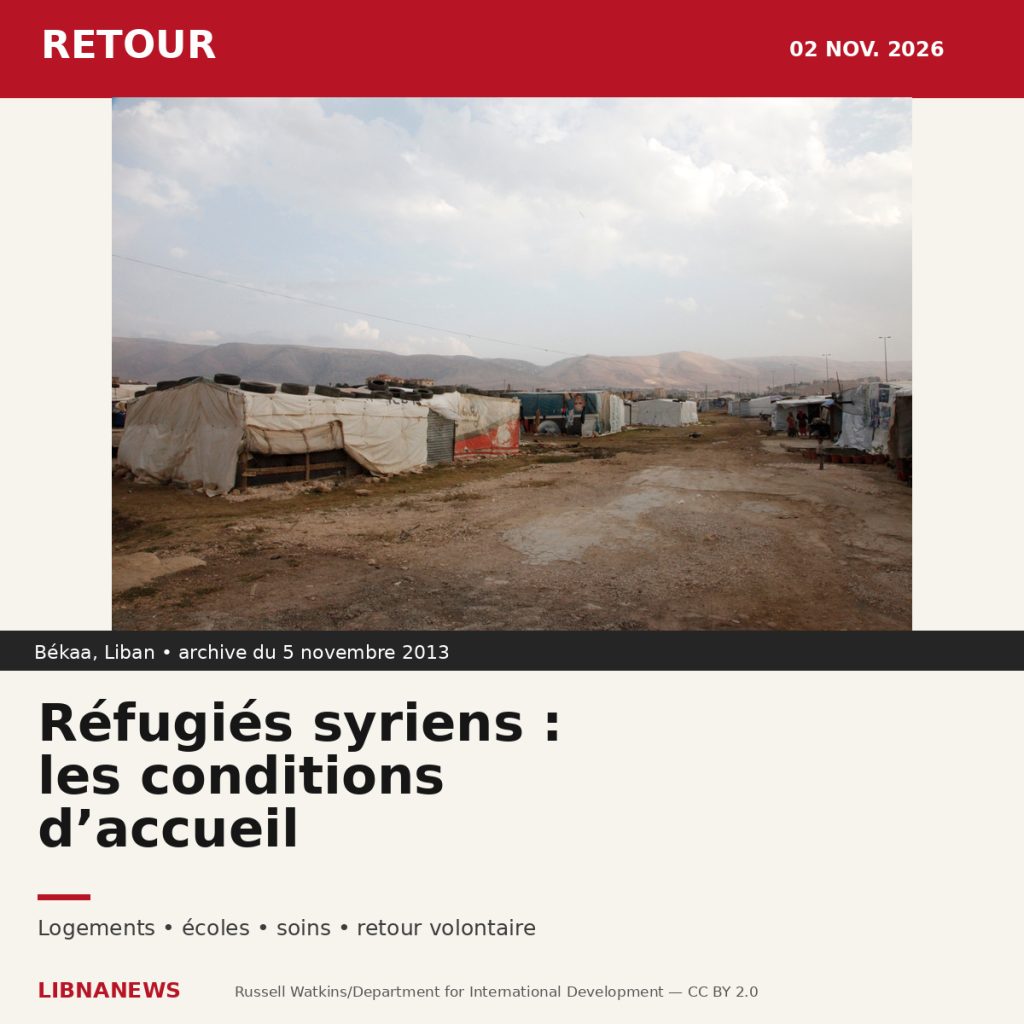
Informal tent installation in Bekaa, Lebanon, November 5, 2013. Photo archive illustrating reception conditions, not a convoy of return announced in November 2026. Russell Watkins/Department for International Development — CC BY 2.0Source of photography.CC BY 2.0 (selected from proposed licences). Resized photograph without cropping; editorial banners added out of image.






Comments