

The negotiations opened after the Israeli elections do not give Lebanon a clear prospect of de-escalation. The newspapers of November 2, 2026 describe several ways of forming a government. They also distinguish this political competition from the security choices that may persist. The possible replacement of Benjamin Netanyahu would therefore not be sufficient to break the policy in Lebanon.
This caution is particularly evident in Ali Haidar’s analysis published by Al Akhbar. According to him, the differences between Israeli leaders also concern the means and timing of action. They do not necessarily mean abandoning the goal of weakening Hezbollah. However, the government’s blockage also does not prove that a war is imminent.
Results that leave alliances open
Al Joumhouria of 2 November 2026 reports that the Likud remains the first party, with 27 seats. Benjamin Netanyahu, however, must have a majority of 61 seats to govern. The daily describes a weakened outgoing coalition and hard-to-recompose alliances. The granting of a presidential term to Netanyahu is not presented as acquired.
The article, signed Isabel Kershner, examines two great possibilities for the leader of Likud. He could look for defections in the opposite camp. He could also try a formula of national union with Gadi Eisenkot. The latter leads Yashar, presented as the main formation of the hostile bloc to Netanyahu.
However, the proximity of certain political positions is not sufficient to conclude an alliance. Commitments to voters and personal breakdowns complicate negotiations. Parties must also agree on the conditions for participation. The gap between a possible arithmetic majority and an effectively governing coalition remains therefore central.
Al Binaa, for its part, reports a minority government hypothesis led by Eisenkot. The account contains information attributed to Amir Ettinger, from the Israeli newspaper Yediot Aharonot. The formula would depend in particular on the attitude of Arab and ultra-Orthodox formations during the inauguration. It remains a possibility discussed, not a coalition concluded.
External support is a point of friction
The negotiations also include support that would not involve direct participation in government. Formations may consider facilitating a nomination while remaining outside the coalition. Others refuse precisely that a majority depends on this configuration. These differences make political calculations particularly unstable.
Al Akhbar thus reports a provision in the Common List to recommend Eisenkot without joining his government. The newspaper also mentions the positions of Avigdor Lieberman. The latter refuses a formula dependent on Arab parties. Al Binaa also notes his objections to dependence on ultra-orthodox formations.
The conscription file weighs heavily on relations with the latter. Budgetary and legislative requests are also part of the discussions. According to published accounts, some parties would consider conditional external support. But the conditions themselves may run counter to the commitments of other opposition members.
Finally, the competition concerns the functioning of parliamentary institutions. Al Binaa reported discussions on the Knesset presidency. He also mentioned several political or legislative proposals. These initiatives signal a struggle to organize a change of power. They are not, at this stage, reforms that have already entered into force.
The former partners of Netanyahu are not available allies
Al Joumhouria highlights tensions with Naftali Bennett and Avigdor Lieberman. Their training may seem compatible with Likud on certain subjects. Yet their leaders have deeply degraded relations with Netanyahu. The history of past alliances explains part of this difficulty.
Bennett worked with Netanyahu before leading a coalition formed to remove him in 2021. This coalition brought together very different parties, including an Islamic Arab formation. Lieberman also participated in several Netanyahu-led governments. Their reports have been repeatedly broken, particularly on security and religious issues.
Eisenkot also cooperated with Netanyahu in a particular setting. After the attacks of 7 October 2023, he joined the war cabinet with Benny Gantz. Al Joumhouria recalls their departure eight months later. In particular, they denounced the lack of an exit strategy and a political project for Gaza.
Further cooperation would therefore require more than an ad hoc agreement on seats. The article discusses possible concessions on controversial policies, including plans for judicial transformation. These topics concern the internal Israeli balance. They do not in themselves give a certain indication of future decisions in Lebanon.
In Lebanon, security continuity needs to be examined separately
In his analysis, Ali Haidar believes that several objectives go beyond electoral boundaries. He cites the use of force and freedom of military action in Lebanon. He also referred to the occupation of areas described by Israel as safe areas. These convergences would limit the expected changes of an alternation.
The author does not argue, however, that all leaders defend exactly the same methods. It distinguishes between means, timing and tactical choices. He presented Eisenkot as favourable to the weakening of Hezbollah, with an approach that could combine several instruments. This would include financial, economic, political, media and security pressures.
This reading remains that of an analyst from Al Akhbar. It allows us to examine possible continuity, without announcing the decisions of a still uncertain government. Above all, it avoids the idea that a new personality in power should be assimilated to a guarantee of withdrawal or peace. The intentions given to the leaders do not replace the actions they actually take.
The same reasoning prohibits an inverse conclusion too fast. A difficult government formation is not enough to announce a forthcoming attack. Ali Haidar explains this in his analysis. Political blocking is a matter of context, not an autonomous evidence of military decision-making.
Confrontation with Iran remains a major variable
For Ali Haidar, one of the decisive variables concerns American and Israeli choices against Iran. A new confrontation could have consequences in Lebanon. However, its extension is not presented as automatic. The nature of the operations and the decisions of the various actors would remain decisive.
Al Joumhouria also describes a week of mixed regional negotiations and political uncertainty. Diplomatic circles interviewed by the daily are considering several issues. They cite stabilization with talks, prolonged crisis below the threshold of an enlarged conflict, or further escalation. None of these scenarios is presented as definitely chosen.
In Al Binaa, information on military negotiations and preparations coexist. This coexistence limits the scope of an exclusively electoral reading of the situation. An Israeli coalition remains to be built, while regional exchanges follow their own timetable. Both processes can weigh on one another without getting confused.
For Lebanon, a number of concrete elements remain to be observed: the composition of the Government, the conditions for its inauguration and its military decisions. Diplomatic commitments concerning Lebanese territory should also be monitored. Parliamentary negotiations do not yet prejudge these choices. Above all, they establish that potential change of authority and policy change remain two distinct issues.
Sources
Al Akhbar, 2 November 2026, pages 3 and 10–11; Al Joumhouria, page 9; Al Binaa, pages 2 and 4.
Cover credit
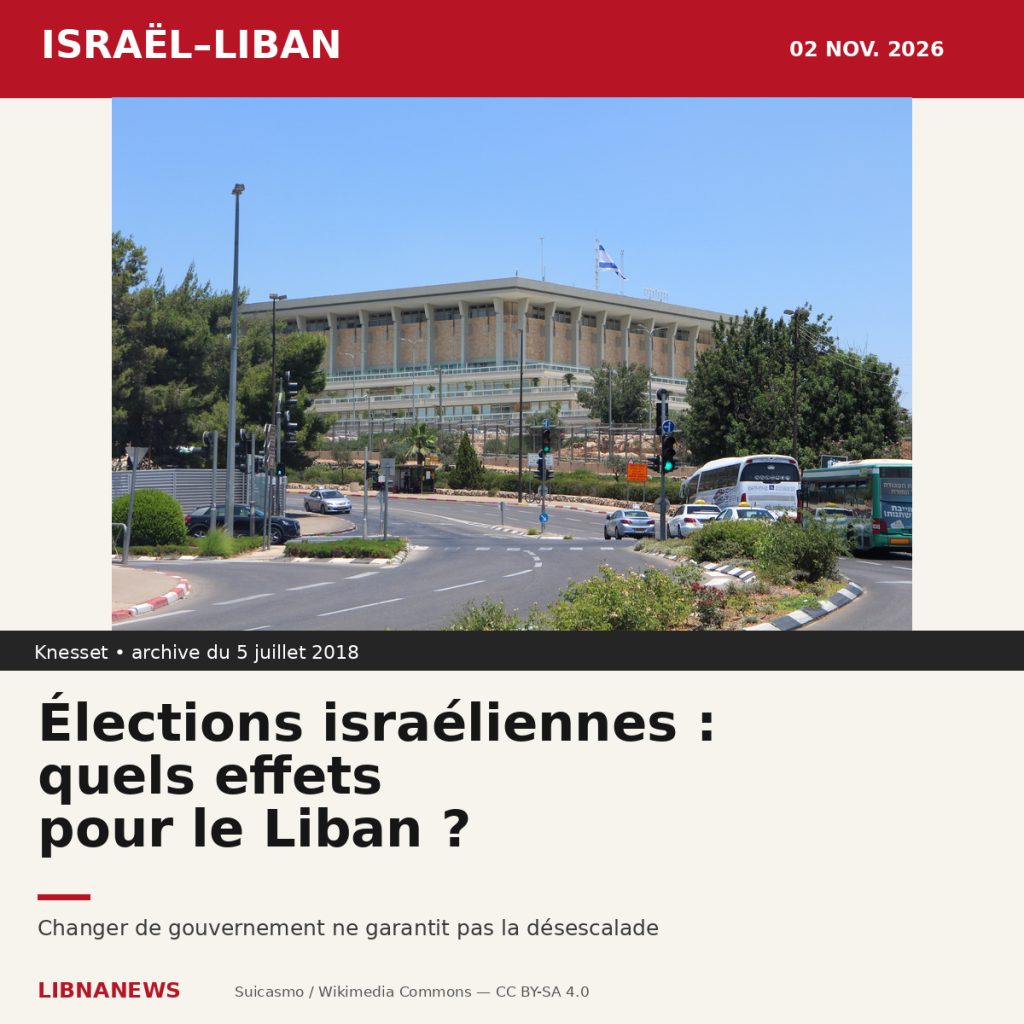
The Knesset Building, July 5, 2018. Photo archive illustrating issues of parliamentary majority; It does not show the elections of 2026. Suicasmo / Wikimedia Commons — CC BY-SA 4.0Source of photography.CC BY-SA 4.0. Resized photograph without cropping; editorial banners added out of image.
Coverage composition distributed under CC BY-SA 4.0.






Comments