

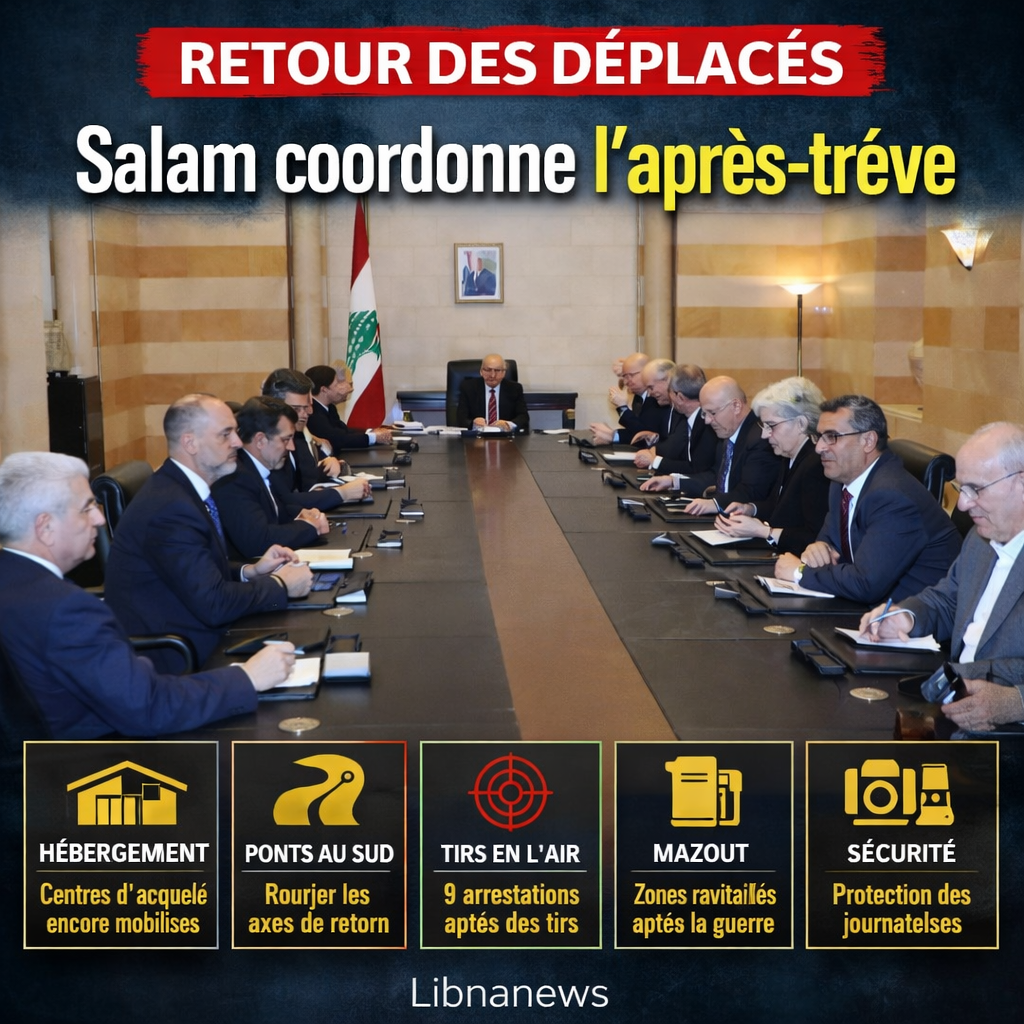
The first ministerial meeting held in the Council Presidency after the ceasefire came into force did not focus on diplomacy, but on the stewardship of a country trying to return to itself. Meeting at the Sérail under the presidency of Nawaf Salam, several ministers reviewed the conditions for the return of displaced persons, emergency accommodation, arrests related to air fire, the state of the ground in the South, fuel requirements and even attacks against photographers. In this sequence, the government seeks less to celebrate the truce than to transform it into services, traffic and security.
From truce to management
The daily meeting held at the Governmental Serail marks a change of registry. For weeks, the country had been following mainly strikes, military communiqués and announcements from abroad. This morning, the executive wanted to move the centre of gravity towards concrete post-minuit management.
According to the elements presented at the end of the meeting, the Prime Minister reviewed with several ministers the situation opened by the ceasefire, the facilities for the return of displaced persons, the instructions given by the army and the security forces, and the services still needed in the reception centres.
The political message is clear. The entry into force of a truce does not mean automatic standardization. On the contrary, it requires an intermediate phase of caution, coordination and logistical support. The government seems to want to avoid two pitfalls at once: giving the illusion of an immediate return to normal, and suggesting that the state remains spectator of a return movement already launched on the roads.
The meeting was therefore not summarized as an exchange of information. She’s drawing a method. Each ministry is invited to bring up the state of its sector, while the Presidency of the Council tries to assemble an overall picture: security in the South, displacement of population, fuel, aid, damaged bridges, accommodation centres and law enforcement in large cities.
This choice of coordination has nothing to do with it. In a country where the state is often accused of arriving after the events, the Serail seeks to show that it wants to take up the initiative from the early hours of the truce. However, the success of this sequence will be measured less by the frequency of meetings than by their translation on the ground, in the villages of the South, on the routes of return and in the centres which still house internally displaced persons.
Return of internally displaced persons, immediate priority
The first topic of the meeting was the return of internally displaced persons. This priority is not surprising. Since midnight, the roads in the South have once again seen families moving home, sometimes even before all the security guarantees were gathered. The executive therefore had to answer a simple and urgent question: how to frame this return without turning it into a new collective risk.
The Prime Minister, according to the government report, insisted on the facilities to accompany this movement, but also on the need to stick to the guidance of the army and the security forces. This insistence deserves to be raised. It means that the State does not only want to facilitate return. He also wants to sequence it.
In other words, the government does not seem to consider that the announcement of the ceasefire is sufficient to open all roads and villages without distinction. It recalls that the army retains control over the assessment of the land, access, risk of unexploded ordnance, the state of infrastructure and areas where the enemy presence or traces of recent operations still require extreme caution.
This line is politically sensitive. On one side, the displaced want to return as soon as possible, sometimes to check the condition of their homes, to find relatives or to reopen a business. On the other hand, the authorities know that a massive and disorderly return can produce new victims, block rescue or saturate still fragile axes. The Serail meeting shows that the state is trying to arbitrate between these two temporalities.
For this reason, the question of accommodation did not disappear with the truce. The government has kept its attention to reception centres, proof that it is not considering full and instant return. This is an important point. In the official communication, the return of displaced persons is not presented as a large uniform shift, but as a process that will still coexist with reception facilities.
Reception centres remain mobilized
One of the most significant moments of the meeting was the intervention of the Director of the Disaster Unit at the Serail. Called by the Prime Minister, he presented the services provided in the reception centres, the steps prepared for the post-ceasefire, as well as the difficulties and facilities associated with the return of displaced persons.
This administrative sequence speaks volumes about the real state of the country. If the disaster cell remains at the centre of the ministerial meeting, it is that the situation has not yet left the emergency register. The ceasefire did not erase the crisis logic. He only moved this crisis from a military front to a logistical and social front.
In many conflicts, return quickly becomes a political symbol. In Lebanon, it is also a material equation. Families don’t just come back to houses. They return to damaged neighbourhoods, closed roads, unstable networks, sometimes absent services and infrastructure still being repaired. The reception centres therefore retain an essential function: to absorb the time between the relative end of the fire and the concrete recovery of a possible life.
This fact explains the prudence of government discourse. By sidelining the return of internally displaced persons and the provision of services in reception centres, the Serail implicitly admits that both phenomena will coexist again. Some of the families are leaving. Another rest. Others may go back and forth to measure the damage before deciding.
The government must therefore manage not just a movement out of the centres, but a more complex flow between emergency accommodation, partial returns, assessment visits and gradual relocations. This type of transition requires resources, reliable local information and clear communication with the inhabitants. It is precisely on this ground that the executive will be expected in the coming days.
Land, bridges and the human balance
Another central point of the meeting was the briefing by the Minister of Defence on the situation on the ground and the conditions for returning to a number of southern areas. This intervention had a key role to play in bringing government discussion back to the actual topography of the ceasefire.
It is not enough, in fact, to decide a return politically. It is still necessary to know where roads are practical, which bridges have been repaired, which areas remain exposed and in which areas the army believes the minimum security conditions are met. By highlighting the army’s effort to rehabilitate some bridges, the minister gives a very concrete picture of the priorities of the moment.
War has not only displaced people. She also broke continuity. A destroyed or damaged bridge is not just an infrastructure less. It is sometimes an entire region that is isolated, or forced to concentrate its traffic on some still usable passages. Under these conditions, repairing a bridge amounts to reopening a piece of territory.
This details the general logic of the meeting. The government does not treat the ceasefire as an abstract event. He converted it into specific problems: where the cars pass, where the families live, where the fuel is missing, where the danger lies, where the services are still standing, where the army must be deployed, where the return must be slowed down.
This approach also has a political dimension. By highlighting the army’s efforts on bridges and roads, the government seeks to show that the military institution is not only engaged in securing the ground. She is also an actor in territorial recovery. This reinforces its reference role when the state tries to give a spine to the immediate postwar period.
The Minister of Defence also recalled the recent human report: 2,196 dead and 7,185 injured. These figures give the whole meeting a special gravity. They recall that it is not a simple administrative adjustment after days of tension, but a war that left behind a massive human cost.
In the public treatment of post-ceasefire, these balances play an essential role. They prevent the slip too fast towards a story of relief. The return of internally displaced persons, the opening of roads, services in reception centres or the resumption of certain activities cannot be detached from the weight of the dead and wounded. Each logistical decision is now taken in the shadow of these figures.
The number of the wounded, in particular, says something about the social depth of the conflict. More than 7,000 people were injured, meaning disorganized families, long-term care, possible disabilities, interrupted incomes and complicated returns. A home does not return in the same way when one of his missing calls, or when a heavy injury still requires medical care.
The reminder of this in a coordination meeting is therefore not ritual. It sets the level of reality that the government must now confront. The displaced do not just return after a parenthesis. They return after a deadly sequence whose effects will continue to weigh long on the social, economic and psychological fabric of the country.
This reminder also explains why the meeting does not focus exclusively on roads and accommodation. Once the human balance sheet reaches this level, the post-treve becomes a policy of consequence management, not only of geographical return. Bridges, reception centres and public services are only the visible surface of a deeper problem: how does an already fragile state absorb the shock of such violence.
Airfire, first authority test
The meeting also addressed a subject that might seem secondary to the weight of the war, but which is in fact an immediate test of state authority: the shooting in the air the night after the ceasefire came into force.
The Minister of the Interior informed the participants of the arrest of nine people after the shooting of the night before, as well as of other ongoing prosecutions. This has its full place in a government report. In Lebanon, the firing of celebrations is not an innocent folklore. They endanger the inhabitants, degrade public order and symbolize the State’s inability to impose a clear limit on the social use of weapons.
The fact that this case was brought up to the meeting chaired by Nawaf Salam shows that the executive does not want to dissociate after the fire from the issue of maintaining order. The truce must not be the moment of a safe release in the cities in the name of popular joy. On the contrary, it must open up a gradual return to public authority.
This logic is not just repressive. She’s political. If the state lets the shootings in the air accompany every sensitive moment, it sends a message of weakness at the precise moment when it seeks to frame the return of the displaced, to secure the roads and to restore confidence. The announced arrests therefore serve as much to prevent an immediate danger as to restore a clear hierarchy between the partial end of the war and the continuation of armed behaviour.
This point should also be read mirrored with the rest of the meeting. On the one hand, the government asks the inhabitants to follow the instructions of the army to return. On the other hand, he claims that he pursues those who shoot in the air in the capital and its suburbs. In both cases, the idea is the same: post-minuit must be governed by public rules, not by individual or community reflexes.
Mazout, help and safety of journalists
The meeting did not neglect the economic and material dimension of the transition. The Minister of Energy briefed the participants on fuel oil supplies, while several ministers presented the relief efforts of their administrations and the status of the arrival of external aid.
Again, these topics may seem technical. They are in fact decisive. Fuel oil conditions the operation of generators, pumps, certain transports, utilities and part of the daily economy. In a Lebanon where access to public electricity remains structurally weak, the issue of fuel supplies is never secondary. It becomes even more crucial after infrastructure strikes and when families return to areas partially deprived of services.
The fact that the fuel oil issue is being discussed at this level shows that the government is at risk of a cascade crisis. A cease-fire without available fuel can quickly turn into a truce without services, thus in return blocked or untenable. The inhabitants can return, but without stable current, without sufficient pumping and without minimum ability to operate daily life.
Same logic for external aid. Its arrival is mentioned not as an image element, but as a management parameter. This reflects administrative realism. Lebanon cannot deal alone with all the logistical, social and humanitarian consequences of the current sequence. But international aid only has an effect if it is integrated into a coherent national system. This is precisely what the meeting is trying to build.
One of the most political elements of the meeting was the intervention of the Minister of Information on the aggression against photographers. In raising this issue before his colleagues, he recalled that post-ceasefire cannot be treated solely as a problem of roads, fuel and accommodation. He also commits the safety of journalists.
The Minister stressed the need to ensure the protection of information professionals. In response, the Minister of Interior indicated that the incident in Debbine was monitored by the army intelligence services and the internal security forces. This clarification is important. It means that the executive does not relegate the case to the rank of marginal hanging. It is part of the normal chain of security responsibilities.
In the current context, this is a signal. Journalists, photographers and videographers are covering a particularly sensitive phase: the return of displaced persons, the state of villages, traffic on roads, security incidents and damage to infrastructure. To expose them to attacks at a time when the country needs reliable images would further weaken public understanding of the situation.
The fact that the Minister of Information raised this issue in a meeting largely dominated by the logistical urgency therefore reflects an interesting hierarchy. The government wants to show that it sees the safety of journalists as a public issue, not as a corporatist detail. It remains to be seen whether such verbal recognition will lead to prompt, identifiable and credible follow-up on the ground.
This point is essentially in line with the general logic of the meeting. The ceasefire is not presented as a mere suspension of weapons. It opens another battle, that of returning to a governmentable public space. This includes internally displaced persons, roads, reception centres, air fire, fuel, helpers, as well as journalists to document this period.
A management meeting more than a communication meeting
In total, the Serail meeting gives the image of an executive seeking to translate the truce into administration. What dominates is not rhetoric, but mechanics: return of the displaced, state of the ground, bridges, reception centres, arrests, fuel, aids, security of journalists. The government is trying to show that it understands where the post-minuit credibility will be played.
This credibility will not be gained in general statements. It will be played in concrete situations: the fluidity or not of the roads of the South, the capacity of the centres to absorb those who cannot return, the speed of rehabilitation of some bridges, the availability of fuel oil, the pursuit of the perpetrators of shooting in the air, the protection of photographers and the real coordination between ministries.
The presence of several ministers around Nawaf Salam suggests a centralization effort. But it also reveals a constraint. No portfolio can deal with the situation alone. The return of displaced persons depends on the army, the interior, transportation, energy, information, emergency cells and the arrival of aid. It is therefore both a matter of command and a matter of articulation.
At this point, the meeting does not close any questions. She’s organizing them. It traces the lines of an immediate post-war period where the state tries to prove that it still exists as a coordinator, while the inhabitants of the South, the displaced and the field professionals will judge above all what they will see in the coming hours: a reopened bridge, a still full centre, a walkable road, a protected journalist, a chased shooter, a service restarted, or on the contrary a return hampered by the persistence of the same frailties.




