

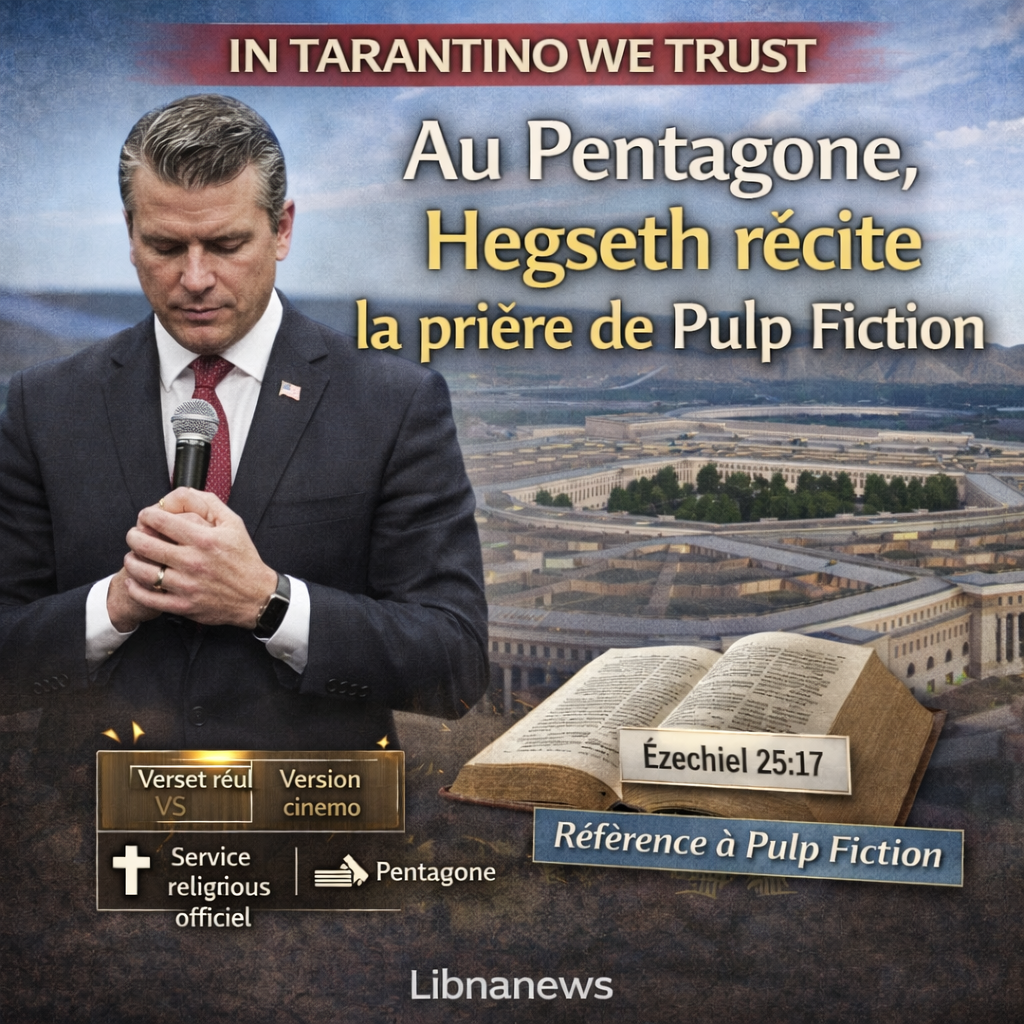
The gesture lasted a few minutes. Yet it was enough to revive a much broader debate in Washington on the place of religion, popular culture and warrior language in the American state apparatus. According to the American press and a news agency, the US Secretary of Defense Pete Hegseth conducted a Christian prayer service in the Pentagon on April 15 during which he recited a prayer rehearsing one of the most famous Bible verses in American culture, popularized by the filmPulp Fiction. This Pulp Fiction prayer, pronounced in an official setting, immediately transformed a religious sequence into a political matter.
The episode did not grow because a politician would have slipped a film reference into a speech. It has grown in scope because this reference came in an official setting, at the headquarters of the defence department, during a religious service for civilian and military personnel, in a context of war with Iran and religious rhetoric already very present in the Trump administration’s communication.
The heart of the controversy lies in a simple question. Did Hegseth quote Scripture, or did he borrow from Hollywood the tone of Scripture to sacralize a military operation? The answer at this stage is less definite than it seems. The Pentagon argues that it was not a mistake, but an adapted prayer, inspired by both a real verse and a text that became famous in cinema. His critics see it as a deliberate interference between religion, war and heroic narrative.
A Prayer Becomes Political Business
According to several American media, the scene took place during a monthly religious service in the Pentagon. Hegseth referred to a combat search and rescue mission to recover an American airman who had fallen into Iran. He presented a text called « CSAR 25:17 », with reference to the English acronym for search and rescue in combat, but also in chapter 25, verse 17 of the book of Ezekiel.
In the ear of many American observers, the text immediately recalled not the Bible itself, but the monologue made famous byPulp Fiction. The comparison circulated very quickly on social networks and then in the press. Several passages used by Hegseth took over the structure, rhythm and formulas of the popular text in the film, while replacing certain elements with military references related to the mission and the radio code « Sandy One ».
The most sensitive point is the nature of the original text. In the popular American imagination, thePulp Fictionis often associated with Ezekiel 25:17. The actual Bible text is much shorter and very different in its formulation. The film version is a dramatic rewriting, which has become a cult but does not correspond to the verse as it appears in the Bible.
This difference is not a detail for theologians. It changes the meaning of the Pentagon gesture. Using a Bible verse in an official religious service is a classic practice in American public life. Using a stylized cinema text as if it belonged to the scriptural register, or as if it could confuse it, moves the terrain. We leave the religious quotation to enter the symbolic staging.
According to American media, Hegseth explained that this prayer came from the rescue team. It was on this point that the Pentagon then built its defense. Service would not have been based on naive confusion between Bible and fiction, but on an assumed appropriation of a text already transformed by the military culture itself. In other words, the reference toPulp Fictionwouldn’t be a blunder. It would have become, in this account, an internal code, almost a group rite.
Why Prayer Pulp Fiction Changes Everything
The controversy would probably not exist with the same intensity if the reference were to refer to an anomalous formula of popular culture. But that is not the case. The popularized text byPulp Fictionbelongs to a scene of violence. It is associated with a threat, execution and logic of revenge. Even reworked to honour a rescue mission, he carries with him this visual and narrative memory.
That’s what makes the sequence politically explosive. The problem is not only that a non-Scriptural passage was used in Christian service. The problem is that a text on screen in a context of armed violence was reinvested in a religious ceremony led by the head of the Pentagon. In today’s climate, this slide has a far wider scope than a mere rhetorical dishonour.
According to a news agency, the spokesman for the Pentagon Sean Parnell defended Hegseth by saying that those who spoke of the wrong quote of Ezekiel 25:17 were spreading a false or ignorant reading of the episode. In this official version, the secretary knew exactly what he was doing. The text would have been a custom-made prayer, inspired by the spirit of the real Bible verse and reworked to greet the authors of the rescue mission.
This defense sheds light on the Pentagon’s strategy. It aims to move the debate of literal truth to symbolic intent. The problem, the administration says, would not be whether each sentence comes exactly from the Bible. The problem would be whether prayer reflects the courage, protection and justice sought by the participants. From there, cinematic inspiration becomes secondary.
But it is precisely this displacement that feeds critics. For in an official religious setting, the boundary between sacred text, pious paraphrase and pop reference is not neutral. It commits the authority of the speaker, the status of the ceremony, and how a ministry as sensitive as the defence uses religious codes to dress military action.
The American debate does not therefore oppose only movie lovers to Bible readers. He opposes two conceptions of public speech. For some, a manager can freely draw on a common imagination if it serves morale and cohesion. For others, an official religious service is not a space of symbolic collage between verse, cult film and war narrative.
The Pentagon defends, but the embarrassment remains
The most striking in this case is the speed with which the Pentagon chose to defend the episode rather than trivialize it. The institution did not speak of a moment of somewhat clumsy language or of a reference launched on the fly. She took the side of justifying the substance of the gesture.
This is probably due to the political context of Hegseth himself. Since his arrival in the Pentagon, according to the American press, he has multiplied the explicit religious references, to the point of making them one of the distinctive features of his leadership. Where other officials invoke God in general terms, he often speaks of Jesus Christ, quotes the Psalms, organizes monthly prayer services and assumes a language more clearly evangelical than that of most of his predecessors.
According to an agency dispatch published in March, he had already directed a service at the Pentagon during which he prayed for « every shot to find its target » and for « absolute violence » against those who « do not deserve any mercy ». This sequence had already alarmed a part of the religious, legal and military world. The episode ofPulp Fictionso don’t happen on a pristine land. He adds to a series.
The day after the controversy, Hegseth further expanded this religious grammar by comparing part of the press hostile to Trump with the Pharisees who wanted to destroy Jesus. According to a press agency, this exit contributed to a greater climate, at the very moment when Pope Leo denounced the political and military use of religion. Again, the question is not about the personal faith of a minister, but about his public and institutional use.
The Pentagon therefore does not seem to want to reduce the religious burden of communication. On the contrary, it seems to assume it as an identity axis. In this context, prayer inspired byPulp Fictionis not an isolated accident. It is part of a wider practice where Christian reference, combat rhetoric and the moral narrative of military operations are mutually reinforcing.
A monthly practice now under surveillance
The other reason why the case goes beyond the anecdote lies in the very context of the ceremony. According to the American press, Hegseth has been organizing a monthly Christian service at the Pentagon since May 2025. These meetings take place in a professional and governmental environment, with civilian and military personnel, not in a private space separated from the hierarchy.
This data changes the reading of the event. In a liberal democracy, a public official can display his or her faith and attend the worship of his or her choice. But when he organises regular services within a military institution, the question of individual freedom becomes more sensitive. Even as volunteers, these ceremonies can create an implicit sense of pressure among employees who are anxious not to cut themselves off from their hierarchy.
According to the American press, an organization defending the separation between the State and religion has taken legal action to obtain internal documents on these services, their cost, their guests and any complaints from staff. Litigation does not only accuse Hegseth of being a believer. He questions the use of public resources and ministerial authority to promote an identified religious practice.
According to the same source, the services organized under his authority have so far involved mainly evangelical leaders. This detail is not secondary in a religiously diverse American army. Regularly reported data from the press show that a majority of military personnel claim to be Christians, but that a significant proportion of them are from other religions, unclassified religious identities, or from no religious affiliation.
The problem of prayer inspired byPulp Fictiontherefore, it is not only his film source. It also resides in the fact that it was pronounced in an already contested arrangement, where the question is no longer simply that of religion in public space, but of the religion of a leader in the space of command.
War, faith and heroic narrative
To understand why this controversy is taking on such a large scale, we must also look at the strategic context. The scene unfolds as Washington is engaged in a war with Iran and the Trump administration multiplys the stories of miracle, mission and national destiny. In this environment, faith is not only a personal register. It becomes a language of legitimation.
Hegseth’s prayer did not honor an abstract commemorative ceremony. It aimed at a rescue mission carried out in a context of war. The text was therefore used to translate a military act into a moral gesture, almost a providential gesture. It is this symbolic conversion that interests the administration. An operation is no longer only successful. It becomes just, protected, meaningful.
In American history, this type of vocabulary is not new. Presidents, defence secretaries and military leaders have often invoked God in times of war. But the current sequence is distinguished by its density and denominational accuracy. It is not just a call to God’s blessing. It is a clearer, more partisan vision, more rooted in an identified evangelical Christianity.
According to observers quoted in the American press, this development is concerned because it turns the Pentagon into a theatre of action theology. The danger in this reading is not that believers pray. It is that the war itself is increasingly being told as the expression of a moral battle under divine mandate, with its heroes, enemies, elected officials and signs.
The reference toPulp Fictionthis mechanism is further enhanced. Here cinema provides an immediately recognizable vocabulary, full of dramatic power, stylized violence and popular memory. It offers ready-to-use mythology. Religion gives the gesture a moral depth. The military mission, finally, provides the heroic framework. When all three come together, the scene becomes very symbolically effective. That’s exactly what makes it so discussed.
What the Hegseth case reveals
It would be easy to reduce the episode to a mere mockery of a minister who would have confused the Bible with Tarantino. But it would be missing the main subject. The real problem is not the error of general culture. The real problem is the interference of the registers.
Hegseth did not by chance cite an imprecise formula. He mobilized an extremely well-known text, immediately theatrical, in a solemn institutional moment. He did so to glorify a military mission, in a ministry where religious neutrality is supposed to protect a very diverse professional community. And when the controversy broke out, his entourage did not deny the reference. He claimed it as a tool of meaning.
This choice reveals a very special way of exercising power. The current administration does not seem to seek to compartmentalize its languages. It overlaps faith, war, politics, national narrative and mass culture. Where more prudent officials would have separated worship from the military message, she staged them together.
For his supporters, this method has a virtue. She speaks plainly. According to them, it gives moral energy to a state apparatus that is too technocratic, too cautious or too disillusioned. For its critics, it produces the opposite effect. It weakens the border between government and evangelization, between personal religion and state use, between tribute to soldiers and sacred glorification of violence.
The Pentagon scene therefore acts as a teller. It shows how far the fusion of several American imaginations can go: military patriotism, evangelical Christianity, hero worship, popular culture, and the presidency-spectacle. The false verse is finally just a symptom. What matters is the ecosystem that makes it possible, admissible and defensible.
A debate that will not stop at the verse
The case is probably not close to closing. Because she touches several American fracture lines at once. The first one is religious. How far can a Pentagon leader print his own Christian vision to an institution that does not belong to any denomination? The second is political. How far can the Trump administration mobilize the sacred to give superior meaning to its military operations? The third is cultural. What happens to public speech when it borrows as much from Hollywood as it does from the Bible?
In the short term, the Pentagon’s defence should be enough to reassure its own camp. The power chose his story: it is not a blunder or a lie, but a suitable prayer, rooted in the experience of a rescue team. Yet, even in this version, discomfort does not disappear. For a prayer adapted in a private setting does not have the same weight as a prayer adapted in one of the most strategic places of power in the world.
The debate therefore risks moving towards the structure more than towards the sentence. The real question will be less whether Hegseth knew the source of his text or not than why this type of ceremony, this type of language and this type of symbolic mixture now occupy such a visible place in the heart of the Pentagon.
This is also where legal action against monthly religious services could become more important. If internal documents, costs, organisational circuits or personnel complaints were made public, the controversy would no longer be limited to a viral video. It would focus on how a defence ministry gradually allowed a political liturgy to be established within its daily functioning.
In the immediate future, the phrase that has circulated around the world will probably remain as a moment of media ederation. But it is not alone that will weigh in the long term. What will weigh is the answer to a question now put aloud in the United States: when the Pentagon prays, does he still speak on behalf of an institution, or already on behalf of a particular religious vision of war and power?




