

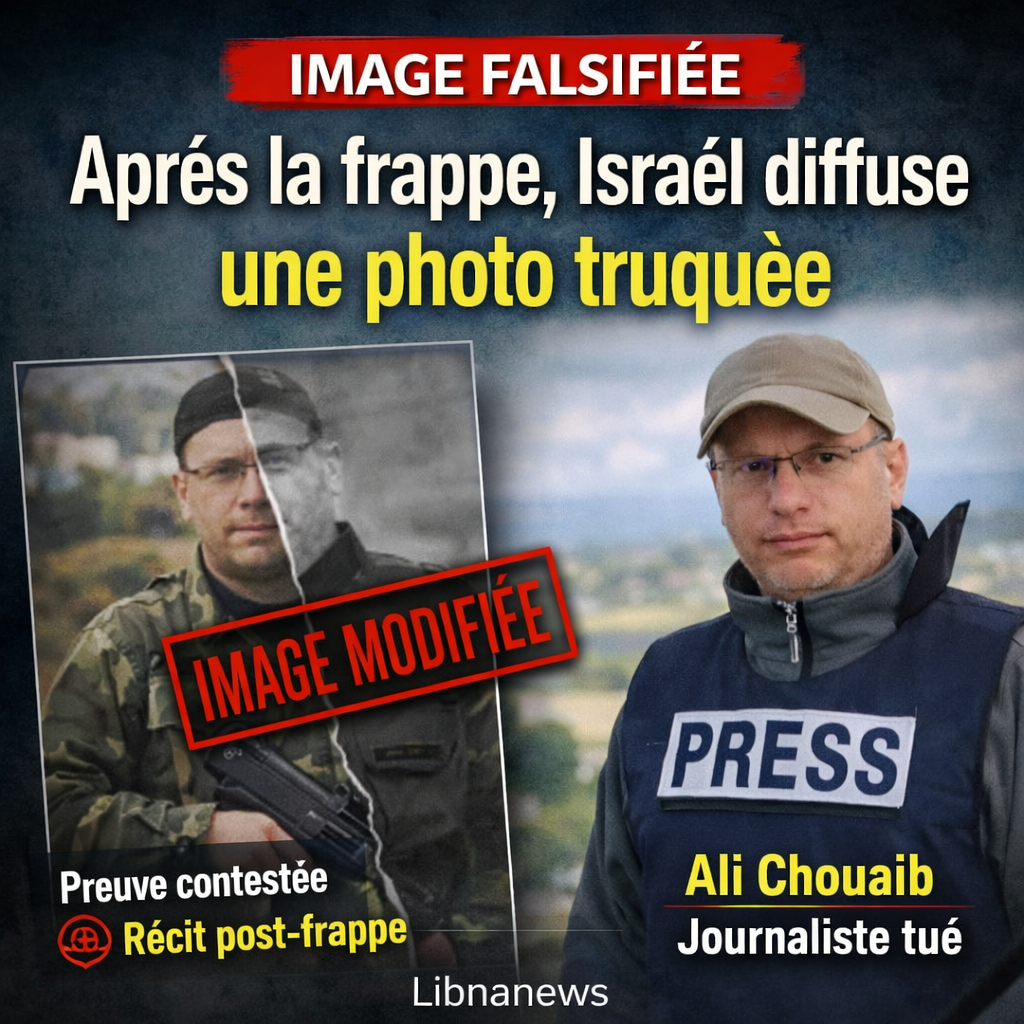
The case is not only about a modified photo. It concerns what comes after a strike, when an army seeks to impose its story before an independent investigation has established the facts. According to a foreign press association based in Jerusalem, the Israeli army broadcast a false image of a Lebanese journalist killed in late March in South Lebanon in order to discredit him after his death. The case of Ali Chouaib, the correspondent of Al-Manar killed with two other journalists in a strike on their vehicle, now puts a broader question in the foreground: how far can military communication go when it produces, diffuses and corrects a manipulated image to justify a strike already conducted?
A false image at the heart of the case
The starting point is precise. On 28 March, three Lebanese journalists were killed in southern Lebanon. Among them are Ali Chouaib, the Al-Manar correspondent. In the following hours, the Israeli army claimed that the journalist had been eliminated and claimed that he was operating for Hezbollah under press cover. In support of this accusation, she spreads a split image on social networks: on one side, the journalist in his work suit with a press vest; The other, a version showing it in military uniform.
The problem, according to several media and a professional association of foreign journalists, is that this second half of the picture was not genuine. It had been changed. In the current digital sequence, this detail changes everything. A serious charge can always be made. But when it is accompanied by a visual presented as evidence, then that visual appears to be falsified, the stake is no longer solely a matter of controversy. It directly affects the credibility of military speech.
The case is all the more sensitive as it concerns a man already dead. Once the strike is completed, the image becomes a posterior justification instrument. It does not document an immediate danger. It is used to convince the public, the media and allies that a man presented as a journalist was not really it, or not only. The modified photo therefore does not illuminate the strike. She comes to legitimize her after all.
This is where the case goes beyond mere communication error. A retouched image, released by an army’s official account, does not play the same role as a rumor published by an anonymous account. It instantly acquires an institutional authority. It’s moving faster. It is mandatory before the checks. It establishes a lasting suspicion, even if a correction is made afterwards.
In this case, the question is not only whether a visual has been altered. The question is why it was broadcast, when, with what purpose, and why a military apparatus found it possible to use a falsified image to support such a heavy charge against a journalist killed.
A journalist killed, then accused without public evidence
The heart of the file stays here. Ali Chouaib was killed in an Israeli strike in South Lebanon, with Fatima Ftouni, journalist of Al-Mayadeen, and Mohammad Ftouni, photojournalist. The Israeli army confirmed that it had targeted Chouaib, accusing him of being a member of a Hezbollah intelligence unit operating under cover of a journalist. However, according to several international media, it did not provide any solid public evidence in support of this charge at the time it was made.
In such cases, the problem is not limited to the existence of a charge. An army may claim to have information that it does not want to make public. But from the moment she chooses to publish an image herself as a demonstration element, she moves the field. She no longer simply asks the public to trust her. She pretends to show.
But what she showed was falsified. This chronology is heavy. First, hit it. Then the prosecution. Then the image. Finally, the contestation of the image. It’s not an anomaly inversion. Because in digital space, the first version often remains the most powerful. It spreads before denials, nuances or corrections. It prints the opinion before the facts are stabilized.
It is also for this reason that the foreign press association used a hard vocabulary. She was not content to speak of imprecise or clumsy image. She spoke of a false image, broadcast to discredit the journalist. It also considered that, although the army subsequently published a clarification, this first image should never have been broadcast.
In the hierarchy of issues, this sentence counts almost more than the late admission of the problem. It means that, in the eyes of a professional organisation of international journalists, the main damage is not only technical fault. It is in the original decision to publish a manipulated visual in a file where a man had just been killed.
How the Israeli version cracked
One of the peculiarities of this sequence is that the challenge of the image did not arise several weeks later after a lengthy investigation. She appeared very quickly. Questions were asked about the origin of the photo. Journalists asked if the visual was genuine. Then an Israeli military official finally admitted that the image broadcast the day before had been modified, while publishing another photo, of poor quality, presented as untouched.
This is a decisive step. It shows that the admission did not precede the controversy. He followed him. In other words, the correction did not come from a spontaneous reflex of transparency, but from an external challenge. It is a central point in any misinformation affair. A correction imposed by pressure does not produce the same effect as a voluntary and immediate correction.
The distribution of a second image did not close the file. She moved him. Because the problem was no longer just the situation of Ali Chouaib, but the method itself. Even if another authentic photo actually existed, why did you first choose a retouched image? Why have you released the most spectacular version, the most convincing visually, the easiest to share? Why gave the public altered evidence when the issue was precisely to base a charge of involvement in an armed activity?
These questions remain open. And they are all the more heavy as the first image was broadcast on an official channel, with a message designed to mark the minds. In this kind of communication, the aim is not only to inform. It is to strike, frame, impose a moral and political reading of the target.
The sequence thus illuminates a mechanism now familiar in contemporary wars: military action does not stop with the strike. It extends into the digital ecosystem, where image, short text and supposed evidence become weapons of legitimization.
Why this sequence looks like a misinformation operation
Use the word misinformation only if it is based on specific facts. These facts exist here. A military institution claims that a journalist killed was actually an armed operator. It broadcasts a visual to support this accusation. The visual is then recognized as modified. A foreign press association said this image was used to discredit the journalist. The sequence therefore corresponds to a documented case of manipulated visual information put into the service of an official narrative.
However, we must be rigorous. This dossier does not alone demonstrate an overall strategy for making false information. It demonstrates at least one specific, serious and politically heavy case where a falsified image was used by an army to publicly support a charge against a killed journalist. It’s already considerable.
This point deserves to be stressed because public debate often shifts between two excesses. The first is to reduce the case to a simple miscommunication, as if it were a bad visual choice. The second is to immediately generalize to all Israeli information production. Between the two, there is a much stronger finding: in this particular case, manipulated content was released through an official military account to support a disputed version of the facts.
This is sufficient to justify that one speaks of misinformation in a precise sense: not a floating rumor, but misleading visual information used to direct the perception of a lethal event. The choice of image was not secondary. It was designed to turn an identifiable journalist into a credible member of an armed formation in the eyes of the public.
That is what makes the notion of fake news too weak if we hear it in the ordinary sense of the term. The word often evokes rude content, made for social networks, quickly disassembled. Here we talk about an institutional communication product, broadcast in the instant, with the force of strike of an army, with the apparent aim of rewriting the victim’s figure.
Reciprocity as a Second Strike
There is an even colder dimension in this case. The target died when the image was released. The visual is therefore not intended to neutralize an opponent. It aims to publicly redefine his identity after his death. In this, it works as a second strike, no longer physical but narrative.
This mechanism is essential to understand the particular violence of this sequence. Killing a journalist in a war zone is politically and legally costly. Then presenting him as an activist operating under press coverage reduces this cost, or at least try. The falsified image then carries out a specific task: to blur the civil status of the victim.
This logic is not new in contemporary conflicts. The battle is not just about lives and territories. It also covers categories. Who was civilian? Who was fighting? Who was a paramedic? Who was a journalist? Who really worked for a media outlet? Who acted for an armed formation? In this grey area, a well-chosen image may be sufficient to move the entire perception of a folder.
The case of Ali Chouaib shows how fast this movement can be. A man dies in a press vehicle. A few hours later, an image circulated to suggest that his press vest actually concealed another role. Even if this image proves to be false, suspicion is already sown. And in an environment saturated with war, propaganda and real time, suspicion often has a longer life than denial.
This is precisely what some disinformation researchers denounce: the first impression dominates. The correction follows, but too late. It does not nullify the initial effect. She’s with him. In many cases, it even reinforces it, giving the case a new visibility without completely repairing the damage suffered by the victim or his profession.
The fate of journalists at the centre of the file
The case of false image is not separable from the broader question of the protection of journalists in this war. According to several press organizations, journalists have been paying a very heavy price in Lebanon, Gaza and the Palestinian territories since the outbreak of regional hostilities. The Lebanese case is therefore not isolated in a statistical desert. It is part of a climate where the border between alleged military target and journalistic work is becoming increasingly disputed.
An international organisation for the defence of journalists called for an impartial investigation into the strike on 28 March. UN experts also called for an independent international investigation into the deaths of the three Lebanese journalists. These requests do not mean that the facts are already legally decided. They mean that circumstances are serious enough to require anything other than self-justification by the belligerents.
The issue becomes even more sensitive when the target works for media deemed to be close to an armed actor. This is where the armies often seek to create ambiguity. Does a journalist employed by a partisan media or close to a political party cease to be a protected civilian when he is working? The answer to international law is not automatic, but it is certainly not limited to an allegation published on a social network.
This is why the diffusion of a falsified image is so heavy. It intervenes exactly where the evidence should be the strongest. If an army wants to demonstrate that a person was not solely a journalistic activity, it must produce robust, verifiable and coherent elements. When it begins with a manipulated image, it weakens its own version at the same time as it claims to strengthen it.
What this case says about the Israeli report in the image
The file also tells something else: the central role of image in the Israeli communication war. The Israeli army is not the only one using visuals to impose his story. All camps do. But here, originality lies in the fact that the manipulation was recognized after diffusion. This removes an essential part of the institution’s possible defence.
In many propaganda campaigns, doubt benefits those who spread. Each accuses the other, the evidence contradicts each other, the images are blurred, the sources are partisan. Here, the problem is clearer. The photo used as evidence was officially presented and subsequently recognized as amended. The question therefore no longer concerns the existence of an initial manipulation. It focuses on its scope, its intention and what it reveals of the method used.
This case highlights a very special use of image: not document, but script. The visual installation between the press vest and the uniform was not the sole function of informing. It produced an instant dramatic effect. He said to the public: Look, the civilian appearance was just a mask. It is a very powerful visual language, because it turns a verbal accusation into an almost obvious demonstration.
It is precisely this fabricated evidence that collapses when the image is recognized as false. Mounting no longer appears as evidence. It appears as a narrative operation. And all the communication that accompanied him suddenly becomes much more fragile.
A case that goes beyond the case of Ali Chouaib
The risk would now be to close the file too quickly on one name. The case concerns Ali Chouaib, of course. But it also concerns the way in which armies can today re-qualify the dead they produce. A journalist killed may become, by a well-built post, an undercover activist. A first aid worker can become an armed auxiliary. A civilian can become a reinterpreted threat. In this digital war economy, the battle over the status of the dead becomes almost as decisive as the battle on the ground.
That is why the foreign press association has expanded its criticism. It considered that in recent wars the Israeli army had often sought to discredit journalists, sow doubt and make allegations without clear evidence. Such a charge does not have the value of a judgment. But it reveals a climate of deep suspicion between part of the international press and Israeli military communication.
This climate doesn’t come out of nowhere. Journalists have already been killed, injured or targeted in various theatres covered by international media. Each new incident is therefore read in the light of precedents. When a falsified image adds to this passive, it does not remain confined to the status of vile. She reactivates a memory.
The real scope of this case may be here. It does not only prove that an image has been changed. It shows the extent to which the official military word is now read through a defiance filter in this war. And when this filter encounters a documented case of visual manipulation, distrust ceases to be an militant posture. It becomes an almost mechanical professional reaction.
The stake is no longer the photo, but the proof
Basically, the case eventually shifted the key issue. The debate is no longer really about whether the image was false. This point seems to be established. The debate is whether the Israeli army has, beyond this image, serious, verifiable and publicly defensible elements to support the accusation against Ali Shuaib.
For now, this is not what has dominated public space. What dominated was the retouched photo, then the correction, then the controversy. The result is clear: instead of consolidating the Israeli version, the dissemination of this fragile image. It shifted the centre of gravity of the file to a question of method, credibility and disinformation.
This is often the sign that a communication failed, not because it was contradicted, but because it destroyed its own trust base. An army can politically survive a disputed charge. She survives much less well a charge supported by manipulated evidence. From there, each subsequent element is reread in the light of this first fault.
In this case, the real sequel will not depend on a slogan on fake news. It will depend on the Israeli authorities’ ability or not to produce something other than an already discredited image, and on the ability of international bodies to obtain a sufficiently robust investigation to establish what really happened on 28 March on this South Lebanon road, in a press car that became, after the strike, the starting point of another battle, that of the narrative.




