





January 15, a discreet disagreement in Baabda
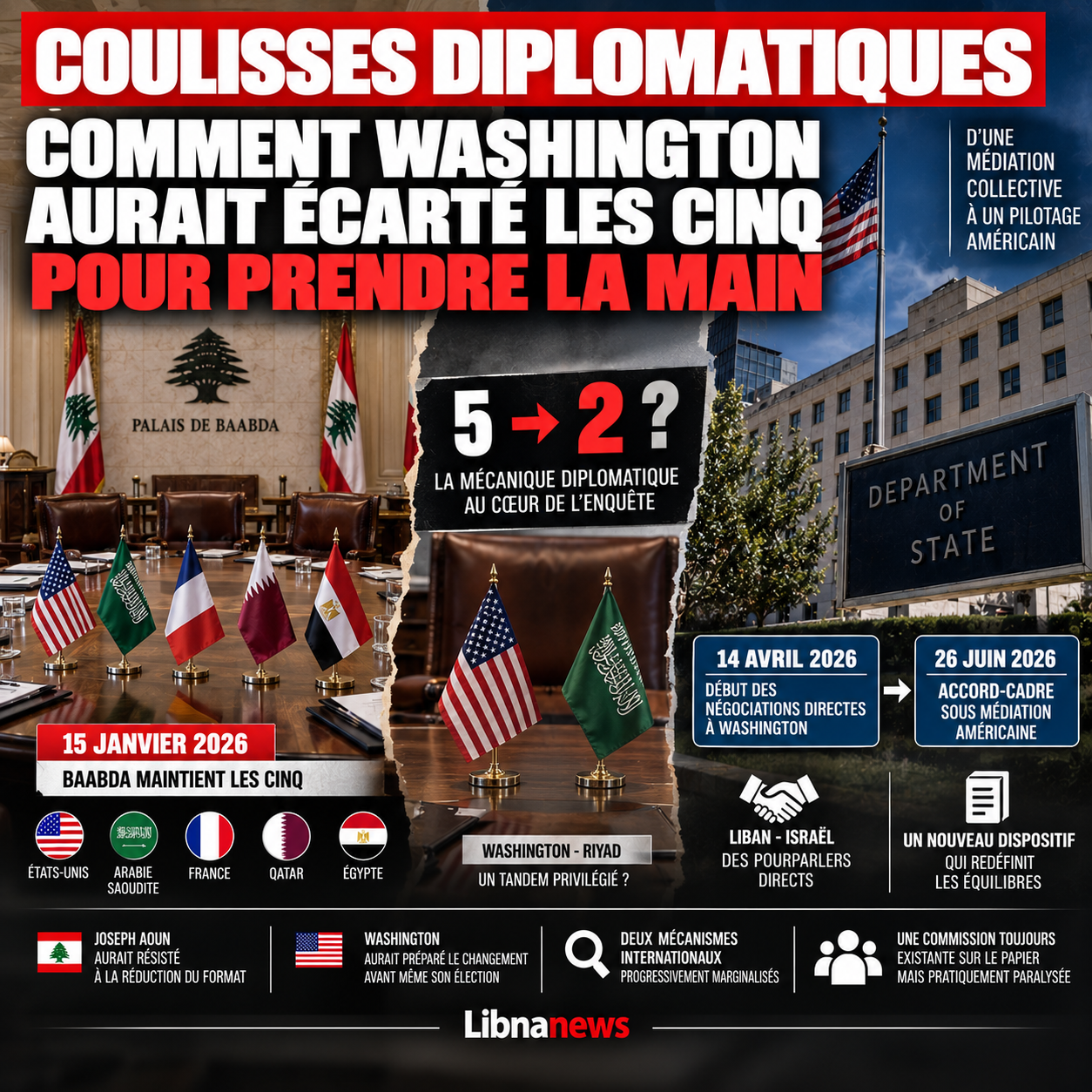
A meeting held at the Baabda Palace on 15 January 2026 today takes on a different meaning. Officially, it gathered around President Joseph Aoun the representatives of the five countries that collectively followed the Lebanese case: the United States, Saudi Arabia, France, Qatar and Egypt. However, according to a source informed of the discussions, the very composition of this meeting would have been the subject of behind-the-scenes disagreement.
Joseph Aoun would have insisted on receiving the five representatives. Washington would have preferred a much smaller format, limited to Americans and Saudis.
The episode might seem protocolary. He’s not. For, according to the same source, the American administration was already seeking before the presidential election to reduce the political function of the Committee of Five to install, in its place, essentially American-Saudi management of the Lebanese file.
Thus, 15 January would have been less a further demonstration of unity of the five than an attempt by Baabda to preserve an already threatened mechanism.
Nine months later, the commission was not officially dissolved. Yet it would hardly work anymore. No solemn communiqué announced his disappearance. None of its members declared that it had ceased to exist. However, issues previously dealt with in collective discussions are now dealt with elsewhere and in different formats.
This development is all the more important since it does not only concern a diplomatic structure. It tells the story of a phase in which several foreign capitals were trying together to influence Lebanese balances at a stage when Washington directly controls the most sensitive strategic issue: the security relationship between Lebanon and Israel.
Before Joseph Aoun, Washington would have already wanted to change format
The most interesting element is chronological.
According to the informed source, the American will to reduce the commission to a privileged partnership with Riyadh was not born after Joseph Aoun’s arrival in Baabda. It would have started before.
This changes the reading of the folder.
The Committee of Five had found its main reason for the presidential vacancy. Each of its members brought a different lever. Washington had the American weight. Riyadh maintained a decisive influence in part of the Lebanese political landscape. Paris maintained its historical networks and access to almost all camps. Doha had its own channels and mediation experience in Lebanon. Cairo also offered an additional Arab presence and relations with several Lebanese forces.
That plurality was useful as long as the main issue was the election of a President.
It becomes much less necessary from the American point of view when the central problem changes in nature.
After the presidential election, the heart of the issue is no longer just the reconstruction of institutions. It became military and strategic: the Israeli presence in the South, the deployment of the army, Hezbollah weapons, the monitoring mechanism, negotiations with Israel, the future of UNIFIL and conditions for lasting stabilization.
On these issues, the five members no longer have comparable means of action.
Washington has what no other has: decisive access to Israel.
The change in diplomatic format can therefore be read as the result of a change in file. But the information that the United States would have started preparing for this reductionbefore the election of Joseph Aounalso suggests a more constructed strategy.
Why keep Riyadh and discard the collective format?
The Saudi presence in the new scheme is not accidental.
A Washington-Riyadh tandem brings together two different levers. The United States controls an essential part of the Israeli channel and has direct military and diplomatic influence. Saudi Arabia has a political and economic capacity in Lebanon that Washington cannot reproduce alone.
Such a configuration also allows for the distribution of functions.
To the Americans, the security issue, Israel, guarantees and diplomatic pressure. To the Saudis, part of the Arab relationship with Beirut, political balances and, potentially, economic support for stabilization.
This hypothesis allows us to understand why Washington would have sought to reduce the mechanism without removing any Arab participation.
It also helps to understand why Joseph Aoun would have better to keep the five.
For Baabda, a five-way architecture prevents a single external axis from having a monopoly on mediation. It allows you to search for Paris when an American position becomes too rigid, Doha when a particular channel is needed, or Cairo to reintroduce an Arab balance.
The January 15 disagreement would therefore have been much more than the number of chairs around the table.
It concerned the number of diplomatic doors available to Lebanon.
Two mechanisms were reportedly neutralized before 14 April
Another element of the available information deserves further attention. The source does not only refer to the Committee of Five. She claims that Washington would have gradually sought to get rid of its partnership with France, weaken the role of international forces and take almost the lead in the follow-up mechanism.
Then comes an extremely short sequence.
On 14 April 2026 the direct negotiations between Lebanon and Israel began.
On 26 June the tripartite framework agreement was reached.
According to the source,before these two steps, Washington would have managed to marginalize the two previous mechanisms.
It’s probably the real subject.
It would therefore not be simply the disappearance of a commission that had become useless after the presidential election. This would involve restructuring the mediation system prior to the transition to direct negotiations.
In other words, before setting Beirut and Israel up in a new framework, Washington would first have reduced the places where other powers could influence the parameters of the negotiations.
This reading still needs to be corroborated. It comes from a source and includes some interpretation. But chronology gives him a real journalistic matter.
15 January: Joseph Aoun wants to bring the five together.
14 april: opening of direct negotiations.
26 june: tripartite framework agreement.
September: Key discussions on the South take place directly with Washington, UN or bilateral meetings. The Commission of the Five no longer appears as a place of decision.
France would lose its place in the manufacturing of the decision
To say that France disappeared from Lebanon would obviously be false.
Paris remains active. Emmanuel Macron maintains contacts with Lebanese leaders. France is working on the future of the international presence in the South. It expressed its readiness to cooperate with Italy and other partners to develop a successor to UNIFIL. It also wants to host an international conference to strengthen the capabilities of the Lebanese army.
But we must distinguishbe presentandparticipate in the production of the decision.
This is probably where the French decline is.
Paris can organise a conference for the army, discuss the future international force and maintain political contacts. But if the essential parameters of the Lebanon-Israel relationship are negotiated in a channel led by Washington, France then intervenes around the agreement rather than in its core.
This difference is considerable.
It also explains why the post-FINUL dossier has become so important for Paris. Strong participation in the future international presence would enable France to regain an operational role in a system whose diplomatic centre had moved to Washington.
The battle around the succession of UNIFIL, therefore, is not just about the security of the South. It also concerns the respective place of foreign powers in the next architecture.
Egyptian case reveals the break-up of the commission
Egypt is another indicator.
According to available information, Cairo is now seeking to revive its Lebanese activity, particularly with the arrival of its new ambassador.
This would be much less significant if the Committee of Five were still functioning normally. In this case, Egypt would already have a collective channel established to influence decisions.
On the contrary, the need to reactivate one’s own diplomacy suggests that each former member must now rebuild its ability to influence individually.
The same logic applies to Qatar.
Doha did not leave the case. It continues its contacts, initiatives and relations with Lebanese officials. But it acts mainly through its own channels.
Thus, the disappearance of the commission does not mean that three countries have been expelled from Lebanon.
It means something more subtle:coordination has disappeared, while national diplomacy remains.
That’s exactly what strengthens Washington. In a group of five, positions can be discussed before being presented in Beirut. In a fragmented system, each capital capital intervenes separately while the controlling actor retains the advantage.
Joseph Aoun allegedly tried to retain diplomatic insurance
The behaviour attributed to the President on 15 January can then be reread from another angle.
In demanding the presence of the five representatives, Joseph Aoun did not necessarily defend the commission for itself. He could defend an architecture in which Lebanon retains several interlocutors simultaneously.
This plurality is a form of assurance.
A small State facing negotiations with Israel and heavily dependent on external support should avoid a single intermediary controlling all stages of the process.
This does not mean that Paris, Doha or Cairo systematically defend the Lebanese position. This means that a plurality of intermediaries allows Beirut to confront proposals, send messages through multiple channels and seek support when a disagreement arises.
An American-Saudi tandem is simpler.
It is also more concentrated.
The 15 January episode could therefore constitute one of the first manifestations of a discreet disagreement between the Lebanese Presidency and Washington on the very way in which the issue should be internationalized.
Nawaf Salam now faces Washington
The current situation shows the result of this development.
Nawaf Salam uses the meetings in New York to make several demands: Israeli withdrawal, maintenance of an international presence in the South, reinforcement of the army, reconstruction and return of the inhabitants.
But the decisive stage is in Washington.
The most sensitive issues need to be discussed with the US administration. Washington is the sponsor of negotiations with Israel. It is also its position that the possibility of obtaining Israeli concessions depends largely.
The eighth round of negotiations is expected in October. However, by 23 September, Lebanon still did not receive the precise date or formal invitation from the American mediator.
This detail is indicative of the new balance of power.
The country organizing the process is also in control of its timetable.
With an active commission, several capitals could have intervened on this calendar or asked for explanations. Under the new scheme, Beirut is essentially awaiting the decision of the American mediator.
UNIFIL, next step in the US concentration?
The UNIFIL file will provide information on how far this transformation is going.
The mandate is due to end at the end of 2026. Lebanon seeks to avoid any vacuum. A six-month extension is discussed as an intermediate solution, although it is not yet presented as a finalized agreement.
France is defending a new international formula. Turkey also refers to the need for an international initiative. Jordan supports the continuity of an external presence. Beirut wants to keep United Nations coverage.
But Washington remains a must.
Should the United States impose the form of the successor arrangement to UNIFIL, the change undertaken with the Commission of Five will have reached a new stage: after the presidency and direct negotiations, the future security architecture of the South will also be structured mainly around the American Canal.
On the other hand, a truly multilateral force under UN mandate would give a margin to Paris and other capitals.
The six-month debate therefore hides another debate:who will control politically after FINUL?
A dead commission without a death certificate
The most remarkable is finally the method.
Washington would not have needed to formally request the dissolution of the five commission. Such a decision would have created unnecessary tensions with Paris, Doha and Cairo.
It was enough to move the folders gradually to other speakers.
With the presidential elections completed, the security issue could be dealt with in a different mechanism. Direct negotiations could be entrusted to American mediation. Discussions on the international presence could go through the Security Council and bilateral consultations. Economic issues could be dealt with separately with Riyadh, Doha or international institutions.
As competencies migrated, the commission lost its function.
It could continue to exist nominally without further determining decisions.
That is why the meeting on 15 January deserves more attention than it received. According to the information available, Joseph Aoun defended the presence of the five at the same time as Washington already wished to reduce the table to two foreign actors.
Three months later, direct negotiations with Israel began. Two and a half months later, the framework agreement installed a new architecture. In September, the five former partner capitals all remain around Lebanon, but they no longer really sit around the same table.
So it was not just the committee of the five that was erased.It is the international way of managing the Lebanese case that would have changed: from a system of powers controlling one another towards a much more concentrated mediation in the hands of Washington, with Riyadh as the privileged Arab partner.
And that’s precisely what makes the January 15 episode interesting: it might have been the time when Baabda realized that the question was already no longer what the five would decide, but how long the five would continue to decide together.