





The Deir Mimas incident raises a question that goes beyond the ground
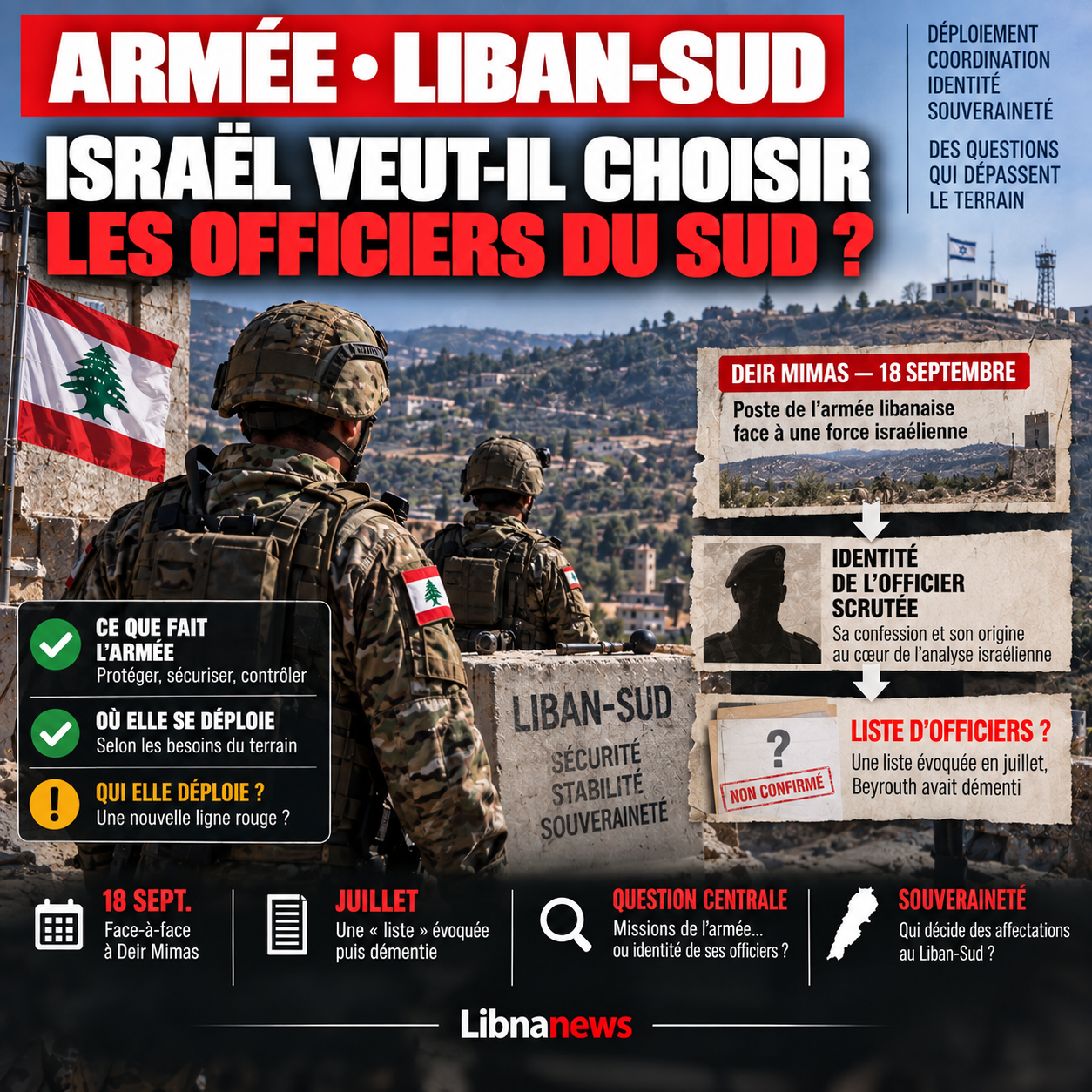
The incident in Deir Mimas on 18 September 2026 may have revealed a much deeper dispute than a local confrontation between Lebanese and Israeli soldiers. According to available information, soldiers of the 7th Lebanese Armed Forces regiment had set up a temporary observation point near the town to protect farmers from inspecting their land. The arrival of an Israeli force caused tension. Stunning grenades were then thrown into the area where the Lebanese military were, prior to their withdrawal.
The Lebanese Armed Forces reportedly reported that its deployment had been coordinated within the framework of the international mechanism resulting from the framework agreement. This clarification could have closed the incident on an operational issue: who had been informed of the movement, what contact information had been provided, and why had the Lebanese soldiers nevertheless been caught?
The Israeli treatment of the event has displaced the debate on a much more sensitive terrain. An Israeli centre working on security issues in the North was interested not only in the presence of the army, but also in the identity of the officer in charge of the area, presented as Mohammad Nabih Nassereddine, officer of the 7th regiment.
Israel’s analysis reportedly emphasized its membership of the Shiite community and its origins in the Hermel region. It would then have associated this geographical origin with the political and social environment of Hezbollah, before considering that the officer’s denominational identity could not be ignored in the analysis of the incident.
However, none of the elements cited in this reasoning established an officer’s membership in Hezbollah or the performance of a mission on his behalf. The reasoning was based on its community identity and regional origin.
It is this passage that turns the Deir Mimas incident into a state file. The question is no longer just where the Lebanese army can deploy. It becomes:Does Israel now seek to determine which Lebanese officers are considered acceptable to serve in the South?
Mohammad Nabih Nassereddine, an officer turned into a political case
The case of Mohammad Nabih Nassereddine is important because it shows the mechanism used.
The officer is not only described by his military function. His confessional affiliation is emphasized. Hermel’s origin is then used as a political index. Finally, this combination leads to a question about its reliability.
The problem is far beyond his person.
If membership of a community or origin of a region considered to be favourable to Hezbollah becomes criteria for suspecting an army officer, a significant part of the Lebanese military could be placed under suspicion without any individual element.
This logic conflicts directly with the structure of the Lebanese military institution. The army is composed of military personnel from all communities and regions. The very principle of its operation presupposes that soldiers act in accordance with the military chain of command and not as representatives of their original community.
To make confessional identity a security criterion would therefore be to introduce into the army an external classification which the institution does not officially recognize.
The precedent would be particularly heavy in the South, where the army is precisely called upon to become the central security actor.
The Government of Nawaf Salam claims to want to extend the exclusive authority of the State and to entrust the sole responsibility for security to the legal apparatus. If, at the same time, Israel implicitly claims the possibility of distinguishing between « acceptable » and « suspect » officers, the sovereignty of the State is confronted with a fundamental contradiction.
A list of officers reportedly already circulated in July
The case wouldn’t start in Deir Mimas.
According to information recalled in the sources of 23 September, Israel transmitted to the Lebanese authorities through the United States,a list containing the names of senior army officers he refused to be present in South Lebanon.
This information had circulated in July 2026. It was accompanied by denials and never led to the official publication of a list.
Its existence cannot therefore be regarded as definitively established from the only available documents.
But the new episode of Deir Mimas gives him another reach.
Taken in isolation, the July account could be seen as a difficult leak to verify. Two months later, an Israeli organization publicly analyzes a Lebanese military incident by examining the denominational and regional identity of an officer.
The two elements do not prove that an official Israeli policy of selecting officers exists. However, they reveal continuity in the question asked: is the identity of the Lebanese military deployed in the South now of interest to Israeli security structures in the same way as their missions and positions?
If the July list actually exists, the subject becomes much more serious. This would no longer be an analysis published by an Israeli research centre, but a request from a foreign State concerning the internal organisation of the Lebanese army.
What the list would contain remains unknown
The first problem is that the list is not public.
The number of officers concerned is not established in the available information. Their names are not provided. Nor are the criteria that would have led Israel to challenge them known.
Would it be intelligence-based individual suspicions? Family ties? Regions of origin? Faithful belonging? Operational precedents? Or simply an Israeli appreciation of how some officers conduct their missions?
These differences are fundamental.
A specific charge against an officer on the basis of individualised information may be verified. An objection to his confession or place of birth raises a completely different question.
Therefore, the possible publication or confirmation of this list would be a major step. It would determine whether the Nassereddine case is isolated or if it corresponds to a broader assessment grid.
The idea of a special unit for the South adds a second shadow zone
Another element appears in the available information: discussions have already been held on the creation of a force or regiment specifically for the South.
The idea of a specialized unit is nothing extraordinary in itself. The particular situation of the border may justify an appropriate organisation, specific equipment and training for monitoring missions.
But a much more sensitive version would also have circulated: the composition of this force could be designed so as to exclude Shiite soldiers.
There is no evidence that such a project has been adopted by the Lebanese State or by the army command. This information is reported in the context of the discussions surrounding the military presence in the South.
However, it deserves to be examined because it exactly fits the logic of Nassereddine’s treatment.
If a unit for the South were to be composed according to a religious criterion, the problem would no longer concern Israel alone. It would directly affect the organization of the Lebanese army and the balance on which it rests.
Such a decision would also have considerable political consequences. The Shia population is a significant part of the people of South Lebanon. Deploying a force designed to exclude soldiers from that community would immediately create a crisis of confidence between the army and a part of the population it is supposed to protect.
There is now no evidence that such a decision is in preparation. But the very existence of this discussion explains why information about officers’ identities is particularly sensitive.
From the military mission to its composition
The progression of the alleged requirements is probably the most important issue on the file.
In the first phase, discussions focused on:what the lebanese army must do: deploy to certain areas, control weapons, inspect sites, prevent certain activities and ensure security after an israeli withdrawal.
In a second phase, discussions may focus on:where it can deployand coordination mechanisms to avoid incidents.
But if the information on officer lists is confirmed, a third phase appears:who can carry out these tasks.
It’s a change of nature.
Military coordination may determine that a unit must announce its displacement in order to avoid confrontation. It does not normally give the other party the right to choose the commander of that unit.
It is precisely the border that seems to become blurred.
The case of Deir Mimas shows a Lebanese force whose presence was allegedly coordinated. Despite this, the Israeli analysis then moves towards the officer’s identity.
The operational issue therefore becomes identity.
U.S. pressure is the other dimension of the case
The available information also describes broader American pressure on the Lebanese army.
Lebanese political actors and United States-based activists regularly accuse the command of failing to implement the decisions on the disarmament of Hezbollah quickly enough. According to these critics, the army should adopt a more offensive attitude.
The military command is thus in a particularly delicate position.
The government asks him to extend state authority. Washington finances and team in part the institution. Israel called for security guarantees. At the same time, the army must preserve its internal cohesion and avoid a confrontation that could turn into a civil conflict.
Lebanese officials would also invoke the risk of American sanctions against officers or of a reduction in military aid to explain the need to take into account certain remarks from Washington.
In this regard, the sources refer to the precedent of sanctions against military and General Security officials, as well as the repeated threats of reduced assistance to the military institution.
This dependency creates a lever.
The Lebanese army has been receiving significant US assistance in equipment, ammunition, training and logistical support for years. At the same time as needs are increasing in the South, external aid therefore becomes a tool that can influence institutional choices.
This does not prove that Washington transmits or supports every Israeli request for officers. On the other hand, if the July list actually went through the American mediator, the role of the United States will have to be clarified.
Does Washington transmit the requests or does it endorse them?
This is one of the questions still unanswered.
A mediator may transmit a request without supporting it. The United States may have communicated an Israeli objection to the Lebanese authorities simply because it administers the coordination mechanism.
But they can also consider certain objections legitimate and ask Beirut to take them into account.
The difference is considerable.
In the first case, Washington serves as a diplomatic mailbox. In the second, Israeli pressure enjoys American political and financial weight.
The available sources do not make it possible to decide.
To determine this, it would be necessary to know the exact wording of the July message. Was it an « Israeli list » submitted for information? A U.S. recommendation? A condition related to military cooperation? A simple request for verification?
The answer would measure the real extent of the problem.
The Deir Mimas incident becomes a test
The episode of September 18 can serve as a concrete case.
The first question is factual: had the 7th regiment been properly coordinated? The information available indicates that the Lebanese army says yes.
The second concerns the Israeli intervention: why did an Israeli force approach the post? Why have deafening grenades been used?
The third concerns the subsequent reaction: why has the religious identity of the Lebanese commander become an element of analysis?
If the question was only about an error of coordination, the officer’s confession would not have any operational relevance.
The fact that it is put forward suggests that another reading grid is used: some military personnel would be assessed according to their presumed social environment.
This method has an obvious weakness. It replaces the examination of individual behaviour with a collective presumption.
Being Shia, being from Hermel or coming from a region where Hezbollah has a strong settlement does not demonstrate a relationship with the organization.
A direct risk to military cohesion
For Lebanon, the danger is not limited to sovereignty.
The army is one of the few national institutions whose cohesion lies precisely in the integration of military personnel from all communities.
Introducing a logic of confessional selection for the South could weaken this architecture.
A Shiite officer could then have to prove that he is not linked to Hezbollah. An officer from an area considered hostile to Israel could be subject to special scrutiny. Ultimately, the same reasoning could be applied to other communities depending on the areas of deployment.
The institution would cease to be assessed as a national chain of command. Its members would be assessed according to their origin.
This logic would also be difficult to reconcile with the stated objective of strengthening the state.
If the State is to become the only armed authority in South Lebanon, its army must be able to deploy the officers it chooses according to its own rules. An army whose local composition would depend on an external veto would have limited sovereignty.
The Paradox of Hezbollah Disarmament
The dossier finally reveals a political paradox.
The United States and Israel are calling for the Lebanese army to become strong enough to impose exclusive State authority and reduce the military presence of Hezbollah.
But if, at the same time, Shiite officers in this army are considered suspicious because of their identity, the institution’s ability to present itself as a national alternative to Hezbollah can be weakened.
In the southern Shia villages, the legitimacy of the army also depends on its national and non-community character.
On the contrary, an army perceived to be reorganized to meet Israeli criteria could fuel the discourse of those who claim that the state is acting under external pressure.
This would be exactly the opposite of the objective.
In order to reduce the military role of Hezbollah on a sustainable basis, the State needs an institution capable of being considered legitimate by the local population. Confidence therefore becomes as important as numbers and weapons.
The three elements that would allow to know whether a red line has been crossed
Three audits can now turn this suspicion file into a documented investigation.
The first is the existence of the July list. If it can be confirmed, the number of names, the grades involved and the reasons given for each objection will have to be obtained.
The second concerns the South Special Unit project. It must be determined whether the idea of a composition excluding the Shia military has actually been transmitted to the authorities, by whom and in what form, or whether it has never gone beyond the stage of informal discussions.
The third one concerns Washington. It must be established whether the United States simply transmitted Israeli requests or whether it itself requested changes in military assignments.
The case of Mohammad Nabih Nassereddine now provides a concrete starting point. His name, regiment, date of the incident and Israeli reasoning are identifiable. The July list and the special unit project are the two missing pieces.
If confirmed, the question will no longer be whether Israel is monitoring Lebanese Army activities in the South. This is already evident in a context of military confrontation.
The question will become much more specific:is a negotiation initially devoted to the missions of the army drifting towards an external right of look at the men who make up it?