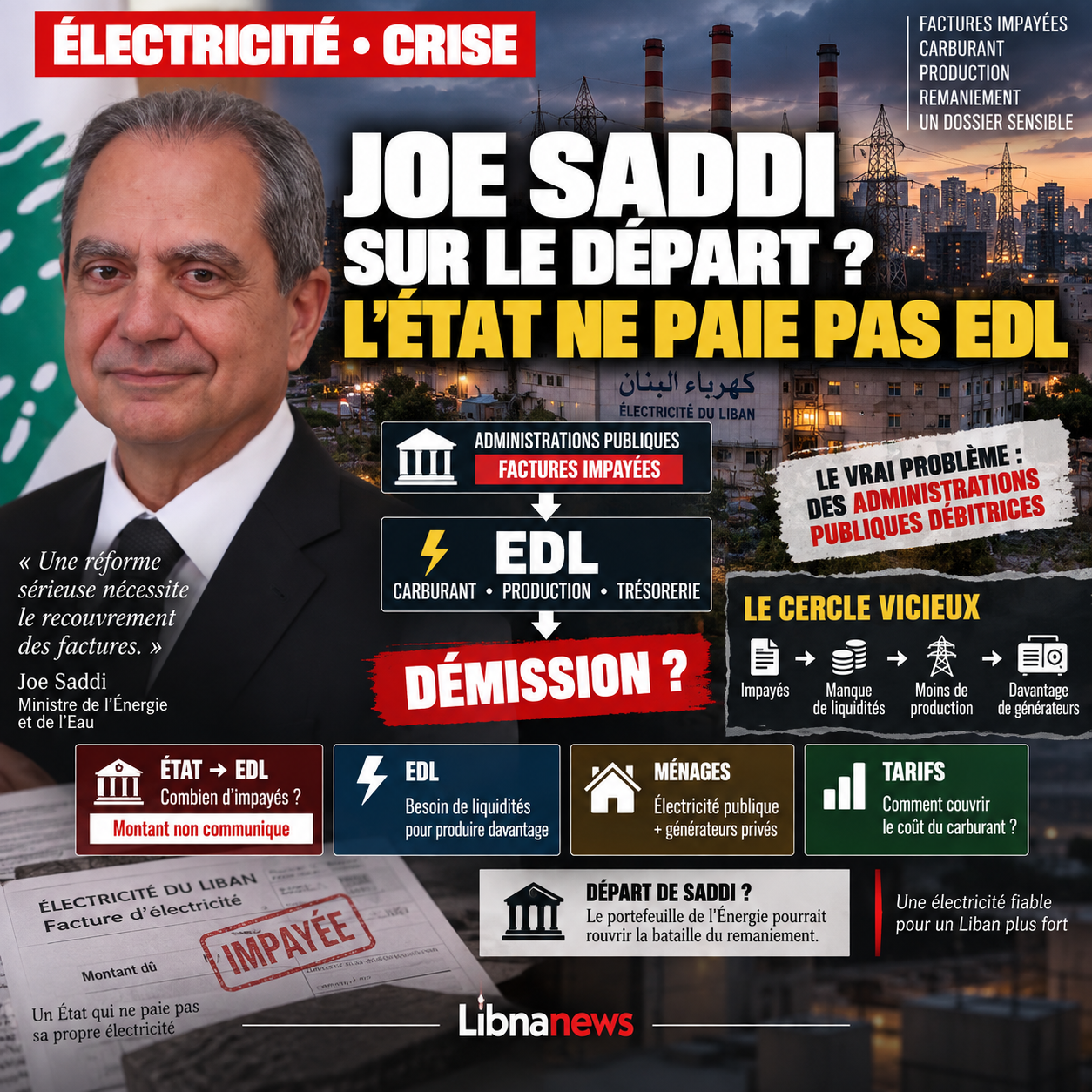
The minister would have started talking about his departure
The possible departure of Joe Saddi from the Ministry of Energy and Water is not limited to rumours of reshuffle in Beirut. According to political information of 23 September 2026, the minister himself started to raise the possibility of resignation. The reasons put forward refer directly to Lebanon’s financial impasse: several governments and public institutions would not pay their bills, while the company must simultaneously finance its fuel, maintain its power plants and try to increase its production.
This situation puts Joe Saddi in a contradiction. The ministry can ask Electricity Lebanon to improve power supply and reduce dependence on private generators. But the public company cannot produce more if part of its own institutional customers do not pay for the electricity they consume. The problem, therefore, does not come solely from households, technical losses or illegal connections. Part of the state would itself be the debtor of the company, which he asked the minister to correct.
The subject becomes political because the eventual departure of Joe Saddi could provide the opportunity for a broader reshuffle. Its portfolio belongs to a balance negotiated during the formation of the government of Nawaf Salam. Therefore, replacing it would not necessarily mean appointing a new energy technician. Several forces could take advantage of the government’s opening up to demand a new division of ministries.
This is particularly the case with the Lebanese Forces, of which Joe Saddi is close and who demand changes within the government. But this demand poses a risk to the party itself: reopening the cabinet could put much more political portfolios into discussion than energy, starting with foreign affairs.
The problem begins with bills that the state does not pay
The heart of the case lies in the electricity accounts of Lebanon.
For decades, the company has been presented as one of the main abyss of public finances. Treasury transfers to finance electricity contributed to the accumulation of public debt before the 2019 crisis. Part of the problem came from the tariff model: for years, the prices charged to subscribers were based on a barrel of oil well below its actual price. The state compensated for the difference.
After the financial collapse, the system was gradually changed. Rates were raised and some of the billing was indexed to the dollar. The objective was simple: Electricity in Lebanon had to stop selling its current well below its cost of production.
But price balance is not enough if invoices are not cashed.
The problem also affects public administrations. Government ministries, agencies, public institutions, offices and other structures that are dependent on the State have long accumulated debts towards Electricity in Lebanon. Some have meters and receive invoices like any consumer. However, they do not always have the budgetary appropriations to pay them, or delay their payments.
The result is absurd: the state is asking Electricité du Liban to operate as a financially responsible company, but some of its own institutions are helping to drain its treasury.
For Joe Saddi, this situation makes reform difficult to defend. A company cannot be held liable for its deficit while being prevented from recovering part of the debts owed by its principal shareholder and administrations.
The price of the current can no longer be treated independently of the price of the fuel
The second difficulty concerns the cost of production.
Electricity in Lebanon is still largely dependent on imported fuels. As the price of oil and petroleum products increases, the cost of kilowatt-hour produced in power plants also increases.
In an economically normal system, this variation should be reflected periodically on the tariff. This is the principle of a moving tariff: when the cost of fuel increases, a component of the invoice increases; When it drops, it decreases.
Joe Saddi would have raised precisely the impossibility of correctly applying this mechanism under current conditions.
The problem is politically explosive. An automatic increase in the electricity bill comes at a time when households are already experiencing an increase in fuel, transport and generator costs. But artificially maintaining a price below the real cost would gradually recreate the model that helped ruin Electricity Lebanon before 2019.
The minister is therefore faced with an easy choice without a solution: to raise tariffs to protect the company’s accounts, or to contain invoices and create a need for public financing.
This difficulty becomes even greater when public food remains insufficient. A household can more easily accept an increase if it receives 20 hours of public electricity. He accepts it much less if he must simultaneously pay a higher bill to Electricity of Lebanon and another to the owner of his generator.
The generator equation makes any increase politically dangerous
The Lebanese electrical system has a particularity that completely distorts the tariff debate. The consumer does not simply choose between expensive public electricity and cheap public electricity. He adds two bills.
Every hour that Lebanon’s electricity does not provide should generally be replaced by another source. In much of the country, this source remains the private generator.
The price of this electricity depends heavily on fuel oil. When it increases, the generator bill increases. The increase in oil thus strikes the household twice: directly through transport and private energy, then potentially through an adaptation of the public tariff.
To get out of this circle, Electricity Lebanon needs to increase its production sufficiently to reduce the number of hours purchased from generators.
But increasing production requires fuel. Fuel requires cash. In particular, cash depends on the collection of invoices.
This is where government unpaid payments become more important than their book value. They help block the very mechanism that should reduce the country’s overall energy bill.
Joe Saddi made recovery a condition of reorganization
Since joining the ministry, Joe Saddi has placed financial discipline at the centre of his conception of reform. The principle is to step out of a system where the company produces, invoices imperfectly, partially cashes and then asks the Treasury to cover the deficit.
This strategy involves simultaneous improvement of several elements: collection of invoices, reduction of losses, fight against illegal connections, control of concessions and adjustment of the tariff to the real cost.
The minister also found himself confronted with the question of the resources available to buy fuel. As long as electricity in Lebanon does not have sufficient predictable cash flow, each increase in production depends on one-off arrangements or government decisions.
This is precisely the model that structural reform is supposed to eliminate.
The conflict with debtor administrations must therefore be read in this context. If the state refuses to discipline itself, it becomes difficult to demand comparable discipline from private consumers.
The government should then choose: to force its administrations to pay, to record their consumption in their actual budgets, or to explicitly assume that the Treasury will continue to fund part of their electricity.
Simply allowing invoices to accumulate amounts to masking the cost.
However, the electricity reform has taken a long-term standstill
The paradox is that the crisis comes at a time when an institutional dossier which has been waiting for more than twenty years has finally advanced.
The government has appointed the regulatory authority for the electricity sector, which has been planned since Act 462 of 2002. This authority should theoretically accompany the transformation of the sector, supervise operators and allow a clearer separation between political decision-making, regulation and operation.
For more than two decades, its implementation had been delayed.
Nawaf Salam now cites his appointment as one of the main reforms undertaken by his Government. He also referred to the restructuring of electricity in Lebanon and to gas and new energy projects.
The minister’s departure in the middle of this phase would therefore pose a question of continuity.
Electricity reform cannot be recommenced with every change of government. Contracts, tenders, tariff rules and investments take several years. If each minister changes the priorities of his predecessor, investors remain cautious and projects grow longer.
This is one reason why a possible resignation of Joe Saddi would be more important than simply replacing a cabinet member.
But the question of departure is also deeply political
Joe Saddi is not an isolated minister on the political map.
His arrival in the government was part of the balance negotiated during the formation of Nawaf Salam’s cabinet. The Lebanese Forces supported his appointment and had political representation in the Government.
But the party now demands changes in the government team itself.
This position creates a special situation. To ask for a reshuffle is to accept that the balances negotiated during the formation of the firm can be reopened.
Once this door was opened, Nawaf Salam would not be obliged to limit the changes to the ministers that a single party wished to replace.
Other forces could demand their own modifications.
This is where the Foreign Affairs portfolio becomes particularly sensitive.
Foreign Affairs Behind the Battle of Energy
The Ministry of Foreign Affairs occupies a much more strategic place since Lebanon was engaged in direct negotiations with Israel and in an intense diplomatic sequence around the South Lebanon.
Youssef Raggi accompanies Nawaf Salam at international meetings. It participates in discussions with foreign partners and carries the Lebanese position at a time when relations with Washington, Paris, Riyadh and the United Nations are directly linked to security issues.
Any change in this portfolio would therefore be much heavier politically than a simple administrative change.
That is why a reshuffle originally requested to improve the functioning of some departments could quickly become a negotiation on the political distribution of government.
The Lebanese Forces may wish to replace some ministers. But their opponents can respond by demanding a change in the portfolios associated with the party.
The Joe Saddi case then becomes a part of a much larger negotiation.
Nawaf Salam has little interest in opening a government crisis now
The Prime Minister is also facing a calculation.
His Government must simultaneously manage negotiations with Israel, the future of UNIFIL, the deployment of the army in the South, reconstruction, banking reform, the project on financial losses, negotiations with the International Monetary Fund and a social crisis aggravated by energy prices.
A major overhaul could immobilize the firm for several weeks.
In the Lebanese system, replacing several ministers is never a purely technical operation. The parties, the religious balance and the relations between the presidencies intervene quickly.
The risk for Nawaf Salam would therefore be to open a government negotiation without any guarantee of being able to close it quickly.
Conversely, keeping a minister who considers that he no longer has the means to carry out his reform is also a problem.
This is what makes Joe Saddi’s threat of resignation politically effective, even if it does not materialize.
It obliges the government to deal with the problems it raises.
The debtor administrations constitute the file to be opened
Before discussing the minister’s replacement, a much more concrete issue should therefore be resolved:who owes money to Electricity in Lebanon?
The information of 23 September indicates the problem but does not provide a complete list of the administrations concerned or the amount of their debts.
However, it is this list that would measure the credibility of the reform.
Institution-by-institution information should include annual consumption, invoices issued, payments made and accumulated arrears.
Central administrations should also be distinguished from public institutions and other publicly funded bodies.
Some debts may arise from a lack of budgetary appropriations. Others may be related to disputes over invoices. Still others can simply result from years of tolerated non-payment.
Without this breakdown, the debate remains political while it should first be an accounting officer.
If the sums are small, the argument loses part of its scope. While they represent a significant part of Lebanon’s electricity claims, they become one of the main obstacles to its recovery.
The real test: making the state pay before making households pay more
The issue ultimately puts the government at the forefront of credibility.
It may require households to pay public electricity closer to its actual cost. It can strengthen collection. It can combat illegal connections and reduce the tolerances accumulated for decades.
But it becomes politically difficult to carry out this policy if public institutions themselves continue not to pay their bills.
The reform cannot work with two disciplines: one for the consumer and another for the state.
This is probably where the real meaning of the threat of departure attributed to Joe Saddi lies.
The minister is not only facing the technical problem of electricity production. It is confronted with a much older question: is the Lebanese State ready to apply to its own institutions the financial rules it wants to impose on the rest of the country?
If the answer remains negative, replacing Joe Saddi will solve nothing. Its successor will recover the same power plants, the same fuel requirements, the same debtor administrations and the same impossibility of building a viable tariff without causing a social crisis.
Thus, for the time being, the dossier of the redesign masks a more concrete question. Before you knowto occupy the Ministry of EnergyIt would have to be established how much the state owes to its own electricity company and why the government has still failed to charge its bills.