

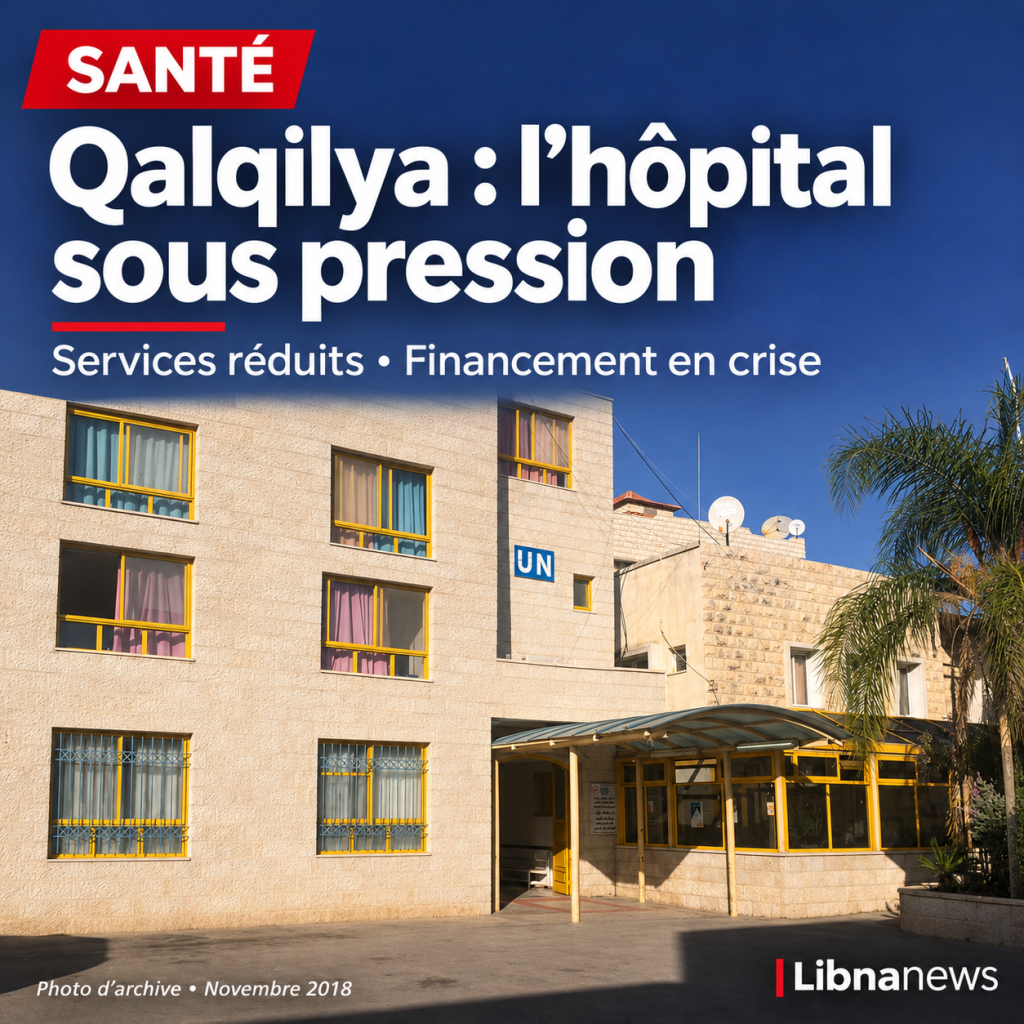
In Qalqilya, in the occupied West Bank, the challenge of service cuts at UNRWA hospital continues against the backdrop of the Agency’s financial crisis. Palestinian representatives called for the reopening of departments and denounced a transformation of the institution’s role. We must distinguish these restrictions already denounced, the contested projects and a total closure: the documents examined do not allow us to affirm that any medical activity has ceased.
Two services at the heart of the claims
On 10 November 2026, representatives of official institutions, the People’s Committee on Refugee Services and local residents demonstrated in the hospital court. Mohammad Khader, the governor’s representative, defended the continuation of the establishment and rejected closure or further reductions.
The chairman of the People’s Committee, Abdel Rahim Jabr, called for the reopening of internal medicine and maternity, as well as the protection of employees’ rights. His claims concern specific hospital functions, not just the presence of a building or a medical reception.
The challenge therefore concerns the nature of the care that must remain accessible. Maintaining outpatient consultations does not necessarily respond to a request to reinstate hospital services.
A concern documented for several months
The November mobilisation did not mark the beginning of the case. In a communiqué dated 30 April, the Palestine Liberation Organization Refugee Affairs Department already reported a request for the reopening of internal medicine and maternity services in Qalqilya.
His head, Ahmad Abu Holi, had raised this issue with a representative of the UN Special Coordinator’s office. He also called for the development of hospital benefits. This document establishes the seniority of the concern. It does not constitute an updated inventory of services opened in November.
The PLO denounces a model change in Qalqilya
Another report from the Refugee Affairs Department, updated on 2 November, describes a mobilization at the Balata camp. The head of the department in the northern West Bank, Nisrine Thouqan, denounced the closure of essential services and the transfer of doctors and nurses to other health centres.
She indicated that the file had been reviewed at the PLO Executive Committee meeting on 25 October. A follow-up team has been established between the Refugee Department and the Palestinian Ministry of Foreign Affairs.
In the same report, Mohammad Abu Kashk, representing the people’s committees, challenged a project to transform the hospital into clinics. This is the description and position of the Palestinian representatives. The text does not provide a detailed administrative decision by UNRWA with its timetable for implementation.
The Agency describes its overall financial constraints
On 12 November, in front of the Fourth Committee of the UN General Assembly, UNRWA’s Acting Commissioner General, Christian Saunders, estimated the budget deficit from $2026 million to $250 million. This amount includes a cash shortfall of about 70 million: the two figures should not be added together.
He warned that financial constraints could impose other employment decisions. He also confirmed a review of the activities and delivery model, while stating that he did not want to dismantle the agency or change its mandate.
This speech does not mention Qalqilya. It illuminates the general constraints, but does not confirm the exact extent of hospital measurements or a closing date. It cannot therefore be used as a specific response to each local charge.
Employees’ contracts become another point of tension
On 15 November, the PLO Refugee Affairs Department denounced a measure concerning over 3,000 UNRWA employees in Gaza with less than 13 years of service. He claims that they are required to sign temporary contracts of three months.
Ahmad Abu Holi believes that this conversion weakens employees and could prepare for non-renewal. This interpretation must remain attributed to the PLO: it does not prove that all these employees have already been laid off. It also does not cover a staff of 3,000 at Qalqilya Hospital.
These two cases show separate challenges to the savings envisaged: on the one hand, the content of the hospital supply; on the other, job stability. Bringing them together under a single announcement of general closure would erase the differences between territories, decisions and consequences.
What remains to be clarified for patients
The key point is now a detailed state of play: services actually maintained, possibilities for admission, orientations to other establishments and conditions for possible reopening. Public positions document concern and conflict over the future of the hospital. They do not replace this operational assessment, which is essential for measuring the effects of restrictions on patients.





Comments