

Agricultural products from Israeli settlements arrive on European markets with documents presenting them as Israelis. A survey published in June 2026 by Global Echo, based on thousands of trade files, describes origin anomalies and requests for undue customs preferences. The Dutch Government gave it an official reply. In Paris, a proposal for a trade ban is to be considered on 19 November.
These elements do not mean that any sale of colonial products would already be prohibited throughout Europe. Three schemes must be distinguished: consumer information, import tariff advantages and national trade bans. A commodity may infringe the first two without being subject to a general European embargo.
What the agricultural trade survey documents
InImporting OccupationGlobal Echo reports having studied more than 30,000 documents, covering in particular 5,900 shipments to Europe between October 2017 and February 2026. The organization links 17.2% of these shipments to colonial products; the proportion reached 19.2% in its EU subsample. These are not estimates of all European imports.
It also identifies 340 problematic evidence of origin out of 2,040 examined, concerning 13.09 million euros of goods. This amount is not that of customs duties evaded.
A certificate reproduced in the report, dated 23 July 2023, concerns 7,818.1 kg of mangoes exported to TOFF in the Netherlands. He mentioned Israel and a phytosanitary region that the organization located in the occupied Golan. TOFF did not respond to its comment request, according to Global Echo.
These exhibits constitute elements of investigation, not convictions. The documents collected do not necessarily represent the file finally presented to customs; they therefore do not prove, for each lot, that an exemption was actually granted.
The Dutch answer is not worth judgment
In aletter to Parliament dated 31 August 2026The Dutch Minister for Foreign Trade and Development Cooperation, Sjoerd Sjoerdsma, responded to this report. The government condemns the circumvention of the European obligations of origin and recalls that consumers must know the origin of the products of the colonies.
The letter states that the Netherlands asked the European Commission on 15 June for an analysis of compliance and monitoring. It supports their strengthening. This reaction establishes that the case was brought to the governmental level; it does not determine the individual liability of the undertakings mentioned in the investigation.
On the label, « Israel » is not enough
The obligation is established by thejudgment C-363/18 of 12 November 2019. Referred to in the case between Vignoble Psagot and the French Minister for the Economy, the Court of Justice of the European Union requires that foodstuffs originating in an occupied territory indicate that territory and, when they come from an Israeli colony, that specific origin.
The Court distinguishes the West Bank, including East Jerusalem, and the Golan from Israeli territory. An indication that these foods come from Israel can deceive the consumer. The producer’s only address does not replace the required indication.
The decision concerns food information, not a general prohibition on sale. It also recalls that the settlements are implementing a policy of population transfer contrary to international humanitarian law. The lawfulness of colonization and the legal qualification of a commercial transaction remain two distinct issues.
At the border, no tariff preference for colonies
The second check concerns customs duties. Thecurrent European Commission instructionsexclude goods produced in ineligible localities from the tariff benefit of the EU-Israel Agreement.
The proof of origin must identify the place of production and its postal code. A registered office, commercial address or place of dispatch does not replace the place where the production gave its origin to the property. For a consignment combining several sources, eligibility must be established for each product or quantity concerned.
Customs code Y864 is used to declare an eligible application of preference. It does not constitute a universal certificate of legality or a label intended for the consumer. Denying a reduced tariff alone does not amount to prohibiting imports.
Brita: a judicial precedent, not a new case
Litigation is not theoretical. Inbrita case, tried on 25 February 2010water gasification appliances, accessories and syrups manufactured by Soda-Club in Mishor Adumim, West Bank, had been declared of Israeli origin for preferential treatment in Germany.
The ECJ confirmed that products from the West Bank do not fall within the territorial scope of the agreement with Israel. German customs could refuse preference, and the assertion of the Israeli authorities did not bind them when the actual place of manufacture was not sufficiently specified. This old case illustrates the legal mechanism; it does not allow the companies concerned to be assigned an existing infringement.
In Ireland, a ban now effective
National measures go further. Theirish customsreport that the law of 2026 prohibiting the importation of property from settlements in the occupied palestinian territory entered into force on 15 september.
Importation from designated postal codes constitutes a customs offence, with seizure and confiscation powers. An exception concerns non-commercial goods in personal baggage intended for use or consumption by the traveller. For codes covering both Israel and an occupied territory, an exemption may be granted if actual non-colonial origin is demonstrated.
This is a verifiable national ban, the scope of which must not be extended automatically to all European states.
France: a text for debate, not yet a law
The9 September, the Quai d’Orsayhad announced a political decision to ban settlement products while specifying that its legal and technical modalities remained to be developed. This announcement was therefore not sufficient to establish an entry into force.
Thenational Assembly fileas of 19 November, Olivier Faure and several of his colleagues have been discussing the proposal. The Committee on Economic Affairs adopted a version on 9 November.
Thecommission textthe aim is to import, purchase and market, as well as certain services related to colonies. It includes products incorporating components from them and provides for original control obligations. Humanitarian services or for the benefit of the Palestinian and Syrian populations are distinguished from prohibited services.
This area exceeds labelling. As of 18 November, it remains the text of a parliamentary proposal, subject to amendments and whose final adoption is not achieved.
London distinguishes sanctions and future trade embargo
Thebritish communiqué of 17 novemberit also makes this distinction: sanctions against eight settlement-related companies are effective, but legislation prohibiting the import of settlement products is still prepared separately. This point supplements themeasures already detailed by Libnanews.
Illegal sale must therefore be characterised precisely: deceptive food origin, undue tariff preference or infringement of a prohibition applicable in the country concerned. The documents collected on the agricultural sectors give rise to targeted controls. They shall not exempt from establishing, for each transaction, the actual provenance, the declaration filed and the duty actually applicable.
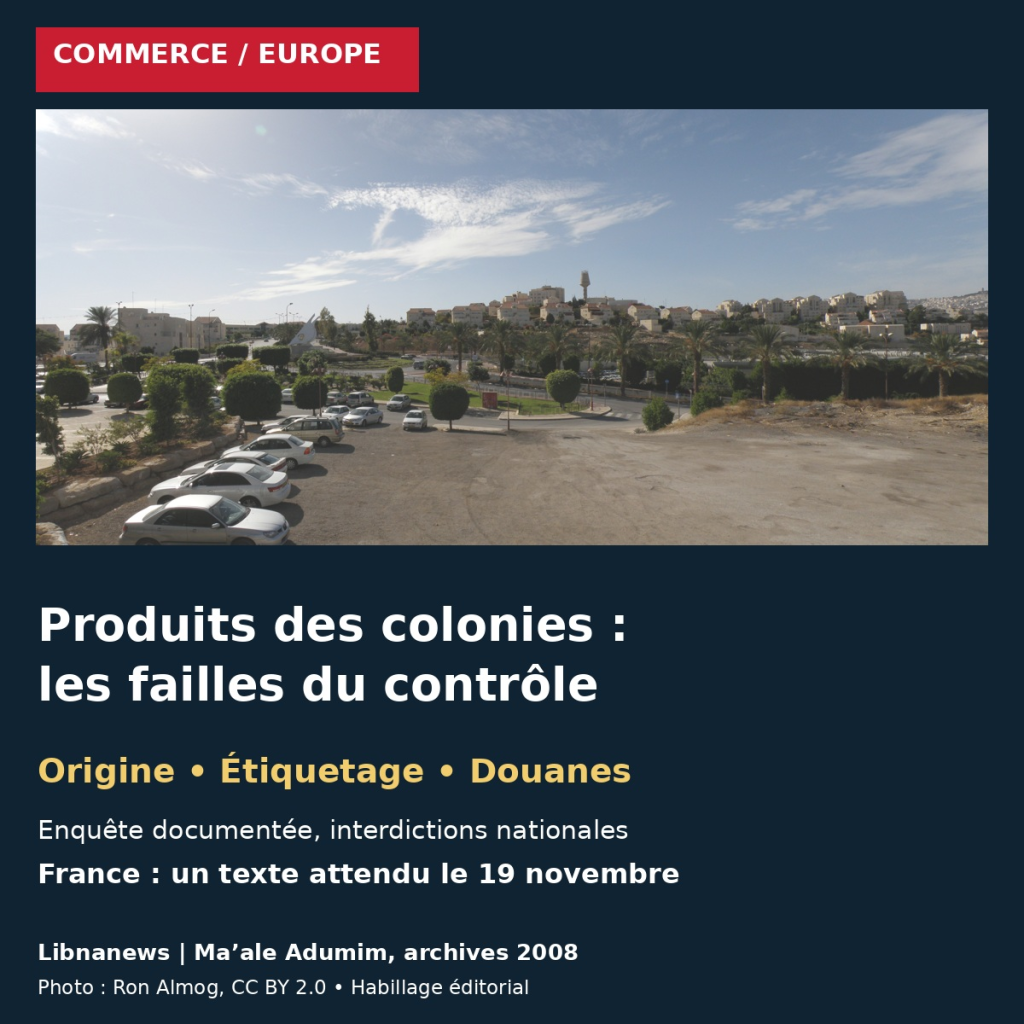
Illustration: Archive view of MaRon Almog, licensedCC BY 2.0. Complete photograph resized, clad Libnanews. It does not represent an agricultural lot or facility involved in the investigation.






Comments