

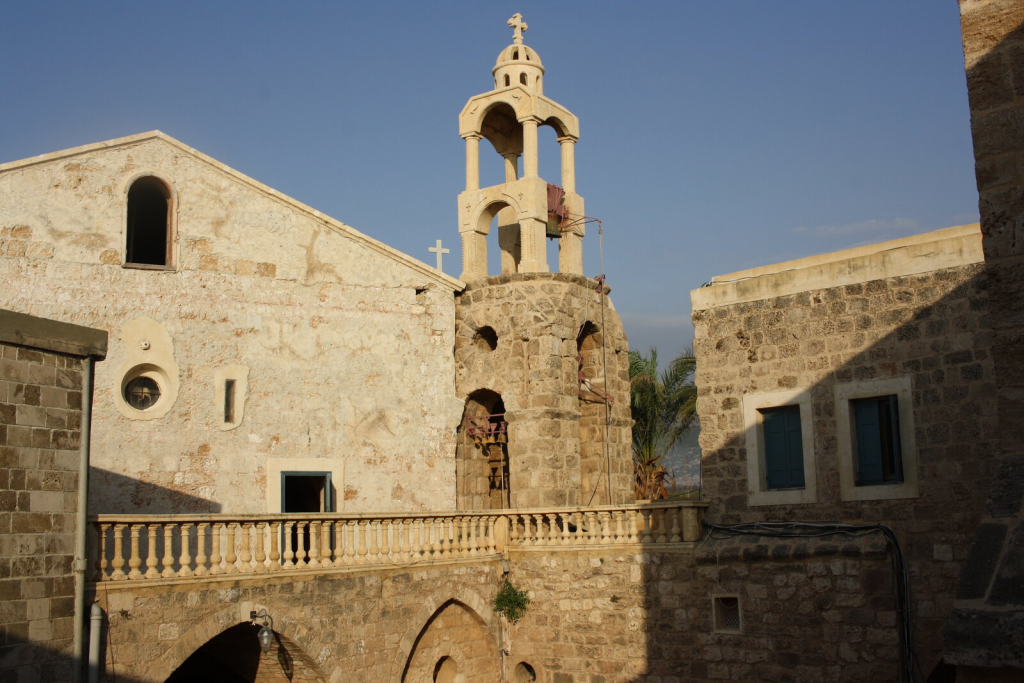
On November 21, Mary’s Presentation in the Temple links an ancient account with the prayers of the Eastern Churches. In Anfeh, the archives of the monastery of Saydet el-Natour allow us to follow a concrete tradition: the vespers of the day before, the liturgy of the feast and the transmission of the same spiritual language.
On the coast of Kura, Saydet el-Natour is known for its stone and saline landscape. His religious calendar tells another dimension of the place. The feast of the entry of the Mother of God into the Temple, celebrated on November 21 in the Orthodox Church of Antioch, brings together a documented liturgical memory. In 2026, this date falls on a Saturday. It makes it possible to understand a Marian feast less visible than the Assumption, without reducing it to an identical custom in all Lebanese communities.
November 21, with calendars to distinguish
In the publications of the Orthodox Archdiocese of Zahlé and Baalbek, November 21 bears the name of the Feast of the Most Holy Mother of God in the Temple. The calendar also provides for the celebration to close on 25 November. This duration shows that the celebration is not limited to an isolated date: it has a forward and a later in the Church’s prayer.
The Marian calendar of the Shrine of Our Lady of Lebanon in Harissa also includes the Presentation of the Virgin Mary on November 21. The Melkite tradition also gives him this date, under the name of the Mother of God. However, a common date does not remove the differences in liturgical rank, texts and usages between rites.
Above all, it is necessary to avoid automatically moving the party on 4 December for all Orthodox. The Council of Churches of the Middle East documented a celebration on 4 December 2022 at the Patriarchate of Jerusalem, corresponding to 21 November of its liturgical calendar. This example explains some dates encountered online; it does not replace the indications of the antiochian dioceses of Lebanon.
A story conveyed by the Christian tradition
The feast evokes Mary as a child, led by her parents Joachim and Anne in the Temple of Jerusalem to be consecrated to God. Metropolitan Basilios, in a presentation published by the Antiochian Archdiocese of Australia, recalls that this episode is not told by the canonical Gospels. It is transmitted, in particular, by the Prot Gospel of James, apocryphal text of the second century.
This distinction is essential: the religious narrative, its reception in the churches and a historical reconstruction of Mary’s childhood do not belong to the same register. The details of his age, his reception by the priest or his stay in the sanctuary must be presented as elements of tradition, not as facts established by a contemporary witness.
The historical record of the National Shrine of the Immaculate Conception in the United States links the origin of the celebration to the dedication of a Marian basilica in Jerusalem in 543 and recalls its development in the Byzantine world. The history of the feast is therefore also that of a cult, places and texts gradually transmitted.
Mary as « living temple »
In this Christian reading, the child’s move to the Temple proclaims the Incarnation: Mary is called to bear Christ. The Melkite catechesis dedicated to the feast thus explains Mary’s image as a home of God. The building and the person respond in the language of the hymns.
The icon reproduces these symbols. Joachim and Anne accompany their daughter; young girls wear lights; A priest welcomes him near the steps. Some representations also show Mary fed by an angel. These images constitute a theological interpretation of the narrative. The candles and painted steps alone are not sufficient to prove the existence of an identical child procession in every Lebanese village.
On the Catholic side, the Holy See’s information service emphasizes self-giving and listening to the word of God. The emphasis is on Mary’s availability, more than on the possibility of materially rebuilding the ancient scene. This spiritual proximity allows for different ways of celebrating.
In Anfeh, vespers certified from year to year
To find local practices, parish archives are more accurate than a general description of « Lebanese folklore ». The diocesan bulletin of 14 November 2010, published by the Archdiocese of Tripoli and the Kura, announced the Vespers of 20 November at 5 p.m. in the Church of the Entry of the Virgin, at the Natour Monastery. The announcement placed the celebration under the blessing of Metropolitan Ephrem Kyriakos.
The same appointment appears in the November 19, 2017 newsletter, always the day before the party and at the same place. These documents show local continuity over several years. They give to see a simple practice: to gather from the previous evening to enter liturgically into the celebration.
The archives of the diocesan homilies of 2024 still mention a preaching of Ephrem Kyriakos in Saydet al-Natour for the feast of 21 November. This recent milestone complements the old newsletters. On the other hand, it does not allow the timetables of 2026 to be deduced: these are part of an announcement specific to the monastery or the diocese.
Songs that already open around Christmas
The feast occurs in the fasting of the Nativity, which the Orthodox Patriarchate of Antioch is located from 15 November to 24 December. She brings a Marian tone to this preparation. Metropolitan Basilios points out that from this celebration the songs called Katavasia of the Nativity already announce Christmas. The wait is therefore also transmitted by music and by the annual repetition of the offices.
In Zahlé, the diocesan bulletin of 21 November 2021 published the tropary and the kondakion of the celebration in Arabic. His teaching linked Mary’s dedication to the responsibility of parents and godfathers in the Christian formation of children. The memory celebrated at the church thus finds an extension in the family transmission, without requiring to invent a meal, costume or domestic rite specific to the whole country.
In Saydet al-Natour, the appointments kept in the archives give flesh to this transmission. The heritage of the feast lies in a place inhabited by prayer, in the texts it sings and in the way a community takes its meaning. November 21 opens a window on the Christian diversity of Lebanon, based on precisely located gestures.





Comments