

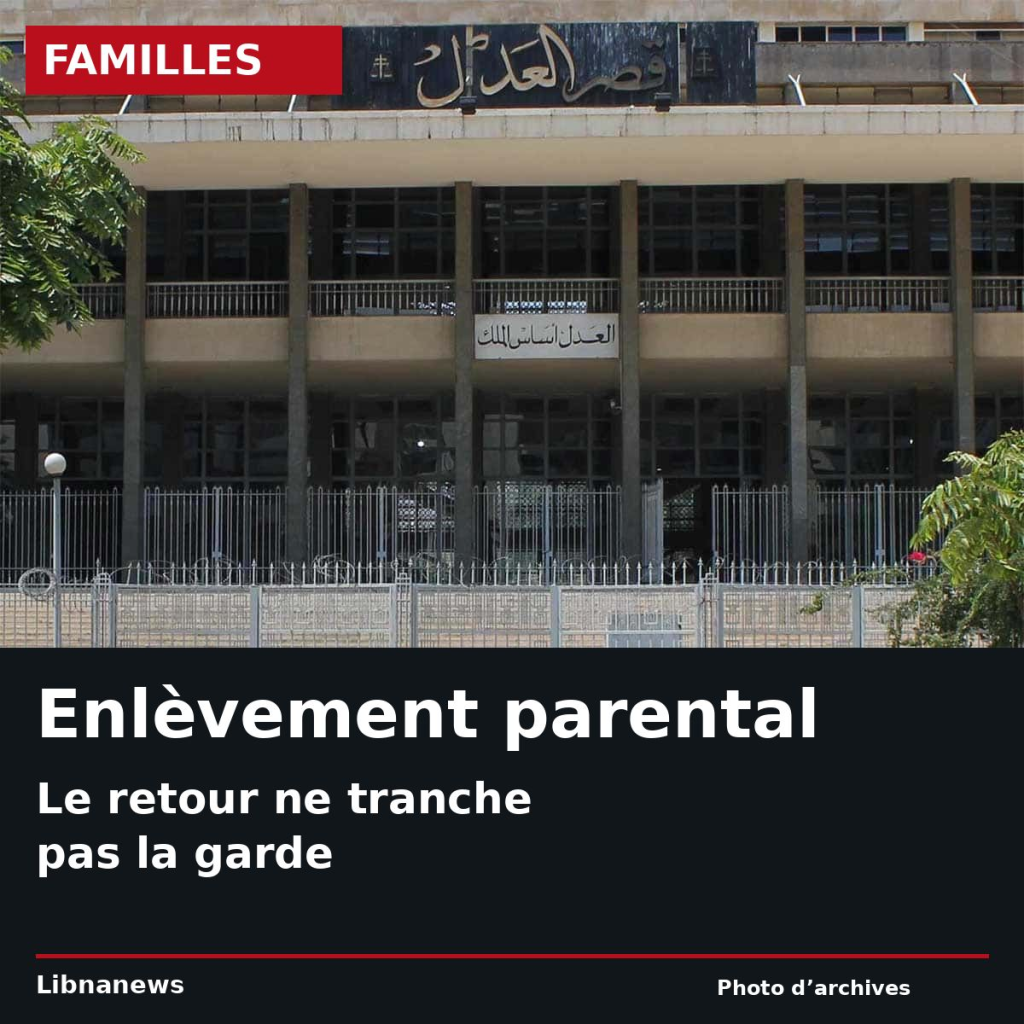
In Lebanon, family disputes that cross borders face a decisive distinction: asking for the return of a child does not mean deciding which of its parents will have custody. The 1980 Hague Convention organizes the first procedure, without settling the substance of the second. Lebanon has not left. Families must therefore deal with local law, judicial decisions and cooperation agreements applicable to their situation.
The debate brought together judges, lawyers and diplomats at the Holy Spirit University of Kaslik on 23 and 24 October 2026. Organized for the fifth anniversary of iHOPE, the meeting focused on international parental abductions and opportunities for Lebanon to accede to the Convention. The Minister of Justice, Adel Nassar, has announced the examination of several avenues: accession, bilateral agreements and improved judicial cooperation. None of these avenues alone is a new procedure already open to families.
Parental abduction: the child’s country of life
International displacement becomes unlawful when it violates the custody rights recognized by the law of the country where the child was habitually resident. The problem is not limited to an organized departure without agreement. It may also arise after an initial authorized trip, when the child is not brought back under the conditions provided for.
The usual residence thus occupies a central place. It is not automatically confused with the nationality of the child or his or her parents. The return procedure is aimed at the country in which his life was established before the displacement or detention in question. It does not involve giving preference to a father, mother or nationality.
The Convention applies to children under 16 years of age under its conditions of application between the States concerned. Article 19 expressly separates the decision of return from the decision of custody. Thus, the judge on whose return the case is brought does not have the function of resolving the whole family dispute in this procedure.
Guarantees against dangerous return
The mechanism does not provide for a blind return. The text includes an exception in the event of a serious risk of physical or psychological danger or an intolerable situation for the child. It also allows for consideration of its opposition when it has sufficient age and maturity.
These guarantees must be examined by the competent authority. They also do not allow a parent to decide the outcome of the dispute alone. Consent to displacement, the effective exercise of custody rights and the circumstances of detention are some of the elements that can be assessed in the proceedings.
The cooperation network is based on central authorities designated by the States. They help locate the child, prevent further harm and facilitate a voluntary solution or procedure. This architecture organizes exchanges between legal systems; It does not create a world family court.
Lebanon remains outside this multilateral mechanism
For a family facing displacement to Lebanon, the lack of membership changes the path. One application does not simply benefit from the 1980 return mechanism because the other country applies it. The instruments that effectively bind the two States must be identified and the remedies available to the competent authorities.
At the Kaslik symposium, the Secretary-General of the Hague Conference on Private International Law, Christophe Bernasconi, stressed the cooperation between different legal traditions. The instrument does not seek to standardize national personal status rules. This issue is particularly important in Lebanon, where family matters are the responsibility of several religious authorities.
The project advocated by iHOPE remains an approach to reform. The support expressed at a conference does not amount to a vote by Parliament or the entry into force of a treaty. In practice, families remain subject to current rules and agreements.
With France, a separate agreement since 2000
The Franco-Lebanese dossiers have a bilateral framework. Signed in Paris on 12 July 1999, the Agreement on Cooperation in Certain Family Matters entered into force on 1 March 2000. The French Ministry of Justice lists it as one of the instruments applicable in relations with Lebanon.
It establishes a joint consultative commission of representatives of the Ministries of Justice, Foreign Affairs and the Interior. It reviews cases concerning custody, visits and the rights of the child in order to facilitate their settlement, including through amicable solutions.
Its missions include assistance in conciliation, information on the situation of the child and procedures, and procedures facilitating visits. The files are transmitted to him through diplomatic channels. The text protects the confidentiality of the information reviewed.
This commission is not a court that replaces national courts. The agreement specifies that its activity does not affect the settlement of the files by the competent authorities. Thus, a parent cannot deduct from its existence that a return or custody decision will automatically be obtained.
Complementary consular and judicial procedures
For the French concerned, the Ministry of Foreign Affairs recommends to contact the competent department of the Ministry of Justice quickly when an agreement allows cooperation. Consular services can inform local lawyers and mediation opportunities. The choice of procedure then depends on the file and the decisions already rendered.
The consulate cannot have a French judgment executed abroad. Recognition and enforcement of a decision may require an action before local courts, with a lawyer. Nor can he organize a kidnapping in return or substitute for a parent’s legal counsel.
Mediation can help re-establish contacts and prepare an agreement, where circumstances permit. It does not exempt from examining the safety of the child or the legal scope of the commitments undertaken. For families, the concrete challenge remains to bring together decisions, travel arrangements and elements relating to the child’s residence, so that competent professionals can determine the appropriate remedy.





Comments