

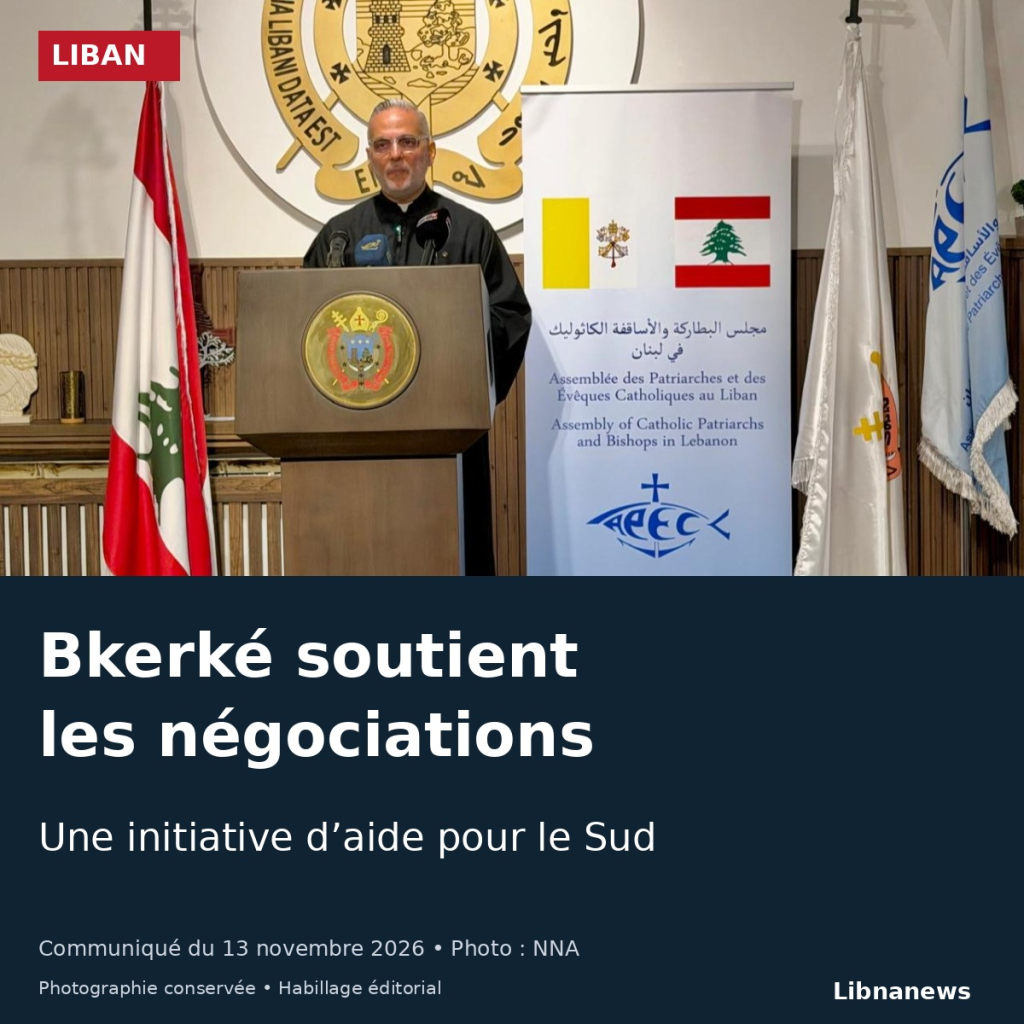
On Friday 13 November, the Council of Catholic Patriarchs and Bishops of Lebanon affirmed its support for the government’s negotiations to end the war. In his final communiqué in Bkerké, he called for Israeli withdrawal, a monopoly of arms for legitimate forces and a decision on war and peace for the constitutional authorities. He also announced an initiative of solidarity between dioceses and congregations for the southern border villages.
The text concludes the fifty-ninth ordinary session of the Council, held from 9 to 13 November, under the chairmanship of the Maronite Patriarch Béchara Rai. The secretary general, Father Jean Younes, read it out. The Syrian Catholic Patriarchs Ignace Youssef III Younan, Greek-Melkite Catholic Youssef Absi and Armenian Catholic Raphaël Bedros XXI participated in the work with the bishops and leaders of the congregations.
Bkerké supports government negotiations
The Council places its diplomatic support in a series of sovereignty requirements. It calls for the State to exercise its authority throughout the country. Decisions on war and peace must be made exclusively by its constitutional institutions. The weapons must be held by the Lebanese army and the legitimate security forces.
In this context, Catholic leaders support the diplomatic and government negotiations aimed at ending the war and consolidating the cessation of hostilities. They demand the withdrawal of Israeli forces from all occupied Lebanese lands. They also call for the full implementation of Security Council resolution 1701 and other relevant international resolutions.
At the same time, the Council calls for Lebanon to stay away from regional conflicts and to preserve its independence and territorial integrity. He called on politicians to focus on national interest and dialogue rather than confrontation. These guidelines extend the call made by Béchara Rai on 8 November for lasting peace and a single national authority.
The communiqué also links the country’s recovery to respect for the Constitution, the independence of the judiciary and the fight against corruption. Protection of public funds and freedoms is one of the conditions for restoring trust between citizens and the State.
An aid initiative for border villages
The humanitarian component responds to the call of the mayors of five villages in the South. The Council is launching an ecclesial solidarity initiative to which Catholic dioceses and congregations will contribute. It must respond to urgent humanitarian needs in border localities.
An episcopal commission chaired by Bishop Elias Nassar will monitor the inhabitants, coordinate aid and mobilize support. It brings together the bishops of the dioceses concerned and representatives of the women’s and men’s congregations present in the South. Its interlocutors will be the Lebanese State, the Holy See, international agencies and humanitarian organizations.
The appointment of Bishop Nassar as head had been announced on Thursday, November 12. The final communiqué takes this decision and clarifies the link between the Commission and the solidarity initiative. The Council calls on the Catholics of Lebanon and the diaspora to contribute to this. It does not set a financial envelope or timetable for distribution in this text.
The mayors of Rumaysh, Debel, Ain Ebel, Alma al-Sha`b and Qauzah had submitted ten requests to the Catholic leaders. Their appeal, issued on 9 November, included safe roads, care, schools, income and the return of internally displaced persons. They also called for a commission to coordinate aid and monitor projects with the authorities and donors.
At the opening of the session, the Apostolic Nuncio Paolo Borgia had invited the Council to take a concrete initiative before the end of the work. The bishops now welcome his humanitarian and diplomatic efforts, as well as the medical, educational and humanitarian assistance provided by the Holy See.
Staying on site and enabling the return of internally displaced persons
The Council affirms its solidarity with all the people affected by the war, without distinction as to religion. He cites the populations of Bint Jbeil, Tyre, Zahrani, Nabatiyah, Marjayoun and Hasbaya, as well as those of other regions of the South and Bekaa.
He especially greets the inhabitants of Debel, Rmeich and Ain Ebel who remained in their villages. In his view, preserving the historical Christian presence in the South is a common national responsibility, linked to Lebanon’s diversity and coexistence between its communities.
The text defends the right to remain safe on its land and that of all displaced persons to a voluntary, safe and dignified return. In particular, it mentions the families of Qauzah, Alma al-Sha`b and Yarun. It calls on the State and the international community to protect civilians and guarantee their freedom of movement.
Continuity of care and education is explicitly included in these requests. The Council also calls for the reconstruction of destroyed property and fair compensation for those affected. The Nassar Commission will have to monitor these needs with the institutions and organisations mobilized from the villages.
Fear of a vacuum after UNIFIL
The patriarchs and bishops express their concern at the possible consequences of the end of the UNIFIL mission. They refer to security, humanitarian and economic risks. They call for measures to avoid a security vacuum and ensure the continued delivery of humanitarian aid.
This concern was already included in the appeal of the five mayors. They feared effects on traffic, relief, but also on jobs, businesses and services linked to the international presence. The final communiqué sends this request to the authorities, without announcing any replacement arrangements.
Beyond the South, the Council requests the Ministry of Finance to pay the contributions due to the free institutions of education, health and social action. It calls on ecclesial and humanitarian agencies to better coordinate their resources and ensure their transparent management. The aim is to maintain their services to all citizens and to provide assistance to families in need.





Comments