

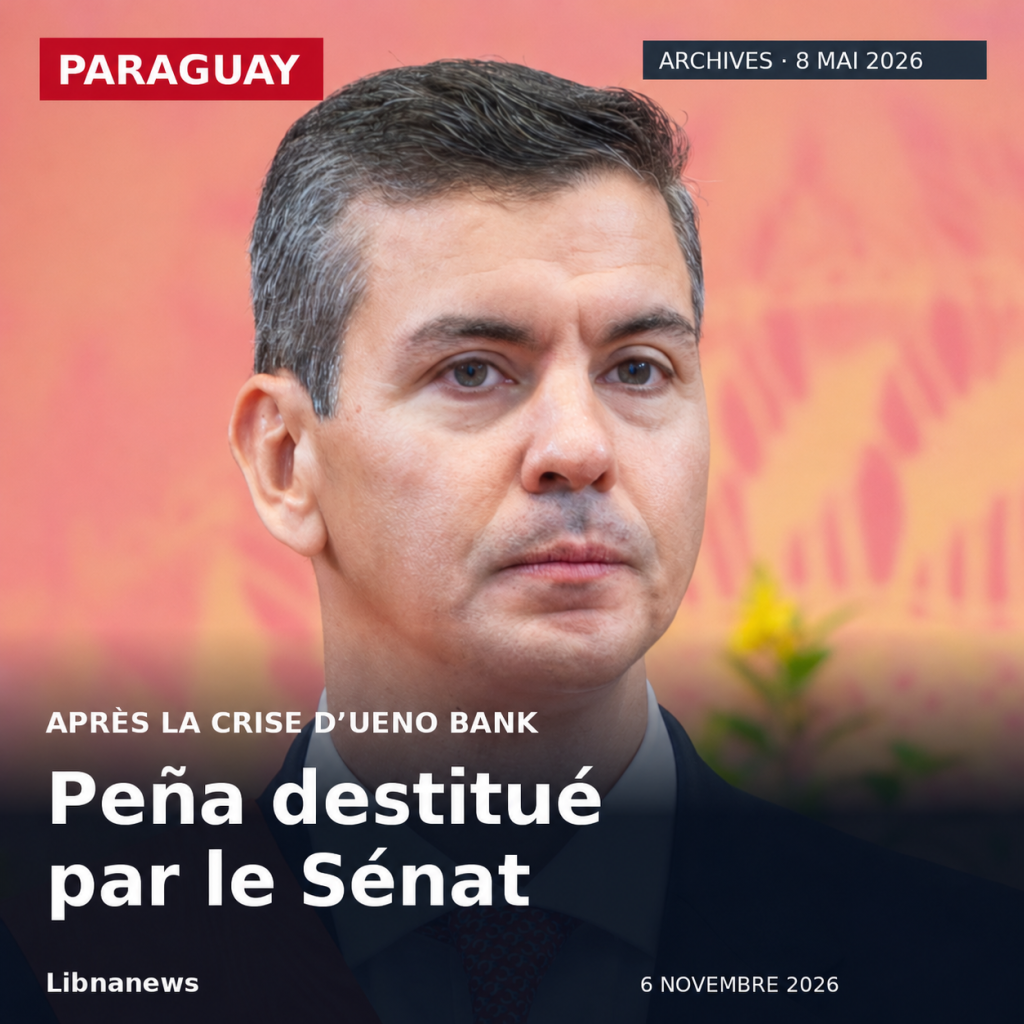
Santiago Peña was removed from Paraguay on Friday, 6 November 2026, and then detained at his home. The Senate dismissed him from the presidency after the Ueno Bank crisis. Pedro Alliana, previously Vice-President, was sworn in before Congress to succeed him and complete the term of office until August 2028.
The 44 senators present voted for Peña’s departure. This vote is a removal after a political trial, not acceptance of his resignation announced on Thursday. The parliamentary procedure continued despite this announcement, in a country where the bank’s bankruptcy caused the freezing of millions of accounts.
Peña removed from Paraguay after the political trial
The Chamber of Deputies transmitted the charge to the Senate on 5 November. The elected representatives questioned Peña’s ties with the financial group, the supervision of the bank and the investments of public funds. The president challenged the charges. His lawyers defended his position before the senators on Friday, without his presence.
The Senate’s decision concerns its responsibility in the performance of its functions. It is not a criminal conviction. Article 225 of the Constitution distinguishes parliamentary dismissal from ordinary prosecution. Article 189 also excludes former presidents convicted in a political trial from being a senator for life.
Thursday’s resignation had not settled the exit from power. Congress had not completed the acceptance procedure. The Peña defenders wanted parliamentarians to favour this path rather than pursue political judgement.
Home detention in Ueno Bank case
After the dismissal, the prosecution ordered the detention of Santiago Peña and Carlos Carvallo, former president of the central bank. The measure is a criminal investigation into alleged abuse of trust and other offences related to Ueno Bank.
The police executed the order against Peña at his home. The Public Prosecutor ‘ s Office foresees that it will remain there until it is presented to the Economic Crimes and Corruption Unit. The measure does not prejudge his guilt. It also differs from a prison sentence imposed after trial.
Alliana invested, Antonio Barrios Vice President
Pedro Alliana was sworn in at a meeting between the two chambers, chaired by Basilio Núñez. The Congress then chose Antonio Barrios as vice-president. He left his seat as a senator and was also sworn in. Both officials must complete the constitutional mandate 2023-2028.
This succession follows the mechanism provided for in article 234 of the Constitution. The Vice-President shall replace the President in the event of a permanent vacancy. The Congress shall appoint the new Vice-President when this office becomes vacant during the last two years of the term of office.
In his first speech, Alliana promised immediate measures to compensate the savers affected by the crisis. He called for giving priority to the most disadvantaged and presented transparency as a requirement of his Government.
The central bank decided on 2 November to place Ueno Bank in resolution. After correction of his accounts, his solvency ratio had fallen below half the minimum required. Reimbursement of applicants remains an urgency of the new authority, while the criminal investigation continues.





Comments