

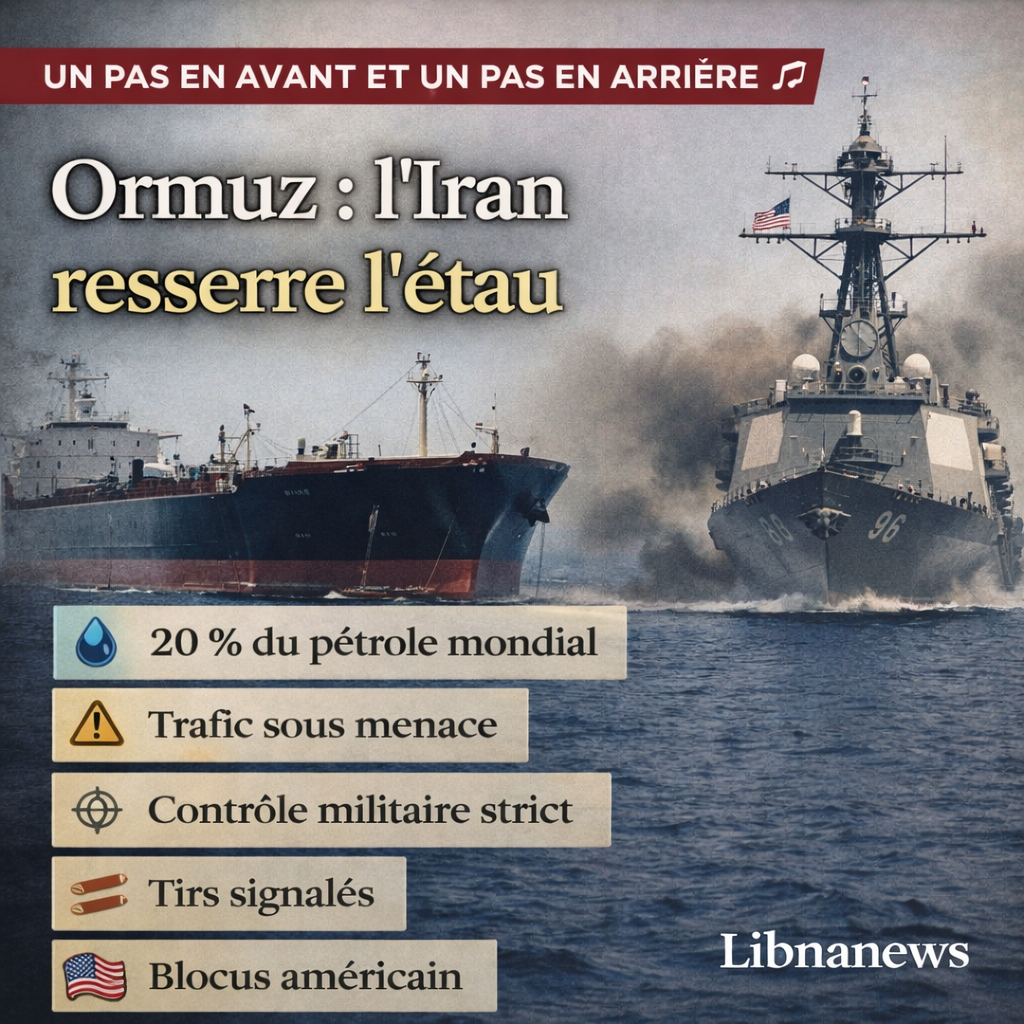
Iran has again tightened, on Saturday 18 April, conditions of navigation in the Strait of Ormuz, only a few hours after announcing a reopening of the passage to commercial vessels during the current regional truce. Tehran did not portray this shift as a total closure, but as a return to « strict military control » of the Strait, in response to the continued US blockade against its ports. On the ground, oil tankers have started to pass again, but in a still unstable environment, where merchant ships have reported fire and where Western authorities continue to talk about traffic far from normal.
The tone change is brutal. On Friday, the Iranian authorities affirmed that the Strait would be open to all commercial vessels for the remainder of the ceasefire period. This announcement was immediately interpreted as a sign of relaxation in one of the main locks of the regional crisis. Oil markets had reacted without delay, with a sharp fall in crude oil prices, while several capitals saw the possibility of an early stabilization.
Less than 24 hours later, the picture is quite different. The Iranian Navy and the Revolutionary Guards have indicated that the passage is now subject to much stricter rules. The message is not that of a fully closed corridor, but that of a sea route entirely placed under Iranian military control, in a context where Tehran accuses Washington of maintaining naval and commercial pressure on its port infrastructure.
This contradictory sequence summarizes the reality of the moment. The Strait of Ormuz is neither fully reopened nor completely closed. It is in a grey area, where political announcements are changing rapidly, ships are advancing under threat and global markets remain suspended at the slightest signal. This is precisely what makes the current situation a major episode: the world’s main energy corridor is no longer a mere maritime passage. It becomes a direct instrument of strategic pressure.
A reopening announced, then immediately hardened
On Friday, 17 April, the Iranian Foreign Minister announced that the Strait would be accessible to all commercial vessels for the remainder of the truce. This statement was welcomed as a start to calm down. Since the outbreak of the war in late February, the crisis around Ormuz had already disrupted part of regional traffic, disrupted expectations in energy markets and revived the spectre of a wider crisis in global supply.
The scope of this announcement was also in its context. The reopening was explicitly linked to the ceasefire sequence in the region. It therefore appeared not as an isolated gesture, but as an element of a more general, at least temporary de-escalation. The United States itself had hailed the movement, Donald Trump speaking of a « great day » and suggesting that a more favourable phase could open.
But on Saturday, Tehran resumed the initiative in the other direction. The Iranian authorities explained that the navigation was going back under « strict military control » because of the United States embargo on the country’s ports. In Iranian reading, there was no question of allowing the ships to move fully while continuing to suffer a strong naval and economic constraint on its own facilities.
The reversal should not be underestimated. It shows that, for Iran, the Strait remains an active lever of negotiation and pressure. Friday’s opening was not an abandonment of this lever. It was conditionally suspended. Since Tehran considered that Washington had not sufficiently relaxed its posture, the military takeover of the passage was put back on the table.
This is not new in the history of Gulf tensions, but it is now on a different scale. The region is barely emerging from an intense military phase. The power balance between Washington and Tehran remains difficult. And the slightest gesture on Ormuz immediately exceeds the only local scene to touch global energy security.
The passage is not stopped, but it is not free
One of the most important points to understand this day is the distinction between possible traffic and normal traffic. On Saturday, oil tankers crossed the Strait. A significant convoy left the Gulf, proof that some shipowners chose to take advantage of the window still available. This image may give the impression that the passage is again practical.
But this reading would be misleading. Traffic did not return to normal operation. Several maritime sources reported that merchant vessels had been shot as they attempted to cross the strait. At the same time, the UK authorities stressed that navigation remained far from an acceptable level of safety and fluidity.
In other words, the Strait now functions as a live corridor. Ships can pass, but in a deeply unstable environment. Companies must assess a risk that is difficult to measure. Insurance remains under pressure. The crews are moving forward in an environment where the danger has not disappeared. It’s not the same as a free passage.
This grey zone is in some respects even more destabilizing than an absolute closure. A total closure produces a rough but clear frame. A passage announced as reopening, then being placed under military control, with ships running but reporting fire, creates a climate of permanent uncertainty. Economic actors no longer know whether the strait is really feasible, nor for how long or at what cost.
For maritime trade, this uncertainty has an immediate effect. A shipowner can theoretically obtain the passage, while judging that it is not commercially bearable. Security costs, risk of incidents, delays, conditions imposed by the Iranian authorities and the fear of further tightening are profoundly affecting the profitability and feasibility of transit. The strait is not simply a place of traffic. It becomes a permanent computing space between military risk and economic interest.
Why Ormuz remains vital to the global economy
The Strait of Ormuz occupies a unique place in the global energy system. It connects the Persian Gulf with the Oman Sea and the Indian Ocean. A significant portion of the region’s oil and gas exports go through this narrow corridor. It is the main outlet for crude oil exported by the Gulf monarchies, and a central crossing for liquefied natural gas shipped by Qatar.
Each crisis in this area therefore has effects far beyond the Gulf. When shipping slows down or becomes more risky, markets immediately fear supply disruption, higher insurance premiums, longer lead times and higher overall energy prices. The effects then affect freight, industrial costs, public budgets and inflation in many countries.
This sensitivity was again verified on Friday, when the announcement of a re-opening of the strait caused a sharp fall in oil prices. The Brent has fallen sharply, as investors see it as a sign that part of the energy risk can be reduced. The Iranian turnaround on Saturday does not mechanically produce an immediate inverse shock of the same magnitude, but it puts in the foreground an uncertainty premium that the markets hoped to see reduced.
The dependence of some Asian countries on Ormuz explains part of this nervousness. Much of the cargo crossing this corridor is heading for Asia. For several importing economies, the proper functioning of the Strait is not an abstract subject of geopolitics. It directly affects energy security, domestic prices and industrial continuity.
Europe also remains attentive to the situation. Even when it depends less directly on Gulf crude oil than before, it remains vulnerable to the global impact of a shock on Ormuz. Prolonged pressure on this passage can alter international prices, reorganize cargo flows and increase competition between buyers in other markets.
The American blockade at the heart of Iran’s hardening
Tehran justifies its change of position by maintaining the American blockade against its ports. According to the Iranian authorities, it was not possible to allow commercial ships to move normally through Ormuz while seeing a very strong US pressure on Iranian maritime trade persist. The message to Washington is clear: Iran refuses a situation where freedom of navigation would benefit others while its own access routes remain constrained.
On the American side, the strategy remains that of maximum pressure framed by a negotiating discourse. Washington continues to link any real relaxation to the conclusion of a broader agreement with Tehran. In this context, the blockade and coercive measures remain instruments of balance of power. The United States wants to retain an advantage in the discussion of nuclear, regional security and Iranian military behaviour.
This shift explains a large part of the volatility around Ormuz. For Washington, pressure control is a way to get more concessions. For Tehran, the strait is one of the few levers capable of imposing an immediate cost on this pressure. One wants to maintain the constraint. The other wants to show that it can disrupt a vital interest in the world economy if this constraint continues.
Thus, the strait is not only at the centre of a maritime crisis. It has become one of the main fields of expression of the arm between Iran and the United States. Every announcement, every convoy, every incident is interpreted as a political message. Navigation is now inseparable from strategic negotiation.
This reality explains why the sequence of Friday and Saturday is not an improvised inconsistency. It’s a method. Iran partially opens, observes the American reaction, and then tightens if the conditions it considers necessary are not met. It does not necessarily seek to cut the passage permanently. He seeks to show that he keeps his hand on the pace, degree of openness and level of risk.
Shipowners proceed cautiously
In this climate, shipping companies remain extremely cautious. The ships that crossed Saturday do not mean that the whole sector considers the road to be safe again. Many shipowners continue to wait for clarification. They want to know the actual rules imposed by Iran, the real level of threat, the risk of mines, the likelihood of armed incidents and the availability of naval protection.
This caution is reinforced by the fact that political statements change rapidly. A shipping company cannot hire its ships solely on the basis of a statement. It must take into account actual water practice. But this one is still moving. Ships turned back on Friday despite the announcement of reopening. On Saturday, others passed, while at least two buildings reported shooting.
In this context, the arbitration of shipowners becomes particularly delicate. Crossing Ormuz may remain indispensable for some cargoes, but this implies accepting a higher risk, heavier costs and a great uncertainty about the continuation of the crossing. Conversely, delaying or delaying delivery can itself become costly, especially for already tense markets.
Maritime insurance plays a major role here. As soon as a road is reclassified as a war zone or very high risk, premiums explode. This changes the calculation of all actors. Even if the strait remains technically open, it can become economically dissuasive. This is one of the most feared effects of the current crisis: a partial neutralisation of the passage not by formal closure, but by an extreme increase in its crossing.
For markets, this dimension counts almost as much as the number of ships observed. A few oil tankers passing by are not enough to restore confidence. What matters is the ability to ensure regular, predictable and insurable flows. This point has not yet been filled.
London calls for full return of traffic
The United Kingdom has reacted cautiously but firmly. The British Foreign Minister called for a full resumption of international traffic in the Strait. This formulation speaks well of the real situation. London does not consider the problem to be solved. She acknowledged that movements had resumed, but stressed that the level of security and normality remained insufficient.
This British position reflects a broader concern of the maritime powers. It is not just about avoiding an absolute closure. The aim is to restore a passage that operates without permanent threat, without firing from civilian vessels, without reversible decisions from day to day and without military control used as a tool for diplomatic pressure.
In diplomatic and maritime circles, the idea of international support for securing the passage has already surfaced. Discussions focused on escort, demining and naval coordination. But as long as the American-Iranian face-to-face is also tense, no technical solution alone will suffice. The Ormuz problem is not just a navigation problem. First, it is a political and military problem.
The strait could therefore remain for several days in this uncertain status: neither closed in the absolute sense nor reopened in the normal sense. This situation is sufficient to maintain a high level of tension on markets and supply chains, even if a few convoys succeed in passing.
A direct barometer of the regional crisis
The Ormuz crisis also sheds light on the fragility of the current regional sequence. The ceasefire observed on other fronts may have given the impression of a wider de-escalation beginning. But Saturday’s day reminds us that this de-escalation remains partial, conditional and very vulnerable. The drop in tension in an area does not guarantee a general appeasement.
The strait works here like a barometer. When an agreement appears possible, Tehran opens. When he believes that American pressure persists, he tightens. Commercial shipping thus becomes an almost immediate indicator of the regional power ratio. Vessels progress or slow down to the pace of unfinished negotiations.
This reality has a broader political scope. It shows that the heart of the crisis is not limited to visible confrontations. It also includes strategic infrastructure, maritime routes, blockade capabilities and economic flexibility. Contemporary war is not only expressed by missiles and strikes. It is also expressed by mastering vital passages.
In the case of Ormuz, this logic reaches a particular intensity. The entire world observes a narrow maritime corridor, but this corridor concentrates considerable energy, military, diplomatic and financial challenges. Each Iranian movement has a resounding effect that far exceeds the local theatre.
On Saturday 18 April, Iran may not have closed the Ormuz Strait in the absolute sense of the term. But he put it back in a logic of military constraint assumed. And that’s already enough to recall that between declared opening and really secure traffic, the distance remains immense.




