

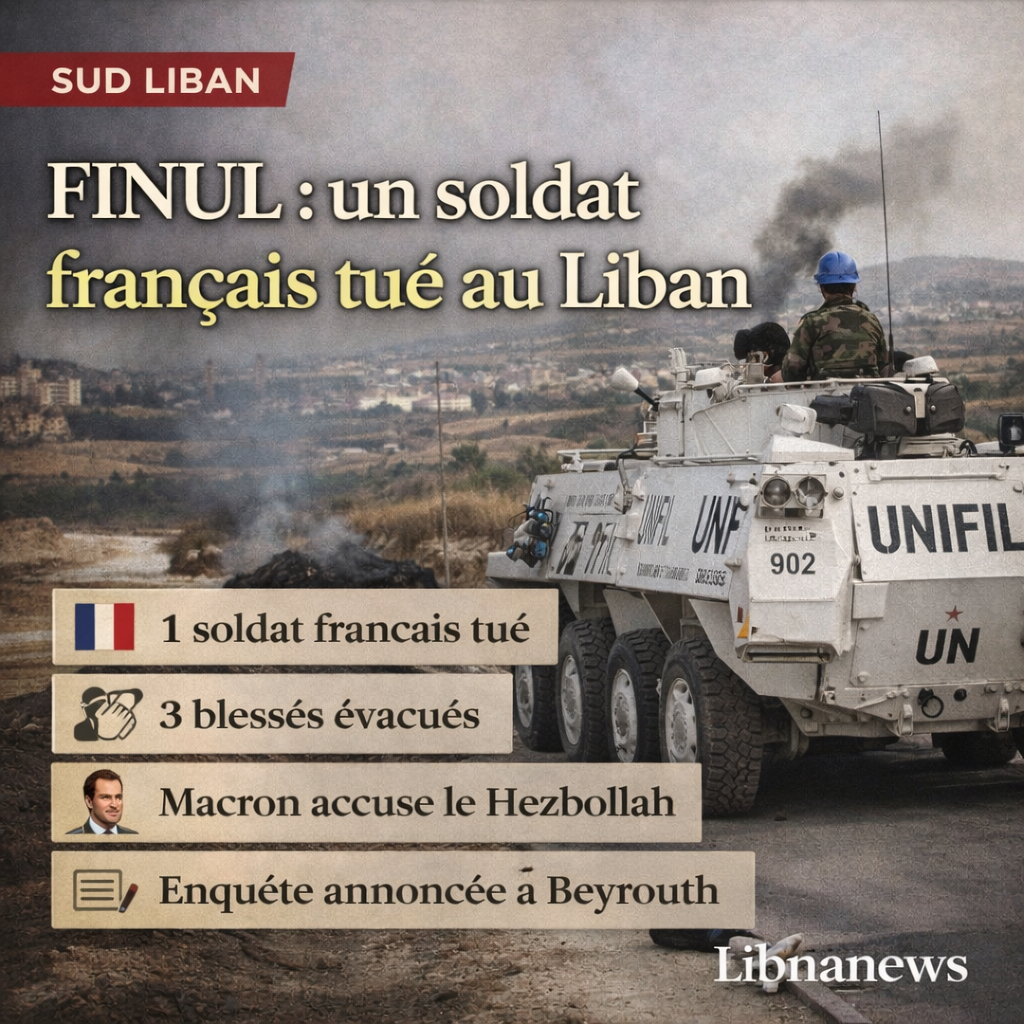
A French UNIFIL soldier was killed on Saturday 18 April in southern Lebanon in an attack on the French contingent of the United Nations force.Three other soldiers were injured and evacuated. Emmanuel Macron claimed that everything led to believe that Hezbollah was responsible. In Beirut, Prime Minister Nawaf Salam condemned the attack and announced the opening of an immediate investigation. This tragedy struck the second day of the ceasefire and brought the United Nations mission to a very fragile area.
The killed soldier is Sergeant-Chief Florian Montorio of the 17th Regiment of Parachute Engineer Montauban. The French president made his name public Saturday morning. He said three of his brothers were also wounded before being evacuated. Paris welcomed the NCO’s commitment and addressed its support to the families of the affected military and to all French soldiers engaged in the peace mission in Lebanon.
According to the French authorities, Florian Montorio was participating in a mission to open a route to a UNIFIL post that had been isolated for several days by fighting. It was during this operation that the patrol was allegedly caught in a very short ambush by an armed group. The chief sergeant was immediately hit by a direct light weapon fire. His comrades tried to rescue him under fire, but failed to revive him.
The attack gives the incident an exceptional scope. UNIFIL is present in southern Lebanon to monitor the cessation of hostilities along the demarcation line and to accompany the deployment of the Lebanese army in the context of resolution 1701. When a French soldier falls into an attack on that force, it is both the security of the contingent, the UN mandate and the stability of the southern zone that are being challenged.
Emmanuel Macron challenges Hezbollah
In his message, Emmanuel Macron stated that everything led to the conclusion that Hezbollah was responsible for the attack. The wording is strong, but it remains at this stage a political challenge, not the conclusion of a completed investigation. Nevertheless, Paris clearly places the Shiite movement at the centre of its suspicions and asks the Lebanese State to react without delay.
The Head of State demanded that the Lebanese authorities immediately arrest the perpetrators and assume their responsibilities alongside UNIFIL. This request applies to both the direct perpetrators of the ambush and the institutions responsible for ensuring security in the sector. For France, this is not just a field incident. The death of a French soldier requires a quick, visible and credible response.
This French position is taking place in an already tense context. For several days, Paris had supported the ceasefire while calling for the restoration of the authority of the Lebanese State throughout the territory. Saturday’s attack turns this diplomatic support into an immediate demand. The question is no longer just one of consolidating the truce. It also becomes the security of the French contingent and Lebanon’s ability to protect the UN mission.
For France, the issue is also institutional. The country is one of the historical players of UNIFIL and remains one of the most consistent supporters of the post-war framework of 2006. A deadly attack on its contingent cannot be treated as an isolated episode. It affects the credibility of the international system itself, as peacekeepers are already evolving in an increasingly degraded environment.
Nawaf Salam condemns and promises an investigation
In Beirut, Prime Minister Nawaf Salam responded. He strongly condemned the aggression against members of the French contingent of UNIFIL and announced that he had ordered an immediate investigation to identify and arrest those responsible. This rapid reaction was expected. The Lebanese government could not remain silent in the face of an attack targeting a UN mission and one of the most committed international partners in Lebanon.
The announcement of an investigation seeks first to contain the political scope of the incident. Lebanon is trying to enter a delicate phase, between truce, negotiations expected, the return of displaced persons and the redeployment of the State. An attack on French peacekeepers on the second day of the ceasefire directly threatens this sequence. By reacting quickly, Nawaf Salam seeks to show that Beirut does not desolute itself from either UNIFIL or the French partner.
But this reaction immediately raises another question. Does the Lebanese State have, under current conditions, concrete means to quickly identify the perpetrators of an armed ambush in the south, in an area where the fighting has isolated certain posts, destroyed axes and weakened the control of the ground? The announcement of an investigation is politically necessary. Its effectiveness will be judged very closely by Paris, the United Nations and other Lebanese partners.
The incident occurs at a time when the Lebanese government is trying to prove that it can take over the initiative. In recent hours, President Joseph Aoun and Nawaf Salam have defended the idea of a state that prepares negotiations, accompanies returns and strengthens its authority. The attack on the French contingent confronts this discourse with a brutal reality. It obliges the executive to show, through acts, that it can protect UNIFIL and not leave such an attack without action.
An ambush against a peace mission
The circumstances described by France give the attack a particularly serious character. Chief Sergeant Florian Montorio was not on an offensive mission. He was involved in a route-opening operation to a UNIFIL post that remained isolated due to fighting. In other words, he was involved in supporting an international peace mission, not in a conventional combat commitment.
The ambush was reported to have been extended very short distances by an armed group. This clarification suggests a prepared action, conducted in an environment known to the attackers. The direct light weapon fire mentioned by the French side reinforces the idea of a short, targeted attack designed to cause immediate losses. The fact that the NCO was mortally hit from the very first moment shows the violence of the scene.
The three injured also recall that the episode is not limited to an isolated victim. The entire group involved in the mission was struck. The soldiers had to rescue their comrade under fire, while managing the tactical situation and evacuation of the wounded. This element gives an idea of the intensity of the incident and the operational severity of the ambush.
UNIFIL has been operating in southern Lebanon for decades, but its exposure has increased sharply this year. Roads have become more dangerous, more vulnerable posts and narrower margins of movement. The death of a French soldier in such an operation recalls that, despite the ceasefire, the UN mission is not operating in a stabilized environment.
An already exposed contingent
The French contingent did not arrive on this day without prior warning. At the beginning of April, the French Delegate Minister for the Armed Forces had denounced intimidation that was considered absolutely unacceptable against French soldiers deployed in Lebanon. According to diplomats cited at the time, three incidents had occurred on 28 March between French UNIFIL forces and the Israeli army.
These incidents had not resulted in casualties, but they had already reported a clear deterioration in the security situation around the peacekeepers. Paris then expressed its solidarity with Indonesia after the death of three of its soldiers in the same period, while stressing that the French military, too, was under unacceptable pressure on the ground.
Saturday’s attack therefore crosses an additional threshold. We are no longer talking about intimidation, incidents of proximity or tension with a regular army. We are talking about an armed ambush that resulted in one death and three injuries within the French contingent. The threat to UNIFIL thus changes its nature and becomes a direct security crisis for France.
A Truce Under Pressure
The timing of the attack is heavy. The ceasefire is only on its second day. It was intended to allow for an immediate reduction in violence, facilitate the resumption of certain movements, make possible the first civilian returns and open a political space for the future. The attack on UNIFIL introduces a brutal rupture in this narrative.
The symbolic shock is considerable. An international peace mission was struck even though the Lebanese authorities, France, the United States and several regional partners were trying to convince that the truce could be consolidated. The death of a French soldier immediately gives the ceasefire the image of an uncertain respite, unable to fully secure the ground.
For the Lebanese Government, the problem is twofold. It must both prevent such an incident from derailing the momentum of truce, and meet French expectations for investigation and accountability. For Paris, the situation is also becoming more complex. France wants to support Lebanon and UNIFIL, but it cannot do so at the cost of silence over the death of one of its soldiers.
Thus, the attack may harden positions. It puts in the spotlight the issue of weapons outside State control, the security of the south and the real ability of Beirut to impose its authority. It could also influence future discussions on the stabilization of the border area, the role of UNIFIL and Hezbollah in the immediate post-war period.
Florian Montorio, a name now in the center of tribute
As in any military drama, the name of the fallen soldier gives an immediate human dimension to the event. Emmanuel Macron wanted to make public that of Sergeant-Chief Florian Montorio, a member of the 17th Regiment of Parachute Engineer of Montauban. This gesture goes beyond the official announcement. He records the death of the soldier in the national memory and in the memory of his unit.
France honours here a non-commissioned officer who fell on a peace mission, at a time when the terrain remained extremely unstable. This type of loss always has a special effect in opinion and in the military institution. Florian Montorio did not die in a distant theatre forgotten by the general public. He was killed in a region that French diplomacy follows closely and in a mission that Paris defends as a pillar of stability in Lebanon.
The three wounded further expand the human reach of the tragedy. A whole unit is affected. Soldiers were struck during a route security mission, in direct contact with the danger, in a space that the truce was not enough to pacify. For their families, for their comrades and for the French army, Saturday’s attack will leave a lasting mark.
Reminder of previous incidents in 2026
The attack on the French contingent is part of a series of serious incidents that have already affected UNIFIL this year. The first turning point was in late March when three Indonesian peacekeepers were killed in two separate incidents in southern Lebanon. A first soldier was fatally hit after the explosion of a projectile near a UNIFIL position in Adchit al-Qusayr. The following day, two other soldiers were killed when an explosion of unknown origin destroyed their vehicle near Bani Hayyan. Two other soldiers were injured in the second attack.
In this case, responsibilities had not been established at the time of the first reporting. The United Nations had initiated two separate investigations. Israel had indicated that it considered whether the facts were the subject of Hizbullah’s action or its own military activity. The United Nations, for its part, had recalled that attacks against peacekeepers constituted serious violations of international humanitarian law and could constitute a war crime.
A few days later, on 1 April, France denounced absolutely unacceptable intimidation against its own soldiers in Lebanon. Diplomats had reported three incidents on 28 March between French UNIFIL forces and the Israeli army. Again, these episodes did not cause death among the French, but they had reported a clear deterioration in the security situation for the contingent.
On 9 April, diplomatic pressure had risen again. Sixty-three States and the European Union had issued a joint statement to the United Nations condemning aggressive behaviour against peacekeepers in Lebanon and calling for their protection to be strengthened. This position occurred precisely after the deaths of the three Indonesian soldiers and reflected the increasing concern of the contributing countries about the deterioration of the ground.
These precedents give Saturday’s attack a wider reach than a single military fact. Since late March, UNIFIL has been under increasing pressure from strikes, armed incidents, inaccessible areas and tensions with the parties on the ground. The death of Sergeant-Chief Florian Montorio marks a new stage in this degradation, and now puts France, Lebanon and the UN at the same immediate question: how can we protect a peace mission when peace itself has not yet recovered on the ground?




