

Outside money always comes back with a grammar
The return of donors is never a mere return of funds. It also provides a language, a hierarchy of emergencies, a way of describing needs and an implicit vision of what the state should become. This is what reappears very clearly in Lebanon after the break. As soon as the strikes slow down, the question of reconstruction and relief mechanically opens the question of external financiers. International institutions, development agencies, multilateral banks and technical partners are returning to the landscape. But they do not arrive empty hands on one side and empty state on the other. They come with procedures, conditions, evaluation schemes, own temporalities and a precise idea of what should be financed first.
This reality is often misunderstood in the Lebanese public debate. Donors are referred to as a potential reserve of money, almost as a counter. A lessor does not only finance a need. He’s funding an executive. He wanted to know how the funds would be used, who would manage them, with what indicators, what sequence, under what control, with what degree of transparency and with what strategy. In a country weakened by banking collapse, the monetary crisis, administrative fragmentation and opaque management habits, this grammar weighs even heavier than the amount itself.
On 18 April 2026, therefore, the question is not only whether donors will come back. They are already there, through their meetings, their contacts, their existing lines, their loans in progress, their promises of evaluation and their first signals. The real question is more demanding: what do they ask for in return. And even more: under what conditions can their return help Lebanon without locking in a new sequence of unproductive dependency, made up of announced funds, promised reforms, slow circuits and a state unable to turn external money into a real recovery.
Donors do not enter a new country, but an already fractured state
The first element to understand is that Lebanon does not approach this new phase as a country emerging from conventional war. It comes after years of financial collapse, currency depreciation, institutional blockage, loss of bank confidence and deep social crisis. That changes everything. In other contexts, the lessor helps a temporarily struck but still functional state. In Lebanon, it is part of an already fragile structure, where war adds a layer of needs to an already unstable budgetary, administrative and political structure.
It is precisely for this reason that donors do not simply assess the material damage. They also assess the capacity of the public sector to absorb, direct and justify funds. A destroyed road is a fact. A network to repair, too. But the real question of financial institutions does not stop there. Pilot. Which administration is running. What a procedure. What audit follows. What is the link between humanitarian emergency, service recovery, infrastructure, social protection and longer-term investment? The more institutionally fragile a country appears, the more the financier tends to strengthen its safeguards.
Lebanon therefore finds itself in a delicate position. He needs money fast. But its own weakness pushes donors to slow down, frame, condition and document more. This contradiction explains part of the recurring discomfort between Beirut and its partners. The country is asking for flexibility in the name of urgency. Donors ask for discipline in the name of risk. The country invokes the needs of the inhabitants and the visible destruction. Donors recall the precedents of mismanagement, capture, dispersion and inefficiency. The two logics are understood. However, they do not produce a fluid relationship.
This gap is already visible in the very nature of the discussions. On the one hand, there is a question of private sector support, infrastructure, projects and recovery. On the other hand, there is a constant need for reform, a readable institutional environment and an enforcement capacity. This means that external money does not come to replace the state. On the contrary, it happens to test whether the state is able to become a credible minimum again.
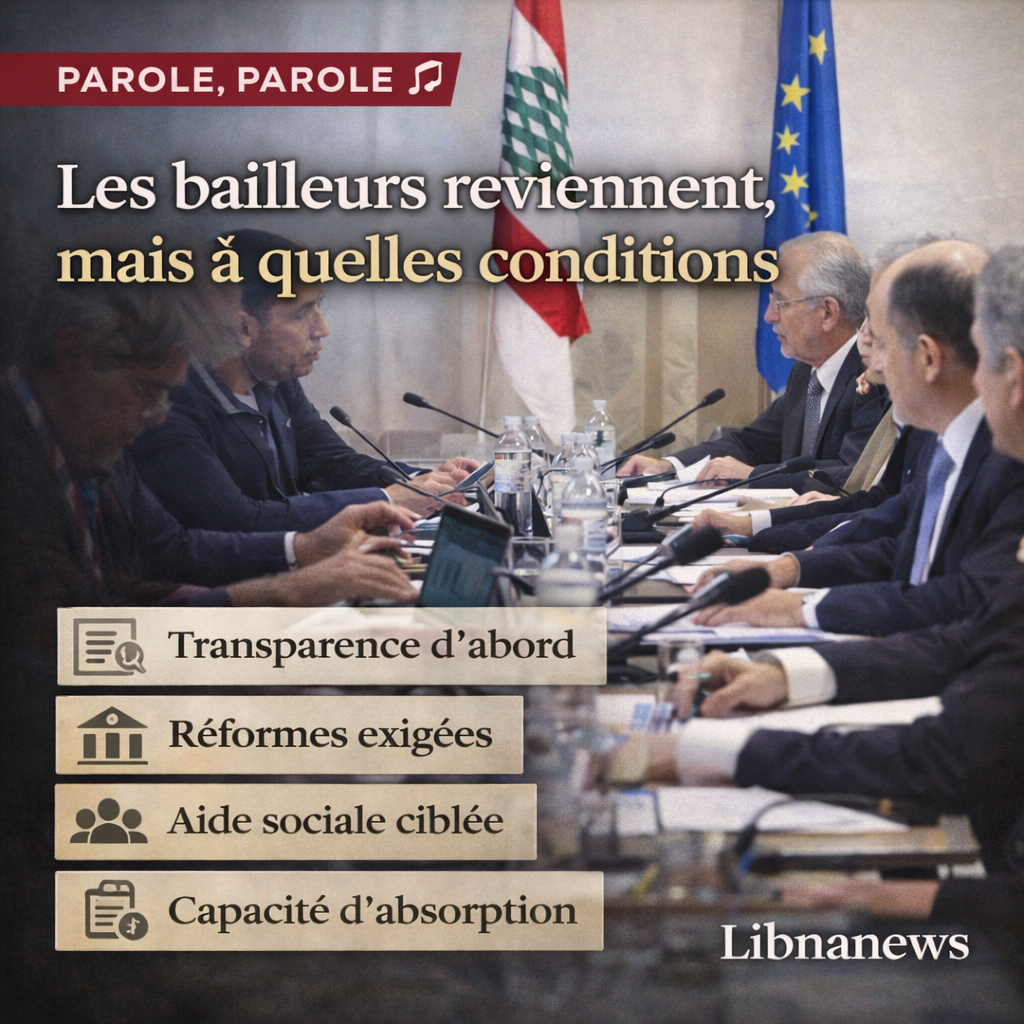
The first condition is transparency, because trust no longer exists by default
The most obvious and perhaps most structuring condition is transparency. In a country where the financial collapse has ravaged confidence, no serious lessor now agrees to finance on the basis of political words. Development institutions, multilateral partners and regional banks want clear accounts, identifiable procedures, monitoring mechanisms and governance frameworks stronger than they used to be. It’s not just a technical posture. This is a direct response to Lebanon’s recent history.
The required transparency is not limited to the publication of figures. It affects the entire chain of spending. Where the money comes from. By what structure it transits. That validates the projects. Who awards the contracts. Who controls the execution steps. That measures results. Who verifies that the funds are being used to achieve the stated objectives. In a context of urgency, this requirement may appear burdensome. But for donors, it has become non-negotiable. They know that fast financing, without tracking architecture, can save appearances for a few weeks and ruin trust for years.
The problem for Lebanon is that this requirement of transparency is in conflict with a culture of public management long marked by opacity, intermediate arrangements and weak consolidated information. Donors don’t know. This is why they often seek to frame circuits, multiply controls, target specific sectors, limit the fungibility of funds and impose valuation methodologies. The lower the initial confidence, the higher the technicality.
This can produce a paradoxical effect. In the name of transparency, procedures become more cumbersome. In the name of fund protection, the deadlines are extended. In the name of control, local governments may find themselves marginalized in favour of hybrid or highly supervised external arrangements. This is one of the post-war tensions. Society wants speed. Donors are demanding traceability. Lebanon will therefore have to meet this dual requirement without losing one to the other. If it fails, the funding will be either too slow to be useful or too poorly supervised to remain credible.
The second condition is the hierarchy of priorities
Donors don’t like to finance blur. However, Lebanon, in post-crisis situations, often suffers from a recurring difficulty: it mixes several levels of urgency without always prioritizing them. Relief, the return of displaced persons, housing, networks, roads, social programmes, the revival of enterprises, support for the army, the repair of heavy infrastructure, the protection of the most vulnerable are all real and legitimate. But not everything can be financed at the same time, at the same pace and by the same instruments.
This is where the second major implicit condition of donors comes in: hierarchy. Even before they promise amounts, they want to know what comes first. Priority should be given to the rehabilitation of basic services. We need to focus on social transfers. We need to focus on infrastructure that restores habitability and activity. Should the private sector be supported to accelerate the recovery of employment. Should we devise a phase between emergency, rehabilitation and heavy reconstruction. No serious institution will finance a country that responds with the same word for a long time: everything is urgent.
This is the challenge of the Lebanese moment. The country is tempted to plead total urgency, because it is partly true. But total urgency is difficult to finance. It produces compassion, not a robust architecture. Donors operate in categories. They want to distinguish between immediate relief, technical recovery, social protection, structural infrastructure, business support and systemic reforms. They want to know which instrument serves what purpose.
This hierarchy requirement is not bureaucratic in the narrow sense. It determines the effectiveness of the financing itself. Without order, the money disperses. With an order, it can produce visible and cumulative effects. Lebanon will therefore have to make an effort of clarity, which it has often postponed. What is the need for a few weeks? What does it mean to restart for a few months? What is involved in longer-term reconstruction? As long as this response remains unclear, donors will return, but in a cautious, fragmented and sectoral manner.
The third condition is reform, even when no one wants to say the word too loud
The word reform is used in Lebanon. It was repeated infinitely, sometimes emptied of its substance, often branded as a ticket to international discussions, then left in suspense when it came time to act. Yet it remains at the centre of the relationship with donors. Simply, it changes shape. In the current sequence, donors do not just say: reform, and we will fund. They say more precisely: show that the funds will not feed the same structural weaknesses, and then we can go further.
This reformulation is important. It shifts the reform from an abstract horizon to a concrete requirement of credibility. For the private sector, this means a more readable environment. For infrastructure, this means running and maintenance capacity. For social programmes, this means clearer criteria and more reliable distribution channels. For the state in general, this means less opaque governance and more coherent decision-making.
Discussions with institutions such as the International Finance Corporation or the European Bank for Reconstruction and Development are in line with this. They are not limited to loans. They address the conditions under which a Lebanese private sector can become financially viable again, how to reactivate investment, the role of infrastructure and reforms that can make these commitments less risky. Again, money comes with a vision of the desired country. A country where spending is not lost in the institutional environment. A country where the company can operate without being buried under general uncertainty. A country where projects have a reasonable chance of success.
For Lebanon, the problem is that war is pushing for rapid funding, while donors continue to view reforms as the indispensable filter of efficiency. The resolution of this contradiction may require compromise. Rapid financing for the most urgent, accompanied by heavier demands as amounts and horizons grow longer. But this compromise will only be possible if Beirut finally accepts that the word reform ceases to be a mere diplomatic politeness.
The fourth condition is the protection of the most vulnerable, but according to increasingly strict targeting criteria
Donors do not only look at roads, ports, lines or major projects. They also look at society. In a Lebanon marked by displacement, loss of income, fragility of employment and pressure on families, the issue of social protection is central. This explains the attention paid to targeted support programmes, safety nets and devices for the most exposed households. The issue is not simply humanitarian. It is also political and economic. A society too weakened does not absorb reconstruction. A recovery without real social protection leaves the most fragile with even more.
But again, support comes with one condition: targeting. Donors want precise, documented, traceable devices. They want to know who receives, why, according to what criteria and with what effect expected. This requirement can be seen as an intrusion into society. It is also the consequence of a simple observation: in fragile systems, untargeted aid quickly dilutes, politicizes, or transforms into a short-term rent without structural impact.
Lebanon therefore faces an additional challenge. It needs broad social support, because fragility is diffuse. But it is being pushed towards more and more targeted instruments, because donors want to reduce the risk of waste. Between the two, the danger is to produce technically clean but socially inadequate programmes, or on the contrary, broader but unfunded responses from outside.
This tension is already visible in discussions about existing social programmes and their possible enlargement. Donors want to help cushion the shock. But they also want this aid to be distributed in more solid settings than before. This requires reliable databases, defensible criteria, verification mechanisms, and an ability to publicly explain the choices made. Again, money doesn’t come alone. It comes with a model of social governance.
The fifth condition is the absorption capacity, the true silent judge of promises
A country can obtain promises, lines of credit and agreements of principle without being able to quickly transform them into reality. This is called absorption capacity, and it is probably one of the most underestimated conditions in the Lebanese debate. Yet donors constantly think about it. A project is not only worth financing. It is valid through the complete chain that allows it to be translated into work, services, transfers, equipment or activity.
In the case of Lebanon, this issue is daunting. Administrations are unevenly equipped. The decision-making channels are fragmented. Coordination between ministries, agencies, operators and territorial levels is often insufficient. Work sites can be slowed down by conflicts of competence, administrative obstacles, weak data or the general political environment. Under these conditions, a lessor may prefer to engage cautiously rather than promise massively and then see the silencing.
The absorption capacity thus becomes a form of hidden condition. Officially, we talk about partnership, support, needs assessment, recovery. In practice, a silent question accompanies all this: is Lebanon in a position to do so. Not just to want to. Not just asking. To do. International institutions look at this capacity carefully, as it determines the speed at which a loan or programme can produce credible effects.
This question again refers to the state. If Beirut wants donors to return more strongly, it will have to show that it can absorb more properly. This can be achieved through dedicated management units, simplified circuits, better articulation between technical expertise and political authority, clearer centralisation of certain data, increased transparency on project progress. Without this, money will come, but below the necessary level, or by fragments too dispersed to really transform the situation.
The private sector is back in donor discourse, but not as before
Another important development deserves attention. The private sector is returning strongly to post-treve discussions. This does not mean that donors are disinterested in public needs. This means that they see the private sector as a more rapid vehicle for boosting activity, employment and investment, provided that the environment is a stabilized minimum. The idea is not new. But it takes on special importance in a Lebanon where the state lacks resources, speed and sometimes credibility.
The problem is that the Lebanese private sector itself does not start from scratch. It was weakened by the monetary crisis, bank collapse, contraction of demand, import difficulties, political instability and now war. The lessor who wants to support this productive fabric therefore does not simply finance companies. It finances a bet that a minimum favourable environment can still be recreated.
This explains why discussions with private finance institutions place as much emphasis on infrastructure, investment, reforms and the restoration of a more predictable framework. The implicit message is clear. It is not enough to lend to companies in an institutional desert. The conditions under which they operate must also be improved. Without this, private financing will remain an attractive word without real depth.
For Lebanon, this guidance may be useful if it is not used as a substitute for public responsibility. The private sector can speed up a number of occasions. It cannot replace the rehabilitation of public goods, networks and social protection mechanisms. Donors themselves will have to avoid this temptation: that of believing that a reactivated private sector will suffice to compensate for the state’s insufficiency. In an exit from war, this illusion would be expensive.
The real challenge: getting money without abandoning the national definition of priorities
In essence, the question of donors is not limited to their technical conditions. It affects something more political: it defines the country’s priorities. Donors have their preferred methods, filters, instruments and sectors. They are pushing for transparency, reform, targeting, absorption capacity, support for the private sector and secure circuits. All this is understandable, often useful, sometimes indispensable. But Lebanon cannot simply receive this grammar without producing its own.
If he doesn’t, the risk is double. On one side, it will receive a fragmented, externally driven, technically coherent but politically inappropriate aid. On the other hand, it will fuel growing internal resentment against financiers perceived as giving more lessons than they really help. The only way to avoid this trap is for the Lebanese state to regain sufficient clarity to dialogue with donors from a legible national line. What are the first emergencies? What are the sequences? Which sectors must come first. How to articulate social, network, private and infrastructure. How to guarantee control without killing speed.
In other words, the real condition imposed by donors calls for a Lebanese counter-condition. Yes to transparency, but in an appropriate local setting. Yes to reforms, but in an order that also meets the needs of the ground. Yes to discipline, but without paralyzing recovery. Yes, in support of the private sector, but without removing the responsibility of the state. The country will not regain its margin by refusing the demands of donors. He will only find her by being strong enough to integrate them without being fully defined by them.
The donors will come back. The question is what country they will return to
There is little doubt on the substance. The donors will come back. They are already there through their meetings, evaluations, discussions, existing programmes and instruments ready to be strengthened. There is no shortage of interlocutors in Lebanon. There is still a lack of a national decision-making channel capable of taking advantage of this return. That is why the right question is not only: under what conditions will donors come back. It is also: in which country will they return.
Will they return to a country that continues to ask all at once, without hierarchy, without clear architecture and without doctrine of urgency. Or will they return to a country that begins to order its needs, clarify its circuits, finally treat transparency and enforcement capacity as issues of concrete sovereignty. This is where the real efficiency of external money will be played.
Donors will not save Lebanon in its place. But they can speed up or slow it up depending on how the country presents itself to them. Their return is therefore a chance, provided they are not experienced as a mere influx of money or as an additional guardianship. It can become a useful lever for reconstruction if the state finally understands that the best way to negotiate with external financiers is to have started to reorganize itself.




