





The increase in fuel oil shows a deeper weakness than the price at the pump
The oil spill highlights a structural anomaly in the Lebanese economy. As the international price of hydrocarbons increases, Lebanon is not only subject to higher transport or heating costs. It also imports some of the fuel needed to generate public electricity, and then more fuel oil to produce, in thousands of private generators, electricity that Lebanon’s Electricity does not supply.
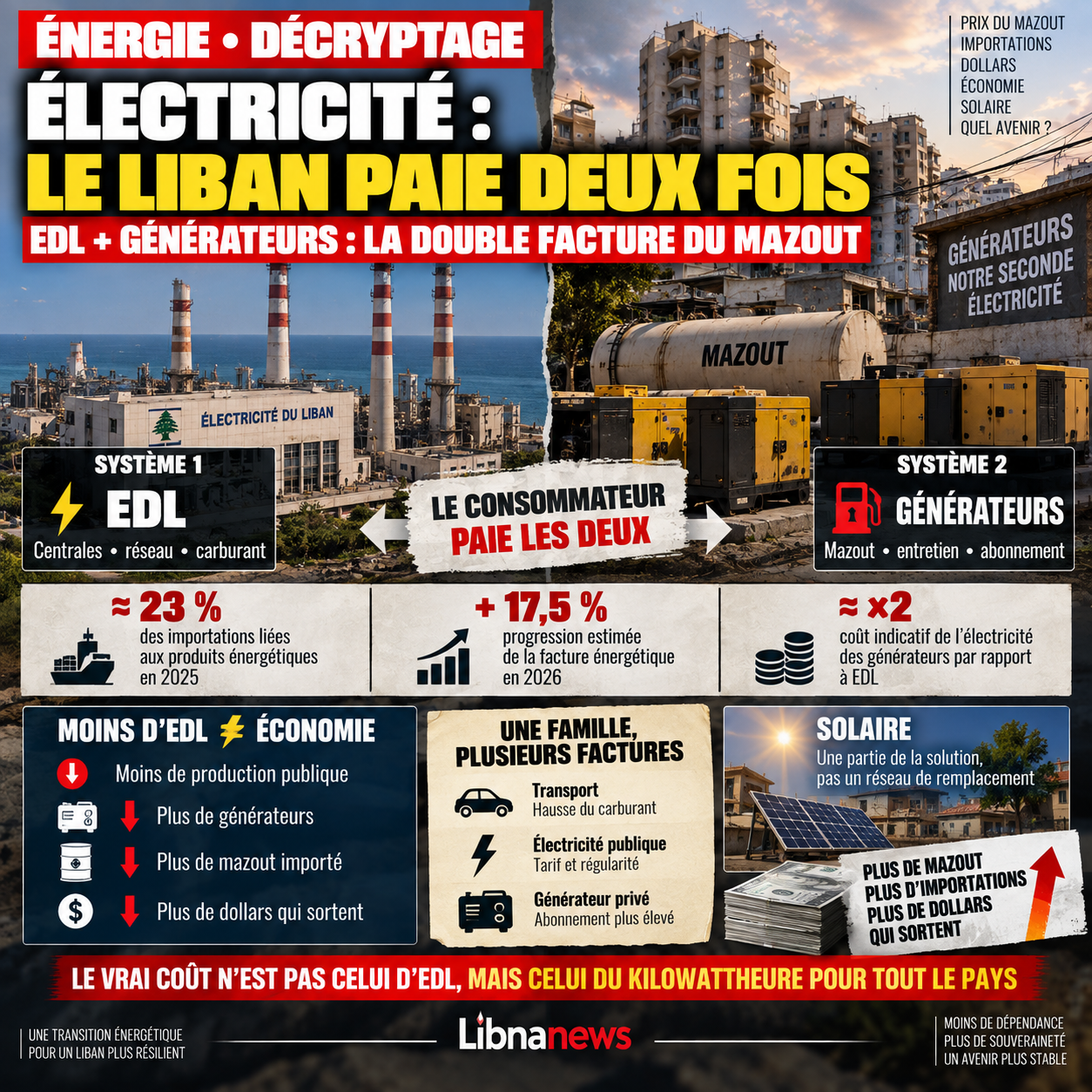
The country supports two parallel production systems. The first is based on public power plants, the national network and the electricity infrastructure of Lebanon. The latter has been developed to compensate for the shortcomings of the former and is mainly based on generators distributed in neighbourhoods, villages, businesses and buildings.
In times of relatively cheap oil, this duplication already represents a considerable cost. When oil flies away, it becomes a macroeconomic vulnerability. Every hour of electricity in Lebanon does not have to be replaced somewhere. In most cases, this replacement consumes imported fuel paid in foreign currency.
The economic data available for 2026 show the importance of the phenomenon. Energy products already accounted for about 23 per cent of Lebanese imports in 2025. The energy bill was expected to increase significantly in 2026, with an estimated 17.5% increase in the available projections. The shock is therefore not only about household bills. It directly affects the country’s dollar requirements, business costs and trade balance.
The question then becomes different from that usually asked. It is no longer enough to ask how much electricity from Lebanon to the State. We have to calculatehow much the country costs electricity that electricity from Lebanon does not produce.
The apparent economy achieved by the State can become an expenditure for the whole country
When electricity in Lebanon reduces its production due to fuel or liquidity shortages, its expenditures decrease mechanically. It burns less fuel and produces less kilowatt hours.
Accountably, this reduction may give the impression that the public sector is saving.
Economically, missing electricity does not disappear. Families continue to illuminate their homes. Supermarkets must maintain their refrigerators. Restaurants, hospitals, offices, hotels, workshops and factories need power. The demand simply moves to the generators.
The expenditure then leaves the electricity accounts of Lebanon to appear in those of households and enterprises.
This distinction is essential. Public costs may decrease, but national costs may increase.
Available economic information estimates that the production of private generators is approximately twice as expensive as that of electricity in Lebanon under the conditions examined. The difference obviously varies according to the price of the fuel oil, the efficiency of the generator, its size, its load and operating costs. But there is little doubt about the direction of the phenomenon: producing electricity with a multitude of small diesel units is generally less efficient than with a properly operated centralized system.
Each hour transferred from the public network to a generator can therefore increase the amount of resources required to provide a comparable service.
The generator is not just a backup solution
The Lebanese model has gradually transformed emergency equipment into permanent electrical infrastructure.
A generator should normally operate for a few hours during an exceptional breakdown. In Lebanon, it has been a regular source of electricity for years. In some periods, it provides more hours than the public network.
This permanence completely changes its economic weight.
It is necessary to buy the generator, maintain, change the oils, repair the engines, finance the spare parts and pay the people who operate it. To this add fuel.
Loss of efficiency is also significant. A large power plant can optimise its production more than a multitude of small engines operating with varying load levels.
The country is therefore constantly financing two production capacities: the public power plants it already owns and a highly fragmented private park.
The consumer pays both. It contributes directly or indirectly to the functioning of the public sector, then settles a private subscription to obtain the service that the former does not provide sufficiently.
It is this duplication, even more so than the isolated price of fuel oil, which explains Lebanon’s extreme sensitivity to energy shocks.
The increase in fuel oil affects businesses before reaching the consumer
For companies, private electricity is a direct component of the cost of production.
A bakery, industrial workshop, cold room or restaurant cannot simply interrupt its activity when the public network stops. The company switches to its generator or that of its neighbourhood.
When oil increases, its unit cost increases immediately.
The company then has three possibilities. It reduces its margin, which quickly becomes impossible in already fragile sectors. It reduces its production. Or it affects its prices.
In the latter case, the energy shock spreads throughout the economy.
Fuel oil becomes an invisible component of the price of bread, cold preserved food, locally manufactured product, overnight hotel or medical service.
This is one reason why an energy crisis can fuel inflation even when the currency remains relatively stable.
The phenomenon also reduces the competitiveness of Lebanese producers. A company that has to manufacture a significant part of its electricity itself is handicapped by a foreign competitor powered by a stable network.
Electrical weakness thus becomes an implicit tax on local production.
Households now have three shocks
The situation is equally difficult for individuals.
The first shock comes from transport. An increase in oil prices increases the price of gasoline or diesel used by vehicles.
The second one comes from the generator. The monthly rate depends directly on the price of the fuel oil.
The third can come from Electricity of Lebanon itself. If the cost of fuel used by the public undertaking increases over time, its financial balance theoretically requires an adjustment of the tariff.
The same household can therefore undergo the energy increase three times in the same month.
The problem becomes particularly acute when incomes do not grow at the same rate. The trade union demands of September 2026 on wages and transport compensation must also be read through this development.
The employee does not only ask for an abstract increase. An increasing proportion of his income is absorbed by the energy needed to go to work and to have electricity at home.
This pressure explains why an increase in the public tariff can become politically explosive even when it is economically justified.
More public electricity can cost the country less, even if electricity from Lebanon spends more
It is here that the paradox appears clearly.
Suppose that Lebanon’s electricity purchases more fuel and increases its production. His spending is growing. Seen only from its balance sheet, the operation seems costly.
But if each additional kilowatthour provided by the network replaces a more expensive kilowatthour produced by a generator, the country can achieve a global economy.
Public spending is increasing while private spending is decreasing further.
Therefore, the recovery of electricity in Lebanon should not be assessed solely through the amount of its fuel purchases.
The total cost of electricity to the economy must be measured.
This approach changes the way government decisions are judged. Reducing fuel purchases in Lebanon is not necessarily an economy if this reduction forces consumers to buy even more fuel oil for their generators.
The same reasoning applies to currencies. If private production requires more fuel to provide the same amount of electricity, Lebanon can eventually import more energy than in a more efficient public system.
The currency problem has become central again
Since the relative stabilization of the foreign exchange market, the issue of foreign exchange reserves is sometimes less visible than at the heart of the financial crisis. Yet it remains decisive.
Lebanon imports most of its hydrocarbons. These purchases must be settled in foreign currency.
The higher the oil bill, the more the economy has to generate dollars through exports, tourism, expatriate transfers, investments or other capital inflows.
A significant increase in energy imports can therefore deteriorate the trade balance even if other imports remain stable.
The massive operation of generators increases this dependence. Some of the dollars leaving the country are not being used to increase future productive capacity. It simply finances fuel burned to compensate for insufficient public infrastructure.
The country thus consumes foreign exchange to maintain a permanent relief system.
This is one of the major differences between productive energy expenditure and substitution expenditure. Investing in a power plant, network or solar installation creates an asset that continues to produce. Importing fuel oil for a generator allows to produce for a few hours, then the fuel has disappeared.
Solar energy has already changed the equation, but not enough
The crisis has prompted thousands of households and businesses to invest in solar energy. This movement reduced part of the demand for generators, especially during the day.
This transformation is one of the few structural adjustments produced spontaneously by the crisis.
However, it has limits. Solar production varies by time and season. Without sufficient storage, it does not completely replace the network or generators. Batteries are also an important investment and need to be renewed.
Massive solar development also raises a new issue for the public network. Consumers able to invest produce part of their own electricity. Those who cannot remain more dependent on electricity from Lebanon and generators.
In the long run, the financing of the network must therefore be rethought to ensure that the most solvent customers do not significantly reduce their public procurement while the fixed costs of infrastructure remain to be borne.
The energy transition is not simply about adding panels to roofs. It requires a network organisation capable of integrating this decentralised production.
Gas could change the cost of production, but infrastructure remains crucial
The government also refers to gas projects and regional energy links.
Gas can provide more efficient production in certain power plants designed or adapted for use. It can also reduce dependence on some more expensive petroleum products.
But again, the announcement of a project does not produce electricity.
There is a need to secure supply, have transport infrastructure, adapt power plants and conclude financially viable contracts.
Lebanon has experienced many energy projects announced and subsequently delayed by political, financial or regional constraints.
The credibility of the new strategy will therefore depend less on announcements than on the timing of implementation.
Each year of delay keeps the country dependent on the current system.
The network is as important as power plants
Increasing production is not enough if a significant part of the electricity injected is not billed or cashed.
The technical losses come from the state of the network. Non-technical losses include illegal connections and recovery difficulties.
This is why the problem of public debt is of particular importance. Electricity in Lebanon must be able to cash what it bills, whether it be a household, a business or a state-owned institution.
Otherwise, each increase in production can simply increase unrecovered amounts.
Reform must therefore proceed simultaneously on three fronts: production, networking and collection.
Treating only the first would repeat old mistakes.
The real cost should be calculated at the country level, not just the electricity of Lebanon
The Lebanese energy debate ultimately suffers from a measurement problem.
Lebanon’s electricity expenditures are relatively well known because they appear in the public accounts. Treasury transfers have long been visible and politically challenged.
The cost of the private system is much more dispersed. It is paid by hundreds of thousands of households and businesses. It therefore does not appear in the form of a single budget line.
This difference creates an illusion.
One billion spent by the State immediately appears to be a public problem. One billion divided between the bills of generators of the entire population is less visible, while it weighs equally on the economy.
To make a rational decision, the government should compare both.
How much does one kilowatt hour actually cost from Electricity Lebanon, integrating fuel, operation and losses? How much does the same kilowatthour produced by the generators cost? How much fuel oil is imported specifically for private production? How much could be saved with four, eight or twelve additional hours of public power?
These figures would help to determine the economically optimal level of public production rather than reason solely from the company’s immediate cash flow.
The oil crisis finally offers a simple test
Lebanon cannot control the world price of oil. However, it can control the amount of fuel it is wasting on producing the same electricity in a fragmented system.
This is where the real stake lies.
When public food decreases, energy consumption does not disappear. It moves towards a generally more expensive system. Lebanon’s electricity deficit then becomes a private invoice, an increase in business costs and additional pressure on imports.
Energy policy should therefore no longer seek only to reduce what the state spends on electricity. It should seek to reducewhat whole Lebanon spends to get a reliable kilowatt hour.
It is this difference that makes it possible to understand the current paradox: Electricity in Lebanon can spend less while the country spends more.