


On Thursday, November 5, Wall Street underwent a strong correction, particularly marked in technology, while the barrel resumed part of the ground lost the previous day. However, the results of the chip manufacturers show that there is still a strong demand in the data centres. This gap between industrial activity and stock prices is the driving force behind our evening economic agenda. Another warning: the Bank of England raises its policy rate to 4%, at a time when rising energy prices threaten to prolong inflation.
This edition brings together quotations available before 7 p.m. in Beirut, the latest American economic publications and the accounts of four companies. Since the sessions are not synchronized, the European, Asian and American figures do not all describe the same moment. The hours of each survey are indicated below. Quarterly accounts are used to examine enterprises; They alone do not allow each movement to be explained.
Cover photograph: Libnanews archive, published in June 2019 and used as an illustration.
Scholarships : Wall Street picks up, gaps widen
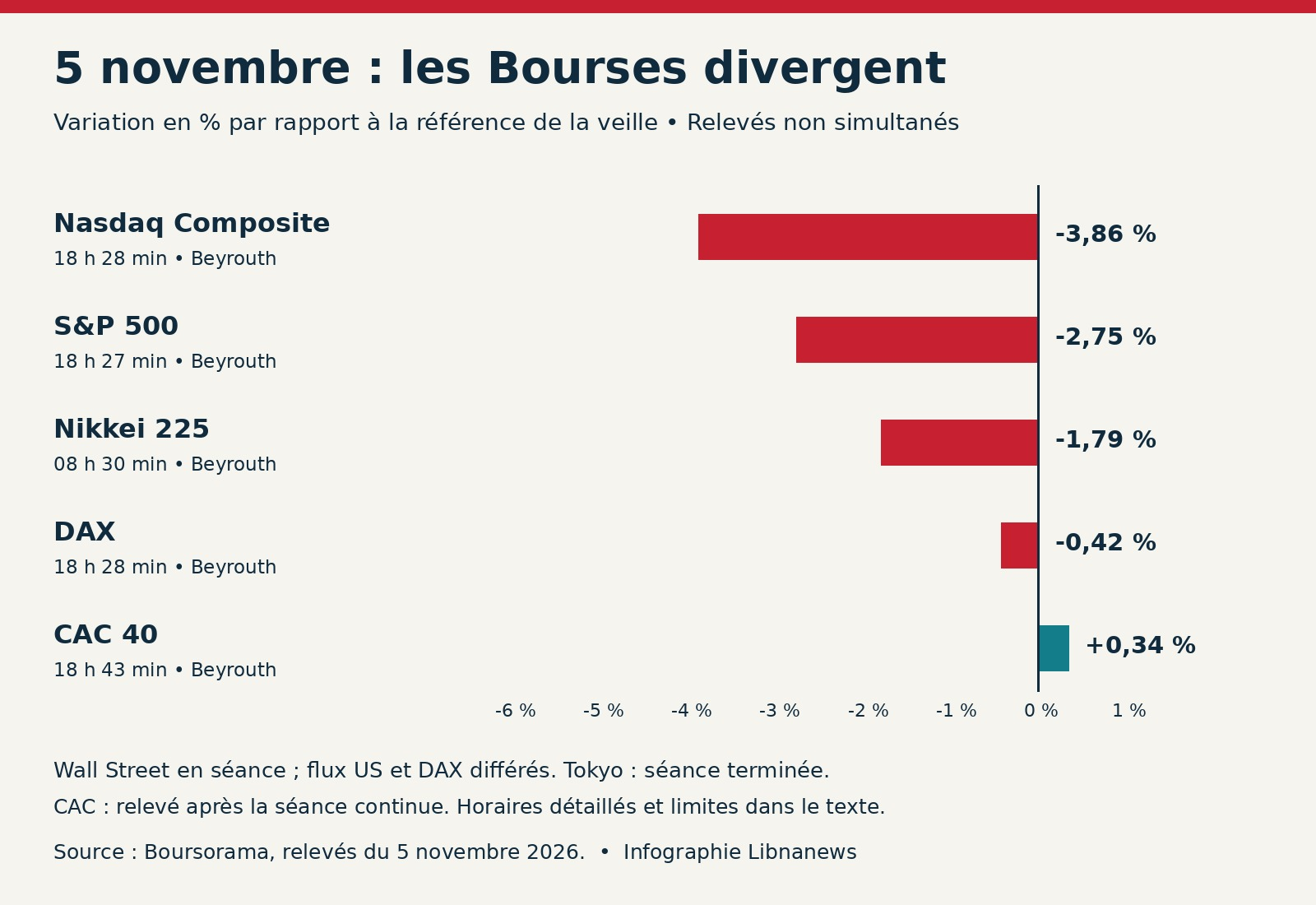
- S&P 500:7 476.87 (−2.75%), time stamping 18:27:32 in Beirut (16:27:32 UTC), delayed price.
- Nasdaq Composite:24 743.44 (−3.86%), time stamping 18:28:29 in Beirut (16:28:29 UTC), delayed price.
- ACC 40:8 205.37 points (+0.34%)18:43:15 UTC), recorded after the continuing meeting, not presented here as final closure.
- DAX:26 327.90 points (−0.42%)18:28:28 UTC), delayed price.
- Nikkei 225:61 077.90 points (−1.79%), time stamp 08:30:01 in Beirut (06:30:01 UTC), Japanese end of session.
Variations from the previous day’s reference displayed by the supplier. Time stamping of the French site converted from Paris time to Beirut and UTC. US and German data are reported as delayed; They do not constitute a simultaneous photograph or wall street fence. The Japanese record belongs to the meeting already completed.
Reuters connects part of the salesfears of stricter supervision of the expansion of data centres, after the Republican defeat in the mid-term elections. Investors thus reassess the possible pace of AI projects. This reaction focuses on future development conditions: it does not directly measure orders already delivered or profits made by companies.
The gap between the indices deserves as much attention as their direction. Nasdaq concentrates more companies whose value is based on long-term expected profits. When investors reassess the return they demand or the price they agree to pay for growth, these values can be adjusted particularly quickly. However, a sharp decline in the index does not prove the collapse of demand for artificial intelligence or the equivalent deterioration of each company making up it.
CAC 40 and DAX have different structures, with varying weights of industry, finance, luxury or energy. A comparison of their only variations therefore does not directly measure the relative health of the French and German economies. Listed groups also make a significant share of their sales outside their country. To interpret the session, it is necessary to separate the effects of sectors, currencies and business-specific news. Attributing the entire movement to a single political event would remove these differences.
The same caution applies to Tokyo. The Asian session was already over at the time of the acceleration of the American decline observed in our surveys. The Nikkei is therefore not a reaction to this phase of Wall Street. This gap is useful for reading the next day: the Asian opening will show how investors in the region absorb American movements, and then how export values respond to expected currencies and orders.
The immediate question is the extent and duration of the decline. A correction concentrated in a few large capitalisations does not have the same meaning as a general decline accompanied by a tightening of credit. Our evening photograph does not allow us to conclude on this second scenario. We will have to look at the American closure, the spread of movement between sectors and the market’s ability to absorb the new economics expected on Friday.
Oil: the rebound of the day does not erase the fall of Wednesday
In the reference series published by Boursorama, theBrentis displayed at$97.37 per barrel (+2.91%)18:33:23 UTC in Beirut. TheWTI, ICE WBS series, is to$90.76 (+3.12%)at 1833:11 UTC (16:33:11). Both flows are delayed. Since the precise deadline is not displayed on these pages, these levels are cited as indicative series, without assimilating them to a specific delivery contract or calculating a gap between contracts.
The comparison point remains the sharp drop of the previous day. Thewednesday 4 November settlement reported by Xinhuaplaced the Brent for delivery in January at $94.62 per barrel, down 8.67 per cent, and the WTI of December rated the Nymex at $88.12, down 8.29%. These dated contracts should not be confused with an indicative series whose expiry date is not specified by the supplier. Nevertheless, they give the order of magnitude of the shock before Thursday’s sitting.
A positive daily movement can therefore coexist with a price that is still much lower than before the fall. Arithmetic counts: after a decrease of 8.67 per cent, it takes an increase of about 9.5 per cent to return to the starting level. The calculation relates to price change, not a forecast. Simply speaking of « upward oil » without specifying the period would give a misleading impression of complete reversal here.
For companies, the price of the barrel is only one part of the energy bill. Refinement, transportation, insurance, taxes and purchase schedule also determine the cost paid. Depending on the form and maturity of its covers, an airline may not immediately benefit from any drop in the crude oil. An industrialist may, on the other hand, remain exposed to electricity or gas as oil relaxes. The results of an energy group themselves depend on its activity: extraction, refining and distribution do not react in the same way.
U.S. stocks provide a physical benchmark. According to EIA figures published on 4 November andreported by Reutersgross trade reserves decreased by 865,000 barrels in the week ended 30 October to 409.8 million. Distillate stocks, which include diesel and heating oil, fell from 3.6 million barrels to 99.3 million barrels. Gasoline fell from 222,000 barrels to 209 million barrels.
These variations show why monitoring of the crude oil alone is insufficient. Pressure on diesel can increase road transport and some agricultural activities, even when the reference barrel drops. But a weekly decrease in stocks does not in isolation prove a shortage: imports, exports, the operation of refineries and the season also alter the available volumes. The series becomes more informative when it is closer to several weeks and delivery capacities.
Gold, currencies and raw materials: distinguishing the price from its use
Lonce d$4,117.70 (+1.33 per cent)at 1843:17 UTC in Beirut (16:43:17 UTC). This is the reference per troy ounce, about 31.1 grams, and not the price charged for a piece or jewel. For currencies, thereference rate published by the ECB on 5 Novemberis1 euro for 1.1224 dollars. This daily reference rate is neither an instant quotation nor a bank conversion rate.
The price of gold deserves to be read with the dollar and the real rates, i.e. the inflation-adjusted returns expected. Metal does not pay income. Its relative attractiveness therefore changes with the remuneration of other assets, but also with demand for protection and institutional purchases. A session where the gold rises while the actions fall is compatible with a security search; it does not demonstrate that all buyers pursue the same objective.
For industrial raw materials, the problem of timing is particularly concrete. The copper survey available during our collection was still dated November 4. It is therefore not presented as a Thursday course. An old figure may remain useful for following a trend, provided it keeps its date. It becomes misleading when it is placed, without warning, next to updated quotations a few minutes before. The same applies to less frequently documented agricultural prices and local markets.
Enterprises: the AI accelerates, but not all revenues follow
The results of the November 5th session draw a multi-speed digital economy. Manufacturers most exposed to data centres benefit from high demand for computing power. General public outlets remain far less promising. To read these publications, two distinctions become essential: between income already achieved and business objectives, and then between accounting profits and adjusted indicators. Qualcomm, AMD, and Arm accounts measure these differences. In Europe, BT illustrates another difficulty: to convert network modernization into available cash.
Qualcomm, a diversification that still needs to compensate smartphones
Published on November 4, thequalcomm results release for its fourth fiscal quarter, ended September 27, 2026shows GAAP accounting revenue of $10.322 billion, down 8% year-on-year. Sales of smart phones dropped by 26% to $5.137 billion. The car grew by 89% to 1.990 billion, but its weight was still insufficient to erase this decline. The diluted earnings per share is $1.17 according to GAAP standards, compared to $2.17 after the group’s adjustments.
Annual comparison requires additional caution. The GAAP net profit for fiscal year 2026 jumped 146 per cent to $13.628 billion, with a tax advantage of $5.7 billion related to the resumption of a provision for depreciation of deferred tax assets. Adjusted net earnings decreased by 15%. This contrast prohibits presenting the increase in accounting profit as an equivalent acceleration of activity. At the same time, Qualcomm reaffirms a target of $5 billion in revenue in the data centres for fiscal year 2027: this is a forecast, not sales.
According toReuters, who interviewed CEO Cristiano Amon, the outlook for the next quarter does not include more flea sales to Apple. The agency also notes that sales of smart phones remain below the expectations of analysts. The industrial issue is therefore specific: new markets must replace part of the historical base, even before generating further growth.
AMD and Arm: the calculation request does not exempt from reading the details
AMD has the most dynamic side of the cycle. Itsresults published on 3 november, for the quarter ended September 26, posted $13.377 billion in revenues, up 45%. The data centre segment reached about 8.5 billion, an increase of 97%. Diluted earnings per share were $1.46 in GAAP and $2.09 in adjusted data. For the fourth quarter, management targets approximately $17 billion in turnover, with a 3% margin of change.
This strength is not uniform: video game revenues fall by 40% to $773 million. Economic reading is therefore due to the composition of sales. Orders for computing infrastructures can draw a group very strongly without reporting a general recovery in computer purchases. The objective of the next quarter will also depend on the increase in production announced by AMD; a perspective is not yet a delivery.
The British Arm, whose accounts are presented in dollars, provides a complementary nuance. Itspublication of 4 novemberfor the second quarter of financial year 2027, ended 30 September 2026. Revenues increased by 27 per cent to $1.443 billion. But licensing and other revenues are up 50%, compared to 8% for royalties. The profit per share is $0.12 in GAAP, compared to $0.52 in adjusted data. Management expects $1.54 billion in revenue in the following quarter, up to $50 million.
These two sources of revenue do not tell exactly the same thing. Licences include access to technology; fees are linked to the chips marketed.Reuters highlightsthe former exceed estimates, while the latter are lower. A large overall publication can thus coexist with a slower increase in the income attached to the delivered chips. Arm also states that the size and timing of certain contracts influence licensing revenues.
BT, profits up but cash under pressure
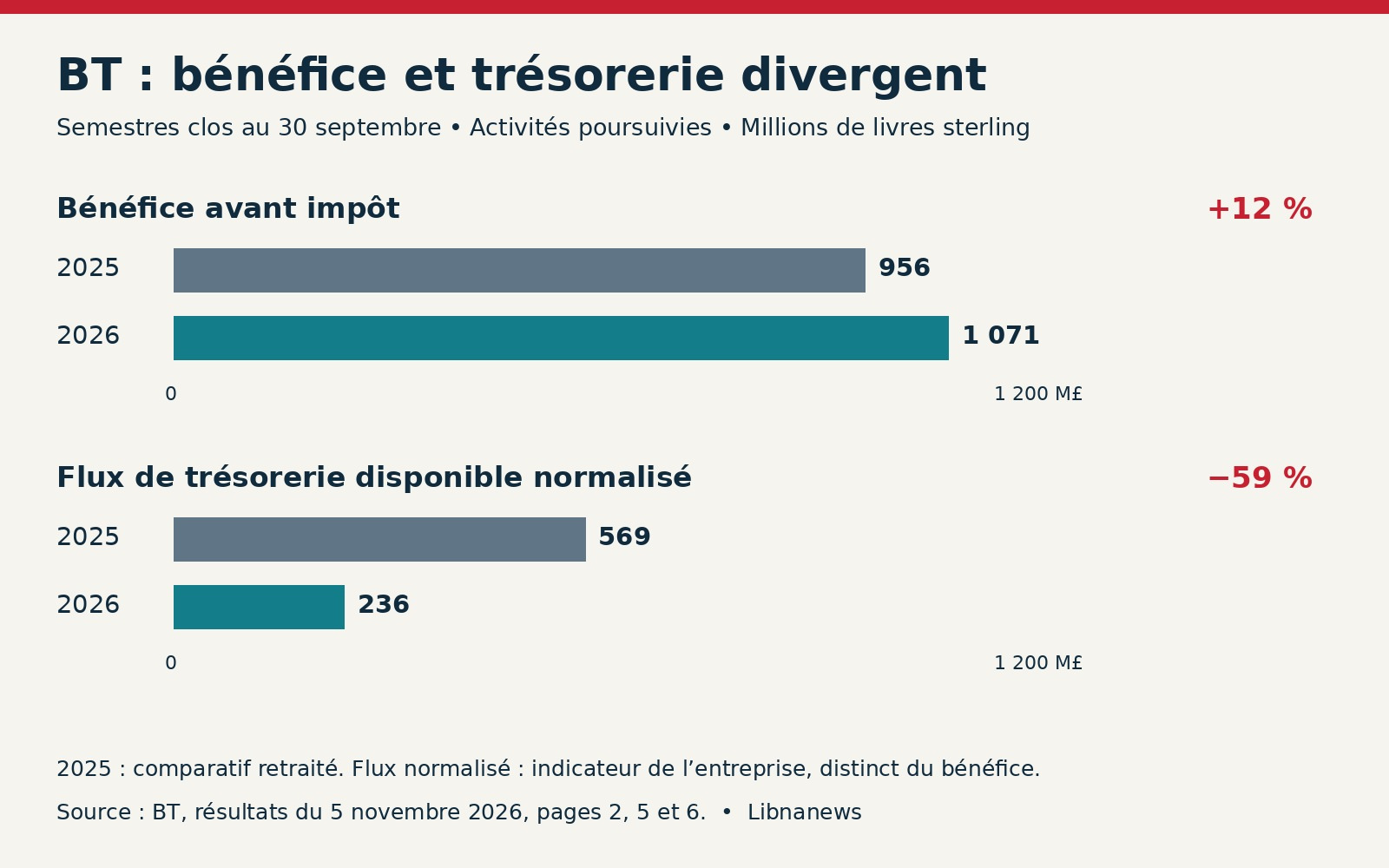
Thebiannual results published by BT on 5 Novemberoffer a European counterpoint. In the six months ended on 30 September, the activities continued generated 8,753 billion pounds of turnover and 1,071 billion profit before tax, the latter increasing by 12 %. Adjusted EBITDA, at £4.097 billion, earns only 1%. Standardized cash flow fell to Pound236 million, down by 59 per cent, due in particular to movements in working capital requirements.
However, BT maintains its target of approximately £2 billion of normalised cash flow for fiscal year 2027, excluding the effects of the acquisition of TalkTalk. The gap between half-yearly performance and annual target will therefore remain central. The achievement of this target implies a strong improvement in the second half of the year. This flow is itself a standard indicator, the scope of which excludes certain disbursements, including restructuring. The growth of pre-tax earnings is therefore not sufficient to describe the group’s financing capacity.
Why a good activity can accompany a bad session
The publications of the technology groups invite three questions to be distinguished. The first concerns real demand: do customers buy more computing capacity? Sales at AMD provide a positive response on its perimeter. The second concerns profitability: how much remains after production, research and commercialization costs? The third is a stock market: what price does the investor pay today for these incomes and for those he hopes for tomorrow? A favourable response to the first does not guarantee the other two.
The shift from investment to profitability concerns the entire AI chain. Manufacturers can register their sales before data centre operators have demonstrated the full performance of their equipment. The user companies must then convert these capacities into savings, new services or additional revenue. Each link follows its own calendar. Adding investment announcements as if they represented as many future benefits could confuse each other’s spending with the revenue of the other, without measuring the net profit of each link.
BT recalls, in another sector, that profit and money available do not always progress together. A recorded sale is not necessarily cashed immediately. Investments and payment deadlines can absorb cash while the result improves. For a company that modernises a network or builds a digital infrastructure, the analysis must therefore focus on the financing of the programme, its duration and the revenues actually generated, beyond the announced profit.
Rates and employment: economic signals that do not tell the same story
TheBank of England raised its policy rate Thursday from 3.75% to 4%. Eight members chose this increase by a quarter of a point; the ninth wanted a half point. The institution notes an inflation rate of 3.5% in September and forecasts that it could approach 5% by mid-2027. The latter figure is a projection, not a rate already observed. Energy remains at the centre of its concerns, although it still shows few signs of a sustained spread of the shock to wages and prices.
For British households and businesses, a rate increase is gradually taking place. It changes the cost of new loans and certain refinancings, but not necessarily all monthly payments the next day. For international markets, the decision recalls above all that a recent oil reflux is not enough to remove the accumulated price pressures. Central banks should assess the persistence of the shock and its consequences on behaviour, rather than following every daily change in the barrel.
In the United Statesinitial unemployment benefit applications published thursdayfor the week ended 31 October, 189,000 fewer than the revised figure for the previous week. The four-week average was 194,750. The ongoing requests relate to another week: they amount to 1.718 million for the one of October 24. Mixing these two dates or assimilating this total to the national number of unemployed would lead to a misreading.
Low initial applications indicate few new redundancies covered by this scheme. They do not provide direct information on the ease of finding a job, job creation or persons who remain outside the compensation system. The monthly report expected on Friday will therefore provide additional information. In particular, it will help to bridge the gap between employment, earnings and labour market participation.
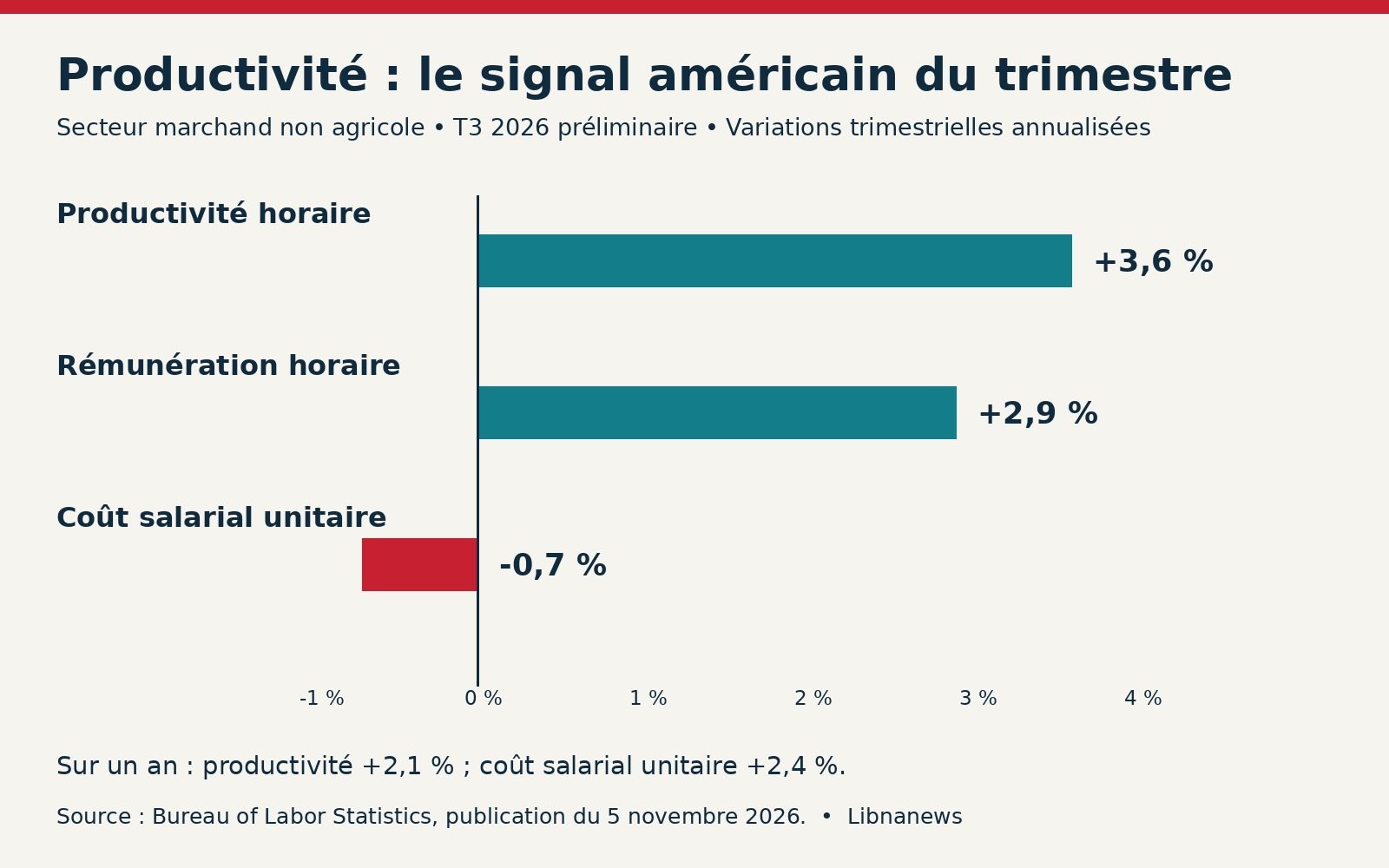
Another Thursday publication deserves to be brought closer to the AI without assigning its results too quickly. According toBureau of Labor Statisticsproductivity in the U.S. non-agricultural trading sector grew 3.6% in the third quarter at an annualized rate, in a preliminary estimate. Over a year, the increase is 2.1%. Unit labour costs are decreasing by 0.7% at a quarterly annualised rate, but are still increasing by 2.4% year-on-year. These aggregate indicators do not allow the contribution of artificial intelligence to be isolated.
In Lebanon, energy prices and access to finance remain linked
For an importing economy, a sustainable reduction in oil can ease the external payments needed to buy energy. In Lebanon, its effect on households also depends on distribution arrangements, available electricity production and fuel purchases. A single market session does not allow to quantify the future economy. The amount actually paid varies with the imported volumes, when they are purchased and the costs that add to the product itself.
Billing currency creates a second channel. A company whose sales are cashed in one currency and supplies paid in another may see its margin change without changing its volumes. The appreciation of the euro against the dollar, for example, increases in dollars a European bill denominated in euros, all other things being equal. The reverse direction can lighten this bill. Contracts and payment deadlines must be reviewed before a change in exchange rate becomes a gain or loss.
Funding is a distinct obstacle. Theannounced American displacement of Governor Karim Said, scheduled later in November, will include exchanges with the Treasury and IMF. Consultations on bank restructuring and deposits continue. No final agreement or repayment schedule was announced in the minutes of the meeting with President Joseph Aoun. An international meeting cannot therefore be counted as funding already obtained.
For local businesses, the expected concrete result of bank consolidation would be more predictable access to payments and credit. This requires credible balance sheets, transparent allocation of losses and viable institutions. It cannot be based solely on an improvement in speech. As long as available resources and funding conditions remain uncertain, a cost-effective paper project may be delayed due to a lack of cash flow. The movements of the large stock exchanges do not summarize this Lebanese constraint.
The concept of the day: the second round effects of inflation
An increase in oil directly increases the price of certain fuels. It’s the first effect. It can then increase the cost of transporting a product, heating a trade or electricity required by a factory. Companies then arbitrate between raising their prices, reducing their margin or limiting other expenses. These are, first, the indirect effects of higher energy prices, with different times and intensities depending on the activities.
The central banks mainly monitor the risk that this spread will become persistent. If everyone anticipates sustainable increases, wage negotiations and price decisions can integrate this expectation. Second-round effects refer to these broader effects on wages and prices, which may maintain inflation after the initial shock. Their appearance is not automatic. It depends in particular on competition, demand, margins and indexing mechanisms.
Productivity also changes the equation. When an employee produces more per hour, an increase in earnings can be absorbed without an equivalent increase in the cost per unit produced. This is why the reading of wages is getting closer to that of productivity. A wage increase does not mean mechanically that prices will have to rise as much.
The concept today is important because it explains the difference between a declining oil price and a central bank that is still raising its rate. The institution seeks to judge the duration of the shock and its future dissemination. Its instrument remains imperfect: a higher rate does not produce additional oil. It mainly affects credit, demand and expectations, with the risk of slowing down activity. The question is whether this cost is necessary to prevent inflation from settling in.
Friday: the American employment meeting
Theofficial american calendarprovides for the publication of the employment report on Friday, 6 November, at 8.30 a.m. in New York, 3.30 p.m. in Beirut. Job creation, wages and revisions in previous months will have to be read together. An isolated figure can be spectacular without changing the trend alone.
Until then, Wall Street’s closing will give the final measure of Thursday’s correction. For energy, it will be necessary to check whether the barrel bounces beyond the session. And for technology companies, the distinction will remain the same: the growth of the market, the profits realized and the price paid on the stock exchange are three different objects. Bringing them together in a single enthusiastic or alarmist formula would lose much information.





Comments