

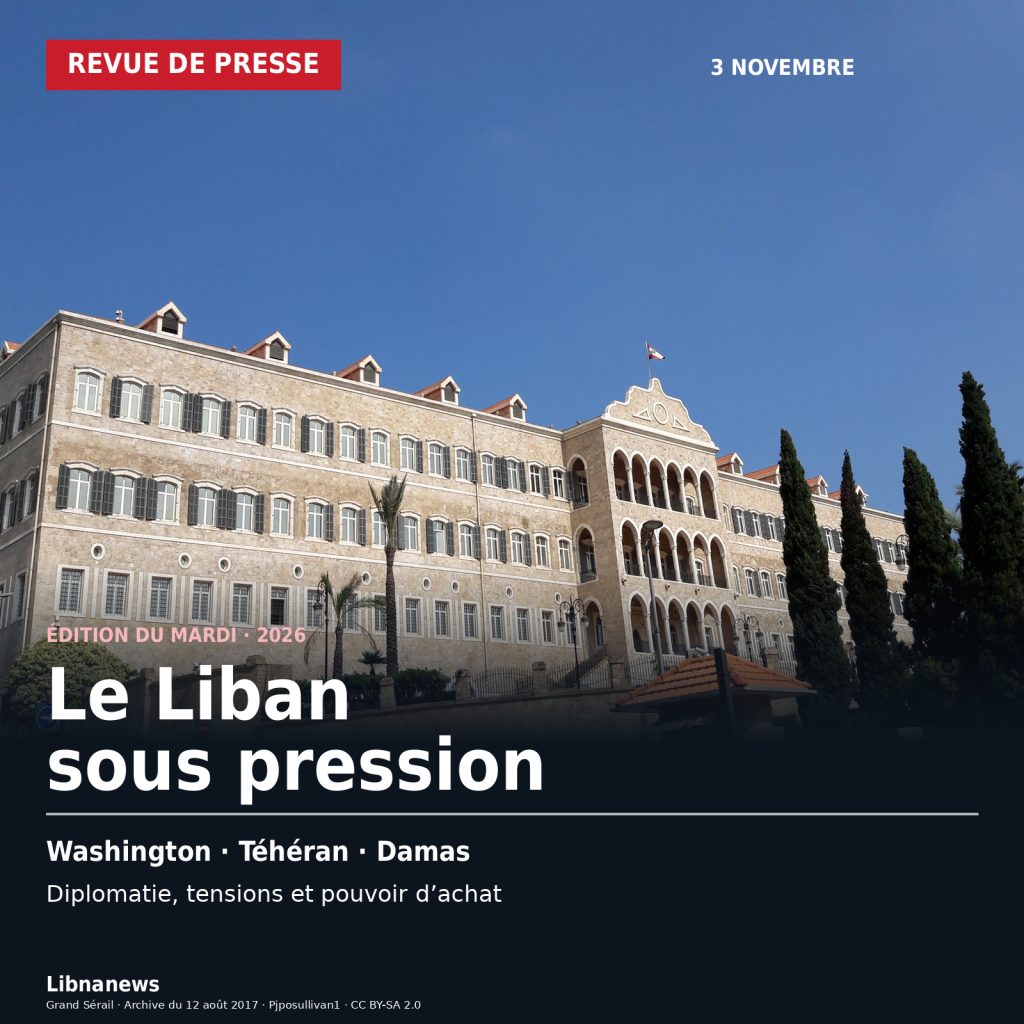
Front page: Lebanon awaits Washington and Tehran decisions
Negotiations that do not erase the military threat
The newspapers of 3 November 2026 place Lebanon in double expectation. The US elections can change power relations in Washington. Exchanges between Iran and the United States can influence regional confrontation. None of the titles provided, however, announce an agreement. Neither do they have the final results of the American election. This uncertainty dominates the one by Ad Diyar, which opposes the prospects of settlement to the risks of war. Ibrahim Nassereddine describes a country exposed to both developments, without taking a direct view of their timetable.
Al Arabi Al Jadid of 3 November 2026 highlights the intensification of indirect contacts between Washington and Tehran. Qatar and Pakistan appear to be the main intermediaries. Al Sharq Al Awsat, in its same day edition, also reports the circulation of a proposal after discussions in Doha. The scope of this progress remains limited. A text transmitted, messages exchanged and permission to negotiate are not yet a reciprocal commitment. Iranian conditions concerning the blockade and navigation remain at the centre of the reported declarations.
In the South, diplomatic expectations do not interrupt violence
The contrast with the terrain structure several narratives. Al Liwa of 3 November 2026 reports strikes, shootings and house demolitions in the south. Al Arabi Al Jadid mentions Zawtar al-Sharqiyah and several neighbouring areas. Ad Diyar illustrates his first page with destruction in this locality. These events are not presented as the consequences of a new agreement. Instead, they accompany a sequence in which de-escalation mechanisms remain contested or blocked.
The newspapers differ mainly in their reading of intentions. Al Sharq Al Awsat insists on warnings to Lebanese officials. Ad Diyar examines the possibilities for diplomatic recovery after the elections. Al Joumhouriyat of 3 November 2026 exposes the fears of a wider confrontation, while stressing the lack of a certain timetable. The common point is therefore a persistent threat. The extension scenarios mentioned by anonymous sources do not describe an operation whose trigger would be established.
Local policy: arms and state authority weigh on government
Dahr el-Baydar, a judicial procedure that has become a political issue
Al Liwa of 3 November 2026 gives an important place to the Lebanese Forces position on the Dahr al-Baydar explosives case. Georges Adwan said the party ministers would boycott the government’s meetings until the case was referred to the Justice Council. He also referred to a reassessment of their presence if the government could not act. The newspaper reports political pressure, without announcing an already decided resignation. The choice of jurisdiction thus remains a separate point of disagreement from the investigation itself.
In the same edition, Sami Abi el-Mona warns against a government crisis related to this case. His call for cohesion reveals another priority: to prevent the conflict around the judicial response from paralyzing the executive. These statements do not say the same thing. The Lebanese Forces demand a precise institutional gesture. The Druze spiritual leader insists on the consequences of a breakup. Their juxtaposition shows how a criminal case now involves the functioning of the government.
Army and the limits of coordination with Israel
Al Joumhouriyat of 3 November 2026 reports from military sources that there was no breakthrough in the Tampa talks. These sources say that the army refuses direct coordination with Israel without American mediation. Al Sharq Al Awsat develops a close reading in his edition of the same day. The sources cited point to the continued occupation and attacks. They defend the presence of an American or UN intermediary, who can also testify to the fulfilment of commitments.
These are positions reported by the press, not the text of a new agreement. They nevertheless shed light on the disagreement on the method. Technical coordination cannot be separated from its political implications. Who oversees trade? Who finds faults? What obligations are imposed on each party? The articles present these issues as still open obstacles. They do not lead to the conclusion that direct bilateral cooperation would have started.
Public Responsibilities Beyond the Security Crisis
Ad Diyar, Al Bina and Al Liwa of 3 November 2026 also report Joseph Aoun’s interview with the Minister of Telecommunications. The president asked to speed up the launch of the new telecommunications company. He stressed the rights of Ogero’s employees and the conditions for their transfer. Unauthorised networks and the role of the regulator are also included in trade. Ad Diyar states that broadband development must respect the law, without rising prices for users.
This institutional sequence concerns daily services, but it also raises the question of enforcement. The launch of a company, the protection of employees and the supervision of networks form separate dossiers. The newspapers report a presidential orientation. They do not announce that all administrative or social steps would already be completed.
Diplomacy: Beirut and Damascus bring their files together, without removing their different priorities
Ministerial delegation on several fronts
The visit to Damascus by Tarek Mitri crosses the 3 November 2026 editions. Al Arabi Al Jadid reports the previous day’s talks with the Syrian Foreign Minister. The Lebanese delegation includes the Ministers of Social Affairs, Education and Labour. Discussions focused on refugees, education, diplomas, employment and borders. Expanded meetings are followed by bilateral discussions. The newspaper places this visit in the work of the joint bodies between the two countries.
Al Sharq Al Awsat of 3 November 2026 stresses the difference in priorities. Damascus focuses on security and border control. Beirut wants to see progress on the return of refugees and the issues that accompany their presence. These two approaches overlap without confusion. Education and recognition of diplomas require administrative decisions. The return of families also implies economic conditions and security guarantees.
The return of refugees depends on concrete conditions
In Ad Diyar of November 3, 2026, Paula Mourad describes a relationship whose benefits remain unbalanced. It reports Lebanese expectations for missing persons, security and refugees. An official source points out that bilateral agreements will not suffice. International aid and livelihoods are also needed in Syria. The newspaper refers to the weakness of the Syrian economy as a hindrance to return. This analysis is not a finding that each family could enter the same conditions.
Al Arabi Al Jadid and Al Sharq Al Awsat of the same day contain an estimate attributed to Haneen Sayed, based on UNHCR data. It covers approximately 700,000 returns from Lebanon to Syria until the end of September 2026. This total is prior to the ministerial visit on 2 November. It therefore does not measure its result. Logs use it as part of the file, while new commitments remain to be specified.
An absence that does not mean rupture
The absence of Ahmad Hajjar fueled questions. Ad Diyar of 3 November 2026 reports the explanation of his office: the Syrian Minister of the Interior had reported an urgent personal impediment. The displacement of the Lebanese Minister was postponed. However, a technical team participated in the discussions. This is important because it distinguishes the cancellation of a ministerial meeting from a suspension of cooperation. There is no evidence of political disagreement that led to the postponement.
Al Arabi Al Jadid makes another distinction concerning Mohammad Haidar. The sources of Hezbollah cited by the newspaper indicate that he participates as Minister of Labour, not as representative of the party. The presence of an official associated with a political formation is therefore not enough to transform this visit into a meeting between this formation and Damascus. Exchanges remain described as government.
Qatar and the role of international partners
The Qatari role goes beyond the relationship with Iran. Al Jumhouriyat of 3 November 2026 reports an appeal between Nawaf Salam and his Qatari counterpart. Al Liwa mentions several diplomatic and security contacts with Doha. In Ad Diyar, Radwan Dib states that Qatar proposed a meeting of the group of the United States, France, Saudi Arabia, Egypt and Qatar. According to the sources of his article, Washington had expressed reservations and preferred the mechanisms already engaged.
This last reading remains attributed to the journalist and his interlocutors. It is not an official announcement of an refused meeting. However, it highlights a debate in several titles: the place of France and Arab partners in the handling of the Lebanese case. Behind the discussions on formats, newspapers describe disagreements on guarantees, the international role and ways to enforce commitments.
International politics: American elections, Israeli blockade and Iranian negotiations
In the United States, the vote remains to come in today’s editions
The newspapers of November 3, 2026 analyse the American elections before their results. Al Quds Al Arabi presents the possible consequences of a change of majority in Congress. Control of commissions may open investigations. The Senate intervenes in appointments. Fiscal negotiations also depend on the parliamentary power ratio. The veto power of the President remains an element of this balance. The newspaper therefore presents several institutional configurations, without announcing which will come out of the ballot box.
Al Jumhouriyat and Al Sharq Al Awsat of the same day reported over 54 million early votes. This number does not reveal the choice of voters or the final participation. The articles highlight the weight of the cost of living in the countryside. Al Arabi Al Jadid examines several Senate competitions and the candidates’ difficulties in responding to this concern. Election expectations remain subject to margins of error and conditions of mobilization.
Michigan occupies a special place. Al Sharq Al Awsat of 3 November 2026 describes the confrontation between Abdul El-Sayed and Mike Rogers. He recalls El-Sayed’s victory in the Democratic Primary, then Haley Stevens’ support for the Republican candidate. The newspaper also reports the place of political financing and positions on Israel in this campaign. Charges exchanged between candidates remain charges. They should not be confused with judicial findings.
Ali Barada, in Al Sharq Al Awsat, is interested in Arab-American voters. He cited a survey conducted from 16 to 23 October, with an announced margin of 4.5 points. According to the survey, 59% of respondents plan to vote for the local democratic candidate, compared with 26% for the Republican. These intentions concern the sample surveyed. They do not make it possible to predict the result of a State alone. The journalist also notes that the rapprochement with the Democrats does not necessarily imply a return to the party.
Israel: recommending Eisenkot is not enough to form a government
Al Arabi Al Jadid, Al Akhbar and Al Sharq Al Awsat of 3 November 2026 describe an impasse after the Israeli elections. The reported distributions give 53 seats to Benjamin Netanyahu’s camp, 48 to his opponents’ camp and 19 to the Arab groups. None of the first two blocks has the required 61 seats. This arithmetic makes the other supporters decisive. However, it does not guarantee that they can become a coalition.
In Al Sharq Al Awsat, Nazir Majli envisages the possibility of additional recommendations in favour of Gadi Eisenkot. However, it distinguishes between the nomination of a candidate and the formation of its government. Avigdor Lieberman refuses a minority government. Other differences relate to the participation or support of Arab parties. The articles describe red lines that can prevent a digital majority from becoming a political majority.
Al Akhbar of 3 November 2026 publishes the analysis of Nabih Awada on four scenarios. The first is based on a change government supported by the United Arab List. The second envisages a national unit including Netanyahu and opposing parties. The third involves support for ultraorthodox formations by another majority. The last is a new election. The author states that preliminary political contacts are not yet formal coalition negotiations.
The conscription of the ultraorthodox and the financing of their institutions complicate these combinations. Their place is not limited to a transfer of seats. Commitments made during the campaign and rivalries between leaders also limit rapprochements. Al Arabi Al Jadid, in its 3 November 2026 edition, highlights the refusal of some officials to depend on Arab elected officials. The role of the latter therefore remains central, but contested.
Ghazi Aridi develops this question in a forum of Al Arabi Al Jadid. The former Lebanese minister sees the Arab parliamentary weight as an influence, but also a risk of increased hostility. It calls for a common strategy. This assessment is that of an author, not the announcement of an agreement between the parties concerned. Nabih Awada warns in Al Akhbar that a change of Prime Minister would not necessarily mean a change of doctrine towards Hezbollah. The newspapers therefore do not automatically associate the alternation with a de-escalation in Lebanon.
Iran: the terms of an agreement remain in dispute
Al Sharq Al Awsat of 3 November 2026 reports the statements of Abbas Araghchi about Iran’s readiness to negotiate and respond militarily. Spokesperson Esmaïl Baghai links the security of Ormuz with Iranian demands and the end of the blockade. He claims that the Tehran proposal could be implemented within two days. This deadline describes the Iranian position. It is not a schedule accepted by Washington.
Al Arabi Al Jadid of the same day also insists on this distinction. Contacts are presented as intensive, but their outcome remains open. The Iranian president referred to an authorization to negotiate received from the guide. The contours of this delegation of authority are not fully detailed. The newspapers also report exchanges with Russia and China. Their existence confirms diplomatic activity, without proving that a compromise has been arrested.
The comments on a possible nuclear strike require special caution. Al Akhbar and Al Arabi Al Jadid report the alert of Tucker Carlson. This is a commentator’s statement, not an announcement of an American decision. Al Bina of 3 November 2026 also envisages its use in a psychological confrontation. This interpretation remains an analysis. None of these elements makes it possible to present a nuclear strike as decided or imminent.
Al Sharq Al Awsat also describes a debate in Iran on nuclear doctrine. Officials and elected officials refer to a possible review in the event of a new war. The newspaper also reports that no new decisions have been taken. Discussing a direction, threatening to change it and adopting it are three different steps. The editions provided do not confuse them.
France: Social mobilization prepares new deadline
France appeared in Al Sharq Al Awsat on 3 November 2026 through a report by Michel Abu Najm. It describes the student and high school mobilization around the number, orientation and state of the institutions. Convergence with trade unions is announced on Thursday, 5 November. The government is willing to receive representatives. The newspaper therefore describes the preparations for a future day, not its progress or its results.
The report cites ministerial sources reporting about 100 high schools blocked out of 3,700. For the 17 October demonstration, he distinguished the estimates of the organizers and those of the Ministry of Interior. This divergence recalls the need to identify the origin of the figures. It does not allow the two assessments to be merged into a single total. School demands and union coordination are the core of French news reported here.
Europe: Energy security remains linked to the Gulf
Al Arabi Al Jadid of 3 November 2026 devotes a dossier to energy relations between the Gulf and the European Union. It reports on the postponement of the planned summit in Riyadh and examines the effects of maritime tensions. Ormuz and Bab al-Mandeb appear as vulnerabilities. The possibilities of pipeline transport do not remove all constraints. The statements and projections cited in the article describe ongoing adaptations, not an acquired exit from the crisis.
Al Sharq Al Awsat of the same day addresses another European frailty: incidents involving refrigeration facilities in shops. The newspaper reports a cyberattack confirmed by Carrefour Belgium in fifteen stores. It distinguishes this case from other incidents whose origin is not established. The succession of breakdowns in several countries is not sufficient to demonstrate a coordinated attack. The file shows above all the importance of separating the confirmed facts from the reconciliations still under consideration.
Middle East: Neighboring conflicts keep their own dynamics
Al Arabi Al Jadid and Al Sharq Al Awsat of 3 November 2026 reported the resumption of fighting in several areas of Yemen. Territorial gains and losses come from local sources or belligerents. The articles also refer to the protection of navigation and the reactions of the European Union. These developments accompany the regional confrontation, but they are not limited to the negotiations between Washington and Tehran.
In Hebron, Al Sharq Al Awsat describes the return of families after their displacement. Residents report damage in their homes. The newspaper distinguishes between the announced withdrawal of certain areas and the maintenance of forces in other areas. This clarification prohibits talking about a complete departure from the city solely on the basis of the return of the inhabitants. In today’s editions, civilian testimony and military statements are not always a consistent story.
Economy: Public unpaid wages at the heart of tensions
EDL conditions the restoration of the current to the settlement of debts
Lebanon’s electricity industry is campaigning against unpaid payments from government agencies, public institutions and municipalities. According to Al Arabi Al Jadid of 3 November 2026, the cuts began gradually on 2 November. They are aimed at organizations that have neither paid their bills nor committed regularization. Public hospitals remain exempt. The institution works from updated subscription lists. It asks the media to keep to the officially announced names, in order to avoid any confusion about the actual private power services.
The restoration of food now depends on the commitments made by debtors. Ad Diyar of 3 November 2026 states that a partial payment may allow a return to service. It must be accompanied by a written undertaking providing for monthly payments. Al Liwa of 3 November 2026 confirms that administrations have regained power after a first settlement and the submission of a timetable. The campaign therefore has a negotiated recovery component, in addition to the cuts.
Beirut airport is treated separately. According to Al Arabi Al Jadid of 3 November 2026, he did not enter the cuts committed at this stage. The Department of Public Works states that it has already paid a significant portion of its invoices. The balance must be audited and then paid in instalments. The department explains the accumulation of arrears by increasing tariffs, without a corresponding increase in budget appropriations. For its part, EDL invokes the exceptional circumstances and the rising cost of oil products related to the regional war.
In the same newspaper, Ghassan Beydoun defends another organisation in the sector. This former head of the Ministry of Energy recommends reducing losses and developing decentralized production. In particular, it proposes solar projects involving municipalities and the private sector. This is an expert proposal. It does not correspond to a programme already adopted.
Wage recovery remains under discussion
Ad Diyar of 3 November 2026 devotes an interview to Béchara Asmar on the loss of purchasing power. The union leader announces a next meeting and is seeking an applicable agreement with employers and the Ministry of Labour. However, it refuses to confirm a percentage increase. Discussions have not been completed. The newspaper thus distinguishes wage claims from a decision actually made.
The file also covers transportation allowances and family allowances. According to daily reports, these issues were examined by the index committee in September. They accompany the debate on remuneration, while current expenditure is on households. No final global agreement is announced in the interview. Asmar insists on seeking a formula that the parties can implement.
The link with social protection also occupies a place in its explanations. An increase in earnings may increase contributions to the National Social Security Fund. Asmar therefore links wage negotiations with the means available for medical benefits. In addition, a source from the Ministry of Labour proposes a periodic indexation review every three or six months. Ad Diyar presents this lead as a proposal. It is not an automatic mechanism that has already entered into force.
Budget 2027 moves forward in committee, with a tax debate still open
The Parliamentary Finance Committee adopted the first two chapters of the 2027 draft budget. Ad Diyar of 3 November 2026 reports the work led by Ibrahim Kanaan, in the presence of Minister Yassine Jaber. These chapters include revenue collection, expenditure, borrowing and credit transfers. This stage concerns the examination in committee. It does not mean the final adoption of the budget by Parliament.
Payment appropriations related to old programmes should be suspended rather than abolished. According to Ad Diyar, some of these commitments date back to 2000. The committee wishes to re-evaluate them before the next budget. Al Liwa of 3 November 2026 also reports this zeroing of credits, pending their examination. Both reports distinguish this freeze from a definitive abolition of the programmes.
Ibrahim Kanaan also claims to refuse new taxes and rights. However, the tax debate remains open. Ad Diyar announces that it will continue to review the tax articles of the project this Tuesday. The position of the chairman of the committee therefore accompanies a procedure still in progress.
Banks contest tax treatment of accounting gains
Al Sharq Al Awsat of 3 November 2026 describes a dispute between the Lebanese banks and the Ministry of Finance. The dispute concerns accounting gains related to international government bonds, provisions and exchange rates. The banks argue that the gains concerned have not been cashed. They contest their tax treatment and invoke the possible consequences on their liquidity.
The Department relies on regulatory decisions and legal advice. Technical meetings are expected, while the deadline has been extended. The newspaper does not report agreement resolving the dispute. Banks also highlight a risk to depositors. This argument is part of their position in the tax debate; It does not alone demonstrate how a possible charge would be distributed.
Justice: procedures remain separate from political accusations
Dahr al-Baydar’s case is not a judgment
Al Liwa of 3 November 2026 reported military charges against thirteen persons in the Dahr al-Baydar explosives case, two of whom were detained. These indications describe a procedural step. They do not establish the guilt of the persons concerned. The debate on referral to the Justice Council remains open. The parties’ requests concern the institutional treatment of the case, while criminal responsibilities must be determined within the judicial framework.
Al Joumhouriyat of the same day places this case in the tensions around weapons and public authority. The distinction between investigation, prosecution and adjudication remains essential. Political comments do not fill in what newspapers do not document on the evidence or acts attributed to each individual. The review therefore considers the status of the proceedings reported, without turning suspicions into conclusions.
Food security leads to a separate investigation
Al Liwa and Al Bina of 3 November 2026 report a meeting chaired by Nawaf Salam after suspicious cases of trichinellosis. A sample of ground meat in a closed establishment is announced as positive. The origin of the contamination and the hypothesis of fraud remain under investigation. The articles refer to inspections and possible prosecutions. They do not make it clear that a fraudulent mixture of meat would have been established.
Closure is a measure reported by newspapers. It does not replace the search for the source of contamination. The case requires health checks and, according to their results, judicial follow-up. This distinction avoids pre-assigning an intention or liability that the available evidence does not demonstrate.
In Iraq, the guarantees of trials of French nationals are challenged
Al Quds Al Arabi of 3 November 2026 recaptures a report on the hearings of French people transferred from Syria to Iraq. The text describes several stages of judgement and reports the criticisms of rights organizations. These include translation, speed of proceedings and allegations of torture. French lawyers also said they were prevented from entering Iraq. These claims are attributed to their authors and do not constitute independent judicial findings.
The report distinguishes between individual situations, including that of an accused who claims to have been taken to Syria as a child. This account cannot be extended to all files. The question raised by the article concerns the conditions of trial and access to the defence. The responsibilities of each accused must be kept under separate review.
Society: housing subsidies and responses to social needs
Hezbollah resumes support for displaced families
Al Akhbar of 3 November 2026 reports on the resumption of Hizbullah’s housing aid. In his article, Zeina Hammoud refers to payments covering one year. The amount pledged is $14,000 for Beirut and its suburbs, compared with $12,000 for other regions. The scheme covers families whose homes were destroyed or rendered uninhabitable during the wars of 2024 and 2026. It also targets displaced people from the occupied border areas. These aids are the responsibility of the party, not a Lebanese state programme.
According to Al Akhbar of 3 November 2026, the lists of beneficiaries were updated. Households that repaired their homes were removed, while others were added. Ad Diyar of 3 November 2026 reports the launch of the campaign « Promesse et engagement ». The newspaper mentions trafficking in Nabatiyeh and Charqiyeh, based on a Hezbollah announcement. His brief does not specify an amount.
Handicaps and the dangers of ammunition on today’s agenda
Al Liwa of 3 November 2026 announces the launch of the National Strategy for the Rights and Inclusion of Persons with Disabilities. The Ministry of Social Affairs organizes this meeting on the same day at the Grand Sérail. Nawaf Salam must participate. The appointment is held under the patronage of the Head of Government.
In the same edition, Al Liwa announced an awareness-raising activity on the dangers of ammunition in Tebnine. The Italian UNIFIL forces are scheduled to organize it on 3 November.
Detainee families question prison health authorities
Al Liwa of 3 November 2026 relays the announcement of the death of a prisoner transferred from Qobbeh prison to the hospital. The Inmate Family Committee states that this man suffered from chronic illness. This clarification comes from the committee. It alone does not constitute a medical conclusion on the causes of death.
The Committee calls for an improvement in the health conditions in detention. He also requested an amnesty, according to Al Liwa of 3 November 2026. The newspaper reports these claims without providing a detailed response from the prison authorities.
In Hasbaya, a local party supports olive growers
Ad Diyar of 3 November 2026 reports the inauguration of the first festival and olive exhibition in Hasbaya. Minister of Agriculture Nizar Hani participates. Organized over two days, Hermon Marathon joins the unions of the municipalities of Hasbani and Arkub.
According to Ad Diyar of November 3, 2026, this demonstration aims to support war-affected farmers. It celebrates local olive production in a region facing the consequences of the conflict.
Culture: Marcel Khalifé, memories of Beirut and November meeting
Fifty years later, Marcel Khalifé reread through Mahmoud Darwich
Al Arabi Al Jadid of 3 November 2026 returns to the fifty years of « Promesses de la tempeste ». This title, translated in French, refers to the work published by Marcel Khalifé in 1976. Mohammad al-Sayed al-Tantawi linked his creation to the departure of Amchit musician to Beirut during the civil war. His analysis focuses on the dialogue between music and the poems of Mahmoud Darwich.
Criticism covers four sets of themes. The mother’s nostalgia is close to love faced with conflict, then identity, exile and hope. He also studied the role of lute and piano. In his eyes, Khalifé gives the worms an intimate force that exceeds the only militant declamation. This judgment belongs to the author of the article. This is not a new statement by the composer.
Al Arabi Al Jadid of 3 November 2026 also evokes a reissue for this 50th anniversary. According to the newspaper, she preserves the four poems of Darwich and withdraws « Jafra », written by Ezzedine Manasra. The article finally recalls the praise addressed to the musician by Jacques Derrida during a Parisian evening in 1997. This critical return accompanies a discographic anniversary; No current Khalifé concert is announced in this text.
In Beirut, photographers explore memory and belonging
Al Arabi Al Jadid, 3 November 2026, presents an exhibition at the Bossa Nova Hotel in East Beirut. His title translates as « And in our two bodies, a sky embraces an earth. » It is inspired by Mahmoud Darwich. The closing date is Wednesday, November 4. Rabih Farran’s report describes a journey dedicated to the memory, loss and connection of women with the places.
Five artists participated: Amira al-Naal, Ola Mohammad, Saba Karim, Hiba Ahmad Said and Yaqin Yamani. The exhibition brings together photographs, archives, texts, sounds and drawings. It also contains contact sheets. Thanaa Farouk is the police station. According to Al Arabi Al Jadid of 3 November 2026, Candid Foundation carries out this initiative, funded by the German Ministry of Foreign Affairs.
The newspaper focuses on Hiba Ahmad Said’s work in Taez, Yemen. His project, which is translated as « mandatory direction », deals with mines and explosive remnants. He follows Abdel Raqib Ali Ahmad, a former restorer of heritage who became a rescuer. Amputated from a leg after a shot, this man reconnected with the drawing and heritage models. His journey gives a face to the lasting effects of the war presented in the exhibition.
The graphic novel tells life after the explosion of the port
Al Arabi Al Jadid, November 3, 2026, reports a graphic novel by Hilal Shuman and Emma Haraké, published by Diwan. His title translates as « I’m not here, I’m not here ». The book starts with the explosion of the port of Beirut in August 2020. It deals with survival, justice and the choice of leaving or staying. Emigration to Canada also belongs to this universe.
According to the newspaper’s presentation, the project comes from a text composed of thirteen fragments. The collaboration between the writer and the cartoonist then combines images and poetic prose. The authors chose not to represent the explosion itself. Their work is about the life that follows him. The story thus relates to links with Beirut and to displacement, rather than to a visual reconstruction of the disaster.
Ad Diyar of 3 November 2026 proposes another memory path with the autobiography of Jean Hawat. Nader Kaspar presents this book, whose title is translated as « My Experience ». The former secretary general of the National Bloc traces a route between law and politics. The report links this personal journey to Lebanese history.
In Akkar, Al Liwa of 3 November 2026 reports the launch in Barkail of a book by Moussa Moussa. The book brings together local folk stories and traditions. This news highlights another form of transmission: stories related to a territory and its inhabitants.
Cinema and tributes to the November programme
Al Arabi Al Jadid, November 3, 2026, announces the Marrakech International Film Festival from November 20-28. The reported programme brings together 76 films from 39 countries. Marion Cotillard must preside over the jury. The newspaper reports the presence of a film by Lebanese director Rami Kodeih, built around a bank robbery in a context of economic crisis.
In Lebanon, Ad Diyar of 3 November 2026 mentions an invitation to the premiere of a film on independence. His title is translated as « Lebe ». Tony Abu Elias and Mirna Khayyat announce this screening for November 18. The same edition reports the creation of an association dedicated to culture and creation in memory of Talih Hamdan. A tribute is scheduled for 15 November in the Ain Anoub public hall.
Sport: The cost of travel weighs on Lebanese stands
Fuel goes into the supporters’ budget
Al Akhbar of 3 November 2026 examines the effects of cost of living on the presence of the public in Lebanese stadiums. The newspaper relies in particular on the meeting between Jouaya and Nejmeh. The evidence gathered raises questions about fuel prices and travel costs. Attending a match thus imposes an expense that exceeds the only access to the stadium.
The place of the meeting counts in the situations described. The report highlights differences in attendance according to the location of the speakers. It links these deviations to the constraints encountered by supporters to move. These testimonies describe concrete difficulties. They do not constitute a national measure of the decline in the number of tributaries and do not allow to quantify its extent for the whole championship.
In Al Liwa of November 3, 2026, Nejmeh’s coach, Armen Menassian, greets his players and their audience. This statement highlights the role of supporters in the club’s life, while Al Akhbar documents the expenses needed to follow the meetings.
Two separate dates for beach football
The Lebanese selection prepares the Arab Beach Football Cup in Port Said. Al Liwa of 3 November 2026 announces the competition from 5 to 9 November. Lebanon is included in a group comprising Morocco, Oman and Libya. This tournament is the first of two events presented by the newspaper for selection during the month.
The Asian Cup will follow in Thailand from November 18-28, according to the same number. Lebanon will meet with Iran, Vietnam and Afghanistan. This is a separate competition from the Arab tournament in Egypt. On November 3, the two competitions remain to come.





Comments