

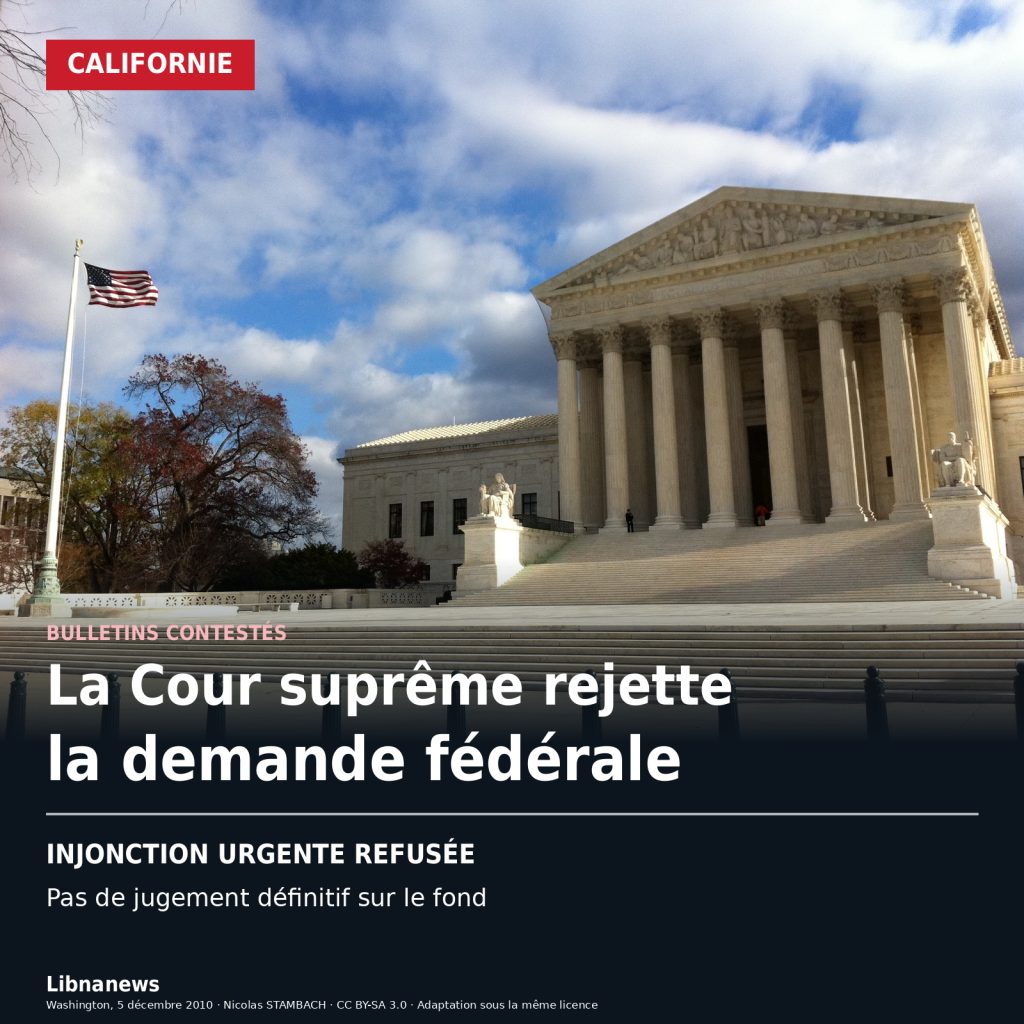
The US Supreme Court rejected on Monday, November 2, the Trump administration’s application for an injunction against disputed ballots in California. The official register of case 26A624 confirms this refusal, after transmission of the application to the Court by Judge Elena Kagan. This is the rejection of an emergency measure pending the appeal, not a final judgment on the substance of the dispute.
Another decision against federal applications
Federal judge James Boasberg granted Monday, November 2nd a preliminary injunction against Trump’s requests for disputed ballots in California. In its reasons dated 2 November, the Court allowed part of the complainants’ request. The decision is also reported by Associated Press and identified by the legal follow-up to Just Security. It intervened on the eve of the mid-term elections.
In the case of Trujillo and Coalition for Humane Immigrant Rights against the Department of Homeland Security, the Washington Court prohibits federal authorities from requiring Californian electoral officials to separate ballots, or derogating from existing electoral procedures, based on lists of suspected non-citizens. These grounds allow in part, and in part reject, the request for an emergency measure. They do not constitute a final judgement on the merits and are distinct from the appeal to the Supreme Court.
In a separate case, DSCC against Trump, the same judge refused on 2 November the emergency measure requested by democratic organizations and officials. The complainants had not sufficiently established their standing, for lack of current or imminent damage. The judge states that this limited decision does not validate the legality of federal applications. It is distinct from the protection afforded to the complainants in Trujillo/CHIRLA.
What Washington asked the Supreme Court
Donald Trump’s administration appealed to the U.S. Supreme Court on Monday, November 2, asking for the removal of disputed ballots in California, reports Reuters. The process took place on the eve of the mid-term elections on 3 November, after several legal setbacks. It concerns correspondence votes related to approximately 20,000 electors whose citizenship is challenged by the federal government.
The Department of Justice wanted the ballots concerned to be separated from the others and not counted before verifying the citizenship of electors. According to Reuters, he requested a temporary intervention. Washington’s suspicions do not constitute a judicial finding of fraud involving all the persons concerned.
In its application, as reported by Reuters, the Government maintains that once the disputed votes were mixed with the others, it would be impossible to redress the damage it claims. The Californian authorities challenge both the reliability of the list and the feasibility of sorting in an already committed election.
Emergency measure denied on appeal
On 30 October, the Federal Court of Appeal of the Ninth Circuit rejected Washington’s application for an injunction by two votes to one. The Order, in File 26-7231, explains that the government did not demonstrate that this exceptional intervention was warranted during an election already initiated.
The majority stressed the risks of late changes in electoral procedures. According to the evidence adopted by the judges, the necessary technical adjustments could disrupt the treatment of votes and deprive voters of their vote. On the contrary, the dissenting Judge Patrick Bumatay defends a temporary separation to verify the eligibility of the persons concerned.
In particular, the dispute is between the federal government and California Secretary of State Shirley Weber and the Los Angeles County Electoral Officer Dean Logan. On 15 October, the government launched its action. After a hearing on 27 October, the court of first instance refused the action requested the following day.
The disputed ballots in California, a list discussed
Californian authorities reject Washington’s accusations. In a statement on the refusal of the court of first instance, the State Attorney General, Rob Bonta, considers that an administration cannot deprive thousands of people of their rights on the basis of allegations of non-citizenship which it considers unreliable.
His office also pointed out that federal estimates had changed sharply: according to the press release, the administration had referred in July to over 190,000 alleged non-citizens registered in California, before reducing its list to about 20,000. These figures describe the successive accusations of the government; They don’t show so many illegal votes.
The Supreme Court’s refusal was verified in its registry on 2 November at 2341 UTC, or 1841 hours in Washington. The exact time of the decision is not indicated. This procedure does not provide any electoral results: the November 3 elections must determine the majorities in the House of Representatives and the Senate.





Comments