

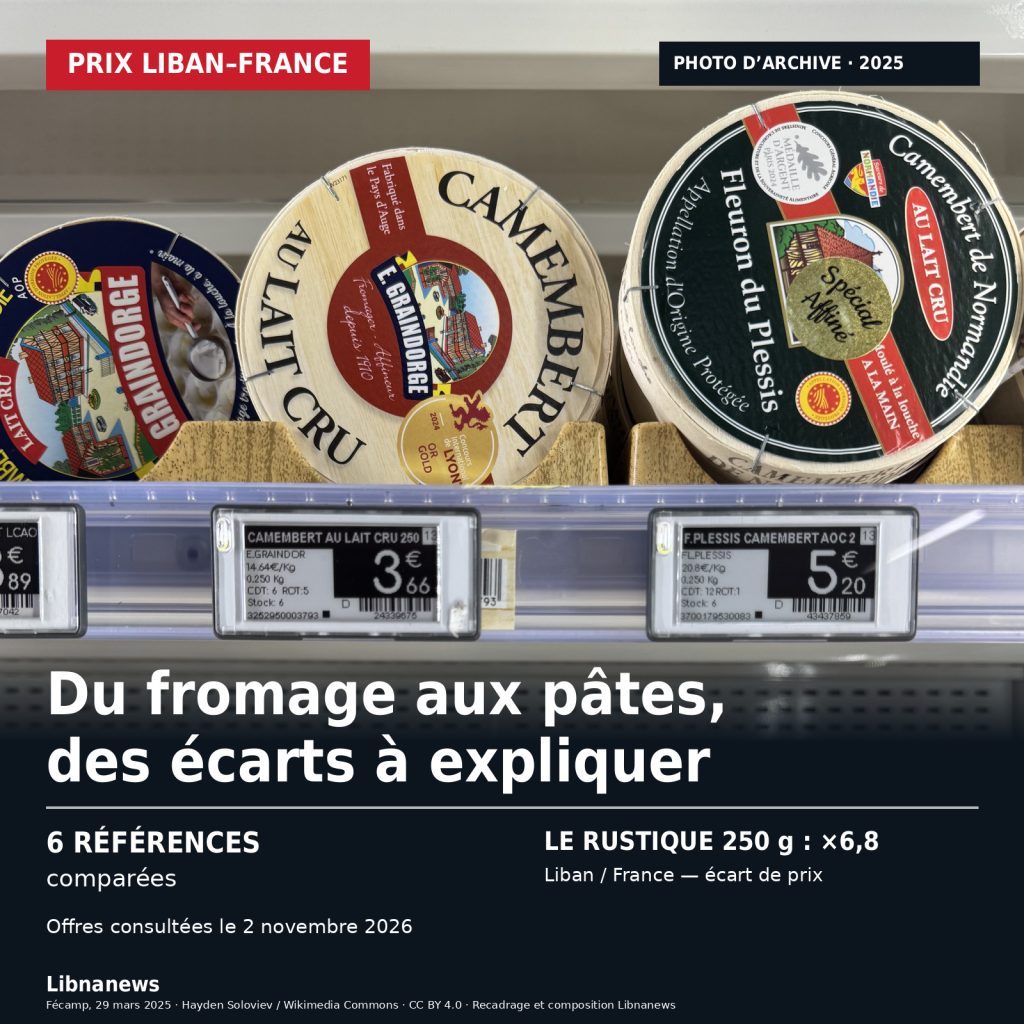
A 250 gram camembert Rustic displayed at $18.24 in Lebanon, compared to the equivalent of $2.68 in France. The comparison of Lebanese-France prices, relaunched by Fady Abboud on November 1st, deserves better than a temporary indignation. The statement of available offers confirms this dramatic deviation for this reference. It also reveals a less uniform situation: the differences are important for two other cheeses, much weaker for pasta and reversed for butter.
The six comparisons below relate to Carrefour offers in Lebanon and France. They bring together brands, variants and formats. They are neither a national price index nor a comparison across Europe. French prices come from indexed official pages, some of which are two weeks old. The finding justifies an investigation into price formation, without allowing the mechanical allocation of any deviation to the benefit of an importer.
Lebanese-France prices: six references, very different differences
In Lebanon, offers were raised on 2 November between 1959 and 2009 hours Beirut time. The site used the Hazmiah-Baabda area. No specific French stores were selected. The figures should therefore not be presented as a guaranteed comparison between two retail outlets in Beirut and Paris.
The conversions use 89,500 Lebanese pounds for one dollar and 1,1216 dollars for one euro, official references of 2 November. They are only used to compare amounts. They do not represent a guaranteed course for a bank payment.
| Product and format | Lebanon, books | Lebanon, dollars | France, euros | France, dollars | Indicative deviation |
|---|---|---|---|---|---|
| The Rustic, camembert 250 g | 1 632 170 | 18,24 | 2.39 | 2.68 | +580.3 % |
| Garlic and herbs, 150 g | 887 753 | 9.92 | 2.25 | 2.52 | +293.1 % |
| Caprice of the Gods, 200 g | 1,340,876 | 14.98 | 2.95 | 3.31 | +352.8 % |
| Sweet gourmet president, buttermaker 250 g | 289 444 | 3.23 | 3.29 | 3.69 | -12.4% |
| Barilla Penne Rigate n°73, 500 g | 130 065* | 1.45 | 0.99 | 1.11 | +30.9% |
| Barilla Spaghettini n°3, 500 g | 103 155* | 1.15 | 0.99 | 1.11 | +3.8 % |
* Promotions posted in Lebanon with no established end date. Calculation of rounded front deviations. The French pages indexed were dated the day for Boursin, Caprice of the Gods and Penne, the day before for Le Rustique, and about two weeks for President and Spaghettini. More recent official lists corroborate these last two prices. The Boursin French card bears a catalogue mention, without any fully established promotional conditions. French rates may vary depending on the store and the mode of withdrawal.
This means that it costs about 6.8 times the French amount withheld. Boursin approaches this amount four times and Caprice of the Gods exceeds four and a half times. These differences do not disappear with a few cents of exchange rate change. They are large enough to call for a detailed explanation of the commercial chain.
Butter is an indispensable counter-example. The comparison is about a 250-gram President Butler, not a cheaper one. At these prices, the Lebanese product is about 12% below the French offer. As for pasta, promotions significantly reduce the difference. A selection limited to the most expensive cheeses would have given a misleading picture of all imports.
A retail deviation does not give the importer’s margin
The French price already includes the costs and the margin of French trade. It does not correspond to the invoice of the supplier to the Lebanese importer. Subtract $2.68 from $18.24 gives a difference between two retail prices. This transaction does not measure the benefit of the distributor or its supplier.
To explain this difference, you need to know the purchase price, transport, insurance, duties and taxes actually paid. It adds storage, cold, possible losses and stock financing. The successive margins must then be distinguished: importer, potential wholesaler and retailer. None of these amounts are documented for the six references examined.
This limit does not exempt professionals from an explanation. Invoking « the costs of Lebanon » as a whole is not enough to justify a price multiplied by almost seven times. Conversely, the comparison alone does not demonstrate an illegal overbilling or agreement. The specific economic question is how much of the supplement corresponds to verifiable expenditure and what proportion reflects low competitive pressure.
Not all European products are free of customs duty
The controversy is also based on the idea that a European origin would necessarily abolish entry duties. This statement is too general. The trade agreement distinguishes industrial and agricultural products. For the latter, preferences vary according to customs classification and origin conditions.
For example, the original agricultural protocol provides for the exemption for butter on line 040510. It maintains preferential duties on certain categories of cheese. Its concessions lead arithmetically to 28% for other non-Kashkaval cheeses and 49% for certain fresh cheeses. These are the provisions of the original text, not a standard certified rate for each box sold today.
The exact classification of references, the applicable amendments and the original justifications remain to be verified. It would therefore be just as imprudent to assert a total absence of duties as to present these percentages as the levies actually paid on the products in the table. The decisive piece would be the corresponding import declaration accompanied by the supplier invoice.
Exclusives must be examined in practice
The Lebanese Competition Act of 2022 amended the protection of exclusivity. Article 5 makes the exclusive clause inapplicable to third parties and opens the import to Lebanese persons fulfilling the conditions laid down. Food products are specifically targeted. This is not to prohibit any private contract of exclusive representation.
The practical issue remains market access. Can a competing distributor buy the reference, import and sell it under economically viable conditions? Do suppliers agree to supply? Do transport costs, minimum volumes or payment terms make this competition possible? A right to import produces little effect if no one can actually exercise it.
These questions require verification, not an automatic accusation against a sign or a brand. A high price does not prove exclusivity, and exclusivity alone does not prove an infringement. On the other hand, the authorities have a concrete ground to examine entry barriers where significant differences persist.
The Council of Ministers approved new appointments to the Competition Council on 10 September 2026. Presenting this body today as never constituted would be inaccurate. The issue is now its actual action: requests for documents, review of practices and publication of reasoned decisions. No records for these six products were established in the items consulted.
Banks have a cost, but which one?
The banking crisis has also deteriorated trade finance. The freezing of deposits and the weakening of credit, documented by international institutions, complicate the cash flow of companies. An importer may have to increase liquidity or immobilize its funds longer. These constraints may affect prices. However, their effect must be quantified for each circuit.
Payment commissions offer a more concrete example. A brochure from Byblos Bank, dated August 2025, indicated for certain international transfers of companies in fresh funds a commission of 4 per thousand, with a minimum of $25 plus $25 SWIFT fees. Four percent mean 0.4 percent, not 4%. This historical tariff does not establish the current cost of an importer or the negotiated terms of its transfer.
Fixed charges weigh more on a small operation than on a large bill. Their distribution among the units therefore depends on the amount of the payment and the volume imported. Some importers also use accounts abroad. It would be abusive to charge all the extra money observed to a passage required by a Lebanese bank.
The criticism of the banking system must focus on its real service to the economy: access to credit, cost of payments and availability of funds. It would lose its precision if an undocumented commission became the universal explanation of each excessive price.
What Signs and Authorities Can Document
This record remains an imperfect snapshot. Bar codes common to versions sold in both countries have not been established. Export earnings, lots and deadlines were not compared. No purchase or check-in confirmed the availability. The six references do not represent a family’s food basket.
However, the offers posted are sufficient to ask specific questions. Signs can confirm prices and their application dates. Importers may document costs returned to Lebanon. The administration can verify the duties actually paid and obstacles to competition. The next useful step is this decomposition, reference by reference, rather than an overall justification that consumers cannot control.
Sources and method
Commercial fact sheets consulted on 2 November 2026. French prices come from the indexed versions indicated in the table note. Legal and banking documents are dated: they do not replace an existing customs invoice or liquidation.
- Carrefour Lebanon: Rustic camembert 250 g
- Carrefour France : Le Rustique camembert 250 g
- Carrefour Lebanon : Garlic and herbs 150 g
- Carrefour France : Garlic and herbs 150 g
- Carrefour Lebanon : Caprice of the Gods 200 g
- Carrefour France: Caprice of the Gods 200 g
- Carrefour Lebanon : President sweet gourmet butter, butter/barquet (NOT plate) 250 g
- Carrefour France : President sweet gourmet butter, butter/barquet (NOT plate) 250 g
- Carrefour Lebanon : Barilla Penne Rigate n°73, classic 500 g
- Carrefour France : Barilla Penne Rigate n°73, classic 500 g
- Carrefour Lebanon : Barilla Spaghettini n°3, classic 500 g
- Carrefour France : Barilla Spaghettini n°3, classic 500 g
- Publication of Fady Abboud, November 1, 2026
- ECB, exchange rate 2 November 2026
- Bank of Lebanon, daily rates
- EU-Lebanon agricultural protocol, original text, pages 5–6
- European Commission: Agricultural Agreements with the Southern Neighbourhood
- Lebanese Competition Act 281/2022, in particular Article 5
- Council of Ministers, appointments of 10 September 2026
- IMF mission to Lebanon of 5 June 2025
- World Bank, Macro Poverty Outlook, October 2025
- Byblos Bank, tariff brochure of 21 August 2025





Comments