


Nvidia’s results confirm the strength of spending on artificial intelligence, without removing questions about margins and the price paid for this growth. Inflation figures in Europe suggest that energy continues to affect economies. In Lebanon, the question takes a different form: how can accounting resources, approved financing and loan announcements be transformed into productive capacity and housing actually available? The economic dossier of 18 November brings these developments closer together without confusing their timetables or their mechanisms.
The following stock exchange observations are explicitly dated and do not constitute a global closing balance sheet. The reported courses are not presented as real time. European observations remain morning records: they should not be interpreted as closures. The American data describe an open session; Asian references correspond to fences. The U.S. oil report published at 3:30 p.m. UTC is distinguished from previous prices.
Global markets: less uniform trajectories than a panic movement
In Asia, Hang Seng closes on 18 November around 23,294 points, down 0.91%, while Nikkei finishes at 59,024 points, up 0.28%. The Japanese Topix fell by 0.42% to 3,824 points. These rounded levels are those of the RTHK report issued at 5.55 p.m. in Hong Kong, or 9.55 a.m. UTC. Shanghai grew by 0.09% and Shenzhen by 0.2%, according to the same synthesis.
The divergence between Nikkei and Topix is important. Two indices of the same country can evolve in the opposite direction without contradiction: they do not group exactly the same companies and do not lay them down in the same way. It invites us to look at sectors and large capitalisations rather than to summarize the day with a formula on the « Japanese Stock Exchange ». International comparison also requires taking into account currencies: a performance in local currency does not automatically match the return of an investor who calculates his or her wealth in dollars.
In Europe, the Reuters point at 0933 UTC places the Stoxx 600 at 651.24 points, up 0.1%. Technological values compensate for the decline in mining. ASML and ASM earn about 3%, while the core sector index loses 2.8%. This statement describes the beginning of the session, not its closing. Legrand and Schneider Electric are also making progress in this report, illustrating investors’ interest in electrical equipment suppliers, beyond the processors alone.
At Wall Street, Reuters reported at 9:30 a.m. in New York, at 14:30 UTC, an S&P 500 at 7,355.69 points, up 0.21%, and a Nasdaq Composite at 24,486.175 points, up 0.65%. The Dow Jones fell 0.26% to 50,627.36 points. These are opening observations reported by the Agency, the deadline for which is not guaranteed here; they do not describe the whole session or its outcome. The gap between the three indices shows above all that the initial technological rebound does not pass uniformly to the market.
Nvidia: Powerful sales, a lower future margin
Nvidia’s accountswere published on November 17, after the American session. The fiscal quarter ended on October 25 produces a turnover of $115.8 billion, up 103 per cent over one year, including $107.6 billion for data centres. The gross accounting margin is 74.8%. For the next quarter, the group projected $130 billion in revenues, at more or less 3%, and a gross margin of between 71% and 72%. This period includes an additional week; The assumption does not include revenues related to computing equipment for data centres in China.
According to Reuters, which cites the LSEG consensus, the revenue forecast compares to an expectation of $125.25 billion. It therefore exceeds it by around 3.8%. This calculation covers a central forecast, not a turnover already achieved. It is also not necessary to compare the two quarters mechanically without recalling their difference in duration.
Economic reading has two dimensions. The volume of activity indicates the supplier’s ability to convert demand into sales. The margin measures the fraction of turnover retained after the cost of the products sold, before the other charges. Strong growth can coexist with lower unit profitability. This does not, on its own, lead to a deterioration in demand: costs, product range and industrial schedule may change this relationship. The publication does not allow arbitrary attribution of any intended variation to a single factor.
For semiconductor customers, the test remains different. Buying equipment creates a computing capacity, but not yet an equivalent recipe. The machines must be fed, connected, used and sold. The result of a manufacturer is therefore not a direct measure of the profitability of all the applications of AI. It provides information on a stage in the value chain, essential but distinct from that of companies seeking to monetize usage.
American distribution: the word « adjusted » is not enough
Target adnovember 18th of quarterly sales of $27.1 billion, up 7.1%. Comparable sales rose 5.6%, 4.6% in stores and 9.8% in digital. Its profit per share amounts to $2.65, both in accounting presentation and adjusted. But this amount includes a profit of $0.50 per share related to refunds of IEEPA customs duties. The group raises its annual sales outlook to about 6% growth.
TJX, owner of T.J. Maxx and Marshalls, for its part, publishes $15,952 billion in revenues, up 6%, and a 4% increase in comparable sales. Its earnings per share of $1.39 becomes $1.34 after adjustment. Unlike Target, this second figure excludes the net benefit of customs refunds. The adjusted pre-tax margin is 12.5%, down 0.2 percentage points; The company cites in particular the increase in freight and fuel costs in the pressure on its costs.
These publications make a frequent difficulty in reading the results concrete. An adjusted indicator is not a universal economic category: each company must explain the items removed or retained. Directly comparing two adjusted benefits can give a misleading impression if one includes an exceptional recipe and the other does not. Account reconciliations should be read, followed by a comparison of homogeneous perimeters.
The increase in comparable sales is another indicator, distinct from the expansion of the network. It limits the effect of openings and closings as defined in each group. However, it is not enough to measure volumes: a more expensive basket can increase revenues without an identical increase in the number of products sold. Similarly, the performance of two distributors does not replace a national consumption statistics. They shed light on business models, customers, and specific spending categories.
European inflation: oil of the day is not the price of the month
Eurostat publisheson 18 November an annual inflation of 4% in the euro area in October, after 3.8% in September. Energy contributes 1.89 points to this rate and services 1.55 points. Food, alcohol and tobacco contribute 0.29 percentage points, non-energy industrial goods contribute 0.30 percentage points. The rounding explains that these components do not exactly reconstitute the total displayed.
In the United Kingdom, the Office for National Statistics announced an increase of 3.6% over one year in October, after 3.5%. The CIHI index, which includes homeowners’ housing costs, is 3.7%. Transport, in particular fuels, is the main contribution to accelerating the annual rate; restaurants and hotels play in the opposite direction. The ICC and ICHC shall not be used as two interchangeable names for the same measure.
These figures describe the October prices. A drop in oil for a few hours on November 18 does not invalidate them. Between a price of crude oil, the purchases of refiners, fuel stocks and prices paid by households, several delays occur. The annual trend also depends on the level of comparison twelve months earlier. A moderate monthly increase may accelerate the annual rate if prices had increased less in the same period of the previous year.
For businesses, this distinction changes the preparation of budgets. Prices already contracted, short-term renewed purchases and indexed expenditures must be separated. An energy bill that stabilizes does not necessarily reduce the level of costs to pre-shock. As for services, salaries, rents and administrative costs can transmit increases with a different schedule. The decision of a central bank therefore does not automatically derive from a single oil price or from a single monthly publication.
Oil: US stocks provide new information
At 1142 UTC, Reuters reported Brent due January 2027 to $92.73 per barrel, down 0.4 per cent, and WTI December 2026 to $85.06, down 1.1 per cent. These are term contracts and a reported intraday point, no delivery prices in Lebanon or closing rates. Above all, this observation precedes the official United States stock report: this earlier variation cannot be explained by a document not yet published at this time.
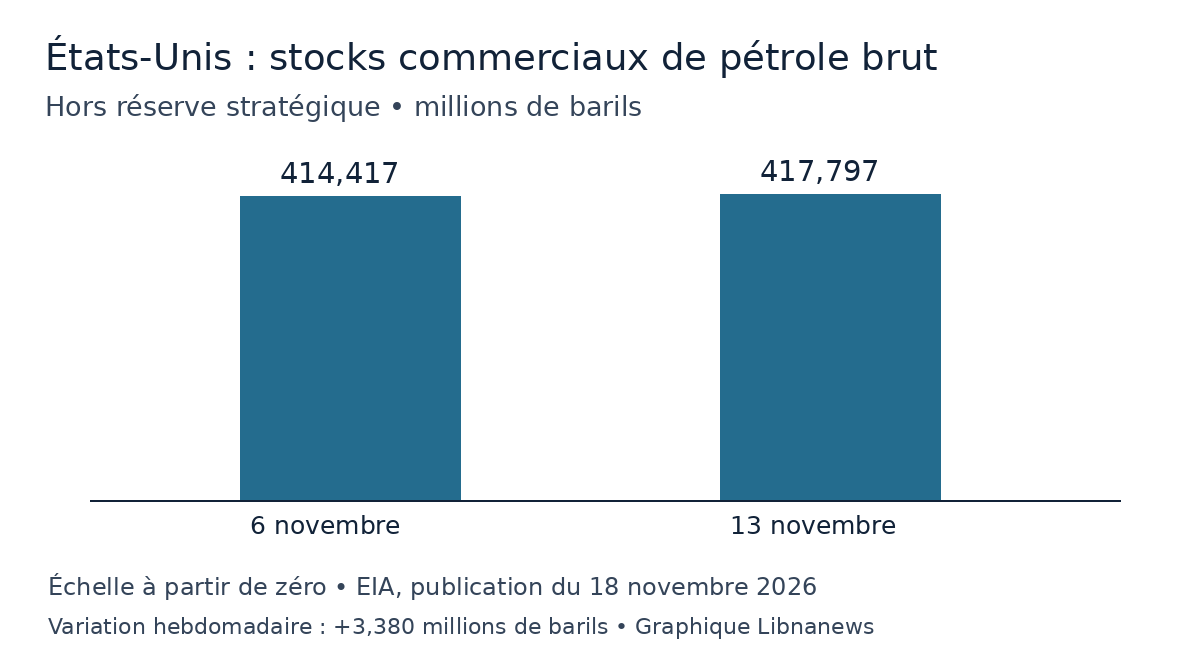
At 10.30 a.m. on the east coast of the United States, at 1530 UTC,energy Information Administration publishesdata for the week ended November 13. Commercial crude stocks, excluding strategic reserves, increased by 3.4 million barrels to 417.8 million. They remain about 3% below their five-year seasonal average. Gasoline stocks increased by 5.2 million barrels and distillates by 1.6 million. The rate of use of refineries is 95.7%.
An increase in stocks alone does not mean a collapse in consumption. Inventories result from inputs, outputs and transformations: production, imports, exports and refinery activity occur simultaneously. Crude and refined products must be examined separately. A refinery can reduce its purchases of crude oil while producing already manufactured products; Conversely, an increase in rates can shift volumes from one category to another.
This official publication should not be confused with the private estimate of the American Petroleum Institute previously released. Differences between the two surveys are possible and do not justify mixing their figures. For the reader, the useful information is to know from which body each series comes, what week it covers and whether it measures a stock or a flow. A number of barrels and a number of barrels per day do not answer the same question.
Currency: a daily reference, not a bank quote
The European Central Bank publishesfor 18 November a reference rate of $1.0968 per euro. The corresponding references are 174.85 yen and 0.83290 pound sterling per euro. Central bank consultation normally takes place at around 14.10 in Central Europe, i.e. 13.10 UTC, before publication at around 16.00, i.e. 15.00 UTC. The ECB specifies that these values are informative and advise against their use as a transaction price.
To this reference, an invoice of 100,000 euros is equivalent to $109,680 before fees. This calculation facilitates a budget comparison; it does not promise this price to the importer. The rate actually obtained depends on the intermediary, the hour, the amount and the commissions. A company may also have purchased its currencies before or agreed on a different contract price.
For Lebanon, where many prices and payments are expressed in dollars, the supplier’s billing currency remains decisive. A product purchased in euros does not have the same risk profile as a product purchased in dollars, even if it is sold in the same store. The income received from the diaspora introduces another combination of currencies. Thus, there is no single favourable or unfavourable effect of the exchange rate on all households and enterprises.
Lebanon: BDL assets do not constitute a net reserve
The Bank of Lebanon’s bimonthly balance sheetas at 15 November, its foreign reserve assets increased to approximately $11.529 billion, compared with $11.465 billion at 31 October. The increase calculated from the official file amounts to 64.12 million. Conversions use £89,500 for one dollar as indicated in the document. These data were detailed separately by Libnanews; their interest in this case is their perimeter, not an extrapolation of the increase.
The position describes a gross asset. It does not measure net reserves after deduction of liabilities or an amount freely available to repay all depositors. It is shown on a separate line. Its valuation drops over the 15th, which does not prove a sale of metal: a price change can change the book value without corresponding physical movement. Nor does the balance sheet allow the additional 64.12 million to be allocated to a single cause.
The practical consequence is that a liquidity indicator should be brought closer to the bonds to which it responds. An institution may hold significant assets and be required to pay if their maturity, currency or availability do not match the amounts due. Conversely, an improvement in an asset position can be real without resolving the entire liability structure. It is this articulation that is important to assess the funding capacity, rather than an isolated figure presented as the end of the crisis.
Reconstruction: from loan approved to construction site
In an interview conducted on 17 November and published on 18 November by AP, Anna Bjerde, Chief Operating Officer of the World Bank, considers reconstruction in Lebanon too slow. The Nawaf Salam office invokes the delays in the ratification of the loan and the deterioration of security; It announces projects of $70 million to be launched before the end of the year. This is an announced timetable, not work already completed.
The Development and Reconstruction Council documentation describes LEAP as a $1 billion framework, initially funded by the World Bank. The remaining $750 million represents a need for funding, not an amount already available. The first components include rubble, road access and the restoration of essential services. The preparation of the studies and the execution of the works are distinguished in the assembly of the project.
This architecture explains why announcing an envelope is not enough to measure the economic activity produced. A project must be selected, studied, assigned and executed. Payments follow contractual terms and verifiable steps. Land security, access to sites and the ability of administrations to process procedures determine the speed at which an approved credit becomes a usable road or a repaired water system.
For local businesses, the opportunity book thus depends on the tenders actually opened and on the payment modalities, not only the ceiling of the programme. For residents, the right measure is the restored service. Consolidating these two horizons creates excessive expectations: funding can be legally acquired while the concrete benefits remain distant. The challenge is not to choose between money and institutions, but to ensure that both progress together.
Housing: loans identified, additional financing still discussed
Received on November 18 by Joseph Aoun, President and CEO of the Habitat Bank Antoine Habib announces approximately $100 million in loans to some 1,500 families. According tothe official record of the presidencyit also presents a product launched on 9 november to finance the purchase and installation of prefabricated houses: amounts range from $20,000 to $100,000, with a duration of up to 20 years.
Habib reported that the Arab Fund for Economic and Social Development had transferred approximately $115 million out of an envelope of $165 million. He mentioned discussions with other funds, without announcing any additional signed amounts. These data are those of the leader reported by the Presidency. The reduced construction time it puts forward falls within the scope of the product presentation, not a uniform guarantee for each plot and file.
The mechanism deserves attention because it links a long resource to a need for housing. But a credit does not remove the other conditions of a project: ownership and suitability of the land, authorisations, connections and capacity to repay remain separate questions. The duration of the loan must be reconciled with the stability of the household’s income. Affordable monthly payments today are not enough if future revenues are uncertain or expressed in a currency other than debt.
Finally, the number of beneficiary families should be distinguished from the number of completed housing units. Funding may precede the project and its disbursements. Similarly, an envelope transferred to an institution is not automatically distributed in full to its clients. These steps do not diminish the scope of the programme; they allow to monitor its execution without turning a financial announcement into a material result already achieved.
Understand: result, cash flow and funding capacity
The concept common to several news of the day is the difference between accounting income and cash. A company can register a sale before being paid. It may also receive a loan that increases its bank account without constituting a profit. Conversely, buying a machine immediately consumes money, while its accounting cost can be spread over several years. These shifts are not anomalies: they respond to different measuring objects.
Let’s take a fictitious company that sells for $100,000 on credit and bears $80,000 in expenses immediately payable. Its activity can produce a positive result, but it must finance the interval before the customer settles. If this payment arrives late, it may lack liquidity despite a satisfactory business margin. A loan provides a temporary solution, while creating interest and a repayment obligation. The quality of the customer and the duration of payment then become as important as the sale itself.
The need for working capital describes, inter alia, this money held in inventory and receivables, after taking into account the time taken by suppliers. It often increases when a company quickly develops its business. Growth can therefore consume cash before producing it. Therefore, the analysis of a supplier of AI, distributor or construction cannot be limited to the rate of increase in sales.
Applied to Lebanese news, this distinction avoids three errors. The assets of the central bank are not comparable to a distributable profit. A reconstruction envelope is not a payment already received by companies. A real estate loan is not yet a busy house. The relevant follow-up is to link each resource to its commitments, timetable and expected concrete outcome. It is these passages between accounts, payments and activity that give the economic figures their real scope.





Comments