

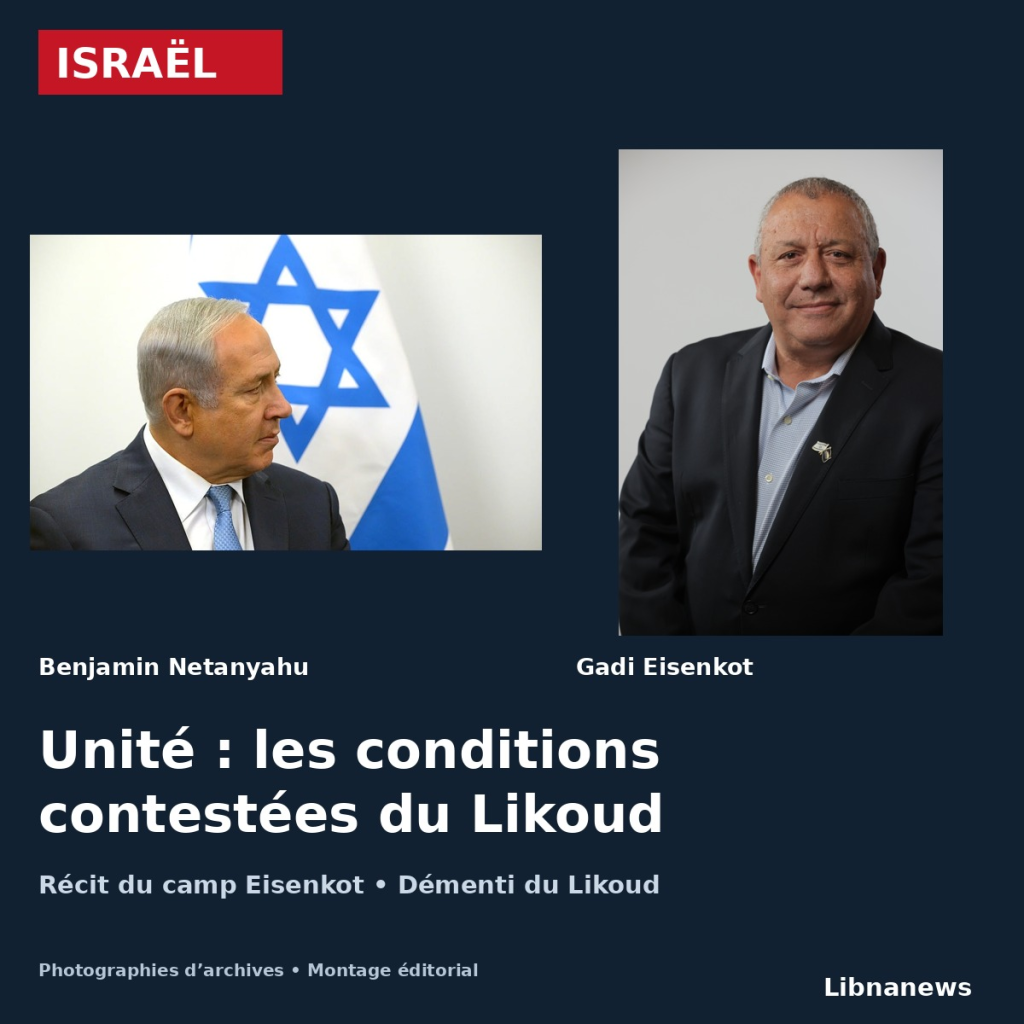
Camp Eisenkot officials attribute several demands to Netanyahu for a unity government, reports Yuval Karni in Ynet on 18 November. The Likud contests the details of these discussions, but confirms that he wants to lead the firm.
Five central conditions, followed by additional principles
The text distinguishes five main conditions and then complementary principles. This is not a program accepted by negotiators:
- A government presidency by Netanyahu for about four years, without alternation.
- A text on the exemption from military service of ultra-Orthodox women according to the formula of Boaz Bismuth, with the agreement of their parties.
- The absence of a state commission of inquiry on 7 October.
- The participation of Itamar Ben-Gvir in government.
- Maintaining the laws of judicial reform adopted by the previous Knesset.
Additional principles reported include the maintenance of military positions on the various fronts until the threat disappears and the absence of any change in the conditions of detention of members of the Hamas elite Nukhba. The text also mentions the refusal of a Palestinian State and the assertion of Israel as the nation-state of the Jewish people.
What Deny Likud
A Likud source cited by Ynet describes preliminary discussions, without any detailed discussion of the October 7 conscription or investigation. Another states that rotation was not addressed. The party nevertheless confirmed its demand to lead the cabinet. These responses do not allow the whole list to be taken for granted or to reach an agreement.
A majority to be built after the elections
The controversy comes after the 27 October legislative elections. The Israeli presidency announced on 7 November its choice to entrust Eisenkot with the formation of the government, with a postponement of the mandate scheduled for the next day. The consultations had included 67 recommendations in favour of Netanyahu, compared with 46 for Netanyahu; seven MPs had not recommended anyone. The procedure provides for an initial period of 28 days, possibly extended by 14 days.
These recommendations are not a coalition already formed. They bring together parties that may differ on military service, institutions and cabinet composition. The difference between appointing a candidate and supporting his government explains why the advantage obtained from the president does not regulate negotiations.
On 17 November, Matan Kahana, an ally of Eisenkot, was elected President of the Knesset by 66 votes to 52 for Ofir Katz. This vote, reported by Associated Press, gives the opposing camp Netanyahu an additional parliamentary leverage. However, it is not a vote of confidence for a new government.
Disagreements over authorities, not just departments
The points raised concern several levels of power. The alternation would determine who heads the executive. The conscription concerns the relationship between the ultra-Orthodox parties and their partners. The investigation on 7 October raises the issue of accountability, while judicial laws strike a balance between institutions. A compromise on portfolio allocation alone would therefore not be sufficient to resolve these differences.
For Lebanon, the principle of maintaining military positions should be read with particular caution: it is an element of an Israeli negotiation whose content is disputed, not a new military order established or a diplomatic agreement. No withdrawal schedule can be deduced.





Comments