

Labour on demand in northern water services is not only a social demand: it corresponds to an identifiable public market. The Register of the Authority for Public Procurement describes a contract for the supply of personnel to the North Lebanon water establishment, signed on 1 June 2026, with a deadline of 1 June 2027. This does not constitute an integration of its workers into the permanent workforce.
A contract to operate services
The procedure, announced in March 2026, covers very different functions: engineering, station operations, maintenance, metering, distribution, work and administrative tasks. The establishment purchases a labour supply from a contracting operator. This sheet does not refer to a public official recruitment competition.
This architecture explains the distinction at the heart of the debate: working in the facilities of a public institution does not automatically mean being employed directly by it. The contract sheet establishes the existence and duration of the contract. It does not give an individual status of the employees, their seniority or the sums actually collected.
Social obligations in the book
The specifications require the service provider to be affiliated with the National Social Security Fund in accordance with the applicable rules and to transmit their names and registration numbers. It provides for monthly reports on family allowances, attendance and transportation allowances, and monitoring of attendance.
The same document states that benefits are not guaranteed on a continuous basis. The establishment may request the staff corresponding to its needs within the limits of the market. The text also covers replacements in order to preserve the transmission of competences. These contractual obligations must be distinguished from their performance: a specification does not prove that each right has been respected or that it has been violated.
Employment stability remains a separate issue
Applications for secure status are therefore not confused with the mere renewal of a market. The contract shall organise a supply of personnel for a specified period; It does not regulate, on its own, the possible transition to permanent employment. Similarly, the publication of an affiliation obligation is not sufficient to establish the actual situation of each worker with the CNSS.
In order to assess the conditions actually applied, market provisions should be compared with attendance records, payments and social declarations. None of these individual documents are provided by the public file consulted. However, the register allows us to situate the debate precisely: it deals with the conditions for an outsourced activity which is indispensable for the operation of services, and not with an already decided tenure.
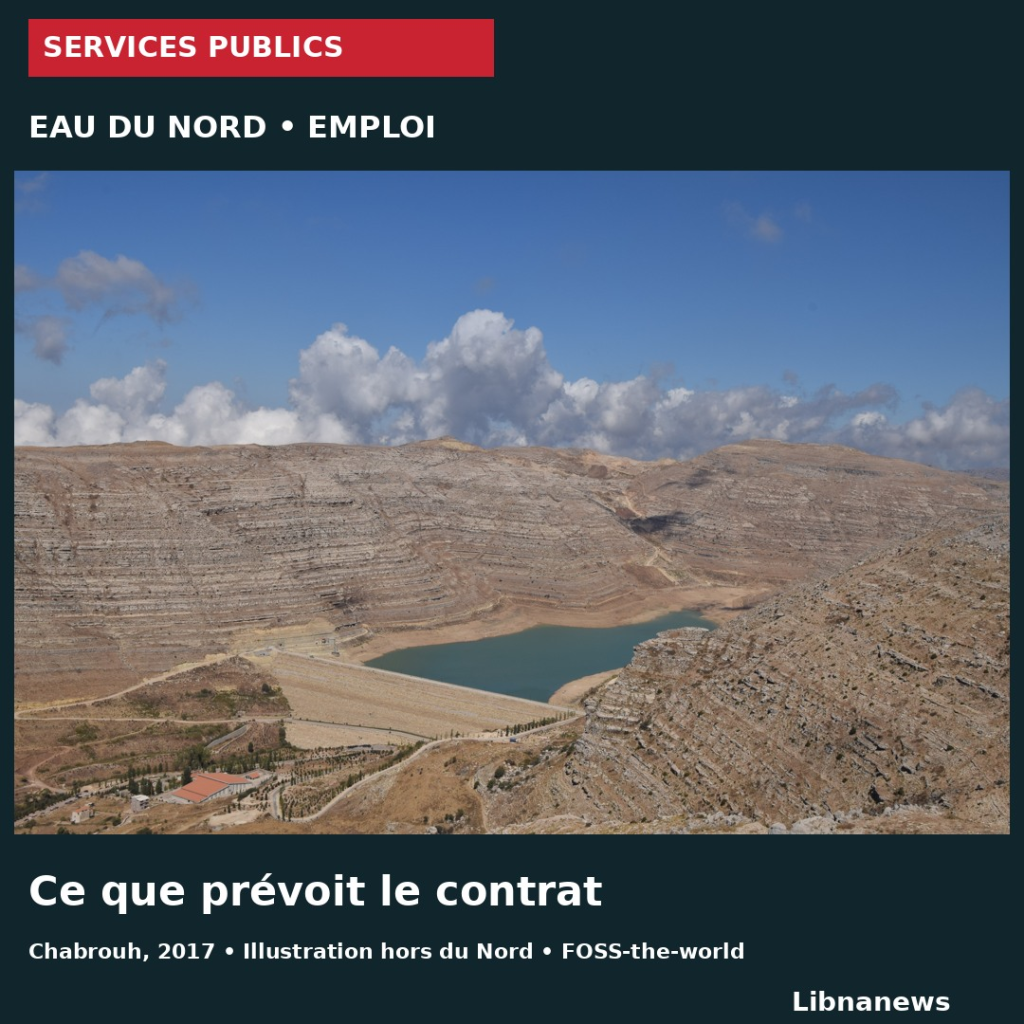
Illustration: Chabrouh Dam in Faraya, October 1, 2017. Illustration of hydraulic infrastructure located outside the perimeter of the Northern Lebanon water establishment; This photo shows neither its installations nor its workers. FOSS-the-world, CC BY-SA 4.0. Resized whole photo, Libnanews dressing under the same license. CC BY-SA 4.0





Comments