





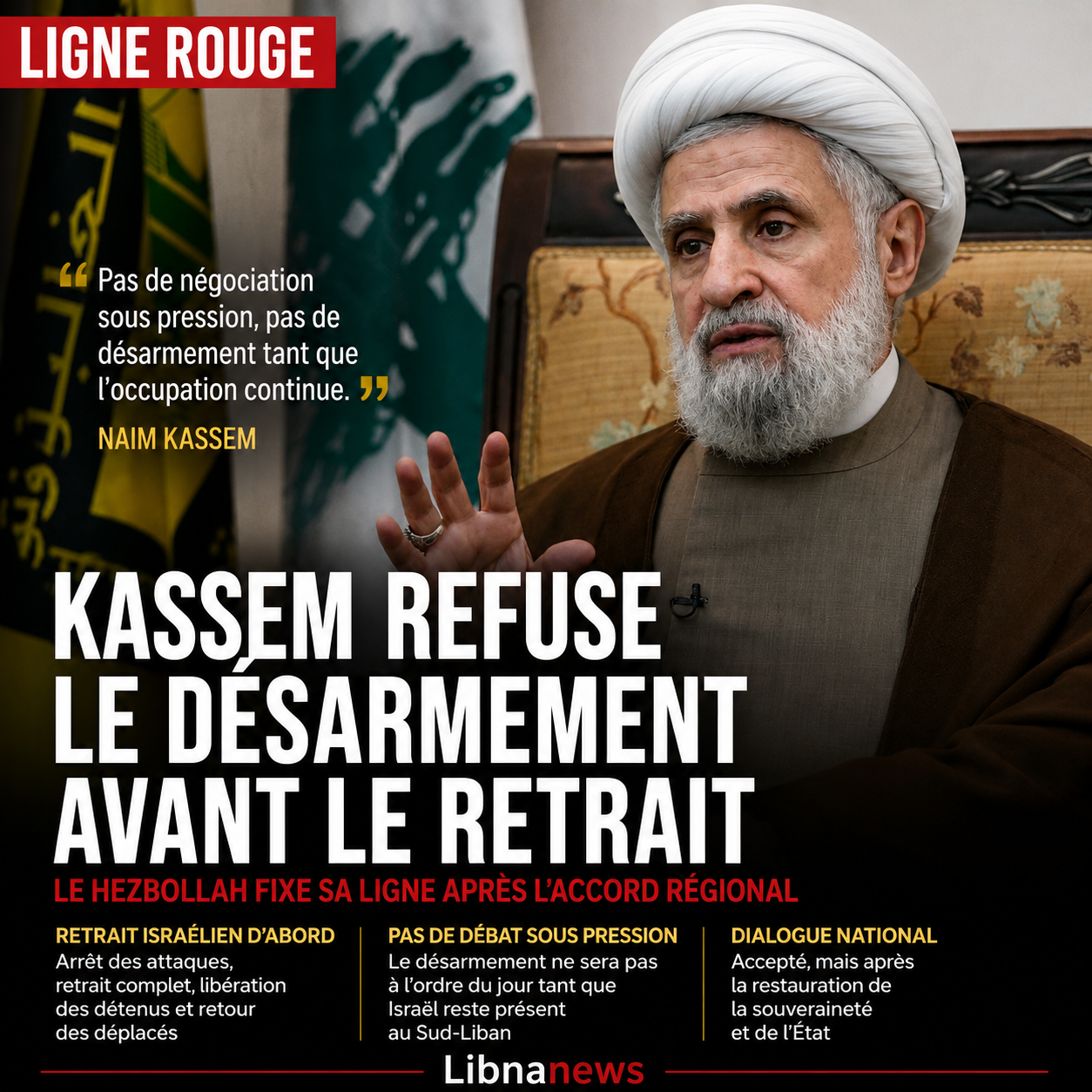
Naim Kassem put Hezbollah back in the sequence opened by the regional agreement between Washington and Tehran with a clear line: Israeli withdrawal must precede any debate on weapons. The Secretary-General of the Shiite party did not close the door to a Lebanese national dialogue, but he refused to allow the dialogue to be organized under Israeli, American or Western pressure, while Israeli troops remained present in southern Lebanon. His last statement, delivered near Hassan Nasrallah’s mausoleum and reported by Al-Manar as well as by news agencies, highlighted five requests: stop Israeli attacks, complete withdrawal, release of detainees, return of internally displaced persons and reconstruction. For Hezbollah, Lebanese internal issues must remain Lebanese. For its opponents, this position may block the full return of the state.
A statement built around the Israeli withdrawal
Naim Kassem’s statement comes at a very special moment. The American-Iranian agreement placed Lebanon in the first circle of regional de-escalation. The first clause of the memorandum provides for the cessation of military operations on several fronts, including Lebanon. But on the ground, Israel maintains positions in the South and pursues ad hoc operations. This contradiction gives Hezbollah its main argument: there will be no serious discussion of weapons until the territory is released.
According to the evidence reported by Al-Manar and taken over by Xinhua, Naim Kassem stated that Hezbollah would reject any disarmament-related proposals. He affirmed that negotiations with Israel should focus on mutual security and the restoration of Lebanese sovereignty. He accused Israel of wanting to eliminate Hezbollah’s military, political, social and popular presence in Lebanon. He also described the conflict with Israel as an existential struggle, in which the party claims to defend the future, territory and people of Lebanon.
The statement, in its entirety reported by the available dispatches, can be summarized as follows without altering its content: Hezbollah rejects any disarmament project; it considers that discussions with Israel should be limited to security and sovereignty; It calls for the cessation of Israeli attacks, the complete withdrawal of the Israeli army, the release of detainees, the return of displaced persons and reconstruction; it affirms that Lebanese internal files should not be included in negotiations with Israel; calls for the implementation of the ceasefire of 27 November 2024, which provides for the cessation of hostilities and the deployment of the Lebanese army south of the Litani River; It maintains that resistance remains a component of the country’s defence as long as the Israeli threat persists.
This architecture is political. Kassem is not just talking to the Lebanese government. He also speaks to Washington, Tehran, Israel, the displaced from the South and its popular base. The message is calibrated: Hezbollah does not refuse the word « state », but it contests the order of the stages. It does not want disarmament to become the price of an incomplete ceasefire. He wants the Israeli withdrawal to be first acted upon, verified and transformed into a territorial fact.
The central message: no disarmament under pressure
The heart of the message holds in one sentence: Hezbollah will not discuss its weapons under occupation. This position is not new. It has been structuring the rhetoric of the party for years. But it is taking a particular strength in the current context, as the regional agreement gives Lebanon a new diplomatic framework. Hezbollah believes that its participation in the conflict has made it possible to impose the Lebanese front in the negotiations between the United States and Iran. He draws a political conclusion: his weapons would have produced a result, so their immediate questioning would be illogical.
This reading is contested by part of the Lebanese forces. For them, the Hezbollah arsenal has mostly led the country into a devastating war, displaced hundreds of thousands of people and exposed the South to massive destruction. They consider that the State cannot regain its sovereignty if an armed formation retains an autonomous capacity to decide war and peace. They see the regional agreement as an opportunity to put the arms monopoly at the centre of national life.
But Hezbollah replies that the state monopoly cannot be restored by external injunction. The party affirms that weapons must be discussed within a national framework, after Israeli withdrawal and after the effective restoration of sovereignty. This point allows Kassem to move the debate. He does not speak of an absolute rejection of any future discussion. He refuses the moment chosen by his opponents.
This distinction is important. It allows Hezbollah to avoid the image of a party opposed to the state in principle. It presents itself as a force that accepts a national debate, but only when conditions are met. For opponents, this formulation can be used to save time. For its supporters, it protects the country from imposed disarmament while Israel remains on the ground.
The agreement of 27 November as a tactical framework
Naim Kassem also called for the implementation of the ceasefire concluded on 27 November 2024. This reminder is not trivial. The agreement provided for a cessation of hostilities, the withdrawal of combatants south of the Litani River and an increased role for the Lebanese army. For Hezbollah, this text remains a frame of reference, but it believes that Israel has emptied its content by its strikes and military retention in the South.
Invoking this agreement, Kassem seeks to return the Western argument. The G-7 countries and Lebanon’s partners are calling for a State monopoly on arms and the strengthening of the Lebanese army. Hezbollah responds: first, to enforce Israeli commitments, then Lebanon will discuss its internal organization. The party thus places itself on the legal and diplomatic field, not only military.
This strategy is clever. It refers the United States to its responsibility towards Israel. It refers France and the United Nations to the question of respect for Lebanese territory. It sends the Lebanese government back to its own limits: how can we ask Hezbollah to hand over its main map if the State cannot guarantee Israeli withdrawal?
But this position has a limit. The agreement of 27 November was not only an Israeli commitment. It also required a security redeployment to the South and a reduction in the non-State armed presence. On the basis of this text, Hezbollah implicitly accepts that the Lebanese army plays a central role south of the Litani. The question then becomes: how far is the party prepared to let this army really exercise its authority?
Face-to-face with the Group of Seven
The Kassem statement responds indirectly to the Group of Seven. Western leaders called for a strong ceasefire in Lebanon, respect for the territorial integrity of the country and a state monopoly on arms. This formula seems balanced, but it contains a tension. It demands simultaneously Israeli withdrawal, Lebanese sovereignty and the disarmament of Hezbollah. However, each actor gives a different priority to these three objectives.
For Western countries, the disarmament of Hezbollah has become a condition of stabilization. They believe that the Lebanese State will not be able to rebuild if the Shiite party retains an autonomous military force. They therefore support the Lebanese army, UNIFIL and the Beirut government in the idea of a gradual return to the monopoly of force.
For Hezbollah, this approach reverses the problem. The party claims that weapons exist because Israel occupies, strikes and threatens. It therefore considers that the priority should be the withdrawal and cessation of Israeli operations. The rest belongs to the Lebanese dialogue. The word « dialogue » thus becomes a political protection. It allows external pressures to be pushed back without closing the door to future debate.
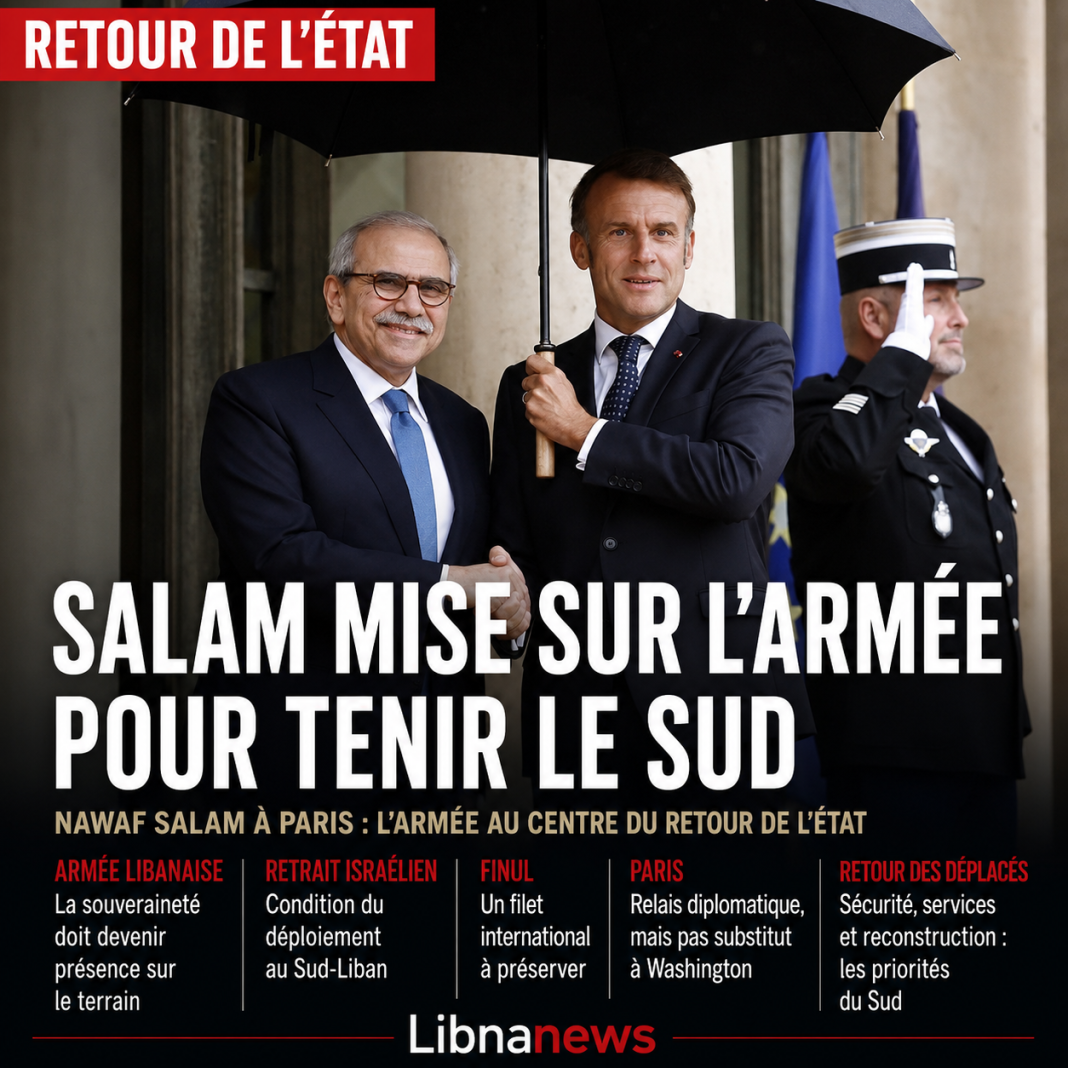
For the Lebanese State, the position is more delicate. Joseph Aoun and Nawaf Salam want to resettle the state as a single interlocutor. They know that sovereignty one day requires an answer to the question of arms. But they also know that opening this issue under Israeli occupation can cause a major internal crisis. The state is therefore looking for a sequence: Israeli withdrawal, army deployment, return of displaced persons, and then national discussion.
Israel as Hezbollah’s permanent argument
The Israeli position gives Hezbollah a political fuel. Benjamin Netanyahu and several Israeli officials claim that the army will remain in safe areas for as long as necessary. For Israel, this maintenance responds to the threat of Hezbollah and the need to ensure the return of northerners. For Lebanon, this is an infringement of sovereignty. For Hezbollah, this is proof that its weapons remain necessary.
Reuters reports that Hezbollah believes that Iran will not sign a final agreement with Washington if Israel does not withdraw from Lebanon. The party press office indicated that the Israeli withdrawal would be an expected result of future discussions, not an immediate precondition. Iranian Foreign Minister Abbas Araqchi said that the end of the regional war should include the end of the occupation of Lebanese lands.
This articulation between Hezbollah and Iran is central. The Lebanese party claims that Tehran has made Lebanon a priority in negotiating with Washington. According to a statement reported by the Ghanaian news agency, Kassem considered that Iran had obtained the immediate and permanent cessation of military operations on all fronts, including in Lebanon, and that this clause constituted the first basis of the framework concluded with Washington. He added: « Iran has given Hezbollah and Lebanon everything, and has taken nothing in return. »
This sentence reveals the party’s reading. Hezbollah presents Iran as a guarantor of Lebanese protection, not as an actor using Lebanon in its negotiations. This interpretation is being challenged by some Lebanese officials, who accuse Tehran of treating Lebanon as a regional map. It also formalizes the Iranian influence on the Lebanese case, at a time when the State is trying to take over the initiative.
A map conservation strategy
The logic of Hezbollah is simple: keep its maps until the terrain has changed. The weapons, the implantation in the South, the link with Iran, the capacity for social mobilization and the narrative of resistance form a whole. The party believes that abandoning an element before obtaining concrete guarantees would be a strategic mistake.
Reuters reported that the American-Iranian agreement could politically and financially strengthen Hezbollah. Sources close to the file indicate that Tehran promised more financial support once some funds were released. The United States, for its part, claims that no funds will be released if it benefits an organization that they designate as a terrorist. This battle around money shows that the post-war period will not only be military. It will also be social and financial.
Hezbollah needs to fund its base. The destruction in the South is massive. Displaced families are waiting for help. Social, religious, health and municipal networks close to the party will be solicited. If Iran can increase its support, Hezbollah will regain some of its ability to influence politically through assistance. This will complicate the task of the State, especially if public aid is delayed.
This dimension is crucial. The debate on arms is not only in barracks or negotiations. It is also played in destroyed houses, displaced families and villages to be rebuilt. The one who helps quickly gains influence. The one who promises without acting loses credibility. Hezbollah knows this rule. The Lebanese State too.
The risks of political blockage
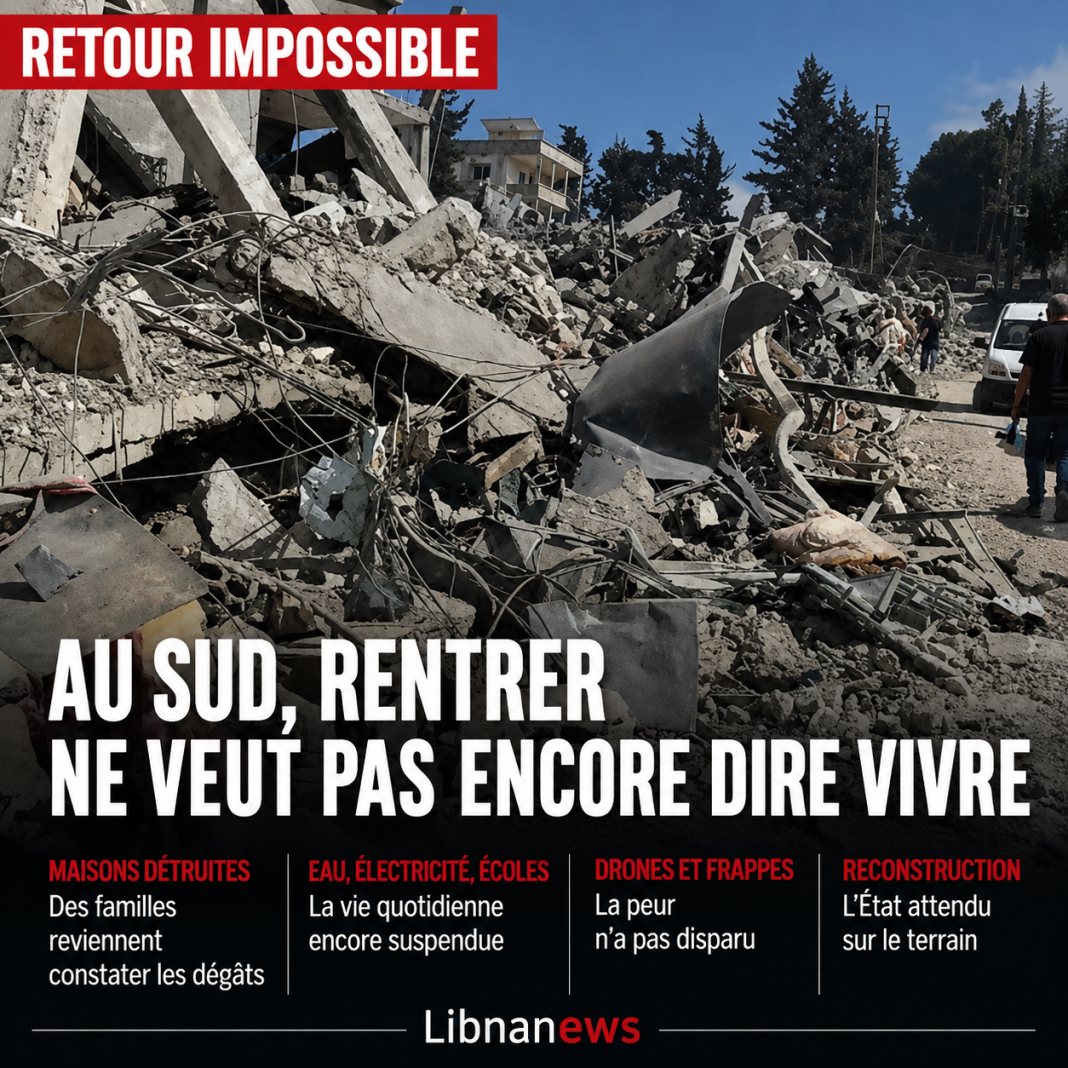
Kassem’s position can strengthen Hezbollah in the short term. It can also lock Lebanon in a protracted crisis. If the party refuses any debate before a complete withdrawal, and Israel refuses to withdraw as long as Hezbollah remains armed, the country finds itself in a loop. Everyone waits for the other to begin. Meanwhile, the South remains vulnerable, the internally displaced hesitate to return, the Lebanese army lacks resources and diplomacy simmers.
This risk is real. Israel can use Hezbollah weapons to justify a prolonged presence. Hezbollah can use the Israeli presence to justify its weapons. The United States can condition aid to the army or the state for progress on the monopoly of force. Iran can maintain the Lebanese case in its negotiations with Washington. Lebanon, for its part, can once again lose control of its own calendar.
Blockage can also increase international pressure. The Group of Seven, the United States and several European capitals consider that the return of the State to the monopoly of force is essential. If Hezbollah refuses any discussion, it may be accused of sabotaged stabilization. If the Lebanese State does not advance, it may be considered too weak to receive massive support. This pressure can weaken Joseph Aoun and Nawaf Salam.
The reverse risk also exists. If the government suddenly opens up the file of weapons without Israeli withdrawal, it can cause dangerous internal polarization. Hezbollah would denounce a manoeuvre dictated by Washington or Tel Aviv. His opponents would accuse him of taking the state hostage. The army would be placed in an impossible position. The country does not need an internal confrontation when it has to rebuild the South.
Conditions for a possible national dialogue
A national dialogue on weapons can only be opened if several conditions are met. The first is an verified Israeli withdrawal. Otherwise, Hezbollah will refuse to discuss seriously. The second is a real stop to strikes and overflights. Limited de-escalation is not enough to create confidence. The third is a credible deployment of the Lebanese army, with sufficient resources and a clear mandate. The fourth is an international guarantee that protects Lebanese sovereignty without imposing a partisan agenda.
The fifth condition is internal. The debate cannot be presented as a victory of one Lebanese camp over another. It must be formulated around a national defence strategy. This strategy will have to answer a simple question: how can we protect Lebanon without allowing an autonomous force to decide the war alone? Hezbollah will have to find a political way out. Its opponents will have to accept that the transition will not take place through humiliation.
Kassem’s statement shows that the party does not want to enter disarmed in this discussion. It also shows that he knows that the question will come back. The word « dialogue » is not trivial. It means that Hezbollah is planning a political battle, not just a military battle. It will seek to transform its weapons into a national strategy or an integrated capability, rather than a separate arsenal to abandon.
For the state, the challenge will be not to let this formula empty the monopoly of the strength of its content. A dialogue that simply enshrines the status quo will not strengthen sovereignty. A dialogue that ignores the balance of power will fail. It will therefore require a method, a timetable, guarantees and a presidential authority capable of keeping the line.
Hezbollah in a favorable but unstable sequence
Naim Kassem has been speaking since a more favorable position than a few weeks ago. The regional agreement included Lebanon. Iran claims to defend the Israeli withdrawal. The United States wants to avoid a resumption of war. The destruction of the South feeds the story of resistance. Israel, by maintaining positions, gives Hezbollah an immediate argument.
But this position remains unstable. The party suffered heavy losses. Its social base is tested. Its financial capacity depends in part on Iran. His military role remains contested by some Lebanese. Its ability to prevent a new war is not guaranteed. If it blocks the return of the State for too long, it can strengthen internal and international hostility.
Kassem’s statement is therefore both defensive and offensive. Defensive, because it protects the party’s weapons from increasing pressure. Offensive, because it tries to impose the order of stages on the Lebanese state and foreign sponsors. Hezbollah wants the sequence to be read as follows: Israel withdraws, the state deploys, then the Lebanese discuss with each other. His adversaries want the reverse or simultaneous order: ceasefire, arms monopoly, withdrawal, stabilization.
The difference between these two calendars will determine the next Lebanese phase. The Israeli withdrawal can open a national discussion. His absence can block everything. Too brutal external pressure can strengthen Hezbollah. Too long a indulgence can weaken the state. Lebanon is therefore moving on a narrow line.
Naim Kassem has set Hezbollah’s position. It is clear: no forced disarmament, no internal negotiation in a discussion with Israel, implementation of the ceasefire, complete Israeli withdrawal, return of displaced persons, reconstruction and national dialogue only after the effective restoration of sovereignty. The next answer will not only come from Beirut. It will also come from the ground, from Washington, Tehran and Israel’s ability to accept or not that southern Lebanon should become a Lebanese state-owned territory.