

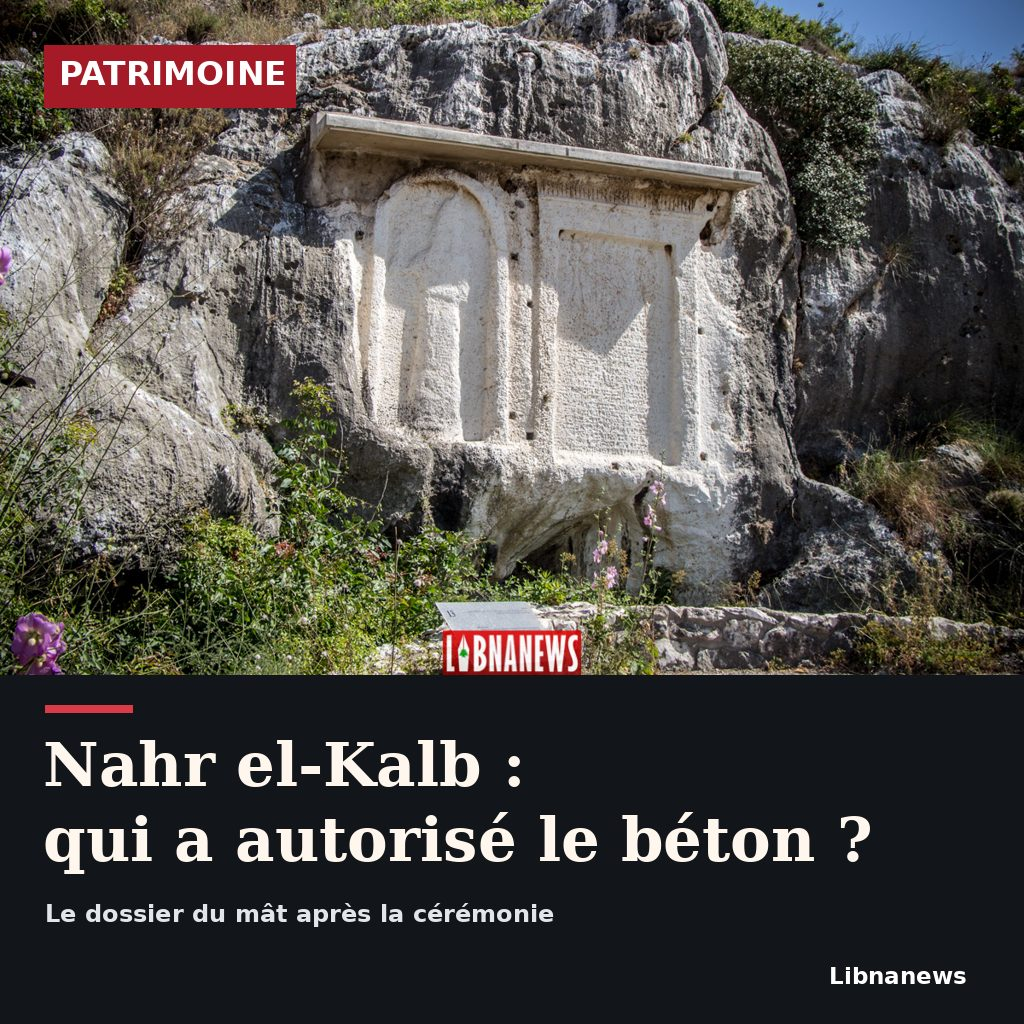
Joseph Aoun spoke on 21 November in Nahr al-Kalb, where the Republican Guard raised the Lebanese flag over the tunnel. But the Independence ceremony did not settle the dispute over the concrete base near the steles. The municipality invokes a Public Works agreement. Culture called for the construction site to be stopped. What exactly allowed the document used by the municipality?
At 6 p.m., the president and his wife Nehmat Aoun arrived at the scene. Nabih Tohmé, Chairman of the Dbayeh City Council, Zuk al-Kharab, Aukar and Haret al-Bellaneh, welcomed them. The presidential couple signed a replica of the 1943 Independence Flag, and Joseph Aoun delivered his speech. The report of the Ministry of Information attests to the raising of the flag. No decision on the status of the site is reported. The presence of the Head of State gives the ceremony political significance; it does not constitute an authorisation to build.
Nahr el-Kalb: a disputed work authorization
The commune had already begun building a base in 2025. The work was interrupted on 15 November of that year, according to the reminder of the Ministry of Culture relayed a year later. The project resumed in early November 2026. On 9 November, the Minister of Culture, Ghassan Salamé, asked his interior counterpart, Ahmad Hajjar, to intervene. The Directorate General of Antiquities maintained that she had not given a permit for the basement. According to ICOMOS Lebanon, the minister also appealed to the Mount Lebanon Prosecutor’s Office to request that work be stopped.
Nabih Tohmé defended another reading. When questioned on 9 November, he claimed that the site was on a parcel not classified as antiques. He also invoked an agreement from the Ministry of Public Works obtained about a month earlier, as well as an instruction to resume work. Its position is based on the distinction between the location of the inscriptions and the plot where the mast was laid out.
ICOMOS Lebanon, which claims to have examined the letter from Public Works, contests its scope. In its November 17 alert, the committee described it as a notice of non-objection. According to his reading, the mail does not exempt the municipality from other permits and requires it to preserve the natural and archaeological elements. An open letter made public prior to the ceremony dates the October 15 letter and links it to a municipal application of September 3.
The full text of this letter and that of the judicial investigation referred to were not found in the public documents consulted. It is therefore not possible to verify whether the instruction was for the work as it was performed, or what conditions accompanied a possible resumption. No subsequent heritage notice authorizing the base was identified in this public record. This does not make it possible to declare the site illegal: this leaves no answer to the question of the act which would have allowed the development actually carried out.
The boundary of a parcel does not tell all the effects of the mast
The ICOMOS alert relates to a reinforced concrete base intended for a 16-metre mast on the promontory overlooking the tunnel. The committee does not dispute raising the flag. He contests the choice of location, dimensions and possible effects of anchoring on the rock. These risks are not evidence of stele degradation.
The debate goes beyond the distance between the base and the first inscription. In Nahr al-Kalb, the relief explains the very existence of the steles: this narrow passage between sea and mountain saw the parade of armies that left their mark on limestone. The file submitted by Lebanon to UNESCO describes a set of 22 steles, reliefs and inscriptions. Two Lebanese inscriptions recall the evacuation of foreign troops in 1946 and the Israeli withdrawal from the South in 2000. For the committee, the impact assessment also had to compare other locations and measure the visual effect of the mast prior to construction.
Three distinct situations at UNESCO
Since 2005, the Mémoire du monde international register has hosted the documentary dossier des steles. Since 2019, the archaeological site has also been on Lebanon’s indicative list, a possible step towards a World Heritage application, and not on this list. Finally, since 18 November 2024, the site has been granted temporary enhanced protection under the Second Protocol to the Hague Convention, which concerns cultural property in the event of armed conflict. None of these three statutes alone address the issue of the permit for this site.
ICOMOS requests the removal of the basement, the restoration of the site and the search for a location off site and its surroundings. These requests are not a disassembly decision. Since the ceremony, the question has been played on specific pieces: the scope of the project, the scope of the judicial investigation and the existence of a written opinion of Antiquities on the base that was built.
Reference documents
- Lebanese Ministry of Information: proceedings of the ceremony
- ICOMOS Lebanon: alert of 17 November 2026
- UNESCO: archaeological site on indicative list
- UNESCO: Stele file in the World Memory Register
- UNESCO: International list of cultural property under enhanced protection





Comments