

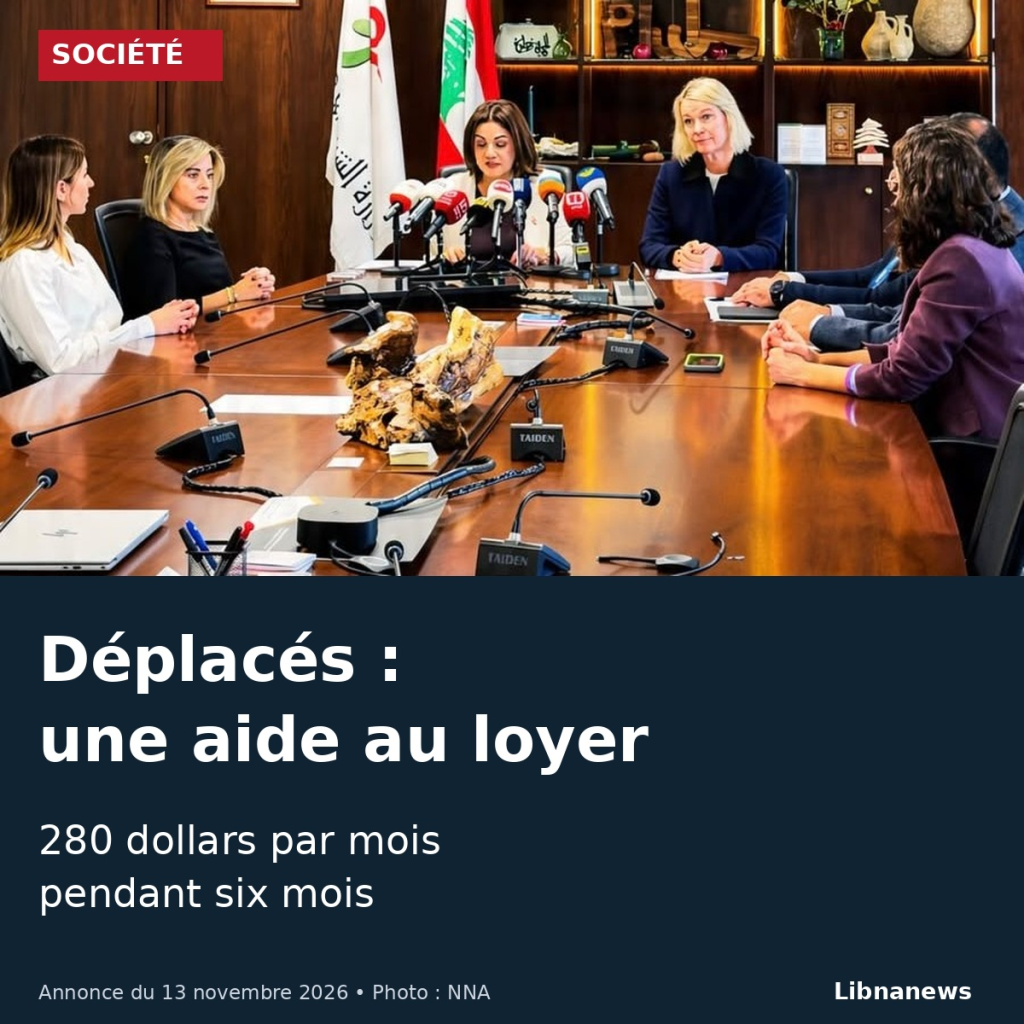
On Friday 13 November, the Ministry of Social Affairs and the Office of the United Nations High Commissioner for Refugees announced the launch of rent aid for 2,700 Lebanese displaced families. Each selected household must receive $280 per month for six months. The scheme is aimed at families who cannot yet return home and aims to enable them to leave accommodation centres or temporary housing for a decent home.
A first wave of about 1,800 families
The launch should start with about 1,800 families currently living in shelters. This first group therefore does not represent all the 2,700 households that are covered by available funding. The department presents this number as an initial capacity, not as an estimate of total needs.
The previous evaluations covered 2,195 families, or 8,406 people, in 131 centres. Of these, 1,802 families were considered eligible and interested in assistance. These figures describe the progress of the selection: they do not constitute a balance sheet of families already in a dwelling or having received a first payment.
Minister Hanine el-Sayed places this programme in the transition from emergency accommodation to more stable solutions. She pointed out that there were different possibilities for households: some could consider reparations for return, while others still needed temporary housing or rental allowance.
How households are selected
A common assessment grid should be used to prioritize applications. It takes into account the social, economic and residential situation of each family, including its size, income and debts. The condition of the original dwelling and the actual possibility of returning to it are also included in the examination.
Among the factors considered are the presence of elderly persons, persons with disabilities or chronic diseases. The situation of pregnant and nursing women is also taken into account. The programme is thus based on an assessment of needs, not on a uniform payment to all displaced families.
After confirmation of eligibility, the implementing partner contacts the household. He chooses the accommodation he wishes to rent. An inspection must then verify that the housing meets the conditions of decent housing. The agreement between family, owner and partner precedes the start of monthly transfers.
Families outside the centres are also affected
The Ministry reported that it was working in parallel with the expansion of the scheme for internally displaced persons living outside shelters. The identification of these families must be based on its own data and the guidance provided by the municipalities.
Hanine al-Sayed recalls that about 3,000 families still live in the centres, with many households staying elsewhere and unable to pay long-term rent or return to their homes. Initial funding does not meet all this demand. The Government therefore intends to seek additional resources from donors and international partners.
Temporary aid, not a replacement for reconstruction
The Minister insists on the transitional function of the allowance. It does not replace return or reconstruction, but must offer a solution to households whose return remains impossible. The announced duration is six months; No general extension is announced in this launch.
For Carolina Lindholm Billing, UNHCR representative in Lebanon, the target exceeds the rent payment. The scheme must also reduce the risk of expulsion and link beneficiaries to social protection services and income opportunities. The departure of a collective centre should enable families to regain more privacy and stability, pending a safe return or a more durable residential solution.





Comments