

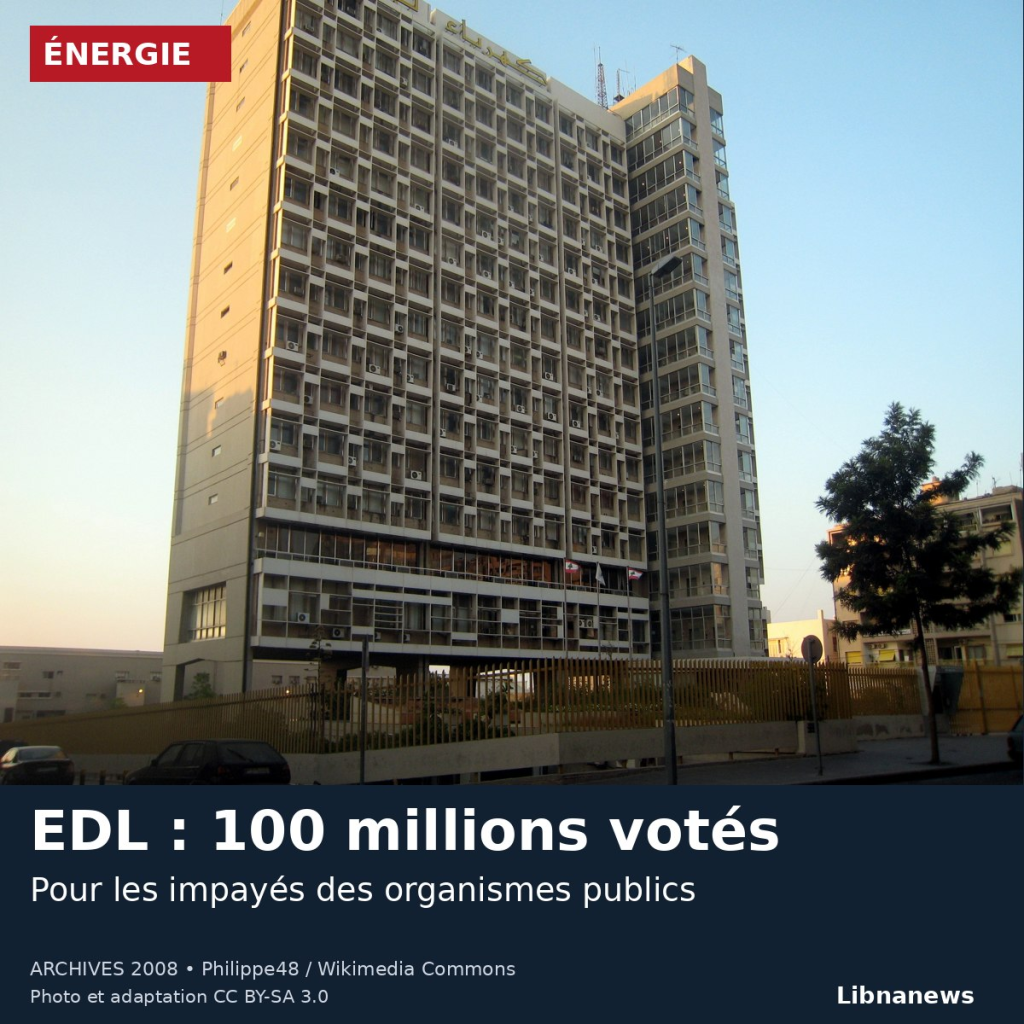
On 12 November, Parliament adopted an appropriation equivalent to $100 million to pay part of the public arrears to Electricity of Lebanon. The decision passed the stage of voting in plenary, after approval in committee on 9 November. It responds to the cuts committed by EDL against administrations and institutions that do not regularize their invoices.
EDL: partial payment of public invoices
The text transmitted by Decree 4210 opens up an appropriation of Pound8,950 billion in the general budget reserve of 2026. Its destination is the settlement of part of the electricityian’s claims on public bodies. The adoption was reported by several minutes of the meeting on 12 November.
This envelope does not constitute a rebate on household bills or aid for the purchase of private generators. It concerns electricity consumption already charged to administrations and establishments. It also does not finance the construction of new power plants by its announced purpose.
The vote does not yet prove the payment to EDL. It authorizes a budgetary expenditure which must then be implemented. The information available does not give a detailed schedule of payments or the share allocated to each debtor body.
Hospitals and municipalities among the priorities
During the panel review, Ibrahim Kanaan linked this decision to the difficulties encountered by users of public services. He cited water, airport and government hospitals as activities affected by unpaid bills and power interruptions.
The Chair of the Finance and Budget Committee had announced a priority for public hospitals and municipalities. However, it stated that a priority for settlement does not mean an exemption. These organizations must continue to pay for their consumption.
On 9 November, Kanaan had quoted $248 million in receivables from public administrations and institutions. He mentioned a total of up to 428 million by adding some exemptions. He had requested a check to clarify the amounts and to take account of payments already made. These figures therefore do not constitute a final balance established after audit.
A response to the November collection campaign
EDL announced on 2 November the updating of the relevant public subscription lists and the necessary instructions for the cuts. Its decision was directed at those administrations, establishments and municipalities that had neither paid nor contacted to resolve their situation.
The institution requested that the distribution of the names of the organizations concerned be based solely on its official communications. An interruption in a public service may have several causes. It is not sufficient to identify, on its own, an administration covered by the recovery.
In its press release of 4 November, EDL states that a partial payment must be accompanied by a written commitment to stagger the balance. The debtor body must also pay its new invoices. This combination distinguishes the treatment of the debt stock from the payment of current consumption.
The risk of a new accumulation therefore also depends on institutions’ budgets and their timeliness. An exceptional credit can reduce arrears without sufficient guarantees for subsequent years that each administration will pay its bills on time.
Audit remains to be conducted
The Finance Committee has asked for a debt check to put the regulation in a more sustainable response. The follow-up includes invoicing, receipts and payments already committed by public bodies.
This file is separate from the credit for solar loans. The first rule of past public consumption; the second is the financing of energy projects. Bringing them together in the same envelope would lose sight of their different beneficiaries and uses.
After the vote on 12 November, the next steps concern the implementation of the credit and its allocation. The actual amount received by EDL and the regular payment of current invoices will help to measure the effect of this decision on public arrears.





Comments