

Are new American sanctions in Lebanon imminent? Information published on Monday, 9 November, by a Lebanese channel evokes personalities close to the Presidencies of the Republic and the Parliament. But no decision corresponding to this list appeared in the latest OFAC publications consulted on Tuesday morning. The names envisaged do not constitute a list of sanctioned persons.
In briefs presented as his own information, Al-Jadeed claims that Lebanese officials received calls informing them of names proposed for a forthcoming wave of sanctions. The channel quotes relatives of the two Presidencies, former Ministers and MPs opposed to the framework agreement and agreements with Israel. It also refers to security officials who participated in Hizbullah’s social events.
This information does not give a public name list, a U.S. document or an effective date. They do not identify the persons concerned or conclude that the two presidents would themselves be targeted. The editorial staff could not independently confirm the calls reported.
American sanctions in Lebanon: what OFAC shows
The control of official publications makes it possible to set a precise limit. At the time of the audit, Tuesday morning, November 10, the last action posted by the Office of Foreign Assets Control dated November 9. It dealt with the modification of the registration of a shipping company, Volta Shipping Services, as part of Iran’s sanctions programme. It did not constitute the announcement of a new list of Lebanese politicians.
The November 6 action involved eight Canadian money services companies, also under Iran-related sanctions. These publications therefore do not support the wave described by Lebanese television. Nor does they prove that no action is being prepared in Washington: internal deliberations are not confused with public decisions.
The remaining point is thus concrete. A possible announcement should specify the identities, reasons and legal basis of the sanctions. Without these elements, it is not possible to present their adoption as acquired, nor to announce a reliable timetable. No name can be inferred from political or institutional proximity.
Pressure already used against Lebanese officials
The possibility of new measures is part of a documented US policy. On 18 June 2026, the Treasury announced sanctions against Lebanese officials and members of a network of companies associated with Hezbollah. His statement accused designated officials of obstructing the peace process and delaying the disarmament of the movement. He invoked anti-terrorist decree 13224.
This precedent shows that Washington has already used individual sanctions in this case. It does not authenticate the 9 November information. The persons designated in June, the reasons published on that date and the names that may be discussed today are in different sequences. Confounding them would turn an official precedent into confirmation of information that remains to be verified.
The United States also has a Lebanon-specific framework. Decree 13441, adopted in August 2007, authorizes the blocking of the property of persons determined by the Treasury, in consultation with the State Department. It includes attacks on Lebanese sovereignty, democratic institutions and the rule of law. The existence of this text does not mean that it would be the basis for a possible new decision.
The framework agreement at the heart of the controversy
The link between the envisaged sanctions and the opposition to the agreements with Israel gives particular political significance to the information. However, it remains the interpretation of the media account, not a reason officially published by the US authorities for a new list.
The framework agreement signed in Washington on 26 June 2026 is the immediate context. In its official presentation of the agreement, the European Union recalls that it provides for the disarmament of Hezbollah allowing for the gradual redeployment of Israeli forces from Lebanese territory. It also called for a permanent end to hostilities and respect for international law.
Disagreements over the application of this framework therefore relate to security and sovereignty commitments. But public opposition to an agreement alone is not sufficient to establish that a person is on an American list. It would be necessary to know the actual decision and the facts Washington would use to justify it.
What would change in case of designation
When a person is the subject of a blocking measure against OFAC, his or her property and interests under US jurisdiction are frozen. This includes property located in the United States and property owned or controlled by American persons. Transactions are generally prohibited, unless exempted or authorized.
The rule may also extend to companies owned, directly or indirectly, at least 50% by one or more blocked persons. It is not an automatic freezing of all property in Lebanon, nor is it a collective sanction against an institution with a designated official.
These consequences require effective action. For the information released on 9 November, the decisive elements remain expected: an identifiable American announcement, the names chosen and the precise reasons for their possible designation.
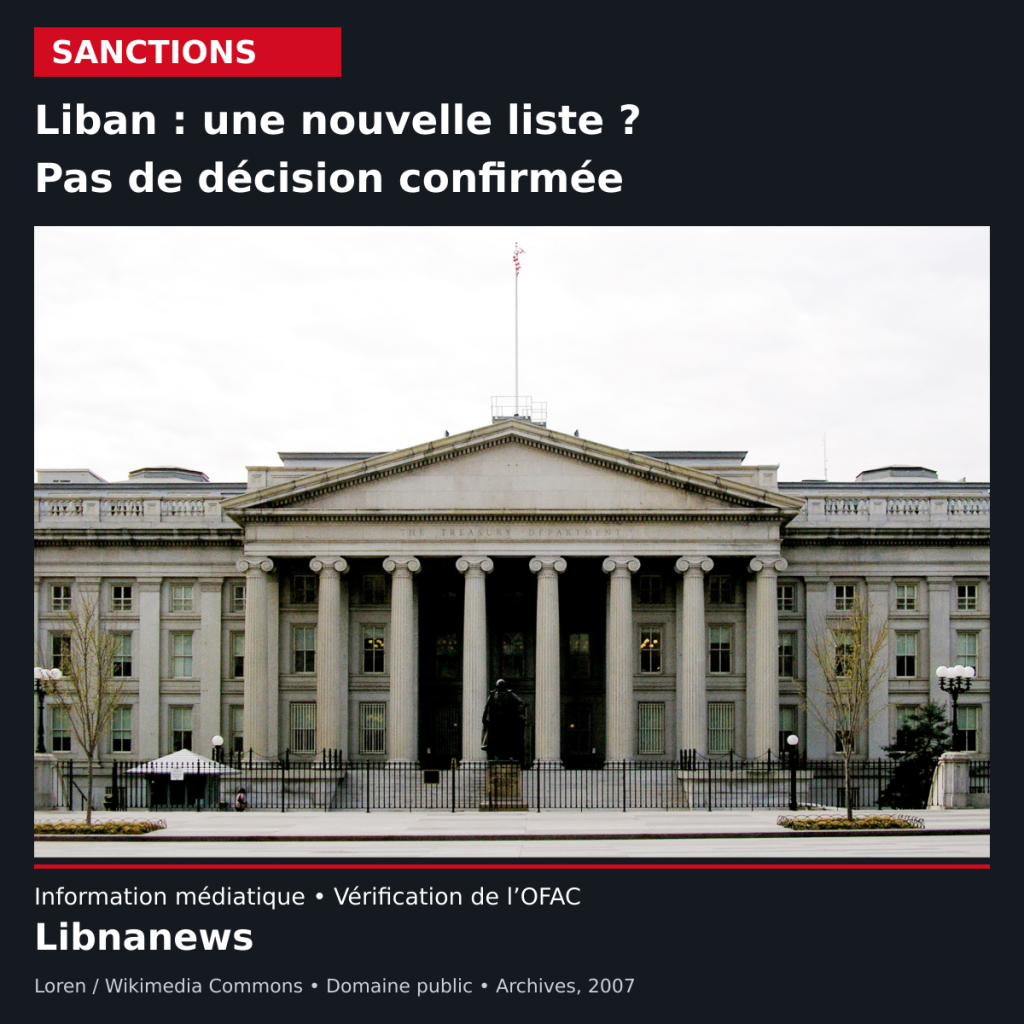
Cover photograph: Treasury Department building in Washington, D.C., March 27, 2007. Illustration archive image. Loren / Wikimedia Commons, public domain; version corrected by Stybn. Photograph kept whole, clothed Libnanews.





Comments