

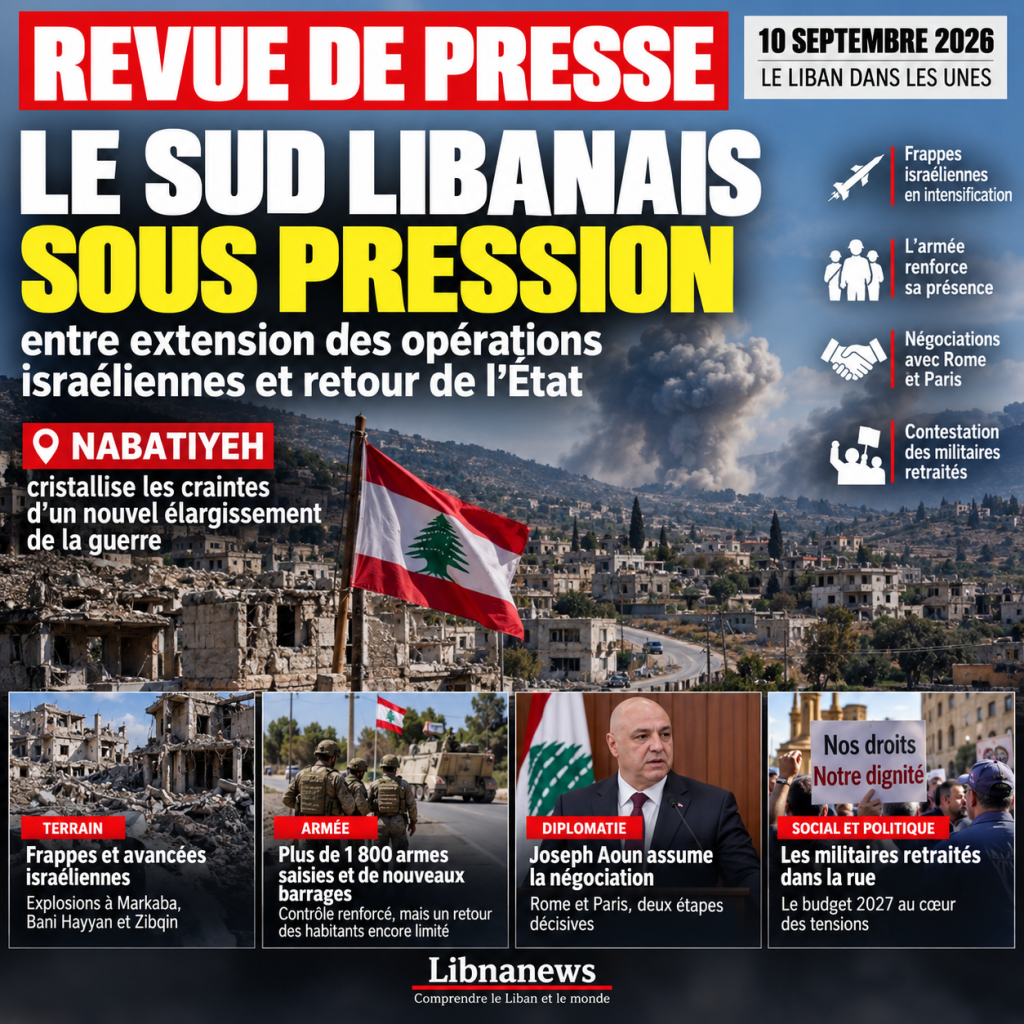
Nabatiyah crystallises fears of a new enlargement of the war
The situation in southern Lebanon largely dominates the political pages of the newspapers of 10 September 2026. Nabatiyeh now focuses much of the concern after fighting around Ali al-Taher, the continuation of Israeli strikes and fears of an expansion of the areas directly exposed. Al Jumhuriyat, 10 September 2026, reported the concerns of a high-level security source about Israeli intentions following the capture of Ali al-Taher. According to this source, discussions would take place in Israel on new operations to expand the controlled areas in the South. The daily insists on the military value of the height of Ali al-Taher, which dominates Nabatiyah and opens up possibilities for monitoring towards Iqlim al-Touffah. He also referred to the risks associated with the Israeli electoral calendar, with elections scheduled for late October. The newspaper, however, remains cautious: the projects referred to are based on information and evaluations reported by its sources and not on an official Israeli announcement. Ad Diyar, on September 10, 2026, asked himself what might follow the crossing of the red lines that Hezbollah had previously considered to be decisive. The daily reports that, according to informed circles of the situation on the ground, Hezbollah does not reduce Israeli intensification to Benjamin Netanyahu’s only election campaign. The party would consider that the bombings, destructions and attempts at territorial progress correspond to a broader plan. Israel would seek to gradually impose new realities while at the moment avoiding the cost of a general war. Ad Diyar also reports that Hezbollah believes that it has restored some of its capabilities after the considerable losses suffered. However, it does not provide a timetable for a possible response. The decision would depend on a much larger calculation than the only balance of forces in the South.
Military pressure remains visible in field reports. Al Sharq, on 10 September 2026, reported Israeli explosions in Markaba and Bani Hayyan, as well as strikes in the Wadi Zibqin and Wadi al-Saluqi areas. An attack on a motorcycle on the road between Zibdin and Marj Harouf also resulted in a victim. Israeli armoured movements were reported east of Khiam. Al Quds, on 10 September 2026, also reported an expansion of Israeli operations in the south and gave particular attention to the demands made in Nabatiyah for an immediate deployment of the army. The newspaper refers to a call signed by more than six hundred people, including doctors, engineers, lawyers, academics, journalists and activists. The stated aim is to protect Nabatiyeh and avoid further destruction. On September 10, 2026, Al Liwa, also observed that the strengthening of the army had become a major demand in the city and its surroundings. The daily sees this as a sign of increased use of State institutions. Nahar, on September 10, 2026, chose a formula that summarized the day: power lies between the « smoke » of internal and southern protests. Al Akhbar, on 10 September 2026, placed this situation in a broader strategic framework. According to his analysis, the essential question is not only which camp has the greatest military power. It focuses on the ability of Israel and the United States to transform their military advantage into a new political order. The daily reports that, after six months of war, Iran remains able to influence the region and the Strait of Ormuz. In Lebanon, Israel maintains a territorial presence while the issue of Hezbollah weapons remains unresolved. Al Akhbar therefore believes that military power can impose destruction and alter certain power relations without necessarily producing a settlement agreed to by all actors.
Army strengthens its presence and exposes the limits of return to villages
The role of the army is the second major driver of current affairs. Ad Diyar, Al Akhbar, Al Bina, Al Jumhouriyat, Al Liwa, and Al Sharq on 10 September 2026 largely echoed the military command statement on operations in areas under its control. The Army reported that it had installed six fixed dams and thirteen checkpoints on the roads leading to and within Zawtar al-Gharbiyah, Frun and Srifa. Walking and motorized patrols are provided on an ongoing basis. The specialized units also report that they seized approximately 1,818 weapons and ammunition. These include 10 rocket launch platforms, seven rockets, six drones, fifty-one projectiles, ten air bombs and 1,560 light munitions. A significant number of mines and explosive devices have also been removed. In addition, approximately 12 kilometres of roads were opened. Houses were inspected with the agreement of their owners. The army claims that the inhabitants cooperated with operations to remove weapons, ammunition and dangerous remnants of war. These measures are presented as the implementation of commitments made since the Framework Agreement of 26 June 2026. The command stresses, however, that a full agreement has not yet been reached on all the steps concerning the areas concerned and the measures to be taken. The question therefore no longer concerns only the physical presence of soldiers in the South. It also concerns the precise modalities of sustainable operational control and the ability of the army to assume more responsibility as the attacks continue.
The data published on Zawtar al-Gharbiyah illustrate the difficulties of returning the inhabitants. Al Joumhouriyat, on 10 September 2026, reports that nearly 70 per cent of the population was able to return to the locality to see the condition of the property. However, only 16 per cent of the population could have actually resettled there. This represents about sixty out of four hundred and fifty families. According to figures provided by the army, 85 per cent of the houses were completely destroyed and the remaining 15 per cent suffered partial damage. The security issue is therefore directly linked to reconstruction. The army can control entrances, remove ammunition and open roads. Sustainable return remains impossible when housing and infrastructure are destroyed. At the same time, the military command claims to have identified approximately 7,700 Israeli violations since the signing of the framework agreement. Shots were also reportedly fired near his soldiers and patrols. The army believes that these operations cause further displacement of the population and undermine its credibility in both the people and the international community. On September 10th, 2026, Al Bina The daily believes that an agreement to stop the war cannot produce real stability if attacks against civilians continue and if victims do not have sufficient channels to obtain justice. He cites the events in Nabatiyah al-Fawqa, Arabsalim and Kfar Rumman. This reading differs from that of Al Liwa, which emphasizes the return of the state and the expansion of the role of the army. The two newspapers, however, converge on one essential element: the future of the South now depends as much on the capacity of Lebanese institutions to act as on the actual cessation of Israeli operations.
Joseph Aoun takes over the negotiation while Rome and Paris become two decisive stages
The political response to this situation revolves around the choice of negotiation. Ad Diyar, Al Bina, Al Jumhouriyat, Al Liwa, Al Sharq and Nahar, on 10 September 2026, gave an important place to Joseph Aoun’s statements. The President said that Lebanon had chosen to negotiate with Israel as a sovereign State and that no foreign power should decide in its place. He described this as a decision based on the national interest and the protection of the country. Joseph Aoun set three objectives: to stop the war, to allow the displaced to return to their villages and to put an end to the state of hostility with Israel. It also responds to the criticism of the latter formulation. According to him, it does not mean that Lebanon abandons its sovereignty. On the contrary, he asked whether the country could continue to endure a series of wars. Al Joumhouriyat, on 10 September 2026, reports that he has placed his choice in a desire to break out of the cycle of conflict that has plagued Lebanon for several decades. The President considers that the decline of the State authority has helped to bring the country to the present situation. He assured us that Lebanon should not return to that period. Al Sharq, on 10 September 2026, also reported his warning against the use of outside powers in internal conflicts. Joseph Aoun claims that he who seeks to lean on the foreigner against another Lebanese ends up losing himself, because the interests of the outside powers do not necessarily coincide with those of Lebanon.
However, the negotiations remain surrounded by uncertainties. Al Jumhouriyat, 10 September 2026, reports that an American spokesman claims that the Lebanese and Israeli parties remain engaged in a dialogue and that a new meeting is to be held in Rome. However, the timetable appears to be linked to the Paris preparatory conference on support for the Lebanese army. The newspaper also mentions a possible separation between diplomatic and military discussions. The first ones would stay in Rome. The second could take place in the United States. Ad Diyar, on 10 September 2026, reported on Italy’s increasing caution regarding possible participation in a new international force to replace the United Nations Interim Force in Lebanon. According to European diplomatic sources cited by the newspaper, Rome wishes to obtain precise guarantees on the safety of its soldiers, the mandate of the force and its rules of engagement. The positive experience of Italian soldiers with the people of the South would not suffice if the nature of their mission were to change profoundly. At the same time, Al Sharq, on 10 September 2026, gave an important place to the preparatory conference to be held in Paris on 17 September. The newspaper states that the army has prepared a detailed study of its needs for weapons, equipment, transport, communications and human resources. The conference should serve to mobilize international and Arab support. The strengthening of the army thus becomes directly linked to negotiation: the more the State wishes to exercise its authority in the South, the more it must demonstrate that it has the necessary material and political means to do so.
Military challenge and government control open second internal front
The crisis in the South does not remove social difficulties. Nahar, Ad Diyar, Al Joumhouriyat, Al Bina The protesters denounce the draft budget 2027 and call for a correction of their pensions and income. Gatherings took place in Beirut, but also in several regions. In Riad al-Solh, demonstrators burned tires in front of the Grand Serail. Some crossed the barriers around the building. Roads were temporarily blocked in Madfoun, Bekaa and Baalbeck. Retired soldiers claim that their goal is not to penalize the population. They want to prevent the government from ignoring their claims and previous commitments. Joseph Aoun stated that he supported the rights of retired military personnel as well as those of those still in service. However, it calls for a balance between their demands and the means available and the need to maintain financial balance. Al Bina, on 10 September 2026, reports that discussions with the representatives of the retirees focused on establishing a common estimate of the cost of the measures claimed. The matter must then be referred to the Council of Ministers. Al Joumhouriyat, September 10, 2026, summarizes this tension by presenting « the rights of the military against the budget test » as one of its main subjects. The image is politically strong: the institution that Lebanon wants to strengthen to secure its sovereignty in the South is, at the same time, facing a profound social crisis among those who served in its ranks.
Al Akhbar, on 10 September 2026, added to this tension the question of parliamentary control of the government. The newspaper questions Nabih Berri’s decision to convene a general session on government action. Parliament had focused on legislation in the previous months. The meeting could now become the venue for a much broader debate on government policy, economic issues, security and the situation in the South. Al Akhbar notes above all the risk that the discussion will quickly leave the field of government responsibility to focus on Hezbollah and its weapons. The same newspaper also highlights the extension of the container terminal in the port of Beirut. An investment of $100 million is planned by the current operator to increase the capacity of the port. Al Akhbar, however, questions the legal basis of the procedure, the absence of a wider competition and the conditions under which this additional investment was granted. These dossiers recall that the sovereignty test facing Lebanon is not just about its borders. It also concerns the functioning of its institutions, the management of its infrastructure and confidence in public decisions. The day of September 10 thus places the power before several simultaneous demands: to prevent the extension of the war, to consolidate the role of the army, to preserve a diplomatic path, to respond to social demands and to maintain political control over an increasingly tense internal situation.
Local policy: the state seeks to consolidate its authority between negotiation, southern control and institutional tensions
Joseph Aoun defends sovereignty based on state decision
The political line defended by Joseph Aoun occupies a central place in the Lebanese press of 10 September 2026. The President of the Republic now openly assumes the choice of negotiating with Israel. He presents it as a sovereign decision and not as a concession imposed by a foreign power. Ad Diyar, September 10, 2026, reports that Joseph Aoun sets as objectives the cessation of the war, the return of the displaced to their villages and the definitive end of the state of hostility with Israel. The President also responded to the criticisms raised by the latter expression. He asked whether the Lebanese wished to remain in a permanent state of war and whether the country still had the means to cope with a new conflict. Al Joumhouriyat, September 10, 2026, developed this position widely. Joseph Aoun stated that Lebanon should not return to a period when state sovereignty was weakened. It goes back to 1969 and considers that the gradual abandonment of certain State prerogatives has contributed to the subsequent crises. He assures that the current power will continue the chosen path. Al Sharq, on 10 September 2026, also reported his warning against the use of external support in Lebanese conflicts. According to Joseph Aoun, the one who seeks to lean on the foreigner against another domestic actor ends up losing, because foreign powers first act according to their own interests. The President thus called for the Lebanese interest to be the reference point of the political decision. He stressed the need to overcome partisan and denominational divisions. He also claims that all parties lost in successive wars. However, on 10 September 2026, Al Liwa The newspaper looks at Joseph Aoun’s comments about the end of the hostile state and those of Nabih Berri about the risks of internal discord. The President of Parliament claims that nothing is more valuable than Lebanon and warns against internal wars, political divisions and security crises. He considered that sovereign issues should be managed without causing confrontation between Lebanese. This difference is not yet an institutional breakdown. Rather, it shows two priorities: Baabda insists on restoring the sovereign decision and negotiating, while Ain al-Tiné emphasizes internal cohesion and the refusal of a solution that could open a conflict around Hezbollah and its weapons.
The situation in the South gives this debate a very concrete dimension. Joseph Aoun chaired a meeting in Baabda with key military and security leaders. Ad Diyar, Al Bina, Al Jumhouriyat and Al Sharq, on 10 September 2026, reported that the meeting was devoted to the general situation in the South and in particular Nabatiyah. The President believes that any security vacuum can serve as a pretext for further attacks and undermine national sovereignty. He therefore described the deployment in Nabatiyah as an obligation of the State, but also as an element strengthening his position in negotiations with Israel. The army is described by Joseph Aoun as the backbone of stability. Its work must be coordinated with that of the Internal Security Forces, General Security, State Security and Civil Defence. This will for coordination comes as the situation in Nabatiyah feeds concerns. On September 10, 2026, Al Liwa, reports that residents of the city and surrounding communities are calling for a stronger army presence. The newspaper believes that Ali al-Taher’s events have changed part of the local debate on the role of institutions. Al Jumhuriyat, on 10 September 2026, reported fears about the possible extension of Israeli operations to areas of Nabatiyah and Iqlim al-Tuffah. In this context, State intervention is no longer merely presented as a matter of principle. It becomes an immediate response to the risk of widening the confrontation zone. Al Akhbar, on 10 September 2026, stressed the limitations of this approach when it was not accompanied by an Israeli withdrawal. The newspaper considers that the core of the problem remains the order of the stages: Israel links its withdrawal to the issue of Hezbollah’s weapons, while the party believes that the withdrawal must precede any settlement of its arsenal. This contradiction directly affects the State’s ability to impose a solution only through the deployment of its institutions.
Nawaf Salam between government management, budget and parliamentary pressure
Nawaf Salam is at the centre of another section of political news. The Prime Minister must simultaneously monitor the situation in the South, conduct a review of the 2027 budget and prepare for Lebanese participation in the UN General Assembly. Ad Diyar, 10 September 2026, reports that Joseph Aoun and Nawaf Salam discussed together developments in the South and the measures taken by the army to strengthen its presence in the unoccupied villages. Both officials also discussed draft budget 2027 and preparations for the delegation to be chaired by Nawaf Salam in New York during the third week of September. On 10 September 2026 the Council of Ministers reported that the budget was further examined on an article-by-article basis. Some provisions have been amended. The government must also review the claims of members and public servants after the cost estimates have been prepared. This issue has an important political dimension. Retired soldiers demonstrated in several areas and near the Grand Serail. They blame the draft budget for not responding sufficiently to the collapse of their income. Ad Diyar, 10 September 2026, takes a particularly harsh tone towards fiscal policy. The newspaper considers that military personnel who have served the State should not be forced to demonstrate in order to improve their pensions. He reported that a delegation led by Chamel Roukoz should continue discussions with the Directorate-General of the Ministry of Finance. Joseph Aoun claims to support the rights of the military, but he asks to take into account the financial capabilities of the state. The tension is therefore clear: the power wants to strengthen the army and the security apparatus at the same time as their staff and retirees demand an improvement in their material situation.
The pressure on the government is not just from the street. Al Akhbar, on 10 September 2026, asked at length about Nabih Berri’s decision to convene a general meeting to discuss government policy. The newspaper notes that the previous parliamentary sessions were mainly devoted to legislative work. The new meeting must therefore open up a genuine exercise of political control. She intervenes in a sensitive context, just before Nawaf Salam moved to New York. According to Al Akhbar, several issues can be addressed: the economic situation, taxes, security policy and developments in the South. The newspaper believes above all that the debate could quickly move towards the Hezbollah weapons and the role of the party. An initial session to question the government could then turn into a confrontation between parliamentary blocs. Al Bina, on 10 September 2026, reported that Nabih Berri had scheduled the general discussion session on 15 and 16 September. Al Sharq, on 10 September 2026, states that the calendar was changed following a request by Sami Gemayel, the first scheduled date coinciding with the commemoration of the assassination of Bashir Gemayel. The Speaker agreed to postpone the sitting. This decision also gives an indication of Berri’s willingness to maintain the parliamentary exercise without creating an additional controversy around the timetable. Nevertheless, the meeting remains politically sensitive. It is the first important opportunity to put the Salam government directly in the face of a general debate on its record, while the executive must simultaneously manage the South, negotiations, the budget and social demands.
Hezbollah frames his speech and the issue of its weapons remains at the centre of the debate
Hezbollah intervenes in this political sequence by seeking first to control the messages attributed to it. Ad Diyar, Al Bina, and Al Sharq, on 10 September 2026, report a press release of the party’s media relations on statements made by various personalities in the media and on social media. Hezbollah recalls that information or analysis expressed by persons close to the party should not automatically be regarded as official positions. He states that his positions are expressed by the speeches of his secretary-general Naim Kassem, by the official press releases of the party and the resistance, by his media relations and by the parliamentary bloc of Fidelity to the resistance. Any other declaration commits only its author. This clarification comes at a time when questions are increasing about Hezbollah’s response to developments in the South. Ad Diyar, September 10, 2026, directly raises the question of the duration of his military silence. The newspaper reports that the party considers that Israel has already crossed several red lines through the destruction, attacks on civilians and the continuation of its operations. However, the decision to resume large-scale operations would depend on a daily assessment of the regional situation. The daily says that the party retains a will to fight, but that it must take into account an unfavourable balance of forces and a confrontation that now exceeds Lebanese territory. Al Akhbar, 10 September 2026, puts this hesitation in the debate on the very function of weapons. The newspaper believes that the issue cannot be resolved only by requiring the delivery of the arsenal. According to his analysis, the persistence of occupation and bombardment has led a part of the population to believe that weapons are still needed. The daily view is that a lasting solution requires changing the security conditions that justify their retention in the eyes of their supporters.
This issue also crosses the positions of Hizbullah’s political opponents. Al Sharq, on 10 September 2026, reported a statement by Samir Geagea calling for the implementation of government decisions on the party’s military and security structures, including in Nabatiyah and its environs. The leader of the Lebanese Forces believes that the army must withdraw non-State weapons and dismantle the relevant infrastructure in order to allow the State to then call upon the United States to exert pressure to stop Israeli attacks. On September 10, 2026, Al Liwa, adopted a close reading when he described an increase in local support for the choice of state. On the other hand, Ad Diyar and Al-Bina–emphasis more strongly on the Israeli occupation and the impossibility of separating the issue of weapons from that of withdrawal. These differences now structure domestic policy. They contrast less actors on the posted objective of a sovereign state than on the sequence to achieve it. For some, the State monopoly of arms must be established immediately in order to strengthen the Lebanese position. For others, prior disarmament while the Israeli army is still present in Lebanese territories would remove a means of pressure before it has been withdrawn. This contradiction should be found in Parliament during the government’s general discussion. It also accompanies negotiations with Israel and international discussions on support for the army.
Financial reforms, state control and new friction
Local politics is not limited to military matters. Joseph Aoun also received the Chairman of the Parliamentary Finance and Budget Committee, Ibrahim Kanaan. Ad Diyar and Al Bina Ibrahim Kanaan stressed the need to restore confidence in the banking system and to treat the issue of deposits fairly. The identification of responsibilities and the verification of figures remain essential steps. This dossier is part of Joseph Aoun’s desire to make the fight against corruption a priority. Al Sharq, September 10, 2026, reports that the President considers this struggle to be one of the main battles in his mandate. He claims that several decades of administrative paralysis, political clientelism and religious sharing cannot be repaired quickly, but argues that the first stages of reform have been initiated. It also highlights the financial progress made by the State before the further deterioration of the security situation. These statements must, however, be seen in their political context: they constitute the assessment presented by the Presidency itself and not an independent assessment of the government’s economic performance.
Al Akhbar, on 10 September 2026, brought precisely a counterpoint to this reformist discourse with his investigation into the extension of the container terminal in the port of Beirut. The project foresees an investment of $100 million to significantly increase the terminal capacity. The newspaper questions the procedure followed with the current operator and the legal basis for direct attribution. He reports that the Minister of Public Works, Fayez Rasamny, asked for an explanation of the legal basis for the operation. Al Akhbar stresses that a contractual priority to operate new facilities does not necessarily mean that development work must be undertaken without competition. The daily also raises the question of the future of the other activities of the port if the container terminal continues to expand. The case thus takes on a political dimension: the reconstruction of the state and the restoration of confidence are not only measured by the presence of the army or the adoption of banking laws. They also depend on the transparency of public contracts, the functioning of institutions and the government’s ability to justify its decisions. Between southern control, negotiations with Israel, the 2027 budget, the anger of the military, the parliamentary discussion session and questions about the management of public infrastructure, Lebanese policy of 10 September 2026 therefore focuses on the same question: that of the State’s ability to effectively exercise its responsibilities without causing a new internal divide.
Diplomacy: Rome, Paris and Washington at the centre of a battle to impose conditions of de-escalation
Negotiations with Israel remain open but their timetable now depends on the ground
The negotiating channel between Lebanon and Israel remains open, but the press of 10 September 2026 describes a process slowed down by military operations in the South and by differences on the commitments expected from each side. Al Jumhouriyat, 10 September 2026, reports that a spokesman for the US State Department claims that the Lebanese and Israeli parties remain engaged in dialogue and that a new meeting in Rome is still planned. However, the timetable announced several weeks earlier is no longer considered as acquired. The newspaper explains that the file was mentioned during the visit to Israel of the American ambassador to Lebanon, Michel Issa, and his interview with Benjamin Netanyahu. A new meeting was then envisaged in the following weeks, without Israeli commitment on a specific date. According to Al Jumhuriyat, Israel then linked further steps to concrete measures by the Lebanese army. This has brought the Rome calendar closer to the Paris preparatory meeting on international support for the army. The daily progresses as well as the results of Paris could determine the time and conditions of the next trading sequence. He also mentioned a growing distinction between two levels. The first would be political and diplomatic, with Rome as a forum for discussion. The second would be military and could be dealt with separately in the United States. For the US administration, according to the analysis developed by Al Jumhouriyat, maintaining this negotiating table is in itself an objective. Washington would seek to prevent the disappearance of a canal that would leave more room for regional power relations and Iran. The newspaper believes that the United States also wants to maintain the stability of the Lebanese political architecture and avoid a collapse of the process under the pressure of events in the South. This reading, however, goes beyond the official American announcements and is part of the daily analysis. Ad Diyar, September 10, 2026, takes a much more skeptical approach to American mediation. The newspaper questions the ability of the United States to obtain concessions from Israel as bombardments, destruction and ground operations continue. He notes that Washington claims to be able to facilitate discussions, but that Lebanon still does not have an effective halt to Israeli operations. This contradiction feeds into a central issue in Lebanese diplomacy: does negotiating while military operations continue improve Beirut’s position or, on the contrary, negotiate under permanent pressure? The Presidency decided in favour of maintaining the process. Joseph Aoun repeats that the choice to negotiate is a sovereign decision and that his aim is to end the war, bring the displaced back and put an end to the hostile state. However, Al Joumhouriyat and Ad Diyar show that the discussion no longer focuses solely on the purpose of the dialogue. It now concerns the sequence of steps, guarantees and actions that each party will have to perform before the next.
At the same time, Lebanese diplomacy seeks to transform the strengthening of the army into a political argument. According to Joseph Aoun, the deployment to the unoccupied areas must prove that the State assumes its responsibilities. It must also prevent any security vacuum that could be used as a justification for new Israeli operations. Al Joumhouriyat, September 10, 2026, reports that Washington is precisely awaiting practical measures from the army. The newspaper states that the United States wishes to see the military institution move forward on the ground under the State’s arms monopoly principle. However, the same newspaper notes that the strengthening of patrols and deployment in Nabatiyah did not translate into direct confrontation with Hezbollah. It confirms that the Lebanese authorities continue to refuse an internal confrontation. This is essential in the diplomatic conduct of the case. Beirut seeks to present the army as the central security actor while preventing external demands from causing an internal crisis. On 10 September 2026, Al Bina, for its part, challenged any strategy that would make Lebanese sovereignty dependent on US pressure alone. In an analysis of the diplomatic response to Israeli operations, the newspaper called for more offensive diplomacy. It believes that Lebanon must use simultaneously the army, internal unity and the political instruments at its disposal, while avoiding the notion of Washington as a neutral arbitrator. The daily also criticizes the speech of Lebanese diplomacy when it considers it too cautious in the face of Israeli attacks. This position is clearly different from the Presidency’s strategy. However, it shows that diplomacy is now a subject of internal confrontation. Discussions with Israel are not judged solely by their results. They are also assessed according to the balance of forces they create in Lebanon. Al Akhbar, on 10 September 2026, developed a similar reasoning on another register. The newspaper believes that the United States has a major influence in the discussions, but that the persistence of occupation and bombing limits Washington’s ability to convince Hezbollah supporters that a full transfer of security to the state is sufficient to guarantee their protection. Thus, Lebanese diplomacy is faced with a difficult equation: to demonstrate to Israel and the United States that the State can exercise its authority, while demonstrating to the people of the South that this authority can also protect them against Israel. As long as the second demonstration is incomplete, institutional progress may not automatically produce the desired political effects.
Al Bina的-10 09 2026.pdf
Paris transforms military support into a diplomatic lever while international actors seek their guarantees
In this context, the preparatory conference devoted to support for the army becomes an important diplomatic as well as military event. Al Sharq, on 10 September 2026, said that the meeting scheduled for 17 September in Paris should mobilize international and Arab assistance to strengthen the capabilities of the army and the security forces. The newspaper reports that Joseph Aoun must participate alongside French President Emmanuel Macron and King Abdullah II of Jordan. A large number of States, military officials and representatives of international organizations were also announced. The objective is not limited to the purchase of equipment. Paris wants to help create the conditions for the Lebanese state to extend its authority, especially in the south and along borders. The army has prepared a detailed study of its material, technical, logistical and human needs. Requests are for equipment, travel, communications and capacity for sustainable deployment. Al Joumhouriyat, on 10 September 2026, stresses, however, that not all international contributions are yet guaranteed. The newspaper claims that Saudi Arabia agreed to participate after French efforts, but that it did not at this stage announce a specific commitment to the fund. He also reports that American circles are waiting for action on the ground before any further substantial aid is released. However, Washington should be represented by a senior military official linked to the coordination mechanism with Lebanon. This caution reveals the political nature of the financial support. Donor States want to know how the army will use its new capabilities and how they will deploy. France thus seeks to transform the Paris conference into a bridge between material support for the institution and the political process with Israel. The more credible the military, the more Beirut can argue that it is able to perform the security functions required by its international partners. But the equation remains conditioned by Israeli behavior. The Lebanese Armed Forces itself asserts that the continuation of attacks and violations undermines its ability to complete its missions. International aid will therefore not be able to solve the problem alone if the areas in which the army is to deploy continue to be bombed. Paris must thus work simultaneously on two levels: to increase the capacity of the Lebanese State and to obtain an environment enabling this capacity to produce results. The conference therefore appears to be an indirect negotiating stage on the future of the South, not just as a donor meeting.
The question of the future of the international presence further reinforces this issue. Ad Diyar, 10 September 2026, reports that Italy has become more cautious about a possible international force to succeed the United Nations Interim Force in Lebanon. According to European diplomatic sources cited by the newspaper, Rome was initially interested in a new formula. However, the visit of the head of the Italian intelligence services to Beirut would have led to a reassessment. He reportedly met officials and other actors in order to obtain guarantees on the nature of the mission, the environment in which the soldiers would be called upon to operate and the risks of confrontation with armed groups or the inhabitants. The report submitted after the visit was said to have been reserved, in particular on the issue of the protection of Italian soldiers. The Italian Parliament would like to know precisely the rules of engagement, the mandate of the force and the responsibilities in case of an incident. Ad Diyar recalls that the Italian military currently present in the South have a trust capital built over the years through their links with the population and their civilian and humanitarian activities. A new mission, with different powers, could, however, alter this relationship. This Italian prudence joins the more general questions about the current international post-mission. It shows that no replacement can be decided without defining who protects the force, what powers it is given and how it coordinates with the Lebanese army. Al Quds, on 10 September 2026, brought to this issue the position of the United Nations. The newspaper reports that Secretary-General Antonio Guterres calls for an immediate cessation of hostilities and the withdrawal of Israeli forces from Lebanese territory. It also calls upon all parties to respect the sovereignty of Lebanon and their international obligations. Al Quds also reported the Secretary-General’s concerns about attacks on civilians, health facilities and public institutions. The daily also quotes the United Nations Interim Force in Lebanon, which claims to have observed a significant number of Israeli fire since the June agreement without recording comparable fire from the Lebanese side. This position provides Beirut with an important diplomatic argument: requests for the obligations of the Lebanese State can be accompanied by an explicit international demand for Israeli withdrawal and cessation of attacks.
Washington seeks wider political access while Beirut expands external channels
American action is not limited to dialogue with the authorities. Several newspapers are interested in Washington’s attempts to establish more direct political contact with the Shia community. Al Joumhouriyat, September 10, 2026, devotes a dossier to what he describes as an American desire to distinguish Hezbollah from its social environment. According to this analysis, Washington maintains its objective of putting an end to the weapons that are beyond state institutions, but seeks to avoid presenting this policy as a confrontation with the Shiites. The problem identified by the newspaper is trust. The people of the South evaluate American politics from their direct experience: bombing, destruction, occupation and return to their villages. Therefore, an American discourse ensuring that the community is not targeted cannot produce a lasting effect if Washington fails to obtain concrete guarantees of security. The logic presented by Al Joumhouriyat is to gradually reduce the reasons for supporting Hezbollah’s weapons. This would require an Israeli withdrawal, a lasting cessation of operations, reconstruction, guarantees for the South and an army capable of effectively protecting the territory. In this scenario, the arms debate could then be moved from military ground to political ground. Al Akhbar, 10 September 2026, deals with the same strategy from a much more critical point of view. The newspaper takes on the role of American Ambassador Michel Issa and his closeness to the Israeli position. He considers that the American approaches to Shiite actors are part of a strategy of political pressure against Hezbollah. Beyond the very controversial tone of this reading, the convergence between the two newspapers is about the very existence of a new American effort towards Shiite interlocutors other than the party. They diverge deeply in its meaning. Al Joumhouriyat sees it as the search for a solution to detach the community from the logic of arms. Al Akhbar sees it as an attempt to weaken Hezbollah politically. This battle of perception is now an integral dimension of American diplomatic activity in Lebanon.
Beirut, for its part, tries not to limit its external action to the American channel alone. On 10 September 2026, Al Bina, reported the visit of the Chinese ambassador to the Lebanese press and the discussions on the regional war as well as on ways to end operations in Lebanon. The newspaper insists on Beijing’s interest in stability and on maintaining contacts with Lebanese officials. Al Sharq, 10 September 2026, also reports that Nawaf Salam is preparing to attend the UN General Assembly meetings in the third week of September. This must offer the Prime Minister an additional platform for exposing the Lebanese position, while diplomatic efforts are focused on the South, Israeli violations and support for public institutions. At the same time, Lebanese politicians maintain their European contacts. Al Sharq reported on Samir Geagea’s meeting with the new French Ambassador to Lebanon, Patrick Durel, during which Lebanese and regional developments were discussed. Internal differences remain in these contacts. The Lebanese Forces want international partners to support the application of the State’s arms monopoly. Other actors are first insisting on obtaining an Israeli withdrawal and stopping attacks. Lebanese diplomacy thus operates on several tracks that do not all carry exactly the same message. The Presidency highlights the sovereignty of the decision and the negotiation. The government seeks to mobilize the United Nations and international partners. The parties use their own networks to defend their priorities. The United States is trying to keep the table open and broaden its internal channels. France is focusing on strengthening the army and preparing for Paris. Italy requests guarantees before any new commitment. The United Nations is calling for the cessation of hostilities and Israeli withdrawal. In this landscape, the next diplomatic stage depends less on one initiative than on the ability to bring three issues together: the cessation of Israeli operations, the effective deployment of the Lebanese State and the progressive definition of a regulation on arms outside public institutions.
International policy: the war between Washington and Tehran extends to maritime routes and leads the Gulf, Yemen and the Levant
The Strait of Ormuz becomes the main theatre of an open confrontation
The confrontation between the United States and Iran reached a new level on 10 September 2026 with the expansion of attacks to oil tankers, commercial vessels and military installations in several countries in the region. Al Arabi Al Jadid, September 10, 2026, describes this new episode as the largest maritime war between Washington and Tehran since the conflict began six months earlier. U.S. forces announced that they had destroyed five Iranian oil tankers during the night, following Iranian attempts at U.S. naval vessels. The U.S. central management then claims that ten Iranian oil tankers were destroyed during the week. Washington presents these ships as belonging to a network to finance the Revolutionary Guards and their regional allies. US Secretary of State Marco Rubio summarizes the new American doctrine: every Iranian attempt against an American warship will result in the loss of Iranian oil tankers. Iran responded by announcing attacks on two American buildings and eight oil tankers in the Ormuz Strait area. The Revolutionary Guards also reported targeting ten vessels near the Strait. Al Sharq Al Awsat, 10 September 2026, confirms the scope of this new phase. The newspaper points out that the Iranian commercial fleet is now directly under American threat. The conflict is therefore no longer confined to military or nuclear sites. It extends to economic instruments that allow Tehran to export its oil and finance its military apparatus. Al Quds, on 10 September 2026, notes that this intensification immediately affected the markets. Oil crossed the $100 per barrel threshold for the first time since July. On September 10, 2026, Al Bina, quoted a barrel of Brent around $101.50 and highlighted the consequences on American markets. The newspaper reports a decline in key stock indices and an increase in the yield of US bonds to ten years. He also referred to the impact of fuel prices in the United States. The average cost of the gasoline gallon would have been $4.22, while diesel would have been $5.94. According to Al Bina, these figures show that the war is starting to enter directly into the American domestic debate, as it weighs on households, businesses and transport.
The Iranian strategy is now to extend the area of risk beyond the Ormuz Strait alone. Al Arabi Al Jadid, September 10, 2026, reports that the Revolutionary Guards want to create a « restricted zone » from the vicinity of Shabahar to the Arabian Sea and the Arabian Sea. The precise coordinates should be announced at a later date. The spokesman for the Guardians of the Revolution, Hussein Mohibbi, claims that the Strait of Ormuz is no longer merely a maritime passage, but one of the decisive elements of global balance. He explained that Iran wished to extend its control over the movement of ships and to make it more costly to pass vessels considered hostile or subject to measures against Tehran. The consequences are already visible. Al Arabi Al Jadid reports that a tanker carrying two million barrels of fuel oil caught fire in Iraqi waters after being hit by a drone. No crew members were reportedly injured. Another attack reportedly damaged a LNG tanker near the Emirati port of Khor Fakkan. These incidents are also reported by Al Bina and Al Sharq Al Awsat. The risk thus extends to Iraqi, Emirati and Omani waters. At the same time, Iran launched approximately 20 ballistic missiles to a base used by US forces in eastern Jordan. The Jordanian army claims to have intercepted 18 of them. Two others reportedly fell into uninhabited areas without causing any casualties. An American official quoted by Al Arabi Al Jadid claims that all American military are safe. Jordan therefore also becomes a space directly affected by confrontation. Qatar, Kuwait, Saudi Arabia, Bahrain and Egypt condemn the Iranian attacks on Jordanian territory. Doha calls for an immediate halt to military operations and a return to dialogue. This series of reactions shows that the Gulf States are seeking to prevent the transformation of their territory or waters into a permanent extension of the war between Washington and Tehran. The main difficulty, however, remains the absence of a credible de-escalation mechanism. Each attack now produces a wider response. Iran states that it will hit 20 targets if two or three of its own targets are met. The United States promises to continue to hit Iranian ships every attempt against their fleet. This logic of retaliation increases the risk of an incident that would exceed the limits so far observed.
The nuclear issue comes before the Security Council while Tehran raises the price for a regional settlement
The military confrontation is accompanied by new diplomatic pressure on Iran’s nuclear programme. Al Sharq Al Awsat, 10 September 2026, reports that the Board of Governors of the International Atomic Energy Agency decided to refer the Iranian case back to the UN Security Council. This is the first such decision in 20 years. The text was adopted by 23 votes to three, with eight abstentions. Russia, China and Niger voted against. On 10 September 2026, Al Binah reported the reaction of the Iranian Foreign Ministry, which considered the decision unjustified and politically motivated. Iranian spokesman Ismaïl Baghai accuses Western powers of ignoring the consequences of American and Israeli attacks on nuclear facilities under international safeguards. In his view, limiting the access of inspectors is a direct consequence of the war. Tehran therefore believes that the Agency sanctions the effects of a situation created by enemy strikes. Al Liwa However, the debate no longer focuses solely on Iran’s past commitments. A new question arises around underground installations. Al Arabi Al Jadid and Al Sharq Al Awsat, on 10 September 2026, reported a sharp acceleration of work at a site near Natanz, which was referred to as Jabal al-Faas in several reports. Satellite images analyzed by an American research centre would show an intensification of construction in the year 2026. Experts believe that the site was probably designed as a safe haven for nuclear activities because of its depth and the nature of the terrain. The United States would consider how to hit such deep buried facilities. The challenge lies in the real ability of available weapons to cross the rock and destroy buried infrastructure. The combination of diplomatic referrals to the Security Council and this military questioning thus increases pressure on Tehran. On the other hand, it does not yet provide a clear path to an agreement. Iran claims that its nuclear programme and ballistic capabilities are under its sovereignty. On the contrary, Washington and its allies want to keep these two issues at the heart of any future negotiations.
Tehran now explicitly links a possible cessation of the war to cases far beyond its territory. Al Arabi Al Jadid, 10 September 2026, reports on the conditions set out by the spokesman for the Revolutionary Guards. Iran demands a complete end to the American war and threats. He also called for the release of $24 billion in frozen Iranian assets. He calls for an end to any intervention in his nuclear and ballistic programmes. But it adds two regional conditions: the Israeli withdrawal from Lebanon and the lifting of the blockade of Yemen. On September 10, 2026, Al Bina, considered this formulation to be particularly significant. The newspaper notes that the two files are not presented as mere gestures of solidarity with allies. They are included in the same list as the direct Iranian requirements. Lebanon and Yemen are thus integrated by Tehran at the price of a regional settlement. This position appears at a time when the war in Yemen is also experiencing a new escalation. Al Arabi Al Jadid and Al Quds, on 10 September 2026, reported the intensification of fighting from Al Jawf to Marib, Taez, Al Bayda and the Red Sea coast. Yemeni government forces are announcing progress and opening a wider operation around Marib. The Houthis claim to have taken over certain sectors and attacked government positions. At the same time, they launched missiles and drones against Saudi Arabia. Pakistan’s Defense Minister Khawaja Asif warns that the strategic agreement signed in Mecca between Pakistan, Saudi Arabia and Turkey could be activated if attacks against Saudi territory continue. Al Sharq Al Awsat, 10 September 2026, reports that the Saudi Council of Ministers reaffirms the Kingdom’s right to defend its sovereignty and citizens. Riyadh accuses the Houthis of pursuing a strategy that threatens not only Yemen, but also commercial shipping in the Red Sea. The President of the Yemeni Governing Council, Rashad al-Alimi, said that his Government had not triggered this new phase and demanded that the international community clearly assign responsibility for the escalation of the Houthis. All these developments show that the confrontation between Washington and Tehran acts as a multiplier of existing crises. The fronts of Lebanon and Yemen are being reintroduced into the Iranian negotiations at a time when fighting is intensifying.
Israel faces growing European pressure on settlements while Palestinian crisis remains open
Another diplomatic front opens up between Israel and several Western countries around colonization in the West Bank. Al Arabi Al Jadid, on 10 September 2026, dedicated its first to British measures against settlement products. The newspaper believes that the Israeli reaction shows the government’s concern about the risk of wider economic isolation. London announced a project to ban goods from West Bank settlements. Other Western countries are studying or applying comparable restrictions. Al Quds, September 10, 2026, reports that Israel responds by accelerating the examination of hundreds of new housing units in the settlements. An Israeli commission is to study a project involving 747 new housing units. At the same time, Israel decided to close the British Consulate in Jerusalem. The British Foreign Minister calls this a regrettable and damaging measure. British Prime Minister Andy Burnham defends sanctions before MPs and says his country must choose fairness in the face of injustice. The most important dimension of this crisis, however, concerns the American attitude. Al Quds reports that Donald Trump’s administration did not seek to prevent the British approach. The British Prime Minister would have even informed the US President before the announcement. The White House then distanced itself from the criticisms made against London by the American ambassador to Israel. According to the newspaper’s officials, these statements had not been coordinated with the Presidency or the State Department. This position does not constitute an American break with Israel. He pointed out, however, that Washington did not wish to take on political responsibility for all the reactions of Benjamin Netanyahu’s government. On September 10th, 2026, Al Bina According to the newspaper, the Gaza war has gradually degraded Israel’s image in Europe. Initial criticisms of the human cost of operations were followed by restrictions on certain arms sales and subsequent settlement-related measures. The daily recalls that Josep Borrell had already criticized in 2024 the ineffectiveness of Western appeals calling on Israel to protect civilians. European policy therefore seems to evolve from protest to the use of more concrete economic and diplomatic instruments.
This international pressure, however, does not put an end to operations on the Palestinian ground. Al Quds, on 10 September 2026, reported further Israeli attacks in Gaza despite the ceasefire that came into effect in October 2025. The Gaza Ministry of Health reported new deaths and injuries, while building destruction continued in several areas. Local authorities are also denouncing restrictions on the entry of food, medicines and materials necessary for internally displaced persons. The humanitarian situation remains particularly fragile as winter approaches. At the same time, the newspaper reports that several Israeli human rights organizations are seeing an increase in settlement and movement restrictions in the West Bank. According to their report, measures previously concentrated in some rural areas are now being applied to larger territories, resulting in the isolation of Palestinian localities from their agricultural lands. Al Arabi Al Jadid, on 10 September 2026, reports at the same time the rejection by several Palestinian movements of the way in which the recomposition of the Palestinian National Council is being prepared. These organizations denounce a process based, in their view, on appointment rather than on genuine elected representation. They called for a common mechanism to enable Palestinians from within and diaspora to choose their representatives. This challenge comes at a time when elections are scheduled for 28 November. The Palestinian crisis therefore has several simultaneous levels: continued attacks on Gaza, expansion of settlement in the West Bank, increased international pressure on Israel and internal divisions over Palestinian political representation. None of these cases are yet settled. On the other hand, European evolution around settlements introduces a new element: the possibility that the diplomatic cost of Israeli policy will gradually turn into commercial and economic costs.
Economy: back-up tourism, digital payments up and key sectors under pressure
Tourism disappoints despite the summer season and weighs on expected revenues
Lebanese tourism, which was to be one of the main drivers of activity during the summer of 2026, did not reach the levels expected. Ad Diyar, September 10, 2026, devotes a great deal of attention to declining attendance and its impact on the economy. The newspaper reports that traffic at Beirut International Airport decreased further in August. The decline is 10 per cent compared to August 2025, while the professionals were looking for an improvement during this month traditionally favourable to Lebanese arrivals from abroad and visitors from the Gulf. The daily also states that the number of passengers departing exceeded that of arrivals by about 9%. Transit traffic fell by 12%. According to Ad Diyar’s report, the tourist season as a whole remains below expectations. Losses are valued at around $1 billion. This loss of profits is not limited to hotels. It also affects catering, shops, transportation, recreation and all activities that are directly dependent on visitor spending. The newspaper links this weakness to ongoing security and political tensions. They continue to affect travel decisions and airline programming. The majority of carriers have resumed operations, but Air France and Lufthansa remain absent, according to Ad Diyar. This situation still limits some international connections. In particular, the daily newspaper focuses on a greater return of visitors from the Gulf countries to support the end of the year. However, this perspective remains linked to the evolving security environment. In an economy where foreign exchange inflows are still largely dependent on tourism and the diaspora, a lower than expected summer season reduces the margins of many sectors. The problem is therefore not limited to the number of travellers. It directly affects foreign exchange earnings, business income and the ability of a part of households to benefit from seasonal activity.
The tourism situation also reflects the difficulties faced by exporters. Ad Diyar, September 10, 2026, points out that Lebanese exports to the Gulf countries pay the price of the increase in the transport bill. Increased freight costs reduce the competitiveness of Lebanese products and increase their entry into foreign markets. This pressure comes at a time when local companies already face high energy, financing and operating costs. In several sectors, however, the Gulf market remains essential. Increased transport therefore directly threatens the margins of producers and traders. It can also reduce their ability to maintain the same export volumes. This issue is all the more important as Lebanon seeks to restore its economic relations with the Arab countries and to regain a greater place in their markets. The same problem appears in aviation. The more regional risks increase, the more insurance, detours and operational costs become. The regional war thus weighs on the Lebanese economy even when it does not directly affect a company. The pressure on tourism and exports illustrates this mechanism. The country depends on the flow of people, goods and capital that become more expensive or fragile as the security environment deteriorates. This observation nuances speeches on a rapid recovery. An increase in some indicators is not sufficient if the sectors that provide foreign exchange remain exposed to permanent instability. Tourism, in particular, cannot produce its full potential if visitors fear an expansion of military operations or if major international companies are still changing their programme. The ability to stabilize these flows therefore becomes as important an economic condition as fiscal or banking reforms.
The port of Beirut and digital payments illustrate two visions of modernization
The modernisation of the port of Beirut is one of the main economic issues of the day. Al Akhbar, on 10 September 2026, devoted a detailed investigation to the extension of the container terminal. The project foresees an investment of $100 million by the current operator. Its objective is to greatly increase the capacity of the terminal. This would increase from about 1.3 million containers per year to 3 million. The plan includes the development of dock number 16, which is approximately 1.1 kilometres long and has a depth of up to 16.5 metres. Sixteen new cranes must also be installed to speed up handling operations. The project is presented as a means of restoring the regional role of the port and strengthening transit to the markets of the region. Al Akhbar does not dispute the economic interest of modernisation. However, the newspaper questions how the project was allocated. It stresses that the existing contract gives the operator a priority in managing new installations, but considers that this does not automatically mean that such a large investment must be entrusted to him without competition. Minister of Public Works Fayez Rasamny himself reportedly asked for clarification on the legal basis of the transaction. The daily also raises the question of the duration of the contract and how the operator can recover the $100 million invested. He pointed out that such an investment involved substantial additional revenue and could lead to requests for extensions or new benefits. The newspaper finally questions the overall balance of the port. A massive extension of the container terminal could, he said, reduce the space available for general goods such as iron, cars, cereals or fertilizers. The stake thus exceeds the amount announced. It concerns the economic model of the port, the transparency of decisions and how to allocate future investments among its various activities.
At the other end of the economy, Nahar, September 10, 2026, highlights the acceleration of electronic payments. The figures presented at a conference at the Bank of Lebanon show a rapid change in habits. The number of card transactions increased by 130% in the first eight months of 2026. Their value increased by more than 50%. Bank transfers in dollars increased by 117 per cent. The movement also appears in several sectors of current consumption. The share of electronic payments at service stations increased from 8% to 12%. In pharmacies, it increased from 16% to 33%. Approximately 1,100 service stations and 1,200 pharmacies now have payment terminals. Nahar also reports a reduction in commissions applied to certain public regulations. For taxes and duties, the commission is reduced to 0.9%. In a number of key sectors, it reaches 1.25%. The newspaper also cites data provided by Visa. Local card transactions are reported to have increased by 160 per cent, electronic transactions by 60 per cent and online commerce by 70 per cent. Initiatives of more than $400,000 are announced to support the dissemination of digital payments in Lebanon. Mastercard also claims to continue its investments and partnerships in this area. Development is accompanied by control measures. In particular, Nahar points out that 45 per cent of the funds held in electronic portfolios must remain with the Bank of Lebanon. The aim is to enhance safety, traceability and transparency. These figures are one of the few clearly positive signals in today’s economic news. They show that the banking crisis and the massive use of cash do not prevent an increase in digital means of payment. However, this development does not mean that confidence in the banking system is fully restored. It mainly reflects a change in practices and a search for faster, more controllable and less liquid-dependent means of payment.
Pharmacies, electricity and inflation show the continuing fragility of the daily economy
The situation of pharmacies reveals the other face of the economy. Al Sharq, 10 September 2026, reports the warning of the president of the order of pharmacists. According to him, about 200 pharmacies have already closed and nearly 700 others are reportedly threatened with closure. Establishments still open are struggling to maintain their activity. This crisis affects an essential sector. Pharmacies face the cost of medicines, operating costs and general market difficulties. The subject goes beyond the survival of the companies themselves. A significant reduction in the network threatens access to medicines, particularly in the less well served regions. It can also increase the concentration of the sector around the most profitable areas. The situation is all the more worrying given the rapid progress of electronic payments in pharmacies, as shown by the figures published by Nahar. This modernisation of the method of payment therefore does not solve the underlying problem. It facilitates transactions, but it does not compensate for low margins, fixed costs and lower purchasing power of customers. The contrast between the two newspapers is illuminating. On the one hand, Nahar shows a sector that adopts new payment tools. On the other hand, Al Sharq shows a commercial and health network facing closures. Technical innovation is moving faster than the financial consolidation of companies. This situation is reflected in other activities. Energy and transport costs remain high. Businesses often have to finance part of their essential services themselves. In this context, a small improvement in consumption or payments is not enough to guarantee their profitability.
On 10 September 2026, Al Bina, reports on discussions by the Parliamentary Economy Committee on inflation, private generators and the need for an emergency economic plan. The chairman of the committee, Farid Boustany, believes that price control cannot be limited to the food basket. He requested that the analysis also cover rent, water, care, hospitalization, transportation, catering and school fees. It also insists on monitoring the whole price chain from the importer to the consumer. The Commission must continue to examine tuition fees with the Ministry of Education. The file of private generators also remains central. According to Al Bina, the Ministry of Economy has strengthened controls and works with the justice and security services. Measures such as the judicial supervision of certain generators or their temporary management by municipalities are mentioned. However, Boustany considers that these are only provisional solutions. The real regulation requires a state-run power supply. He therefore called for a comprehensive plan for electricity and criticized the fact that households continued to bear the high cost of private generators. It also calls for an economic strategy that can go beyond ad hoc responses. The committee expressed reservations about the speed of consideration of the 2027 budget, presented as a document of more than a thousand pages. For Boustany, the budget should not only be an accounting year. It must reflect an economic and financial vision. This criticism echoes the concerns expressed in several newspapers about the absence of a general policy capable of articulating energy, income, investment and consumer protection.
The issue of electricity is also the subject of external initiatives. On September 10, 2026, Al Liwa, reported on the steps taken by Energy Minister Joe Saddi to Qatar, following contacts with Turkey, Iraq and Cyprus. Doha would have declared its readiness to assist Lebanon in the energy and electricity sector. The newspaper also mentions a Kuwaiti initiative on ships to support supply. According to the sources cited, this assistance can reduce the immediate fuel bill and allow the ministry to generate more revenue to finance future purchases. These initiatives are presented as important aid by the Gulf countries. However, they also underline the continued dependence of the Lebanese electrical system on ad hoc solutions. The structural problem remains that of insufficient public production. This weakness requires households to use generators and increases costs for businesses. It then feeds inflation in transport, industry, catering and services. The dossiers studied on 10 September thus show a Lebanese economy crossed by two opposing trends. Sectors are being modernized and some investments are being announced. At the same time, tourism is falling, exporters are suffering the cost of freight, pharmacies are closing and electricity is still dependent on aid and temporary arrangements. The recovery cannot therefore be assessed from a single indicator. It remains dependent on stability, cost reduction and the ability of the State to provide basic services in a sustainable manner.
Society: cost of living, pensions, education and essential services fuel increasing social pressure
Retired members put income at the heart of the budget debate
The mobilization of retired military personnel is the main social dossier of the Lebanese press of 10 September 2026. It comes at a time when the Government of Nawaf Salam is considering draft budget 2027 and households are still facing a high level of current expenditure. Nahar, on 10 September 2026, chose moreover for his image a protester wearing the Lebanese flag in front of burning tires near the Grand Serail. The newspaper links this inner challenge to tensions in the South. Al Joumhouriyat, on 10 September 2026, placed the rights of the military in front of the « budget test » among the main subjects of his edition. Pensioners are calling for an improvement in their pensions and a correction of the deterioration of their purchasing power. The movement touches Beirut but also several regions. Al Sharq, on 10 September 2026, reported roadblocks and a mobilization in Riad al-Solh. The demonstrators claim to want to put pressure on the government rather than the citizens. However, the issue goes beyond the situation of former military personnel. It refers to the State’s ability to raise the income of its staff after several years of monetary crisis and deterioration of remuneration. Joseph Aoun took a stand in favour of the rights of the military, whether retired or still in service. Al Jumhouriyat reports that he justifies this position by the sacrifices made by the army and the security forces. However, the President called for a balance between the state’s financial resources and the demands made. This reserve is important. It shows that political recognition of claims does not mean that their financing is acquired. Al Bina, on 10 September 2026, reports that Deputy Prime Minister Tarek Mitri presented to the Council of Ministers the results of discussions with representatives of the military and retired civil servants. Participants agreed to work on a common vision of the numbers and estimated cost of the measures. The Department of Finance must continue this work before the case comes back to the government. Social confrontation is therefore moving towards a precise budget calculation: to determine what the state can pay without compromising the balances that the government seeks to preserve.
Mobilization takes place while the military institution plays a key role in the national strategy for the South. This simultaneity gives the claims a special scope. The State calls on the army to increase its deployment, control more territories, withdraw unauthorized weapons and reassure the population. At the same time, it is seeking several foreign partners to finance its equipment. Yet its former members are demanding in the street sufficient pensions to live. Ad Diyar, September 10, 2026, strongly insists on this contradiction. The newspaper believes that people who have spent their careers in State service should not be forced to block roads to defend their rights. It also follows the steps taken by representatives of retirees to financial managers. The case concerns the public service more broadly. Al Bina also reported that the Government ‘ s discussions were focused on civil servants. The problem then becomes that of the scale of expenditure. Any improvement in a category creates expectations for other public officials whose revenues have also lost much of their value. At the same time, the State must finance its services and avoid a new fiscal imbalance. This tension explains the caution of Joseph Aoun and the government. It also explains the dissatisfaction of pensioners, who consider that the improvement of public accounts cannot be sustained at the expense of their income. The social question thus directly joins the debate on the reconstruction of the State. A military administration or institution cannot function only through new equipment or legal reforms. It must also be able to pay the people who serve it properly. The military challenge recalls that the restoration of public authority has a social cost that must now be included in the budget.
Teachers, schools and families face rising costs
Education is a second source of tension. Ad Diyar, 10 September 2026, reports a mobilization of public sector teachers at the time of the 2027 budget review. Their demands are in part consistent with those of the military and other public officials: to restore a level of income compatible with the real cost of living and to obtain more lasting guarantees. The problem directly affects the ability of the public school to function normally. During the years of crisis, teachers suffered a sharp erosion in the value of their salaries. One-off aid and temporary mechanisms do not necessarily meet the demand for stable remuneration. The budget debate thus becomes decisive for the next school year. A further deterioration in the relationship between the government and teachers could affect the course schedule, while families already have to bear many additional expenses. On September 10, 2026, Al Bina, specifically expanded the question to cover the entire cost of education. The Parliamentary Committee on the Economy believes that the analysis of inflation should not stop at food prices. It must include rent, water, transportation, medical care, hospitalization and school fees. The chairman of the commission, Farid Boustany, announced that the tuition fee file should be followed up with the Ministry of Education. This approach highlights a problem that has become structural: household inflation is wider than that measured through a few consumer products. A family can see some food prices stabilize while still facing a sharp increase in its spending on school, transport, health or energy. The real weight of the crisis therefore depends on the combination of these burdens.
School fees are a particularly sensitive issue because they affect both the public and the private sector. When public schools experience staff difficulties, some families seek an alternative in the private sector. But rising costs limit this possibility. Conversely, private schools themselves must finance their teachers and operating expenses. The cost of electricity, transport and services therefore affects their budgets. Al Bina has reported that the Economy Commission wants a broader monitoring of price formation and refuses that control should focus only on a few goods. This logic also applies to education: the amount paid by families depends on a cost chain that exceeds teachers’ salaries only. Pressure is reinforced by the transport situation. Households must finance school trips while fuel prices and general costs remain high. The result is an accumulation of small and large expenditures that reduce disposable income. The social debate therefore no longer focuses solely on the unemployed or the poorest households. It also affects public employees, the military, teachers and part of the middle classes. The sources of September 10 thus show an extension of the challenge to categories that demand less exceptional aid than a lasting restoration of the value of their work. This distinction is important to the government. One-off aid can calm an immediate crisis. They do not address the issue of the salary scale, pensions and long-term financing of public services.
Electricity and private generators continue to increase household spending
The cost of electricity remains one of the most visible examples of this daily pressure. On 10 September 2026, Al Binas reported that the Parliamentary Economy Committee devoted part of its work to offences in the private generator sector. Farid Boustany believes that the controls carried out by the Ministry of Economy have progressed. However, he called for them to be applied in all regions and not only in Beirut and Mount Lebanon. Proceedings are now accompanied in some cases by judicial intervention and coordination with the security services. The MP insists that the aim is not to provoke a crisis with generator owners, but to enforce the law. Some provisional solutions are mentioned. Generators may be placed under judicial supervision or temporarily entrusted to municipalities. However, Boustany recognizes that these measures are not a lasting solution. This requires sufficient public power supply. Until the State can provide the necessary electricity, households remain dependent on two bills. They must pay for public electricity when it is available and at the same time finance a private subscription. This situation particularly affects fixed incomes. Pensioners and civil servants whose salaries have lost much of their value are hard to bear. The problem of electricity is therefore directly related to pensions and wages. Income growth can be quickly absorbed if the cost of essential services remains high.
In this context, Al Liwa Qatar would have been willing to support Lebanon in the energy and electricity sectors. Kuwaiti initiatives are also mentioned. They could temporarily facilitate the supply of fuel and allow the ministry to have more revenue to finance future purchases. These aids can alleviate the immediate situation. However, they do not replace sustainable sector reform. Today’s sources show that the social issue of electricity is being addressed at two levels. In the short term, sufficient energy must be guaranteed to avoid further deterioration of power supply. In the longer term, there is a need to reduce dependence on private generators and ad hoc aids. For households, the distinction is concrete. An improvement of a few hours of public feeding can reduce the private bill. A deeper reform could make a lasting difference in the share of energy income. That is why the parliamentary committee is linking the issue of generators to broader economic reflection. It calls for a policy on electricity, water, transport and other services. The cost of living can no longer be processed by product. The result is a system in which insufficient public services require citizens to buy what the state does not provide in the private market.
Pharmacies threatened with closure reveal difficulties in accessing community services
The pharmacy crisis adds a health dimension to this social pressure. Al Sharq, on September 10, 2026, reports that about two hundred pharmacies have already closed their doors and that nearly seven hundred others are reportedly threatened with closure. The warning comes from the president of the order of pharmacists. The figure shows that economic difficulties do not concern only ordinary businesses. They affect an essential network for access to medicines and community care. The closure of a pharmacy in a large city can sometimes be compensated by a nearby establishment. In a less well served community, it may require residents to travel a longer distance to obtain treatment. The issue is becoming even more sensitive for the elderly, chronically ill and households with limited means of transport. Pharmacies themselves face several constraints. They must maintain their stocks, bear operating costs and operate in a market where purchasing power remains fragile. The development of electronic payment, noted by Nahar on September 10, 2026, shows that they are rapidly adapting to the new modes of transaction. The share of electronic payments in pharmacies has increased from 16% to 33%, and around 1,200 establishments now have suitable terminals. This evolution facilitates payment and improves traceability. However, it does not resolve the financial difficulties that lead to closures. The contrast between modernisation and economic fragility is particularly visible in this sector.
The situation of pharmacies must also be reconciled with the general cost of health. On September 10, 2026, Al Bina has included medical care and hospitalization among the posts that the Parliamentary Committee on the Economy wishes to include in its monitoring of inflation. The cost of living cannot be properly assessed if health expenditures are left aside. A disease or hospitalization can be a much greater burden than an increase in some food products. The most vulnerable households are then faced with trade-offs between care, energy, housing and education. The proliferation of pharmacy closures can exacerbate this difficulty by reducing competition and proximity. The dossier thus illustrates a trend present in all the social sources of the day: the problems are no longer isolated. Pensioners’ incomes, teachers’ salaries, school fees, electricity, generators and pharmacies form the same chain. When incomes stagnate and several essential services remain expensive, each new expenditure reduces the ability of households to absorb the next one. The 2027 budget therefore becomes a social issue that goes beyond public accounts. It must respond to the demands of State employees while maintaining the services on which the population depends. The newspapers of September 10 show that this equation is far from being solved.




