

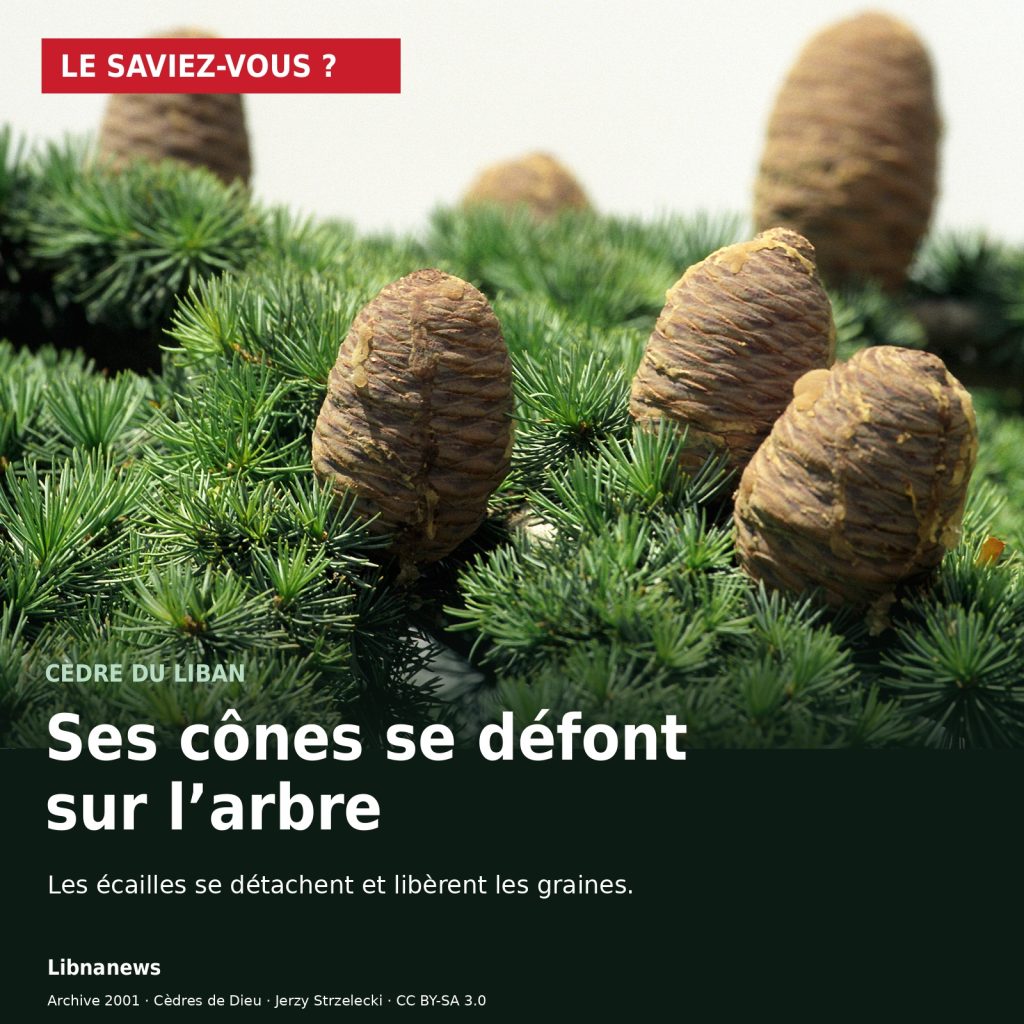
The cedar of Lebanon keeps its cones erect on its branches, but does not usually let them fall whole at maturity. Their scales gradually detach and release the seeds. Part of the cone then remains attached to the tree: its central axis, stripped of its envelope. This discreet detail explains why a walk under a cedar does not necessarily deliver the large cones that are seen in its row.
The silhouette of the tree appears on the Lebanese flag. Its reproductive organs remain less known. To recognize them, one must look over the branches: the cones carrying seeds resemble small barrels, installed vertically. Their disaggregation belongs to the normal functioning of the species.
The cedar of Lebanon scatters its seeds in pieces
A female cone consists of tight scales around an axis. After pollination, these scales close. The cone grows, becomes woody and changes color. First green, then greyish, then brown at maturity. When the time comes, the scales separate instead of remaining assembled in a structure intended to fall whole.
The released seeds have a wing, a fine extension that accompanies their dispersion. The Société nationale d’horticulture de France describes two seeds per scale in the cedar of Lebanon. The opening of the cone thus allows them to be released gradually, not to place on the ground a block containing all the potential progeny of the tree.
The rest visible on the branch can surprise. The large barrel has disappeared, but a small erect stem remains. The Copenhagen University arboretum describes precisely this persistent central axis. A branch bearing such a vestige does not, for this reason alone, show a sign of illness.
Two kinds of cones on the same tree
Not all cedar cones have the same function. The species has male and female organs on the same individual. The first produce pollen; the second bear the seeds after fertilization. Male cones are narrower and elongated than large, barrel-shaped female cones.
Male cones release pollen into the air, then dry out and fall. Their presence on the ground therefore does not contradict the disaggregation mechanism of female cones. Confounding the two easily leads to believe that all the cones follow the same cycle.
The Lebanese Biodiversity Information Platform describes female cones 7 to 10 centimetres long. It also raises their winged seeds and their position at the end of short twigs. It is these characters, associated with the needles gathered in bouquets, that allow to look at the tree other than by its sole silhouette.
A detail to observe without taking
The phenomenon does not concern only the cedar of Lebanon. Other cedars and fir trees also have cones that disarticulate at maturity. It is therefore not sufficient in itself to identify the species. General shape, needles and other botanical characters are still required.
In a cedral, observation can start on the ground, with detached scales, then continue towards the branches. The whole cone, the cone being disaggregated and the bare axis correspond to different steps. No need to break a branch to compare them: a close photograph or binoculars keep these details without taking them.
At the cedars of God, an archive photograph taken in 2001 shows several of these brown barrels still erected among the needles. They seem to be solidly assembled. At maturity, however, each set of scales is destined to unravel to let its seeds go.
Sources and photographic credit
- Société nationale d’horticulture de France: Botanical sheet of the cedar of Lebanon.
- Copenhagen University: description of the cedar of Lebanon and its cones.
- Lebanese Biodiversity Information Platform : Cedrus libani.
- Field Studies Council: Identification of Cedrus libani.
- Portland Parks & Recreation: features of the genus Cedrus.
- Cover: cedar cones at the cedars of God, Lebanon, archive 2001. Photo ofJerzy StrzeleckiundercC BY-SA 3.0 license. Boxing and graphic dressing Libnanews; composition broadcast under the same licence. The photograph does not show an observation made today.






Comments