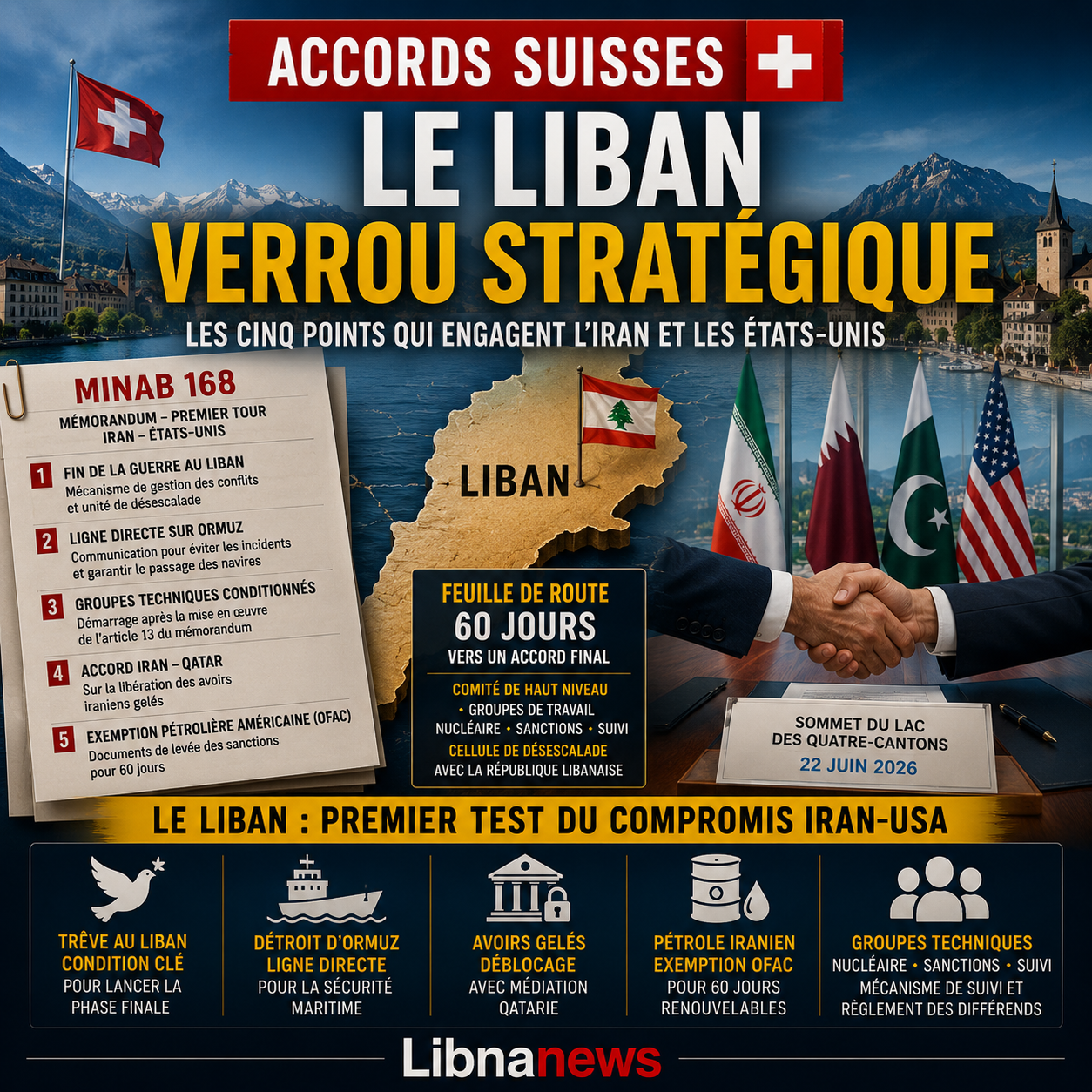







The message sent to Baabda, according to diplomatic information reported in Beirut, is brutal in its simplicity: the Lebanese issue is no longer dealt with first in the Lebanese-Israeli channel opened in Washington, but in the broader context of the negotiations between Iran and the United States. This development was not publicly expressed as an official break. Yet it appears in fact. The de-escalation cell planned for Lebanon emerged from the Iranian-American discussions in Switzerland, with Qatari and Pakistani mediation. The Lebanese authorities must now deal with a reality they wanted to avoid: the country finds itself in the agreement of others.
For Joseph Aoun, the shift is political as well as diplomatic. The President had defended the idea of an autonomous Lebanese road, led by the State, in discussions with Israel. This line was a national necessity. Lebanon cannot accept that its sovereignty should be negotiated by Hezbollah, Iran or a foreign power. But this posture required one condition: that the state should hold cards. Over the weeks, however, several decisions have reduced Beirut’s margin. They have weakened his presence on the ground, weakened his official channel with Tehran and transformed the issue of Hezbollah disarmament into a pre-emptive promise rather than a lever.
A switch that Baabda can no longer ignore
Change is in the order of US priorities. Washington does not give up Lebanese-Israeli discussions. But the centre of gravity has moved. The Swiss talks between Iran and the United States produced a 60-day road map, technical groups on nuclear and sanctions, a line of communication on the Strait of Ormuz and a Lebanese mechanism to prevent friction. It is in this context that the ceasefire in southern Lebanon is now being tested.
The consequence is heavy for Beirut. The Washington negotiations should focus on security, sovereignty, Israeli withdrawal and the future of the South. It was to place the Lebanese state in front of Israel, with the United States as its main sponsor. The new framework partially reverses logic. Lebanon becomes an implementing clause in a regional compromise. Its fate depends on the state of relations between Washington and Tehran, Israeli pressure, Hezbollah discipline and the ability of Qatar and Pakistan to keep the channel open.
This move is not just a matter of protocol. It affects the real power of decision. The setting of the framework also defines the timetable, priorities and counterparts. If Lebanon negotiates alone in Washington, it can request withdrawal, guarantees, cards and a strengthening of the army. If Lebanon is included in an Iran-USA agreement, it must prove its relevance in an architecture where Iranian nuclear, oil, Ormuz and sanctions weigh much heavier than the border towns of Marjayoun, Bint Jbeil or Tyre.
Lebanese file: sovereignty becomes variable
The Lebanese case was already vulnerable. Hezbollah links part of its strategy to Iran. Israel claims to be acting to protect its northern communities. The United States wants to avoid a wider regional war. Qatar seeks to stabilize mediation channels. In this system, the Lebanese State can remain central only if it occupies the institutional, security and diplomatic terrain. He must speak with everyone, document every violation and refuse that his own decisions become free concessions.
This is precisely where accumulated errors weigh. The first concerns the land in the South. The withdrawal of Lebanese soldiers from several positions, after the Israeli escalation, was able to respond to a logic of protecting the troops against overwhelming military superiority. But politically, this movement sent a weak signal. He left the impression that the State was withdrawing at the time when it had to embody sovereignty. The army could not stop a major Israeli operation alone. It could, however, set a presence, signal a red line and prevent the vacuum from being filled by the two armed actors who already dominate the conflict.
The same problem exists with Hezbollah. The role of the army could not be limited to avoiding the shock with Israel. It should also include a capacity to control the axes, passages and flows that could fuel a new confrontation. Blocking Hezbollah’s military supply is not a simple operation. It requires political consensus, means, intelligence and international coverage. But not building this mechanism reinforced the Israeli argument that the Lebanese State does not control its territory. Every time this argument progresses, Beirut’s role declines.
Lost land gets paid at the table
In any security negotiations, the ground speaks before the press releases. A present army may ask for guarantees. An absent army demands them with less weight. Lebanon needs the army in the South not to trigger an impossible war against Israel, but to establish a sovereign reference. The official military presence makes it possible to say who enters, who exits, who shoots, who blocks a road and who violates a line. Without this presence, reports of incidents come mainly from UNIFIL, Israel, Hezbollah or the inhabitants. The state loses its ability to impose its version.
This weakness also affects the de-escalation cell. If it forms without solid anchoring in the Lebanese army, it will become a channel between powers. It may calm down certain incidents, but it will not restore Lebanese authority. Conversely, if Beirut demands that the army be the operational hub, the mechanism can serve the state. It can become a tool for returning, verifying, mapping violations and coordinating with UNIFIL. The difference between these two scenarios will be in detail. It will depend on Joseph Aoun’s ability to refuse a decorative role.
The second mistake is the Iranian channel. The choice of the Ministry of Foreign Affairs to withdraw the accreditation of the Ambassador of Iran and declare him persona non grata was presented as an act of sovereignty. In principle, a State has the right to demand respect for its institutions and to sanction interference. But a diplomatic measure has value only if it produces more control than it does. In this case, it mainly reduced the official channel as Lebanon needed to speak in Tehran directly, firmly and publicly.
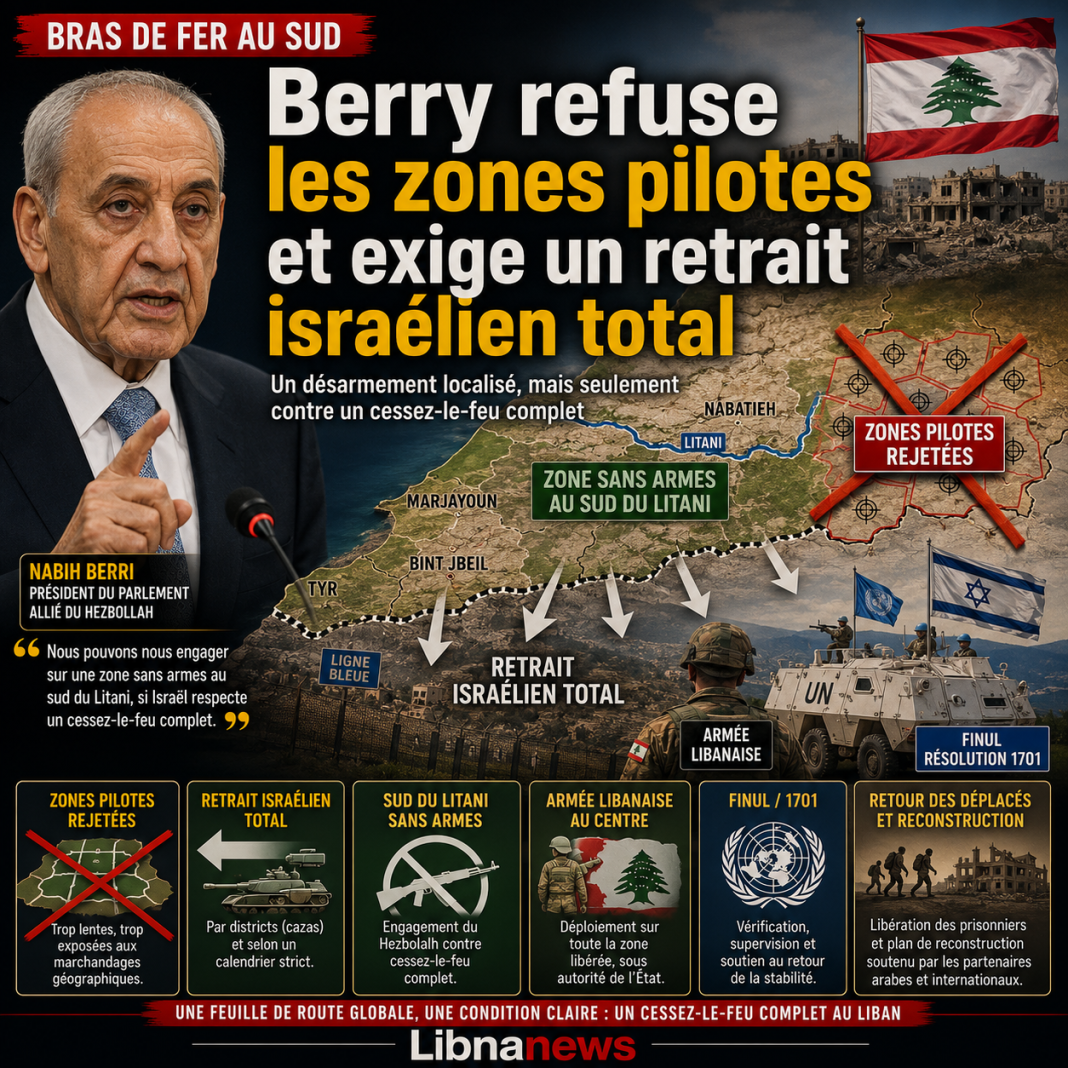
The effect was paradoxical. By wanting to mean that the state would no longer tolerate Iranian interference, Beirut weakened its own instrument of contact with Iran. The exchanges have not disappeared. They slipped to other circuits. Speaker Nabih Berry, Hezbollah and unofficial security or political channels have gained in importance. For a presidency that wants to put the state back at the centre, this is an unfavourable result. Official diplomacy serves precisely to prevent strategic issues from going through partisan intermediaries.
Tehran, the closed channel that becomes necessary again
The Iranian ambassador’s crisis illustrates a frequent confusion between firmness and effectiveness. Firmness consists in setting limits. The effectiveness is to maintain enough channels to enforce these limits. Close or degrade the official channel with Tehran could satisfy some Lebanese opinion and reassure some Western partners. But this decision left the State less equipped when Iran gained a place in the Lebanese mechanism resulting from the negotiations with the United States.
The result is cruel for Baabda. After trying to reduce Tehran’s access to the official Lebanese scene, Joseph Aoun finds himself facing an arrangement where Iran enters through the large regional gate. The path to Tehran then becomes longer than that of Damascus, not by geography, but by political cost. To speak to Iran today would be to recognize that Lebanon cannot stabilize its South without a dialogue with the power that influences Hezbollah and has imposed the Lebanese issue in its negotiations with Washington.
This does not mean that Beirut must align itself with Tehran. This means the opposite: to defend an independent position, we must talk to the actors who can upset it. State diplomacy does not just choose its friends. It also speaks to the difficult powers, in order to make them pay politically for their interference and to remove verifiable commitments. Without an official channel, Lebanon depends more on those who claim to speak for it.
Hezbollah disarmament too soon
The third mistake concerns the disarmament of Hezbollah. In substance, the objective of the State monopoly of force remains indispensable. No country can permanently negotiate its sovereignty if an armed formation decides war and peace alone. The problem is therefore not to have disarmament on the national agenda. The problem is that it was offered as a sign of goodwill before the counterparties were locked.
A trading card loses its value when it is placed on the table before the actual opening of the game. Beirut showed that it accepted the principle of disarmament or progressive dismantling of Hezbollah’s military capacity. But he did not obtain, in exchange, a complete Israeli withdrawal, a binding timetable, written American guarantees, massive military financing, or an Arab framework capable of politically covering this decision. Lebanon has therefore given strategic direction without turning that orientation into a diplomatic price.
This is all the more serious because Hezbollah was not convinced. The movement continues to link any discussion of its weapons to the cessation of Israeli operations, withdrawal and security in the South. Israel, for its part, cites the armament of Hezbollah to justify its so-called security zone. The United States is calling for a Lebanese state with its own weapons. In this triangulation, Beirut needed to calibrate every stage. He could have said: reinforced army deployment against Israeli withdrawal; control of the axes against stopping of the strikes; national debate on weapons against international safeguards. This sequence has not been sufficiently consolidated.
When you’re not at the table
The formula is hard, but it describes the Lebanese moment: when a country is not really at the table, it ends up on the menu. Lebanon was present in the Washington talks, but it was not at the centre of the Islamabad and Swiss discussions. This is where the Lebanese clause was incorporated into the great compromise. The country has not disappeared. He was moved. It has moved from direct bargaining to regional stabilization.
This is not only the fault of the Lebanese authorities. The power relations were unfavourable. Israel militarily controls part of the ground. Hezbollah has an armed capability that escapes the state. Iran uses the Lebanese front as a regional lever. The United States is thinking in terms of regional war, oil, nuclear power and balance with Israel. But the art of a small power is precisely to turn its weaknesses into precise dossiers. Lebanon should have arrived with maps, sequenced requests, public conditions and a single communication strategy.
Instead, several messages contradicted each other. Lebanon wanted to negotiate with Israel, but also to say that the issue did not depend on Iran. He wanted to affirm the state’s monopoly on arms, but without having a fully applicable plan. He wanted to sanction Iran diplomatically, but needed to talk to Tehran. He wanted American support, but did not stop Washington from putting the Lebanese case back in the negotiation with his Iranian opponent. This accumulation gives the image of a State which is right on principles, but which lacks a method of execution.
What Joseph Aoun can still recover
The situation is not irreversible. The president can still turn the shock into a readjustment. The first emergency is to require a central position in the de-escalation cell. Lebanon should not be a guest, but the sovereign territory concerned. The Lebanese Armed Forces must provide field data, receive reports, participate in assessments and work with UNIFIL. Without this device, the cell will primarily serve the needs of Washington and Tehran.
The second emergency is to rebuild an official channel with Iran. This channel must not be a political concession. It must be a tool of sovereignty. Beirut must tell Tehran that Lebanon refuses to be a map in the Iran-USA negotiations, but it must say so in an official forum, with specific demands: stopping the use of the Lebanese front as a lever, supporting the ceasefire, non-contouring the State and recognizing the exclusive role of Lebanese institutions in any public mechanism.
The third emergency is to regain control of the Hezbollah case. Disarmament must no longer be an abstract promise to satisfy Washington. It must become a conditional process, linked to visible steps: Israeli withdrawal, cessation of strikes, deployment of the army, security of roads, control of passages and conference help for regular forces. This method does not guarantee success. But it gives diplomatic value to what has been too quickly transformed into a declaration of principle.
Finally, Lebanon must seek stronger Arab coverage. Qatar is already playing a role in mediation. Other Arab capitals can help finance the army, support reconstruction and politically frame the return of the state to the South. If Beirut stays alone between Washington, Tehran, Tel Aviv and Hezbollah, it will lose ground again. If it transforms the de-escalation cell into an international mechanism backed by an Arab position and resolution 1701, it can limit damage.
The American message to Joseph Aoun, as reported, therefore does not close the Lebanese file. It only reveals that the time of illusions is over. The Washington Canal is no longer enough. The Iran-USA negotiation absorbed Lebanon because the state failed to impose its own conditions early enough. The next step will tell whether Baabda accepts this reduced role or whether it converts the de-escalation cell into a sovereign return instrument. The answer will depend on the composition of the mechanism, the maps of the South, the place given to the army and the President’s ability to speak in Tehran without letting others speak on behalf of Lebanon.