





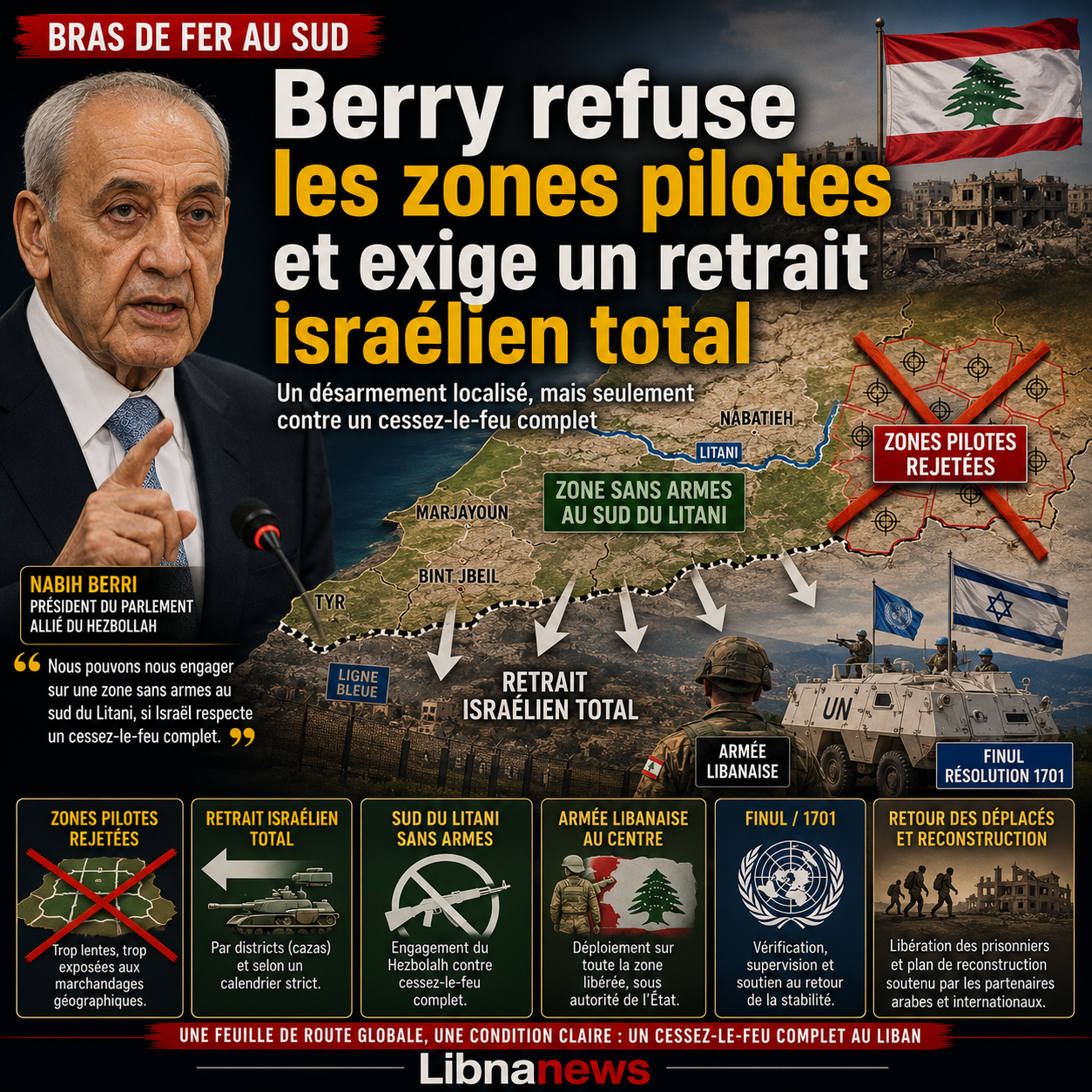
Nabih Berri took an important political step in the South Lebanon issue. The President of Parliament now claims to be able to commit, on behalf of his ally Hezbollah, to an area south of the Litani without weapons, if Israel this time respects a complete ceasefire in Lebanon. In statements published on Monday by a pan-Arab newspaper and taken up by a Lebanese media, he also rejects the principle of « pilot zones », considered too slow and too exposed to geographical bargaining.
This position does not resolve the core of the conflict. However, it changes the negotiating framework. Berri accepts the principle of localized Hezbollah disarmament, but transforms it into a strict exchange: Israeli withdrawal, deployment of the Lebanese army, return of the displaced, release of the prisoners and launch of reconstruction supported by Arab and international partners. The message targets Israel, Washington, Baabda and Hezbollah. He says that the southern front can be stabilized, but only if each step takes place in parallel, under American pressure and with a precise timetable.
South Lebanon: Berri resumes initiative
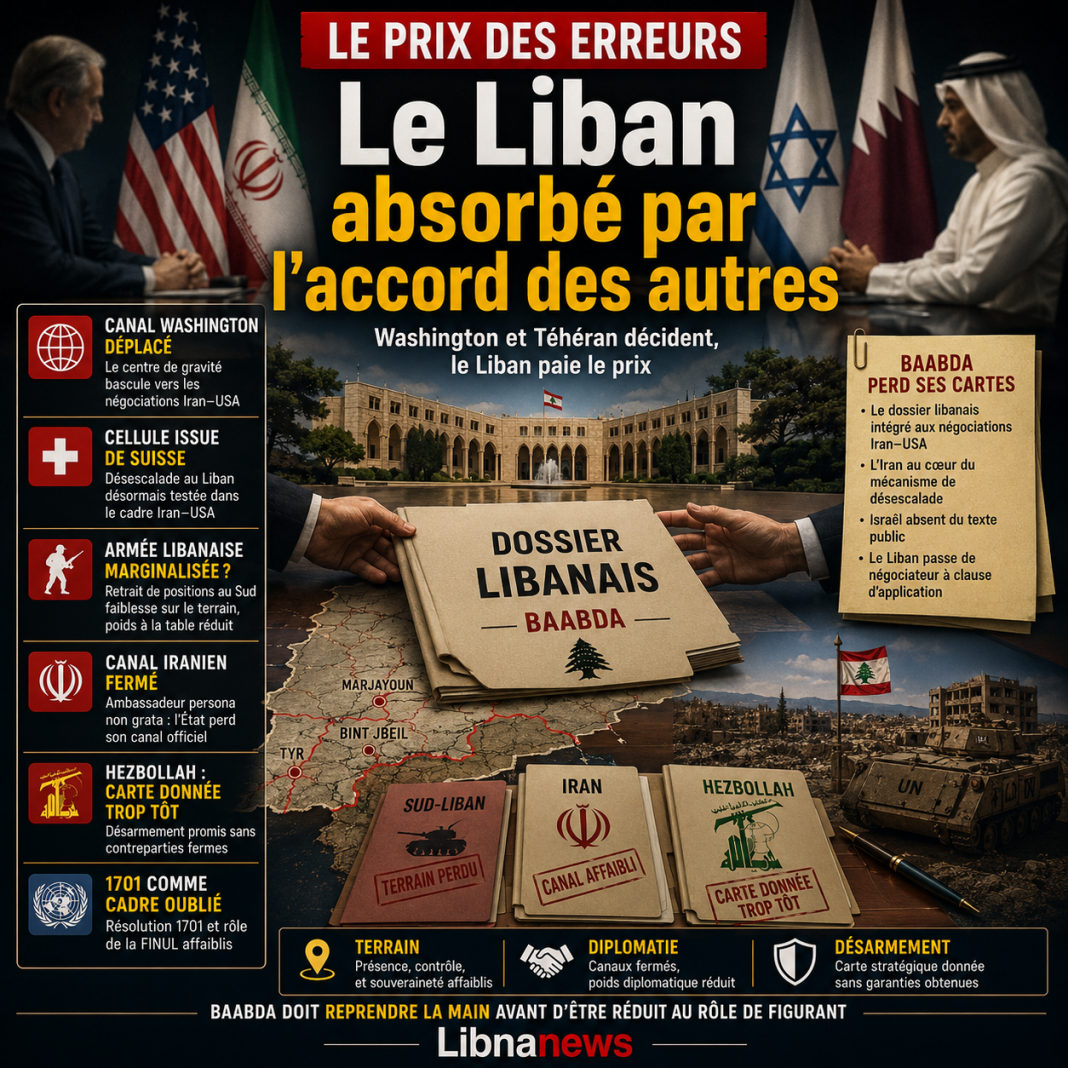
Nabih Berri’s statement comes in a sequence where Lebanon risks losing control of its own file. The regional discussions between Iran and the United States have placed the Lebanese ceasefire in a broader framework. Washington is looking for a regional de-escalation. Tehran wants to preserve its influence on the Lebanese equation. Israel wants to maintain security guarantees. Hezbollah wants to avoid a unilateral concession. In this space, Berri tries to become again the indispensable intermediary.
The President of Parliament speaks with a double statute. He leads the legislative institution, but he also remains the most central political ally of Hezbollah in the state apparatus. When he promises an area without weapons south of Litani, he does not only speak as a public official. He speaks as a channel able to transmit, filter and reformulate the position of the Shiite party. This function can shock those who want a fully sovereign State. It nevertheless reflects the real balance of power.
His message contains a concession and a condition. The concession is based on the recognition of a long-disputed objective: the southern Litani must be free of non-State weapons. The condition lies in the refusal of asymmetrical implementation. Berri does not want Hezbollah to withdraw or dismantle its resources while Israel maintains positions, continues its strikes or retains freedom of military action.
The rejection of pilot areas
The criticism of « pilot zones » is the most technical and revealing element of Berri’s position. This model consists of selecting limited areas, where Israel would first withdraw, prior to the deployment of the Lebanese army and verification of the withdrawal of weapons. Its defenders see it as a gradual method. It would test the capacity of the Lebanese State, reduce risks and not wait for a full agreement on the whole line.
Berri sees it as a calendar trap. In his view, discussing the borders of each pilot zone, their order of priority and their criteria would slow down the Israeli withdrawal. The risk would be that each perimeter would become a separate negotiation. A hill, a village, a road, an observation point or a valley could block the whole. In such a sensitive territory, the map is never neutral. The one who cuts the ground often imposes the political rhythm.
The Speaker proposes another method: to move forward by administrative districts, with a strict timetable for each withdrawal. This approach aims to reduce the debate on micro-borders. It also gives a more legible form to the process. A liberated caza should be a caza under the authority of the Lebanese army, without Hezbollah weapons and with the organized return of the inhabitants. The logic is more political than military. It seeks to transform fragmented negotiations into a territorial roadmap.
Choosing cazas as a pressure tool
The passage through the cazas has an advantage for Beirut. It corresponds to known administrative units, with municipalities, local networks and authorities capable of participating in the return of the inhabitants. It links security, public services and reconstruction. A pilot area, on the contrary, can be defined by military criteria or Israeli needs, regardless of the social coherence of the villages concerned.
There is also a risk associated with this method. Southern districts are not homogeneous. Some sectors are more exposed than others. Roads, agricultural areas, border villages and hinterland communities do not pose the same problems. A calendar per caza should therefore remain precise enough to avoid grey areas. If the cards are not published or validated by the State, the scheme could reproduce the ambiguities Berri claims to want to avoid.
Israeli withdrawal as a central condition
Berri puts the Israeli withdrawal back at the centre of the scheme. This priority corresponds to the Lebanese official position. Beirut claims that any Israeli presence in the South violates national sovereignty and blocks the full implementation of the ceasefire. The President of Parliament adds a political dimension: without credible Israeli withdrawal, no Hezbollah commitment can be sold to its base, defended before Shi’a forces, or accepted as a balanced compromise.
This logic also responds to Israeli accusations. Israel claims that Hezbollah remains a threat to its northern communities and that the Lebanese State has not demonstrated its ability to prevent rearmament. Berri reverses the charge. He says Hezbollah respects the truce and Israel rapes it. This disagreement will not be resolved by statements. It will require a verification mechanism, field reports, withdrawal schedules and a common definition of what constitutes a violation.
The main risk is lack of confidence. Israel may fear that a district withdrawal will allow Hezbollah time to move resources or keep caches. Hezbollah may fear that a partial Israeli withdrawal will be used to obtain concessions without ending the strikes. The Lebanese State may fear being placed before obligations which it cannot enforce alone. This is precisely why a strict timetable must be accompanied by sound supervision.
The Lebanese Army, the only institutional exit
The deployment of the Lebanese army is the cornerstone of Berri’s scenario. Without the army, an area without weapons south of the Litani would be a promise without authority. With it, the process can be linked to the State, resolution 1701 and the mandate of UNIFIL. This articulation remains indispensable. It prevents South Lebanon from being administered by an arrangement between Israel, Hezbollah, Iran and the United States, to the detriment of Lebanese institutions.
The army will have to face a difficult mission. It must reassure Israel without appearing as the tool of Israeli pressure. It must cooperate with UNIFIL without losing its freedom of appreciation. It must prevent the return of unauthorized weapons without causing internal confrontation. It must also protect the inhabitants, reopen the roads and support the municipalities. This accumulation of tasks requires resources, personnel, intelligence and national political coverage.
Lebanon cannot ask its army to guarantee such a heavy transformation alone. It needs financial, logistical and diplomatic support. International partners will be required to provide equipment, monitoring capabilities, vehicles, mine clearance and support to soldiers. The Lebanese authorities must avoid contradictory messages. If each camp interprets the army’s mandate in its own way, deployment will become a source of tension rather than a factor of stability.
Hezbollah: A promise by proxy
Berri’s most sensitive sentence is that which commits Hezbollah. The President of Parliament promised, on behalf of his ally, that the southern Litani could become an area without weapons. This promise raises an institutional question: who has the right to engage a non-state armed force? In a fully sovereign State, the answer should be simple. Only legal institutions decide on war, peace and the status of weapons. In Lebanon, reality remains more complex.
Berri plays the role of political guarantor here. He can speak to Hezbollah, measure his margins, obtain his silence or agreement, and then translate that position into a negotiable language. This function can unlock an impasse. It can also confirm that the State is not the only decision-making centre. It is all Lebanese ambiguity. The same channel for obtaining a concession at the same time reveals the limit of the state monopoly.
Hezbollah, for its part, cannot be content with a general formula. If he agreed to withdraw his weapons south of the Litani River, he would like the Israeli withdrawal to be visible, verifiable and complete in the sectors concerned. It would also like to preserve the idea that its weapons remain linked to a broader Israeli threat. This position opens a debate north of Litani. A southern disarmed area will not resolve the issue of Hezbollah’s national arsenal, but it can become a first step if the state imposes a method.
Common objectives displayed with Aoun and Salam
Berri claims to remain in constant contact with President Joseph Aoun and Prime Minister Nawaf Salam, despite differences of opinion. This precision aims to avoid the image of a parallel channel that would short-circuit the executive. He said that he shared the same objectives: Israeli withdrawal from the South, deployment of the army, return of displaced persons, release of prisoners and launch of a reconstruction plan supported by Arab countries and international partners.
This list gives a political architecture to possible agreement. It shows that security cannot be isolated from the return of the inhabitants. An area without weapons will not make sense if the villages remain destroyed, if the roads remain closed or if displaced families cannot return. Nor will it be sustainable if the prisoners remain a motive for mobilization or if reconstruction becomes an instrument of blackmail between factions.
Reconstruction occupies a special place. Donors will not finance massively areas that could be bombed again in a few weeks. They will demand security guarantees, transparent channels and a clear role for the institutions. Berri knows that. Hezbollah knows that too. Part of the political battle will therefore focus on aid management. The state will want to centralize. The partisan networks will want to remain present. The inhabitants will demand houses, schools and services.
Washington, a necessary but limited arbitrator
Berri hopes that the truce will last this time thanks to American pressure. This sentence summarizes Lebanon’s current dependency. No mechanism can work unless Washington weighs on Israel. The United States has military, diplomatic and political levers that Beirut has not. They can encourage withdrawal, condition certain guarantees, frame discussions and prevent an escalation that would ruin their own regional negotiations with Iran.
But American pressure has its limits. Washington does not fully control Israeli political calculus. The Israeli government can refuse a withdrawal that it considers dangerous. It may maintain a safe area or pursue strikes invoking immediate threats. The United States will then have to choose between two priorities: to protect the regional agreement or to preserve Israeli freedom of action. Lebanon cannot base its entire strategy on American pressure whose intensity may vary.
This limit requires Beirut to document each step. The authorities must produce maps, reports, written requests, lists of prisoners, damage assessments and proposed timetables. The more precise the Lebanese case, the more difficult it will be to reduce it to a secondary clause in regional negotiations. Berri can open a door. The State must enter with its own documents.
One step forward, but not yet an agreement
Berri’s proposal can be read as a real advance. It confirms that the southern taboo of the Litani without non-State weapons has declined. It also recognizes that the deployment of the Lebanese Armed Forces must replace the armed actors and not simply live with them. Finally, it offers an alternative to pilot areas, which could become endless. On paper, this approach can speed up an Israeli withdrawal if it receives international support.
It can also be a maneuver. By rejecting the pilot areas, Berri can save time while claiming to want a calendar. By promising the absence of weapons south of the Litani, he can limit the discussion to an area already covered by 1701, without approaching the Hezbollah arsenal elsewhere in Lebanon. By conditioning everything to Israel, it can postpone responsibility for failure on the adversary. These ambiguities do not condemn the proposal. They show that it must be tested by verifiable commitments.
The test will begin with the method. The first document will have to state which districts are concerned, in what order, with what deadlines and under what supervision. It should specify the role of the army, that of UNIFIL, the modalities of the Israeli withdrawal, the verification procedures and the consequences of a violation. Without these elements, the word calendar will remain political. With them, it can become an instrument of pressure on all parties.
Questions that remain open
Several questions remain. The first concerns the definition of an area without weapons. Are they only heavy weapons, military positions, launchers, depots and tunnels, or any organized Hezbollah presence? The second concerns the inhabitants affiliated with the party. Berri has already rejected the idea of expelling people from the South on the grounds of their political affiliation. The distinction between civilian, militant and combatant will therefore be explosive.
The third question concerns Israel. Will he accept a caza withdrawal if his services believe that Hezbollah retains hidden capabilities? Will he accept that verification should go through the Lebanese army and UNIFIL rather than his own freedom of action? The fourth concerns Hezbollah. Will it accept an area actually controlled by the State, without the right of an operational veto? The fifth one concerns Washington. Will the United States impose a timetable on Israel or limit itself to encouraging gradual de-escalation?
These questions will not be answered in an interview. They will be settled in maps, field reports, follow-up meetings and early withdrawals. Berri put an offer on the table. It commits more than its side, as it affects Lebanese sovereignty and the relationship between the State and arms. The next step will tell whether this offer becomes a mechanism for the return of the State to the South or whether it remains a new formula in the long series of conditional ceasefires.