





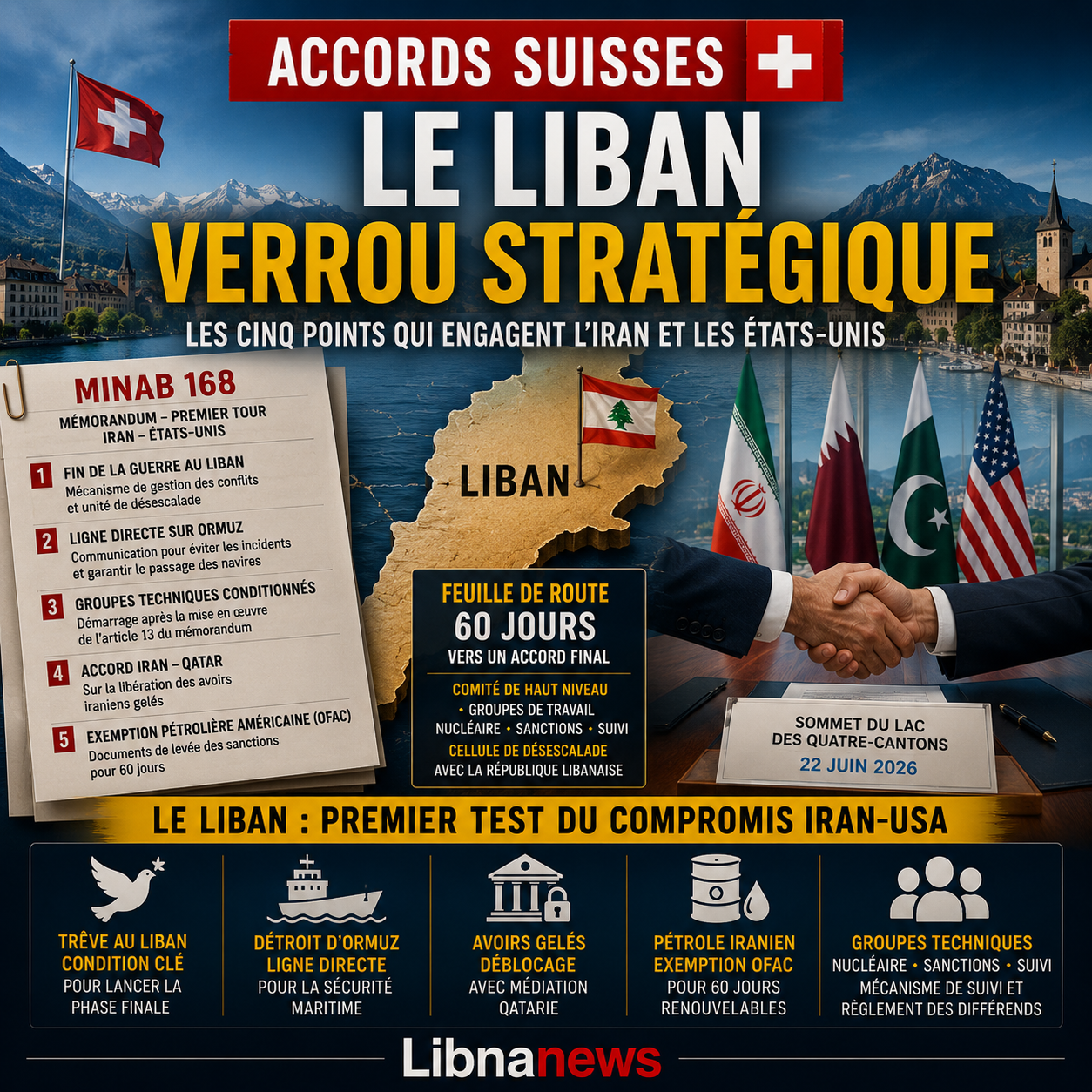
The Swiss agreements resulting from the first round of talks between Iran and the United States place Lebanon at the centre of the practical application of the compromise. The document circulated by the Iranian team’s information committee, presented under the name MINAB 168, highlights five crucial points: the fragile stabilization of the end of the war in Lebanon, the creation of a conflict management mechanism, the opening of a direct line on the Strait of Ormuz, the conditional launching of technical groups, an Iran-Qatar agreement on frozen assets and documents related to the American oil exemption. These elements still need to be translated into verifiable procedures.
The joint statement of the Qatari and Pakistani mediators provides the strongest formal framework. It confirms a 60-day road map to a final agreement, the establishment of a high-level committee, the establishment of working groups on nuclear issues, sanctions and the monitoring of disputes, and a de-escalation cell with the Lebanese Republic. The text does not resolve contradictions. He organizes them in a calendar. This method may prevent an immediate break, but it defers several essential arbitrations.
Swiss agreements place Lebanon first
The first point defended by MINAB 168 concerns the war in Lebanon. According to this reading, the pressure of the Iranian team would have kept an end to the hostilities still fragile for the moment. The mechanism would be called the Conflict Management Unit. It would involve Iran in monitoring de-escalation in Lebanon. This presentation is important because it states that Tehran is officially part of the Lebanese security equation, while the United States has been seeking in recent months to limit its public role in this matter.
This Iranian reading must be distinguished from the more neutral language of mediators. The Qatar-Pakistan text refers to a de-escalation cell between the parties, the Lebanese Republic and the mediators, in order to ensure respect for the cessation of military operations in Lebanon. He does not say that Iran becomes an exclusive guarantor of Lebanese security. However, it recognizes that Washington and Tehran cannot separate the fate of their agreement from the Lebanese front. This shift is enough to change diplomatic relations around Beirut.
The absence of Israel in the public formulation is the most sensitive detail. MINAB 168 insists that the Israeli regime would have no place in this mechanism. The mediators do not use this formula, but their statement does not mention Israel as a participant. For Lebanon, this omission may seem favourable, as it avoids turning the mechanism into direct negotiations with Tel Aviv. It can also become a flaw, as Israeli military operations are precisely one of the problems that the cell must prevent.
Ormuz, hotline and maritime safety
The second point concerns the Strait of Ormuz. As part of the gradual reopening of the crossing, the parties agreed to a direct line of communication with Iran in order to address difficulties in implementation, avoid incidents and ensure safe passage of commercial vessels. MINAB 168 presents this measure as a consolidation of Iranian sovereignty over the Strait. The declaration of mediators uses a more functional formulation. It insists on preventing misunderstandings and maritime security, without repeating Tehran’s sovereignist reading.
The link between Ormuz and Lebanon is not artificial. Iran used maritime tension as a lever when the Lebanese truce seemed threatened. The United States wants to prevent an incident in southern Lebanon from turning into a global energy crisis. The mediators are therefore trying to create two parallel security lines: one for ships in the Gulf and another for military incidents in Lebanon. This dual architecture shows that negotiation is no longer just nuclear. It becomes regional, economic and maritime.
The third point of MINAB 168 concerns the order of technical discussions. According to the Iranian document, the Tripartite Groups on Nuclear, Sanctions and Monitoring will not start their work fully until article 13 of the memorandum has been implemented. This article is presented as linked to the ceasefire on all fronts, especially in Lebanon, at the beginning of the lifting of the maritime blockade, the launching of the release of frozen Iranian assets and the decision to lift sanctions on oil, petrochemicals and their derivatives.
Article 13 as a lock in the final phase
This sequencing is fundamental. It means that Iran does not want to enter the final phase of negotiations without prior benefits. Tehran first calls for visible signs: lower military pressure in Lebanon, maritime opening, access to financial assets and oil relief. Washington, for its part, will seek not to give too many counterparties before obtaining nuclear and regional guarantees. The sixty-day period will be used to test this reciprocity, each file.
For Lebanon, this logic creates considerable weight. The Lebanese ceasefire becomes a prerequisite for discussions that go far beyond the country. If the fighting resumes, Iran may say that Article 13 is not applied. If the Israeli army maintains operations or refuses any adjustment, Washington will be under pressure. If Hezbollah resumes fire, the United States will accuse Tehran of not controlling its allies. Lebanon thus becomes the place where each actor verifies the good faith of the other.
The fourth point concerns a memorandum between Iran and Qatar on the implementation of the release of frozen Iranian assets. This clause gives Doha a financial role, not just a diplomatic one. She suggested that Qatar could facilitate, guarantee or organize certain transfers. Details remain essential: amount, location of funds, currency used, beneficiary accounts, control of usage and timing. Without these elements, the announcement remains political. With them, it can become an economic stabilization tool for Iran.
Lebanon is indirectly interested in this financial aspect. If Tehran obtains new resources, its spending priorities will be monitored. Washington and its allies will want to check that the funds do not strengthen armed networks. Iran will affirm that they will be used for reconstruction and development. Hezbollah and its Lebanese opponents will read this issue carefully. Unblocking Iranian assets can reduce economic tension in Iran, but it can also feed the fears of those who fear the consolidation of Tehran’s regional relays.
Oil exemption, between announcement and application
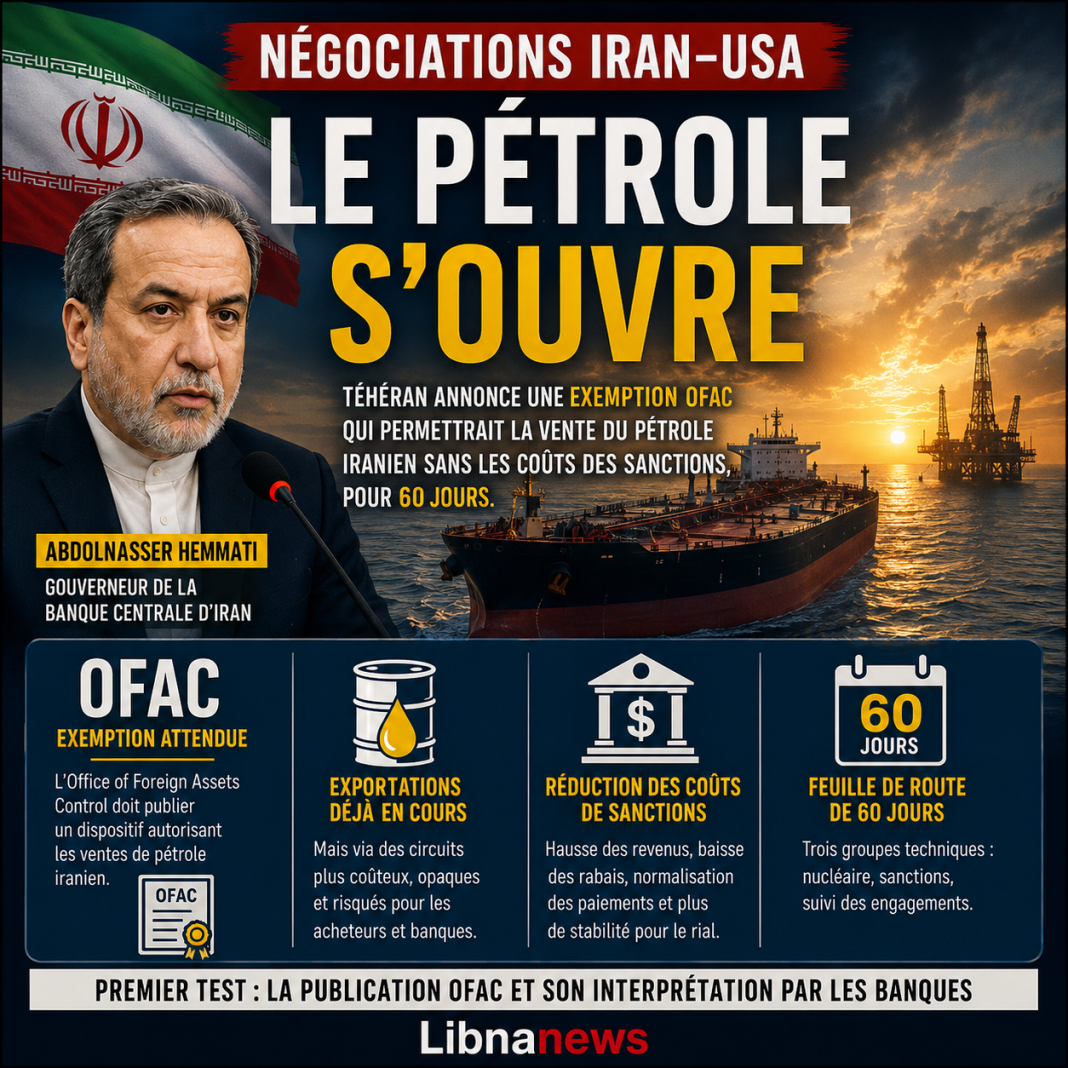
The fifth point concerns OFAC. MINAB 168 states that the United States Foreign Assets Control Office issued sanctions lifting documents on oil, petrochemicals and their derivatives for a period of 60 days. This statement should be made with caution. The real effect will depend on the official publication, the scope of authorized transactions and the reading by banks and insurers. An exemption announced does not have the same value as a clearly applicable licence.
If the exemption becomes effective, Iran will be able to sell its oil to identified customers and receive revenues through more formal Central Bank channels. The gain is not limited to export volumes. It affects the reduction of discounts imposed by the risk of sanctions, the reduction of intermediary fees, the partial normalization of payment and the possibility of planning revenue. This dimension explains why the Iranian delegation puts the oil component so much forward. It gives an immediate economic translation to a still fragile negotiation.
Lebanon is not directly benefiting from these oil measures. Yet it suffers the effects. A drop in pressure around oil and d’Ormuz can reduce the risks in energy markets. It can also open a sequence of aid and reconstruction if the ceasefire holds. Conversely, a failure of the Lebanese mechanism can raise risk premiums, tighten US positions and block financial flows. South Lebanon thus becomes linked to decisions affecting the Gulf, Washington, Tehran and world markets.
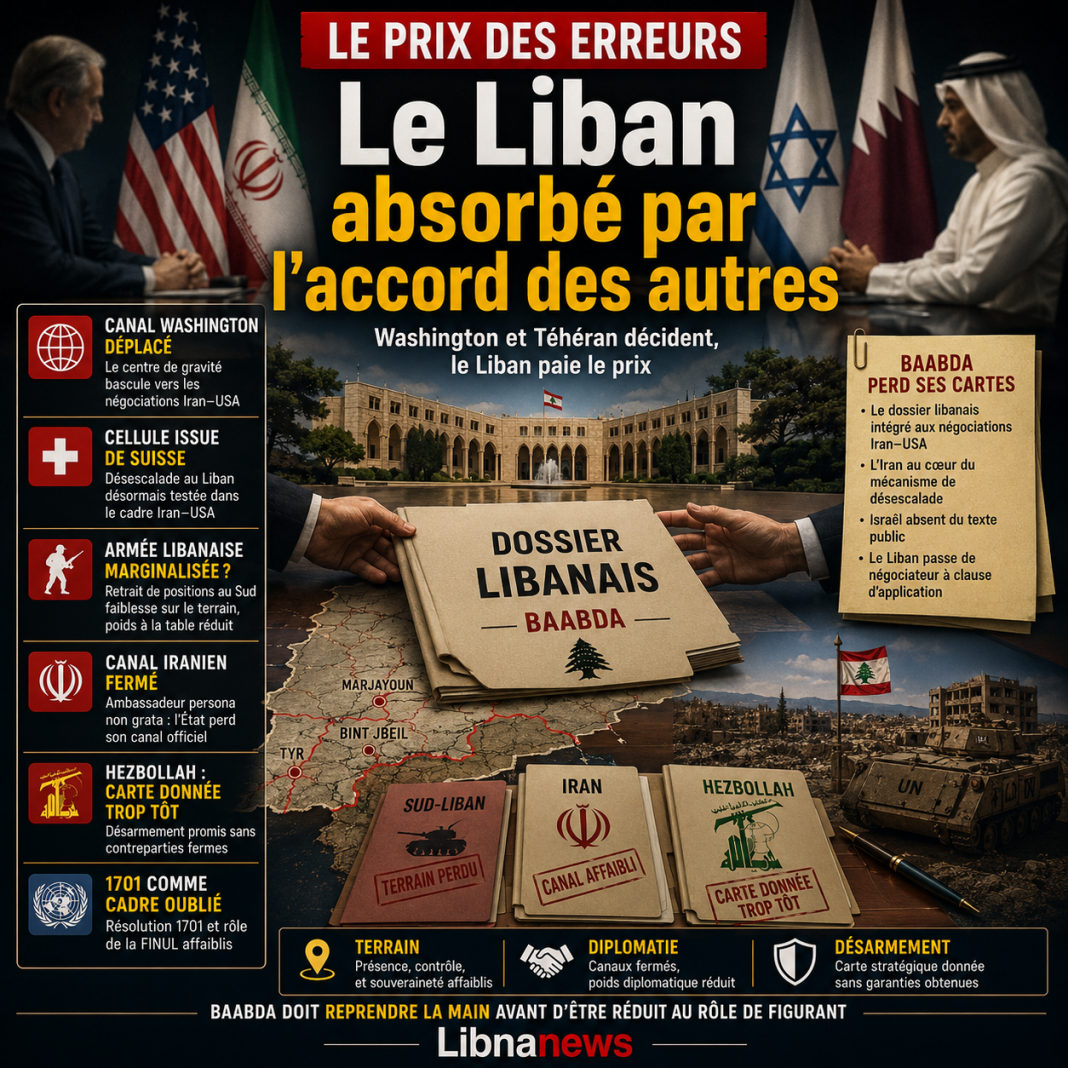
Beirut should avoid the role of the
This architecture gives Beirut a special responsibility. The Government of Lebanon should avoid becoming simple in a mechanism designed by others. It will require clear representation, a central role for the Lebanese army and a link with UNIFIL. Resolution 1701 remains the recognized international framework. It provides for Israeli withdrawal, the deployment of the Lebanese army, the support of the international force and the absence of unauthorized weapons between the Blue Line and the Litani. Swiss agreements cannot replace this framework.
The problem is that 1701 has never been fully implemented. Israel accuses Hezbollah of maintaining military capabilities in the South. Lebanon accuses Israel of repeated violations and illegitimate military presence. UNIFIL monitors, documents and supports the Lebanese army, but it cannot impose a political solution. The de-escalation cell should therefore be compatible with the international mission. If it bypasses it, it will create a new diplomatic layer with no effect on the ground.
The issue of Israeli withdrawal remains the most visible test. A cell that finds violations without dealing with the disputed military presence will not reassure the inhabitants. A cell that too quickly requires impossible commitments can cause a breakdown. It will therefore require a realistic timetable: cessation of strikes, clarification of positions, humanitarian access, gradual return of civilians, enhanced deployment of the Lebanese army and international verification. Each step will have to produce measurable results.
Hezbollah is the other essential element. Its arsenal, location and links with Iran explain Lebanon’s place in the talks. But its role cannot be settled only by agreement between Washington and Tehran. Any discussion of weapons must involve a Lebanese internal balance, security in the South and guarantees against Israeli operations. Without this triptych, the request for disarmament will be rejected as an external injunction, while the absence of debate will maintain the risk of war.
Reconstruction, maps and ground evidence
The Swiss agreements therefore open a narrow window. Their strength is due to their procedural accuracy: high-level committee, technical groups, Ormuz line, Lebanese cell, 60 days. Their weakness lies in their silences: the role of Israel, the real capacity of the Lebanese state, the scope of the OFAC exemption, the control of the funds released and the future status of Hezbollah. For Lebanon, the challenge is not to choose between Washington and Tehran. It is to transform a regional clause into local security, with open roads, accessible villages, present institutions and incidents dealt with before they become a new war.
The Lebanese Presidency may use this sequence to request a written method. Incident reports, position maps, access schedules, emergency contacts and violation criteria will be required. Sovereignty is not only defended by communiqués. It is also defended by technical files that mediators cannot ignore. The more the facts are documented, the less it will depend on competing accounts of Iran, Israel or the United States.
The Southern municipalities will also have to be incorporated indirectly into the scheme. They know the roads cut off, the houses destroyed, the dangerous neighbourhoods and the immediate needs of families. A purely diplomatic unit can reduce a crisis between capitals, but it will not always know whether a road is practicable or whether a village can receive its inhabitants. The Lebanese test of Swiss agreements will therefore involve a dialogue between the international level, the army, UNIFIL and local authorities.
This requirement also concerns reconstruction. Donors will not finance areas where security rules change every week. They will demand guarantees of access, governance and transparency. If the de-escalation cell produces regular data, it can support the first programs. If it remains opaque, aid may be fragmented and slow. Lebanon needs a mechanism that protects its inhabitants, but also a framework that makes reconstruction technically possible.
The next signals will come from the details. The composition of the cell will tell whether Beirut is an actor or a decor. The first alert processed will tell if the mechanism works. The U.S. oil publication will tell whether the announced relief is financial or above all political. Israeli decisions in southern Lebanon will say whether Tel Aviv’s absence in the public text weakens or facilitates the process. The Swiss agreements are now entering this phase where words are no longer enough, as each card, convoy and bank account becomes evidence.