

In « Tajribati », « My Experience », Jean Hawat tells the state through his political journey. The lawyer and former head of the National Bloc established the origin of the book in 2020: the year of his eighty years coincided with the centenary of Greater Lebanon. This rapprochement gave him the starting point of a narrative linking his public life to the history of the country.
In an interview published on November 4, he presented the book as the result of a need to record what he had experienced, the responsibilities he had exercised and the lessons he learned. This testimony looks at an actor engaged in the events in which he took part.
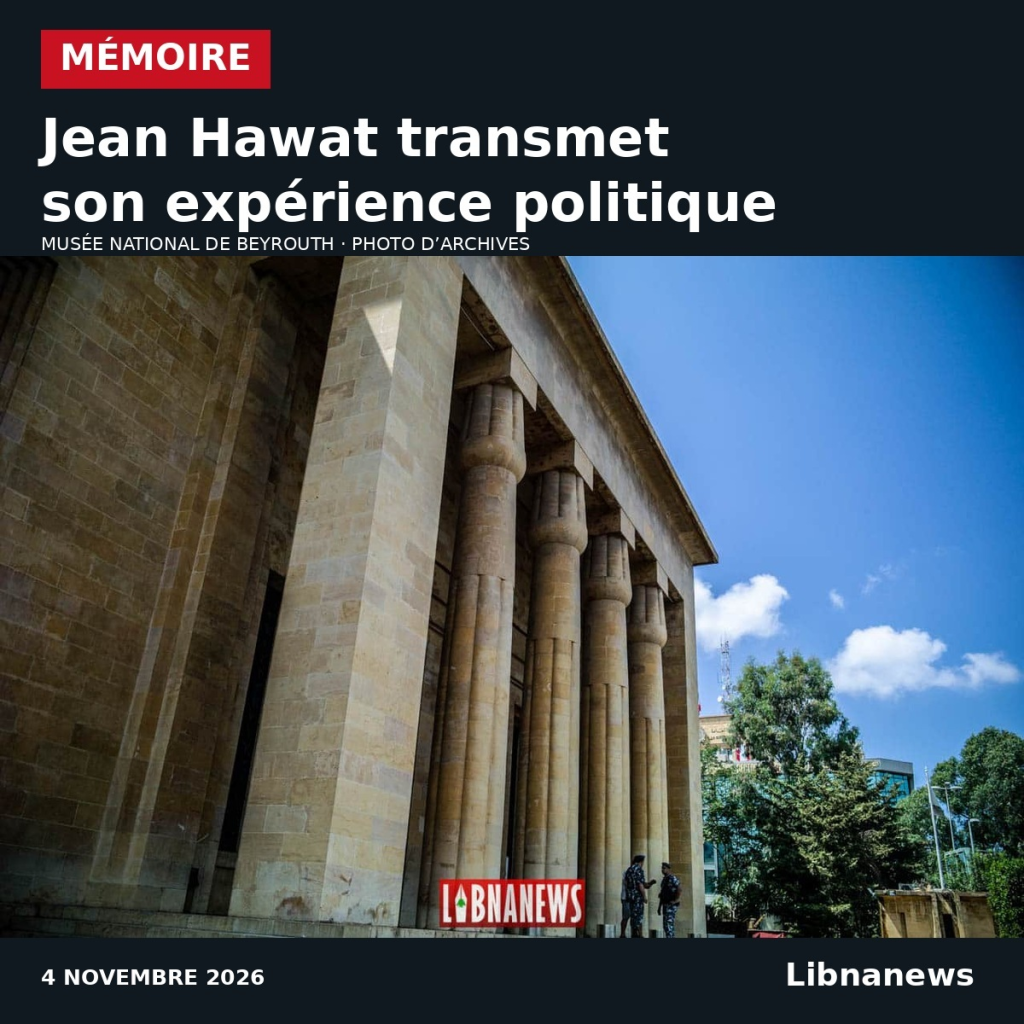
The book was the subject of a signing session at the Beirut National Museum. At that meeting, Hawaii explained that it wanted to gather memory, documents and positions to question Lebanon’s difficulties.
Jean Hawaii tells the State from the National Bloc
Hawat recalled his commitment to the National Bloc before 1965, and then the missions he had undertaken there. His account gave a special place to the period opened in 1976, when Raymond Eddé moved to Paris. He explained that he had to follow activities and files in his absence.
The continuity of this commitment is, according to him, part of a family history attached to Émile Eddé, then to Raymond Eddé. It’s also a way to explain from what position he’s watching events. Political affiliation is not erased from the testimony: it is one of its cadres.
A critique of how to build the state
His judgment on the Lebanese trajectory is severe. In his view, the country had failed to build an effective State on a sustainable basis. It calls into question internal divisions, confrontations around national choices and the place taken by particular interests.
Hawaii reads the weakening of the state through the difficulty of overcoming fidelities and immediate gains to defend a common good.
He also criticizes the search for money, positions and advantages in the exercise of power. Its response takes the form of a requirement of public responsibility, integrity and good administration. From this perspective, passing on experience is not just about telling the leaders they met, but about their choices and their effects.
Political hope under execution
Hawaii expresses a cautious hope for President Joseph Aoun and the government of Nawaf Salam. He expressed appreciation for the directions outlined in the nomination speech and the ministerial declaration. However, it insists on the transition to implementation.
This reserve extends the thread of the book as it presents it: the intentions displayed are not enough to build institutions. He warns against the repetition of the divisions which, according to him, prevented the country from moving forward. The continuity of public work counts more than the momentary adherence to a speech.
Youth as a recipient
Finally, the message is addressed to Lebanese youth. Hawaii invites them to know their history and make Lebanon their common reference. For him, keeping a memory implies a responsibility: to say what is considered true and allow other generations to resume the discussion.
He does not describe reorganization as the case of a man or a single decision. His call is for a generation capable of working for a stronger state. « My experience » thus presents itself as a contribution to this transmission, with the strength and limits of an assumed personal word.





Comments