

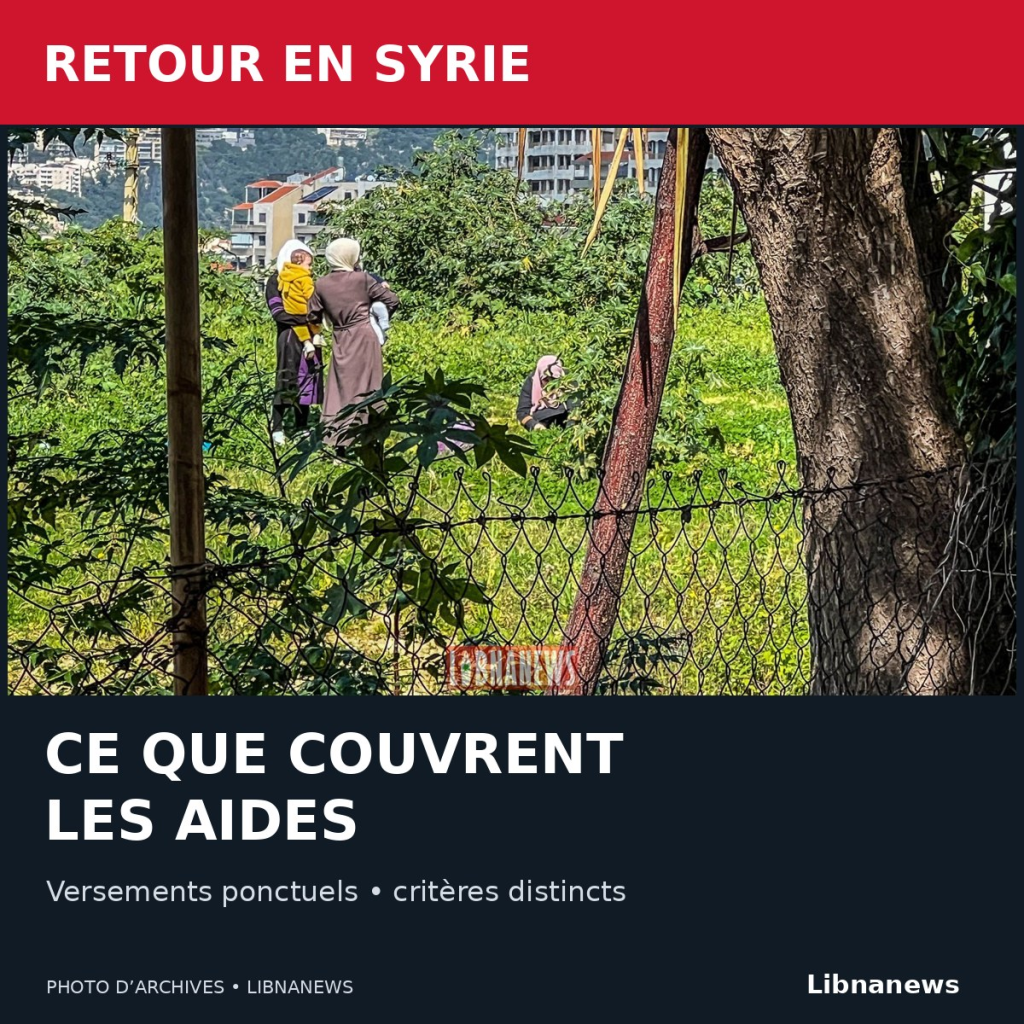
The aid for return to Syria combines information, administrative support, transport and one-off payments. The amounts of $100, $300 and $600 relate to different arrangements. They are not an automatically promised sum to each family.
The return of Syrian refugees occupied the trade between Beirut and Damascus. For those planning to leave, the immediate question remains: what steps will be taken, what costs will be covered and what support will be available upon arrival? The programmes in force on 4 November 2026 provide some answers, with conditions that must be distinguished.
Aid for return to Syria: $100 per person
The voluntary return programme provides a one-time grant of $100 for each participant returning to Syria. It addresses immediate needs related to departure and initial relocation. The scheme concerns persons known to UNHCR in Lebanon who freely choose permanent return.
It is accompanied by information on documents and formalities. In particular, interviews are used to verify the composition of the family, the special needs and the voluntary nature of each adult’s choice. Administrative accompaniment does not replace the necessary documents for crossing the border.
The individual amount does not correspond to a monthly allowance. It also does not constitute full coverage of housing or future expenditure. Its function is to help take a step which needs vary according to the size of the household, the journey and the destination.
A family supplement subject to criteria
An additional $300 may be provided to some vulnerable families participating in the program. It is awarded only once per family, in addition to individual assistance. So it’s not about $300 for each person.
The criteria relate to known vulnerabilities of the device. These include situations of disability or serious illness, the presence of an isolated parent, children at risk or a family with at least eight returning members. Eligibility must be confirmed during the examination of the file.
A family that returns in several stages does not receive this supplement at each departure. The modalities should be examined during the interview. The mere registration of an intention to return does not constitute notification of a payment.
Organized transport or autonomous departure
Two routes must also be separated. In the organized return, free transport is provided by the International Organization for Migration. It links a gathering point to specific places in Syria. It should not be confused with a guaranteed journey to the individual home.
The return organized by the people themselves is based on another logistics. Financial assistance and advice do not mean that all travel will be covered. The place of departure, destination, documents and needs of travellers must be clarified prior to travel.
In Syria, $600 remains targeted
After a permanent return, a family can be examined for a one-time aid of $600 in Syria. This support gives priority to the most vulnerable households. It depends on an individual assessment and the resources available.
The programme cannot therefore cover all returning persons. It is not renewed when another member of the same file joins the family later. The existence of this aid does not allow all amounts to be added in advance to establish a guaranteed income on arrival.
A decision with administrative consequences
The signature and issuance of the repatriation form resulted in the closure of the file with UNHCR in Lebanon. This is part of the information to be understood before engaging. The services and possibilities of assistance are then to be examined in the country of return.
Humanitarian services are free of charge. No intermediary can legitimately sell a place in the program or guarantee financial assistance. Families may request clarification of their situation from the appropriate department before any action is taken.
Beyond the start, the concerns described by spokesman Dalal Harb relate to security, housing, property, schools and livelihoods. One-time help does not address these issues. Their assessment, in the locality where the family wants to settle, remains crucial in preparing for return.





Comments