

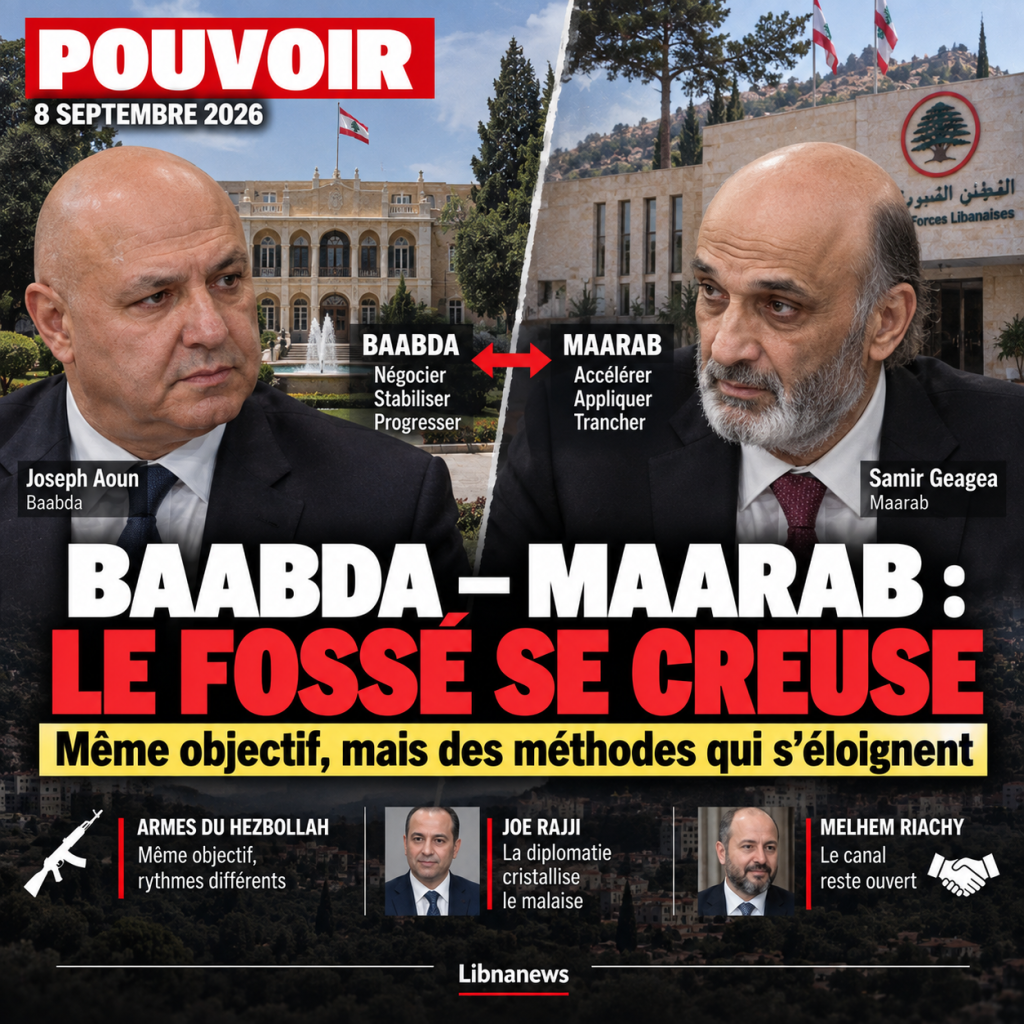
The same objective, but methods that move away
Between Baabda and Maarab, there is still no disagreement on the main principles displayed by the two sides. Joseph Aoun and Samir Geagea both defend the state monopoly of arms. They also support the strengthening of the army and institutions. Yet their way of achieving these goals is gradually moving them away. The differences now relate to the pace, means and political leadership of this transition. Naharnet, on 7 September 2026, reports that Samir Geagea has asked government officials to take concrete action if Hezbollah does not rapidly dismantle its military apparatus. The leader of the Lebanese Forces denounced the procrastination, delays and partial solutions. He also called for a State capable of governing and imposing its decisions. These criticisms are aimed at a method that Maarab considers too cautious. They therefore directly affect the presidency, even when Joseph Aoun is not always appointed. The Head of State favours a more gradual approach. It seeks to preserve the role of the army, internal balances and the path of negotiations. This approach has taken on additional importance with the resumption of discussions with Israel and the worsening of the situation in South Lebanon. The two poles can thus defend the same principle while opposing its implementation. For Maarab, the time devoted to dialogue may allow Hezbollah to retain part of its mechanism. For Baabda, a poorly controlled internal confrontation could threaten the country’s stability. This difference was already noticeable several months earlier. It has become clearer with the war, negotiations and commitments made by the State on the arms monopoly.
The reconciliation observed in July did not therefore remove the differences. An-Nahar, on 10 July 2026, reported that Samir Geagea had gone to Baabda to head a large delegation from the Strong Republic bloc. He said that the State should be alone in deciding how to deal with the Israeli presence. Joseph Aoun had defended the continuation of the negotiations. This meeting gave the image of a convergence on the return of the strategic decision to the institutions. Lebanon24, on 11 July 2026, noted, however, that relations between Baabda and Maarab had long been managed by indirect contacts. MP Melhem Riachy was a messenger between Joseph Aoun and Samir Geagea. The media already described an agreement on the general objective, with different approaches on the speed needed to achieve it. Two months later, this difference became more political. The Lebanese Forces no longer merely want to recall their position on weapons. They demand results and challenge the pace of institutional action. Geagea’s speech on 6 September marks a milestone in this regard. Al-Quds Al-Arabi, on 6 September 2026, reports that he requested the dissolution of the military and security branches of armed organizations, primarily targeting Hezbollah. According to him, the arms monopoly is first and foremost a Lebanese requirement. He believes that the state must act if Hezbollah does not do it itself. The debate between Baabda and Maarab thus moves from principle to execution. It is precisely on this ground that the ditch begins to widen.
Joe Rajji becomes the visible symbol of malaise
The case of Foreign Minister Joe Rajji gave an institutional expression to this tension. Rajji belongs to the ministerial contingent supported by the Lebanese Forces. His place in the conduct of diplomacy is therefore closely followed in Maarab. However, his absence of several important diplomatic sequences caused Samir Geagea’s irritation. Naharnet, September 7, 2026, reports Prime Minister Nawaf Salam’s response to the criticism of the minister’s marginalization. Salam recalled that the Constitution entrusts the Council of Ministers with defining the general policy of the Government, including foreign policy. He also claimed to be in permanent coordination with Joe Rajji. According to the Prime Minister, the composition of official delegations depends on the nature and program of each trip. This development shows that the file goes beyond a simple protocol issue. For the Lebanese Forces, the issue concerns the real place of the Ministry of Foreign Affairs in negotiations that have become essential for the country’s future. For Baabda and the Serail, it is also a question of preserving the capacity of the presidency and the government to conduct sensitive issues without every move becoming a partisan sharing issue. Joe Rajji is thus at the centre of a wider divergence on the manufacture of foreign policy.
Geagea’s criticism is all the more sensitive because Lebanese diplomacy is now central to relations with Washington and in negotiations with Israel. So the question is not just who accompanies Joseph Aoun on a visit. It concerns the location of Lebanon’s outer line. Maarab believes that the Minister for Foreign Affairs must fully assume his institutional role. The presidential camp defends a reading in which the head of state retains a central place in the major negotiations. This difference feeds political suspicion. The Lebanese Forces fear that diplomacy around Baabda will reduce the influence of a minister who expresses particularly firm positions on Hezbollah and sovereignty. The power may, on the other hand, consider that such a sensitive negotiation requires a margin of manoeuvre that exceeds the positions of a party. The disagreement then becomes both institutional and political. It affects not only skills, but also trust among the partners in power.
However, unease did not lead to a breakdown in communications. MTV Lebanon, September 3, 2026, reports that Joseph Aoun received Melhem Riachy in Baabda. The MP for the Strong Republic was sent by Samir Geagea. The meeting focused on political, national and administrative affairs, but also explicitly on relations between the Lebanese Forces and the Presidency. Riachy’s choice is significant. He has long been a liaison between Maarab and Baabda. His visit shows that both sides are still trying to manage their differences through a direct channel. It also confirms the existence of a subject sufficiently serious for the relationship itself to be included in the programme of the meeting. This sequence therefore prevents us from talking about a rupture. Rather, it shows a relationship entering a clarification phase. Both sides continue to communicate, but now they have to deal with public differences.
Hezbollah at the heart of strategic divergence
The weapons issue remains the most important issue. In principle, Joseph Aoun and Samir Geagea find themselves around the state monopoly. The difference lies in how to move from this position to its application. Maarab calls for faster action. Baabda must integrate more constraints. The Head of State must take into account, inter alia, Hezbollah’s ability to mobilize its base, the military situation in the South and the risk of internal confrontation. The Israeli strikes add another constraint. Reuters, 6 September 2026, reports that Joseph Aoun denounced a « dangerous escalation » following Israeli bombings in several parts of the South Lebanon. The President called on the United States and the international community to intervene. In this context, Baabda views negotiation as an instrument to limit war and gradually restore state authority. This priority is not fully in line with the time schedule required by the Lebanese Forces.
Naharnet, September 7, 2026, reports that Geagea rejected what he considers to be procrastinations and half-measures. It called for a sovereign State on its territory and on its decisions. His speech is aimed directly at maintaining an independent Hezbollah military apparatus. But it also contains a critique of those who, according to him, delay the implementation of decisions already taken. This shade is important. The Lebanese Forces are not opposed to the current power. Instead, they seek to push this power towards faster implementation of their own commitments. Geagea can support Joseph Aoun on the principle of negotiations or the monopoly of arms, and then criticize his method. This position allows Maarab to maintain a foothold in the political majority while strengthening its opposition identity on sovereignist issues.
This strategy also includes an electoral dimension. The Lebanese Forces want to appear as the party calling for the uncompromising application of the principle of one State and one army. They cannot therefore allow Baabda to occupy this political space alone. As Joseph Aoun placed the sovereignty and monopoly of arms at the centre of his mandate, the two poles found themselves competing on a nearby terrain. Ideological convergence can paradoxically produce political rivalry. If the president gets progress through negotiation, Baabda can claim the success of the gradual method. If negotiations simmer, Maarab can say that his warnings were justified. The relationship thus depends on the results achieved in the field.
From presidential agreement to a relationship under surveillance
The current tension takes on special importance when compared to the beginning of the mandate. The Lebanese Forces had supported the election of Joseph Aoun in January 2025. They then welcomed the formation of the Government of Nawaf Salam. The new power then appeared as an opportunity to restore institutions after years of paralysis. Maarab’s expectations were high. These included sovereignty, reform and arms control. The passage of time now turns these expectations into evaluation criteria. The longer the announced goals produce results, the more the Lebanese Forces give themselves the freedom to criticize.
The relationship has already experienced phases of tension and calming. MTV Lebanon, on 16 January 2026, reported a long appeal between Joseph Aoun and Samir Geagea, focusing on the arms monopoly. According to the media, this exchange had helped to ease tensions that had previously arisen between Baabda and Maarab. This sequence shows that current disagreements are not entirely new. The relationship works in cycles. A public divergence appears, then political channels seek to contain it. Melhem Riachy’s visit on September 3 seems to meet the same logic. She intervened a few days before Geagea’s very firm speech. The continued contact therefore did not prevent the Lebanese Forces Chief from raising his tone.
The nature of this relationship also explains why each disagreement quickly takes on a national dimension. Joseph Aoun is not the leader of a political party. He holds the presidency and must deal with forces with opposing interests. Samir Geagea leads one of the main Christian formations and an important parliamentary bloc. The two men therefore do not respond to the same constraints. Maarab can demand a clearer position and make it an element of political mobilization. Baabda must measure the institutional consequences of each decision. This difference in function necessarily produces distinct rhythms.
Diplomacy and reforms open second political front
The disagreement is no longer limited to Hezbollah weapons. Geagea’s speech of 6 September also focused on the functioning of the state and reforms. Naharnet, on 7 September 2026, reports that Nawaf Salam responded to the Lebanese Forces leader’s criticism of the pace of financial reforms. The Prime Minister defended the work of his government. The exchange shows that Maarab’s criticism now aims more broadly at the balance sheet of power from 2025. Baabda is therefore not alone concerned. Seral is also placed under pressure.
This changes the position of the Lebanese Forces. The party has ministers in the government, but at the same time seeks to stand out from the slowness that it attributes to it. This balance becomes more difficult when political deadlines come closer. Ministers close to the Lebanese Forces must defend their actions. However, the party wants to retain the opportunity to criticize choices that do not fit its line. Joe Rajji perfectly embodies this situation. Its presence in the government allows the Lebanese Forces to influence foreign policy. Its supposed marginalization also allows Maarab to denounce a functioning which she considers contrary to institutional logic.
The future exchanges between Baabda and Maarab will therefore depend on very concrete dossiers. Joe Rajji’s place in the next diplomatic missions will be observed. The pace of implementation of decisions on weapons will be even greater. The conduct of negotiations with Israel is a third test. On 10 July 2026, An-Nahar reported that Geagea had claimed since Baabda that the State should be the only one to decide in the decisive cases. This position remains consistent with that of Joseph Aoun. However, it contains a requirement that the State exercise this prerogative effectively. It is on the gap between the announced decision and its application that Maarab is now building its criticism.
The relationship thus remains crossed by two opposing movements. The first pushes for cooperation. Baabda and Maarab share several objectives concerning sovereignty and institutions. They also have regular channels of communication. The second one feeds the distance. The Lebanese Forces consider power too slow, contest the management of certain diplomatic issues and want a faster application of the arms monopoly. The Presidency must manage an equation that includes Hezbollah, the army, negotiations with Israel and internal stability. Melhem Riachy’s passage to Baabda on September 3, 2026 illustrates this double reality. The channel is not broken. But the mere fact that the relationship between the Presidency and the Lebanese Forces was an explicit subject of the meeting shows that it now requires full political management.




