

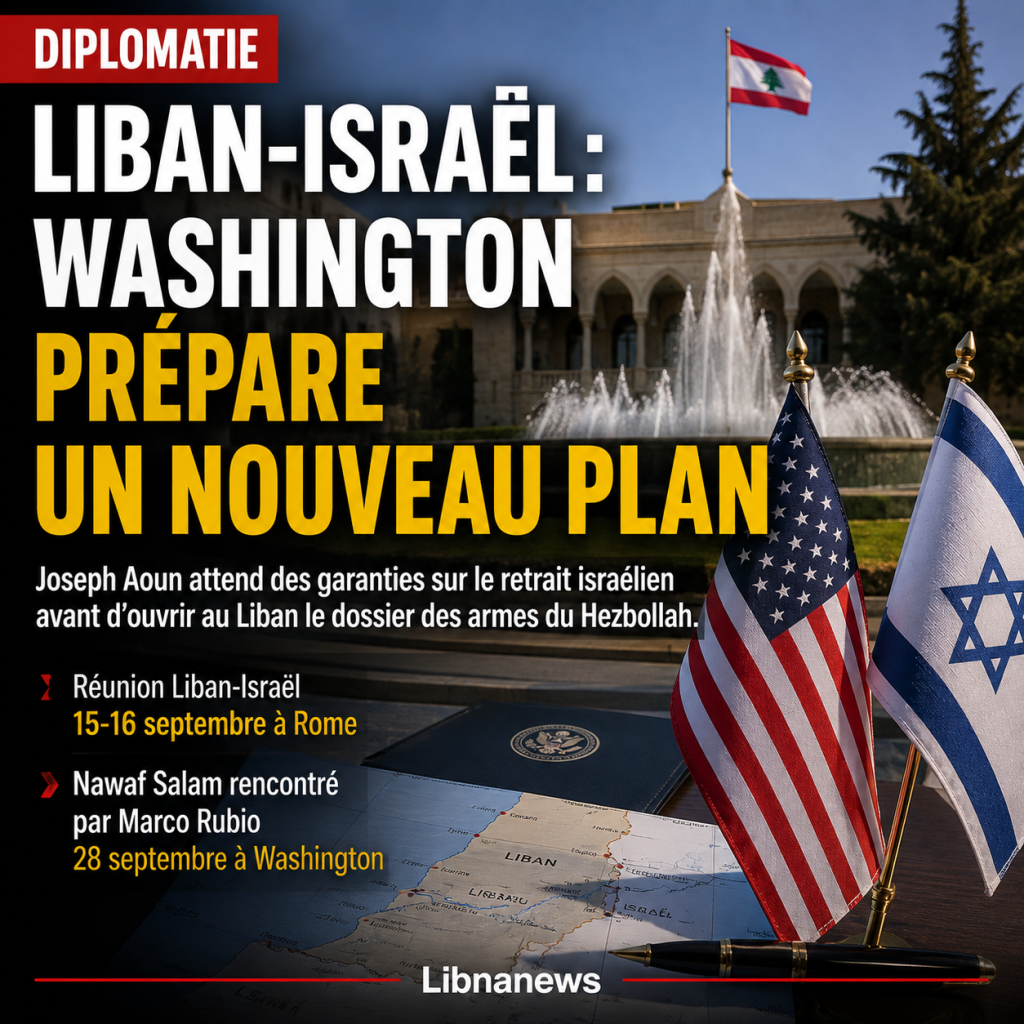
A new diplomatic sequence could open in September around the South Lebanon. President Joseph Aoun would expect a more specific US proposal than the previous one, which could set a timetable and mechanism leading to the complete withdrawal of Israeli forces from Lebanese territory. In return for serious guarantees of withdrawal and security arrangements in the South, the Head of State would be ready to open the Hezbollah arms file at the national level. A forthcoming meeting between Lebanese and Israeli representatives could be held in Rome on 15 and 16 September, before an expected meeting between Prime Minister Nawaf Salam and US Secretary of State Marco Rubio in Washington on 28 September. These deadlines could determine whether the current discussions lead to a real settlement plan or a new impasse.
Joseph Aoun awaits a new American proposal
President Joseph Aoun would no longer seek a general American statement in favour of the Israeli withdrawal. According to press reports attributed Wednesday, September 2, to sources close to the Head of State, Baabda is now waiting from Washington for an operational proposal that would go beyond the formulas negotiated so far.
The Americans reportedly informed the President that they were in contact with Israel in order to develop a programme that could lead to the complete withdrawal of Israeli forces still present in South Lebanon.
The difference is important. The dispute no longer concerns only the principle of withdrawal, which Beirut has been demanding for months, but the conditions for making it effective.
Joseph Aoun would thus await a plan specifying the various stages, the verification mechanisms and the actors involved in the areas evacuated. The central question therefore becomes that of the post-retirement: who controls the areas abandoned by Israel, who checks the commitments and what guarantees prevent a resumption of fighting?
This information does not yet constitute the official announcement of an agreement. They describe the state of the discussions and the expectations attributed to the Lebanese presidency. On 2 September Washington did not make public the comprehensive plan referred to.
Israeli withdrawal against security guarantees
The scheme under discussion is based on a particularly sensitive political exchange.
Lebanon calls for a complete Israeli withdrawal. Israel also demands safeguards to prevent Hezbollah from rebuilding military capabilities near its border. The United States is trying to build a device that meets both requirements simultaneously.
According to available information, Washington would therefore work on a program combining withdrawal, verification and security arrangements.
For Beirut, the order of the stages is decisive. The Lebanese Government does not want the concessions requested in Lebanon indefinitely to precede an Israeli withdrawal that would remain hypothetical. The Presidency is seeking sufficiently precise guarantees to be able to politically defend the process within the country.
The demand thus concerns more than an Israeli promise. Baabda would like to know the sectors concerned, the pace of withdrawal, the modalities of transfer to the Lebanese army and the mechanisms for verifying compliance.
Hezbollah weapons file could then be opened
This is the most important political point of information published on Wednesday.
Joseph Aoun would have told the Americans that if they provided serious and clear guarantees regarding Israeli withdrawal and security arrangements, he would be prepared to put Hezbollah’s weapons on the table for a national discussion.
The wording should be clarified. It is not, in the information available, a presidential commitment to disarm Hizbullah immediately according to an agreed timetable. This would be a commitment to formally open the case at the national level once sufficient guarantees have been obtained regarding Israeli withdrawal.
The difference is major in the Lebanese political system.
The disarmament of Hezbollah is one of the country’s most sensitive issues. In particular, the movement affirms that its weapons remain necessary as long as Israel occupies Lebanese positions and continues its military operations. On the contrary, its opponents consider that the sovereignty of the State requires that the Lebanese army have the arms and the power to decide war and peace alone.
A complete Israeli withdrawal would therefore change some of the terms of the debate. It would withdraw from Hezbollah one of the main arguments used to justify the maintenance of an arsenal independent of that of the State.
A web Baabda wants to make credible
The calculation attributed to Joseph Aoun thus appears sequential.
First step: to secure a concrete commitment from the United States regarding the Israeli withdrawal.
Step two: to define the security arrangements and the verification mechanism for the Lebanese army to resume areas evacuated.
Step three: Opening a national discussion on Hezbollah weapons in Lebanon.
This chronology would allow the President to present the arms debate not as a unilateral concession to Israel or the United States, but as a step in a process in which Lebanon would have previously obtained the return of its territory.
It also responds to domestic political difficulties. Calling for the disarmament of Hezbollah while Israeli forces remain in the territory allows the movement to present this request as an attempt to disarm Lebanon against Israel.
The withdrawal would change this argument without automatically resolving the file.
Who will replace UNIFIL?
Another issue complicates negotiations: the future of the United Nations Interim Force in Lebanon.
According to reports from sources close to the presidency, Washington would continue to insist on the end of the UNIFIL mission by the end of 2026. Nor would the United States support French proposals to maintain an international observer force in the South in another form.
This position creates a practical problem.
For decades, UNIFIL has not only been an international military presence. It plays a role in monitoring the Blue Line, liaison between the parties and coordination with the Lebanese army. Its disappearance would leave an institutional vacuum at the very time when an Israeli withdrawal would require more verification mechanisms.
That is why the American plan expected by Joseph Aoun must specify which actors would replace the functions deemed indispensable.
The Americans would have promised the president « a plan, a verification mechanism and a list of parties » that could play a role in the South.
This list could become one of the most sensitive elements of the negotiations.
France and Washington differ on post-FINUL
For several months, Paris has been defending lasting international involvement in South Lebanon. France considers that an observation presence can help prevent incidents, support the Lebanese army and maintain a channel between the different parties.
Washington would favour another model and would remain opposed to maintaining an international force in the form proposed by the French.
The Franco-American divergence does not necessarily concern the final objective, but the instrument to secure the border.
For the Lebanese authorities, the choice is far from technical. If UNIFIL disappears and no comparable force succeeds, the Lebanese army will have to assume a much greater responsibility with its own means.
The issue of staffing, equipment, surveillance and intelligence became central.
The Lebanese army would be at the heart of the scheme
Whatever the mechanism eventually adopted, the Lebanese army should occupy an essential place in the areas evacuated.
Pilot experiments have already begun. Israeli withdrawal from certain areas was followed by the entry of the Lebanese army, with demining and security operations prior to full deployment.
This process must prevent a gap between the departure of Israeli soldiers and the arrival of Lebanese forces.
Israel specifically expresses its concern that Hezbollah will take advantage of this interval to return to the evacuated areas. News from the Israeli media this week even claimed that some Lebanese officers would share this concern and would not want an Israeli withdrawal too quickly.
The Lebanese army strongly denied this information on Wednesday, denouncing made claims to reach the institution and its command.
This controversy illustrates the importance of the future verification mechanism. The credibility of the Lebanese army is one of the conditions for the success of any agreement.
Rome could host future discussions
The next diplomatic stage could take place quickly.
A further meeting between representatives of Lebanon and Israel could be held in Rome on 15 and 16 September, according to media reports broadcast on Wednesday.
The meeting had not yet been officially announced by all parties at the time of the latest available information. The date must therefore be regarded as being considered rather than definitively decided.
Rome would provide an external framework for delegations to continue discussions without giving the meeting the political dimension of conventional bilateral negotiations.
Lebanon and Israel remain officially in a state of war. Any direct discussion is therefore politically sensitive in Beirut.
Meetings should be presented as negotiations on security, withdrawal and implementation of existing arrangements, not as the beginning of diplomatic normalization.
15 and 16 September could become decisive
If the Rome meeting is confirmed, its agenda will be decisive.
The Lebanese delegation should seek clarification on the Israeli withdrawal, while Israel would seek assurances on areas from which its forces would withdraw.
The American role will be central. Washington must transform the general commitments into a sufficiently precise timetable to convince both parties.
An agreement could take the form of successive stages: Israeli withdrawal of an area, entry of the Lebanese army, verification, and then passage to the following area.
This model would reduce the risk of an overall withdrawal without a replacement device. It would also allow Israel to progressively verify that areas evacuated are not reoccupied militarily by Hezbollah.
For Lebanon, the stakes would be to avoid this mechanism turning an announced withdrawal into an endless process conditional on moving criteria.
Nawaf Salam expected in Washington on September 28
A second deadline is announced by the end of the month.
Prime Minister Nawaf Salam is scheduled to meet US Secretary of State Marco Rubio in Washington on 28 September, according to media reports published on Wednesday.
This meeting would take place less than two weeks after the discussions envisaged in Rome. It could therefore provide an opportunity to review the results achieved and to address outstanding issues.
Washington’s choice also underscores the political level that the issue is now taking. It is no longer just technical discussions about border positions. Negotiations concern the security architecture of the South Lebanon, the future role of the army, the international presence and, potentially, the weapons of Hezbollah.
Nawaf Salam will also have to defend the Lebanese government’s priorities: sovereignty, Israeli withdrawal and strengthening of state authority.
Washington becomes the main referee
The United States now occupies a central position between the various applications.
They have an important leverage over Israel and are simultaneously one of the main international supporters of the Lebanese army. They also participate in broader economic and political negotiations concerning Lebanon.
This position allows Washington to propose a mechanism combining security, withdrawal and strengthening of Lebanese institutions.
It also creates an important dependency for Beirut.
If the United States fails to obtain a precise timetable from Israel, Joseph Aoun will have few arguments to open the Hezbollah case under the conditions currently mentioned.
Conversely, a US proposal to ensure a gradual and verifiable withdrawal could profoundly alter the Lebanese political debate.
Israeli withdrawal could move debate on Hezbollah
For years, the issue of Hezbollah’s weapons has been linked to that of the conflict with Israel. The movement presents its arsenal as a necessary resistance force to protect Lebanese territory.
Its opponents respond that the existence of a military force that escapes state command weakens sovereignty and exposes the country to wars decided outside its institutions.
A complete Israeli withdrawal would not eliminate this disagreement. However, it would change the framework.
The debate could then move towards the national defence strategy, the possible integration of certain capabilities and the issue of the state monopoly on weapons.
That is why Joseph Aoun’s commitment is politically important. The Chair would not promise a pre-emptive solution, but would agree to place the issue formally on the table.
A negotiation where the sequence of stages will be decisive
The coming weeks should therefore focus less on policy statements than on chronology.
Lebanon wants to know when Israel will withdraw and at what stages. Israel wants to know what will happen immediately after his departure. Washington wants a mechanism that is credible enough to prevent a resumption of fighting. The Lebanese Presidency wants to have guarantees before opening the explosive dossier of Hezbollah’s weapons.
The future of UNIFIL adds an additional deadline. If its mission is to end by the end of the year, a new mechanism will have to be ready before its departure in order to avoid a security and institutional vacuum in the South.
The discussions envisaged in Rome on 15 and 16 September could provide the first answers. The forthcoming meeting between Nawaf Salam and Marco Rubio on 28 September would then offer a second political stage.
Joseph Aoun now expects more than an American promise. He wanted a plan indicating the steps of the withdrawal, how to verify them and the actors responsible for securing the South Lebanon. It is the precision of this proposal, still expected in Baabda, that will determine whether the Hezbollah weapons file can really become the next step in the process.




